
lovethailand home >Central Travel Attractions >Bangkok Travel Attractions >Pom Prap Sattru Phai >Pom Prap > Wat Mangkon Kamalawat (Wat Leng Noei Yi)
TL;DR: Wat Mangkon Kamalawat (Wat Leng Noei Yi) is located at Charoen Krung Road, Pom Prap, Pom Prap Sattru Phai District, Bangkok 10100, open Daily, hours 08.00 – 17.00.
Wat Mangkon Kamalawat (Wat Leng Noei Yi)
Open Days: Daily
Opening Hours: 08.00 – 17.00
Wat Mangkon Kamalawat, also widely known as Wat Leng Noei Yi, is one of Bangkok’s most important Chinese Buddhist temples. Located on Charoen Krung Road in Pom Prap Sattru Phai District, close to Yaowarat Chinatown and MRT Wat Mangkon Station, the temple is a major spiritual landmark for Thai-Chinese communities, Mahayana Buddhists, and travelers interested in Chinese architecture, Chinese religious traditions, and Bangkok’s historic Chinatown culture.
The temple is best known as a place for merit-making, blessings, Chinese New Year worship, the Vegetarian Festival, and the annual Tai Sui or zodiac-year blessing ritual commonly associated with the Thai-Chinese practice of resolving an inauspicious birth-year cycle. For travelers, Wat Mangkon Kamalawat is more than a religious stop. It is a compact cultural site where Bangkok’s Chinese heritage, Mahayana Buddhist devotion, Taoist-influenced deities, community rituals, and historic urban life meet in one place.
The original Chinese name of the temple is Leng Noei Yi. In Teochew Chinese, “Leng” means dragon, “Noei” means lotus, and “Yi” means temple. The name can therefore be understood as the Temple of the Dragon Lotus. Its official Thai name, Wat Mangkon Kamalawat, was royally bestowed by King Chulalongkorn, Rama V. This name reflects both the temple’s Chinese roots and its formal place within Thailand’s religious and cultural landscape.
Wat Mangkon Kamalawat was founded in 1871 during the reign of King Rama V and took about 8 years to complete. Its location on Charoen Krung Road was significant because this area was closely connected with Bangkok’s Chinese trading communities in Yaowarat, Sampeng, and the old market districts. The temple became a spiritual center for Chinese residents in the capital, serving as a place for prayer, ancestral rites, chanting, ceremonies, blessings, and community gatherings.
The temple layout follows a traditional Chinese temple plan. From the entrance, visitors first reach the hall of the Four Heavenly Kings. The main ordination hall stands along the central axis, and the rear section houses shrines dedicated to Chinese deities. This layout creates a natural sequence of worship: entering a protected sacred space, paying respect to the main Buddhas, and continuing to the deity halls associated with health, fortune, destiny, family, business, and personal well-being.
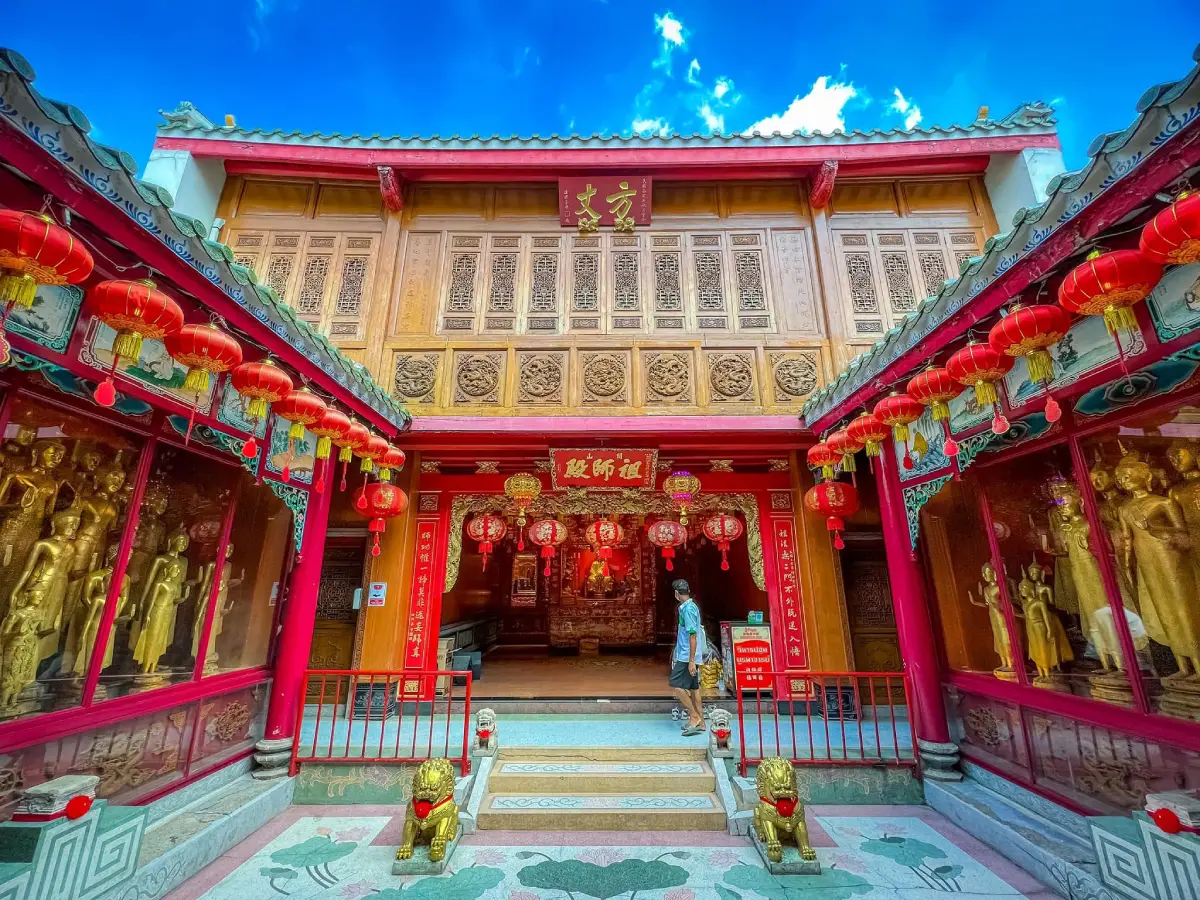
Architecturally, Wat Mangkon Kamalawat is a strong example of southern Chinese Teochew craftsmanship. Wood and brick are key materials. The roofs are decorated with Chinese-style curved forms, dragons, floral motifs, auspicious animals, red lanterns, Chinese inscriptions, and symbolic details related to protection and prosperity. Despite standing in the middle of a busy urban district, the temple preserves a strong visual identity that immediately distinguishes it from Thai Theravada temples with tall spires and gilded stupas.
The first important hall is dedicated to the Four Heavenly Kings, known in Chinese as Si Tai Thian Wang. These guardian deities are shown in warrior attire, holding symbolic objects such as a pipa, a sword, an umbrella, and a pagoda. Their role is to protect the 4 directions and mark the transition from the outer street into the sacred interior of the temple. For first-time visitors, this hall is one of the best places to understand how Chinese Buddhist temples organize sacred space through guardianship and symbolism.
The main hall enshrines 3 principal Buddhas: Shakyamuni Buddha, Amitabha Buddha, and Bhaisajyaguru Buddha. Together, they are known in Chinese temple tradition as Sam Por Huk Jow. Shakyamuni Buddha represents the historical Buddha of the present age. Amitabha Buddha is associated with the Pure Land tradition. Bhaisajyaguru Buddha, often known as the Medicine Buddha, is revered in connection with healing and well-being. This triad makes the main hall the spiritual core of Wat Mangkon Kamalawat.
The temple also houses 18 Arhats, known locally as Jab Poi Lo Han. These figures represent enlightened disciples and guardians of Buddhist teaching in Mahayana tradition. Around the temple, visitors will also find shrines to several Chinese deities and bodhisattvas, including Tai Sui, Hua Tuo, Cai Shen, Heng Jia, Maitreya Bodhisattva, Guan Yin, Pae Kong, and Pae Ma. This wide range of sacred figures explains why worshippers come here for different purposes: health, protection, good fortune, business success, family peace, and peace of mind.
Wat Mangkon Kamalawat is especially lively during Chinese New Year, the Vegetarian Festival, and the beginning of the lunar year when many people come to pay respect to Tai Sui. The Tai Sui ritual is linked to Chinese zodiac beliefs and is widely practiced by Thai-Chinese devotees who wish to ease concerns about an inauspicious year. Even for visitors who do not take part in the ritual, observing the temple during these periods offers a vivid view of how Chinese faith traditions continue to shape Bangkok’s living culture.
Visitors should dress politely, keep their voice low, and avoid blocking worshippers during prayer or ritual activity. During major festivals, the temple can be very crowded, so it is best to allow extra time and use public transport. Driving into Yaowarat is usually less convenient because traffic is heavy and parking is limited. The most practical way to visit is by MRT, getting off at Wat Mangkon Station and walking a short distance to the temple.
Getting There is straightforward. Take the MRT Blue Line to Wat Mangkon Station, then walk to the temple on Charoen Krung Road. Travelers who want to explore more of Chinatown can combine the temple with Yaowarat Road, Sampeng Market, Leng Buai Ia Shrine, Wat Traimit, Wat Chakkrawat Rachawat, and Wat Bamphen Chin Phot. River travelers can also use Ratchawong Pier and continue on foot or by local transport. For taxis, use the destination name “Wat Mangkon Kamalawat, Charoen Krung Road” or “Wat Leng Noei Yi, Yaowarat.”
For photography, the temple offers many memorable scenes: the front gate, red lanterns, Chinese signboards, dragon roof ornaments, the Four Heavenly Kings hall, incense areas, and carved architectural details. Photography should always be done respectfully because this is an active place of worship. Visitors should avoid intrusive close-up shots of worshippers and should not interfere with rituals, offerings, or temple staff.
In a broader cultural sense, Wat Mangkon Kamalawat is one of the clearest landmarks of Chinese settlement and religious continuity in Bangkok. Chinatown was never only a trading district. It also developed temples, shrines, schools, associations, markets, and community institutions that helped preserve Chinese identity while integrating into Thai society. A visit to Wat Mangkon Kamalawat therefore helps travelers understand not only a temple, but also the cultural fabric of Yaowarat itself.
Wat Mangkon Kamalawat is suitable for travelers who want to pray, make merit, observe Chinese Buddhist rituals, learn about Bangkok’s Chinese heritage, or begin a walking route through Yaowarat. It combines architecture, faith, history, and urban culture in a small but highly meaningful space, making it one of the most rewarding cultural stops in Bangkok Chinatown.
| Name | Wat Mangkon Kamalawat, also known as Wat Leng Noei Yi |
| Location | Charoen Krung Road, Pom Prap, Pom Prap Sattru Phai District, Bangkok 10100 |
| Address | 423 Charoen Krung Road, Pom Prap, Pom Prap Sattru Phai District, Bangkok 10100, Thailand |
| Coordinates | 13.7436867, 100.5096124 |
| Highlights | Major Chinese Buddhist temple in Bangkok Chinatown, known for blessings, Chinese New Year worship, Vegetarian Festival, and Tai Sui rituals |
| History | Founded in 1871 during the reign of King Rama V; construction took about 8 years |
| Name Origin | Leng means dragon, Noei means lotus, and Yi means temple, giving the meaning Temple of the Dragon Lotus |
| Distinctive Features | Southern Chinese Teochew architecture, dragon roof ornaments, red lanterns, Four Heavenly Kings hall, 3 principal Buddhas, 18 Arhats, and multiple Chinese deity shrines |
| Travel Information | Take the MRT Blue Line to Wat Mangkon Station and walk to the temple. Buses along Charoen Krung and Yaowarat are also available. From Ratchawong Pier, continue by walking or local transport |
| Current Status | Open for worshippers and visitors |
| Open Days | Daily |
| Opening Hours | 08.00 – 17.00 |
| Main Areas / Zones | Four Heavenly Kings Hall, Main Buddha Hall, deity halls, Tai Sui shrine area, Cai Shen shrine, Guan Yin shrine, Maitreya Bodhisattva area, and other Chinese deity shrines |
| Abbot / Caretaker | Luang Chin Thammarak Chin Prajit (Yen Ngii) |
| Main Contact Number | 02-222-3975 |
| Official Website / Official Page | Facebook Fanpage: Wat Mangkon Kamalawat 龍蓮寺 |
| Nearby Tourist Attractions | 1. Yaowarat Chinatown, about 0.4 km 2. Sampeng Market, about 0.8 km 3. Leng Buai Ia Shrine, about 0.8 km 4. Wat Traimit Witthayaram, about 1.3 km 5. Wat Chakkrawat Rachawat, about 1.0 km 6. Wat Bamphen Chin Phot, about 0.6 km |
| Nearby Restaurants | 1. Jek Pui Curry Rice, about 0.2 km, Tel. 089-459-0267 2. Long Leng Fish Ball Noodles, about 0.5 km 3. Nai Ek Roll Noodles, about 0.8 km, Tel. 02-226-4651 4. Yaowarat Famous Bread, about 1.0 km, Tel. 02-623-3235 5. Lhong Tou Cafe, about 0.8 km, Tel. 064-935-6499 |
| Nearby Accommodations | 1. Grand China Bangkok, about 0.7 km 2. Hotel Royal Bangkok@Chinatown, about 0.8 km, Tel. 02-226-0026 3. ASAI Bangkok Chinatown, about 0.9 km, Tel. 02-220-8999 4. Shanghai Mansion Bangkok, about 0.9 km, Tel. 02-221-2121 5. The Wang Yaowarat, about 0.8 km, Tel. 063-191-8899 6. B2 Chinatown Yaowarat Premier Hotel, about 0.7 km, Tel. 02-089-1455 |
Frequently Asked Questions (FAQ)
Q: Where is Wat Mangkon Kamalawat located?
A: Wat Mangkon Kamalawat is located at 423 Charoen Krung Road, Pom Prap, Pom Prap Sattru Phai District, Bangkok, close to Yaowarat Chinatown and MRT Wat Mangkon Station.
Q: What are the opening days and hours of Wat Mangkon Kamalawat?
A: The temple is open daily from 08.00 to 17.00. During major festivals, visitors should allow extra travel time because the area becomes crowded.
Q: Is Wat Leng Noei Yi the same place as Wat Mangkon Kamalawat?
A: Yes. Wat Leng Noei Yi is the temple’s original Chinese name, while Wat Mangkon Kamalawat is its official Thai name royally bestowed during the reign of King Rama V.
Q: What is Wat Mangkon Kamalawat famous for?
A: The temple is famous for Chinese Buddhist worship, Chinese New Year ceremonies, the Vegetarian Festival, blessings for fortune and health, and Tai Sui rituals related to zodiac-year beliefs.
Q: What is the easiest way to get to Wat Mangkon Kamalawat?
A: The easiest way is to take the MRT Blue Line to Wat Mangkon Station and walk to the temple. This is usually more convenient than driving into Chinatown.
Q: What can visitors see inside the temple?
A: Visitors can see the Four Heavenly Kings hall, the main Buddha hall with 3 principal Buddhas, 18 Arhats, and several Chinese deity shrines including Tai Sui, Cai Shen, Guan Yin, Hua Tuo, and Maitreya Bodhisattva.
Q: What nearby attractions can be visited with Wat Mangkon Kamalawat?
A: Nearby places include Yaowarat Chinatown, Sampeng Market, Leng Buai Ia Shrine, Wat Traimit Witthayaram, Wat Chakkrawat Rachawat, and Wat Bamphen Chin Phot.
 Category: ●Places of Worship
 Group: ●Temple
Last Update : 1 MonthAgo
 Last Update : 1 MonthAgo
 Click to Access the Navigation Map GPS
Wat Mangkon Kamalawat (Wat Leng Noei Yi) Map
Recommend

 Phra Nakhon(24)Dusit(17)Khlong San(7)Khlong Toei(3)Jatujak(2)Don Muang(5)Taling Chan(26)Thon Buri(23)Bangkok Noi(31)Bangkok Yai(13)Bang Kapi(5)Bang Kun Tien(15)Bang Khen(3)Bang Kholam(10)Bang Sue(9)Bang Plad(23)Bang Rak(6)Chom Thong(16)Bung Kum(5)Pra Wet(6)Patum Wan(6)Pom Prap Sattru Phai(11)Paya Thai(1)Pra Kanong(4)Pa Sri Charoen(23)Min Buri(7)Yan Na Wa(8)Ratchathewi(4)Rat Burana(6)Lat Krabang(13)Nong Chok(16)Lat Phrao(4)Sathorn(4)Sam Phan Tha Wong(12)Nong Khaem(7)Huai Khwang(3)Suan Luang(7)Din Daeng(2)Lak Si(1)Sai Mai(8)Khan Na Yao(2)Wang Thong Lang(1)Klong Sam Wa(10)Watthana(2)Bang Na(4)Thawi Watthana(3)Bang Khae(5)Thung Khru(4)Bang Bon(3)


