
lovethailand home >Central Travel Attractions >Bangkok Travel Attractions >Phra Nakhon >Bang Khun Phrom > Wat Makut Kasatriyaram Ratchaworawihan
TL;DR: Wat Makut Kasatriyaram Ratchaworawihan is located at Beside Krung Kasem Road and Khlong Phadung Krung Kasem, near Ratchadamnoen Nok Road, Bang Khun Phrom, Phra Nakhon, Bangkok, open Daily, hours 08:00 – 18:30.
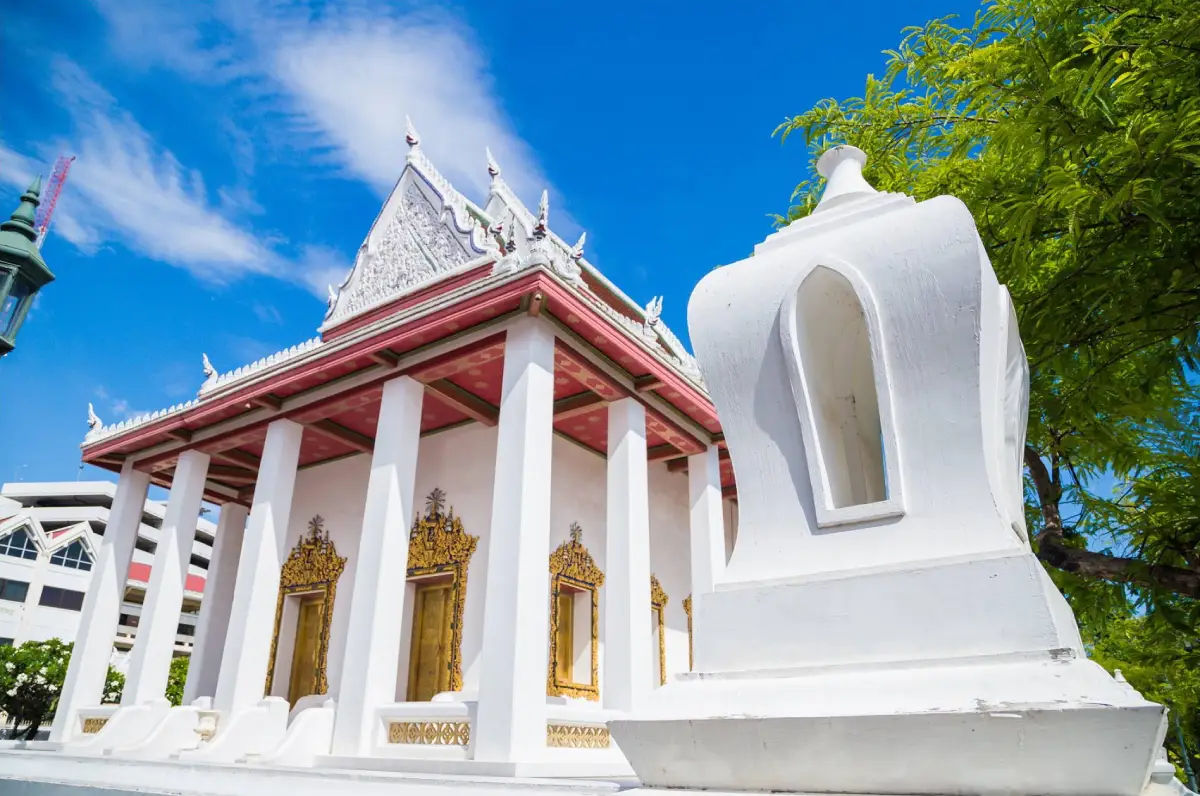
Wat Makut Kasatriyaram Ratchaworawihan
Open Days: Daily
Opening Hours: 08:00 – 18:30
Wat Makut Kasatriyaram Ratchaworawihan in Bangkok is a second-class royal temple of the Ratchaworawihan rank under the Dhammayut Order. It is located at 330 Krung Kasem Road, Bang Khun Phrom, Phra Nakhon District, Bangkok, beside Khlong Phadung Krung Kasem and close to Ratchadamnoen Nok Road. The temple is one of the most meaningful royal monasteries connected with King Mongkut, Rama IV, and it is a valuable stop for travelers who want to see Bangkok through royal history, Buddhist architecture, old-city planning, and quiet religious life rather than only through major tourist landmarks.
Wat Makut Kasatriyaram, often called Wat Makut, was created from an important royal vision. After Khlong Phadung Krung Kasem was excavated as the outer moat of Bangkok, King Rama IV wished to have temples lined along the canal in a way that recalled the old urban pattern of Ayutthaya. He therefore commissioned Wat Makut Kasatriyaram as a companion temple to Wat Somanas Rajavaravihara nearby. The two temples are linked not only by location, but also by royal intention, canal-side city planning, and the religious identity of Bangkok during the early Rattanakosin period.
The construction of Wat Makut Kasatriyaram began late in the reign of King Rama IV. Somdet Chaophraya Borom Maha Sri Suriwong, Chuang Bunnag, served as the chief supervisor of construction, while Prince Chumsai, Krom Khun Ratchasihawikrom, served as the principal architect and engineer. Parts of the ordination hall, vihara, and main stupa were completed in 1868. During the early period, the temple was temporarily known as Wat Phra Nam Banyat or Wat Nam Banyat because its royal name was closely connected with the King’s own name. After the end of the reign, the temple returned to the royal name Wat Makut Kasatriyaram.
The name Wat Makut Kasatriyaram carries a direct royal meaning. Makut is connected with the name of King Rama IV, who was formerly Prince Mongkut, while Kasatriyaram can be understood as a royal monastery or a monastery associated with kingship. This meaning is visible throughout the temple. Visitors will see the Great Crown emblem on the pediments of the ordination hall and vihara, as well as above door and window frames. The temple’s name is therefore not only a historical label; it is expressed in the architecture itself.
The layout of Wat Makut Kasatriyaram is highly organized and meaningful. The temple area is divided into 3 main zones: the central Buddhavasa, the eastern Sanghavasa, and the western Sanghavasa. The Buddhavasa contains the ordination hall, vihara, cloistered vihara, and main stupa. The eastern monastic zone includes 3 groups of monks’ residences and is associated with the residence of Somdet Phra Sangharaja Chuan Utthayi. The western monastic zone is known as Khana Nok and contains memorial space connected with the ashes of Krom Phra Sommot Amonphan. This division helps visitors understand the temple not just as a single building, but as a planned religious compound.
One of the most distinctive features of Wat Makut Kasatriyaram is its double boundary-stone system. The first level is the Maha Sema, set in niches at the corners of the temple wall. The second level is the Khanda Sema surrounding the ordination hall. Between the two boundary areas is a separating zone known as Simantarik. This special arrangement allows monks to perform certain ecclesiastical acts in both the ordination hall and the vihara within the defined sacred boundaries. Wat Makut Kasatriyaram and Wat Somanas Rajavaravihara are especially important examples for understanding this rare boundary system in Bangkok’s royal temple architecture.
The ordination hall is a 5-bay Thai-style building with stucco chofa, bai raka, and hang hong roof elements. Its pediment is decorated with the Great Crown emblem surrounded by stucco ornament. The door and window frames are gilded stucco decorated with glass, while the outer panels feature traditional lacquer designs. Inside, the panels contain Buddhist verses written in Khmer script, including selected Dhammapada verses and the Solasa Panha. The ordination hall is therefore a religious, artistic, linguistic, and symbolic space at the same time.
The murals inside the ordination hall are different from those in many other Thai temples. They include the lives of 11 chief male disciples, the lives of 9 chief female disciples, scenes connected with Buddhist discipline, images of austere monastic practices, and themes related to meditation. The principal Buddha image inside the ordination hall is a gilded bronze Buddha in meditation posture, enshrined in a busabok pavilion. The image does not have a specific recorded name, which makes the surrounding mural program even more important for understanding the hall’s religious purpose.
The vihara stands at the front of the Buddhavasa zone. It is a 7-bay Thai-style structure used for chanting, morning and evening prayers, and Kathina ceremonies. Its pediment also features the Great Crown emblem, while the upper parts of the door and window frames include a tray supporting the number 4 and the Great Crown on a three-headed elephant, flanked by 9-tiered umbrellas. These details connect the building directly with the royal symbols of King Rama IV and make the vihara one of the most important areas to observe during a visit.
Inside the vihara is the principal Buddha image known as Phra Buddha Vajiramongkut, one of the temple’s most important sacred objects. In front of the main image is Phra Nirantrai, the Buddha image associated with the reign of King Rama IV. The vihara is significant not only because of its architecture, but also because it gathers the temple’s royal symbolism, Buddhist devotion, and living religious practice into one space.
The cloistered vihara is connected to the rear of the main vihara on both sides and encloses the stupa area. The main stupa is large and visually important. It stands within the cloistered area, rises about 20 wa in height, and rests on a substantial square base. The structure has stairways on 4 sides and a surrounding crystal wall. Together, the vihara, cloistered vihara, and stupa form a complete sacred group that defines the character of the Buddhavasa zone.
Historically, Wat Makut Kasatriyaram clearly reflects continuity between the reigns of King Rama IV and King Rama V. Construction began late in the reign of King Rama IV, but some work paused after his passing. King Chulalongkorn, Rama V, later continued construction and restoration until the temple became more complete. This makes the temple an important witness to royal Buddhist patronage during a transitional period of the Rattanakosin kingdom.
The temple is also connected with important senior monks in Thai Buddhism, especially Somdet Phra Ariyavongsagatayana, Somdet Phra Sangharaja Chuan Utthayi, the 16th Supreme Patriarch of the Rattanakosin period. He was ordained as a novice and later as a monk at Wat Makut Kasatriyaram. His connection to the temple gives it special value for visitors interested in Thai monastic education, the Dhammayut Order, and the history of the Supreme Patriarchs.
Today, the abbot of Wat Makut Kasatriyaram Ratchaworawihan is Phra Thep Wachiramethachan, Boonruam Atthakamo, Pali IX. The temple remains active as a place for worship, merit-making, chanting, and Buddhist ceremonies. It also serves the community through funeral chanting and cremation rites, showing how a royal temple in Bangkok continues to be connected with everyday religious life and family ceremonies.
The atmosphere of Wat Makut Kasatriyaram is calm, dignified, and less crowded than many famous tourist temples in Bangkok. Its location near Ratchadamnoen Nok Road, schools, public institutions, old neighborhoods, and Khlong Phadung Krung Kasem gives the temple a strong old-city character. Visitors can experience it as a working royal monastery rather than a site separated from its community. This makes the temple suitable for quiet worship, close observation of architectural details, and a short pause from the city’s faster rhythm.
For travelers interested in architecture, important details include the Great Crown emblem, gilded stucco and glass decoration, lacquered doors and windows, Khmer-script Buddhist verses, murals about disciples and monastic discipline, the double Sema boundary system, and the relationship between the vihara, cloistered vihara, and stupa. Seeing these details turns a simple temple visit into a deeper reading of royal symbols, Buddhist practice, and early Rattanakosin craftsmanship.
The best time to visit is in the morning or late afternoon, when the light is softer and walking around the old-city area is more comfortable. A focused visit usually takes about 45 minutes to 1 hour, especially if visitors want to observe the ordination hall, vihara, stupa, murals, and boundary stones. Those planning a half-day heritage walk can combine Wat Makut Kasatriyaram with Wat Somanas Rajavaravihara, King Prajadhipok Museum, Rattanakosin Exhibition Hall, Wat Ratchanatdaram, Loha Prasat, the Golden Mount at Wat Saket, or Khao San Road.
Getting There is convenient by private car, taxi, public bus, or public transport followed by a short ride. The clearest map destination is Wat Makut Kasatriyaram Ratchaworawihan on Krung Kasem Road, Phra Nakhon District. Visitors using private cars should allow extra time because roads around the old city and Ratchadamnoen Nok Road can be busy. For a walking route, the temple can be linked with nearby historic sites along Krung Kasem Road and Ratchadamnoen Nok Road.
Visitors should dress respectfully, keep their voices low, remove shoes where required, avoid touching murals or historic objects, and be mindful of worshippers and ceremonies. If funeral rites or temple events are taking place, visitors should walk quietly and keep a respectful distance from the ceremonial areas. The temple is an active Buddhist monastery, so its religious function should always come before photography or sightseeing.
Overall, Wat Makut Kasatriyaram Ratchaworawihan is one of the most rewarding temples in Bangkok for travelers who want depth rather than crowds. It brings together King Rama IV’s royal vision, the canal-side planning of Khlong Phadung Krung Kasem, a rare double boundary-stone system, the Great Crown emblem, Buddhist murals on monastic discipline, Phra Buddha Vajiramongkut, a large central stupa, and a continuing role in Thai monastic life. It is a strong choice for anyone who wants to understand Bangkok’s old city through faith, architecture, and history.
| Name | Wat Makut Kasatriyaram Ratchaworawihan |
| Common Name | Wat Makut |
| Type | Second-Class Royal Temple, Ratchaworawihan Rank, Dhammayut Order |
| Location | Beside Krung Kasem Road and Khlong Phadung Krung Kasem, near Ratchadamnoen Nok Road, Bang Khun Phrom, Phra Nakhon, Bangkok |
| Address | 330 Krung Kasem Road, Bang Khun Phrom, Phra Nakhon, Bangkok 10200, Thailand |
| Coordinates | 13.76037, 100.50696 |
| Highlights | Royal temple of King Rama IV, companion temple to Wat Somanas Rajavaravihara, double Sema boundary system, Phra Buddha Vajiramongkut, Great Crown emblem, Buddhist discipline murals, and large stupa |
| History | Commissioned by King Rama IV after the excavation of Khlong Phadung Krung Kasem; construction began late in his reign and continued in the reign of King Rama V |
| Name Origin | The name is linked with King Rama IV’s royal name. The temple was temporarily called Wat Phra Nam Banyat or Wat Nam Banyat before returning to the royal name Wat Makut Kasatriyaram |
| Distinctive Features | The temple has 2 sacred boundary systems, Maha Sema and Khanda Sema, allowing monks to perform ecclesiastical acts within defined sacred areas |
| Main Areas / Zones | Ordination Hall, Vihara, Cloistered Vihara, Stupa, Buddhavasa Zone, Eastern Sanghavasa Zone, Western Sanghavasa Zone, Funeral Pavilions, and Religious Activity Areas |
| Main Buddha Images / Sacred Objects | Phra Buddha Vajiramongkut, the principal Buddha image in the main vihara, and Phra Nirantrai, the Buddha image associated with King Rama IV |
| Travel Information | Accessible by private car, taxi, public bus, or public transport followed by a short ride; use Wat Makut Kasatriyaram Ratchaworawihan, Krung Kasem Road, Phra Nakhon as the map destination |
| Current Status | Open for regular visits, merit-making, and Buddhist religious activities |
| Open Days | Daily |
| Opening Hours | 08:00 – 18:30 |
| Fees | No admission fee |
| Facilities | Parking, restrooms, funeral pavilions, and areas for Buddhist ceremonies |
| Abbot / Caretaker | Phra Thep Wachiramethachan, Boonruam Atthakamo, Pali IX |
| Main Contact Number | 02-281-2089 |
| Official Website / Official Page | facebook.com/Watmakutkasat |
| Nearby Tourist Attractions | 1. Wat Somanas Rajavaravihara, about 0.6 km, Tel. 02-281-1061 2. King Prajadhipok Museum, about 0.8 km, Tel. 02-280-3413, 02-142-7703 3. Rattanakosin Exhibition Hall, about 1 km 4. Democracy Monument, about 1 km 5. Wat Ratchanatdaram and Loha Prasat, about 1.3 km 6. Golden Mount at Wat Saket, about 1.6 km 7. Khao San Road, about 1.6 km |
| Nearby Restaurants | 1. Krua Mongkut, about 0.1 km, Tel. 02-282-3188, 02-280-0659 2. Krua Apsorn Samsen Branch, about 1.4 km, Tel. 02-668-8788 3. Methavalai Sorndaeng, about 1.5 km, Tel. 061-362-6322, 02-224-3088 4. Ayeeshah Roddee Bang Lamphu, about 1.6 km, Tel. 081-307-0654 5. Steve Café & Cuisine Dhevet Branch, about 2 km, Tel. 02-281-0915, 02-280-2989 6. Shoshana Restaurant, about 1.8 km, Tel. 02-282-9948, 084-942-6954 7. Ethos Vegetarian and Vegan Restaurant, about 1.8 km, Tel. 02-280-7549 |
| Nearby Accommodations | 1. The Raweekanlaya Bangkok, about 0.4 km, Tel. 02-628-5999 2. Royal Princess Larn Luang Bangkok, about 1.1 km, Tel. 02-281-3088 3. Ayathorn Bangkok, about 1.2 km, Tel. 02-280-8888 4. Nouvo City Hotel, about 1.3 km, Tel. 02-282-7500 5. Chillax Resort, about 1.4 km, Tel. 02-629-4400 6. Siri Heritage Bangkok Hotel, about 2 km, Tel. 02-224-0095 |
Frequently Asked Questions (FAQ)
Q: Where is Wat Makut Kasatriyaram Ratchaworawihan located?
A: It is located at 330 Krung Kasem Road, Bang Khun Phrom, Phra Nakhon District, Bangkok 10200, beside Khlong Phadung Krung Kasem and near Ratchadamnoen Nok Road.
Q: What are the opening hours of Wat Makut Kasatriyaram?
A: The temple is open daily from 08:00 to 18:30.
Q: Is there an admission fee to visit Wat Makut Kasatriyaram?
A: No. There is no admission fee for a regular temple visit.
Q: Why is Wat Makut Kasatriyaram historically important?
A: It was commissioned by King Rama IV after the excavation of Khlong Phadung Krung Kasem and was designed as a companion temple to Wat Somanas Rajavaravihara. It reflects royal Buddhist patronage, old-city planning, and early Rattanakosin architecture.
Q: What are the main highlights inside Wat Makut Kasatriyaram?
A: Important highlights include the vihara, ordination hall, Phra Buddha Vajiramongkut, Phra Nirantrai, the large stupa, murals about Buddhist discipline, and the rare double Sema boundary system.
Q: Who is the current abbot of Wat Makut Kasatriyaram?
A: The current abbot is Phra Thep Wachiramethachan, Boonruam Atthakamo, Pali IX.
Q: How can visitors get to Wat Makut Kasatriyaram?
A: Visitors can travel by private car, taxi, public bus, or public transport followed by a short ride to Krung Kasem Road in Phra Nakhon District.
Q: What nearby places can be visited after Wat Makut Kasatriyaram?
A: Nearby places include Wat Somanas Rajavaravihara, King Prajadhipok Museum, Rattanakosin Exhibition Hall, Democracy Monument, Wat Ratchanatdaram, Loha Prasat, the Golden Mount at Wat Saket, and Khao San Road.
 Category: ●Places of Worship
 Group: ●Temple
Last Update : 1 MonthAgo
 Last Update : 1 MonthAgo
 Click to Access the Navigation Map GPS
Wat Makut Kasatriyaram Ratchaworawihan Map
Recommend

 Phra Nakhon(24)Dusit(17)Khlong San(7)Khlong Toei(3)Jatujak(2)Don Muang(5)Taling Chan(26)Thon Buri(23)Bangkok Noi(31)Bangkok Yai(13)Bang Kapi(5)Bang Kun Tien(15)Bang Khen(3)Bang Kholam(10)Bang Sue(9)Bang Plad(23)Bang Rak(6)Chom Thong(16)Bung Kum(5)Pra Wet(6)Patum Wan(6)Pom Prap Sattru Phai(11)Paya Thai(1)Pra Kanong(4)Pa Sri Charoen(23)Min Buri(7)Yan Na Wa(8)Ratchathewi(4)Rat Burana(6)Lat Krabang(13)Nong Chok(16)Lat Phrao(4)Sathorn(4)Sam Phan Tha Wong(12)Nong Khaem(7)Huai Khwang(3)Suan Luang(7)Din Daeng(2)Lak Si(1)Sai Mai(8)Khan Na Yao(2)Wang Thong Lang(1)Klong Sam Wa(10)Watthana(2)Bang Na(4)Thawi Watthana(3)Bang Khae(5)Thung Khru(4)Bang Bon(3)


