
lovethailand home >Central Travel Attractions >Bangkok Travel Attractions >Pom Prap Sattru Phai >Wat Thep Sirin > Wat Thepsirintrawat Ratchaworawihan
TL;DR: Wat Thepsirintrawat Ratchaworawihan is located at Wat Thepsirin Subdistrict, Pom Prap Sattru Phai District, Bangkok, near Kasat Suek Bridge and Bangkok Railway Station / Hua Lamphong, open Daily, hours 08.00 – 17.00.
Wat Thepsirintrawat Ratchaworawihan
Open Days: Daily
Opening Hours: 08.00 – 17.00
Wat Thepsirintrawat Ratchaworawihan, commonly known as Wat Thepsirin, is a second-class royal monastery of the Ratchaworawihan type under the Dhammayuttika Nikaya order. It is located at 1464 Krung Kasem Road, Wat Thepsirin Subdistrict, Pom Prap Sattru Phai District, Bangkok 10100. The temple is one of Bangkok’s most historically significant royal monasteries, closely connected with King Chulalongkorn, King Rama 5, Queen Thepsirindra, Debsirin School, the Royal Cemetery, the royal crematorium, Phlapphla Itsariyaphon, Kasat Suek Bridge, and Bangkok Railway Station or Hua Lamphong. It is therefore not only a place of worship but also a living site of royal history, Buddhist devotion, education, memorial culture, and state ceremony.
Wat Thepsirintrawat is suitable for visitors who want to make merit, worship important Buddha images, study the history of King Rama 5, observe a royal ordination hall, learn about Phra Nirantrai, understand the relationship between temple, school, Buddhist sanctuary, and royal cemetery, or explore the role of the royal crematorium in Thai ceremonial life. The temple is calm, dignified, and deeply historical, yet it remains part of the city. It stands near major roads, old neighborhoods, a railway station, schools, and historic commercial districts of inner Bangkok.
The temple was founded in 1876 by King Rama 5 when he was 25 years old. The foundation of the temple was not simply an act of temple construction. It was an act of royal merit-making and filial devotion. King Rama 5 established Wat Thepsirintrawat to honor and dedicate merit to his mother, Queen Thepsirindra, who passed away when the king was still young. This makes the temple a Buddhist monument of gratitude, remembrance, and royal devotion.
The name “Thepsirintrawat” directly preserves the name of Queen Thepsirindra. The word “awat” refers to a dwelling place or monastery, so the name can be understood as a sacred residence associated with Queen Thepsirindra’s royal memory. Visitors should understand that the temple is more than an old Bangkok monastery. It is a place where royal history, Buddhist merit, and personal devotion meet within a single sacred landscape.
July 3, 1878 is another major date in the temple’s history. On that day, King Rama 5 invited Phra Ariyamuni from Wat Bowonniwet Vihara, together with monks, ecclesiastical attendants, and novices, totaling 23 monastics, to reside at the temple. The king then performed royal merit-making, granted the consecrated boundary, and bestowed the name Wat Thepsirintrawat. This event gave the temple full religious and royal status in the early period of its establishment.
The layout of Wat Thepsirintrawat is one of its most meaningful features. Debsirin School stands on the eastern side, the front temple area and Buddhavasa or Buddhist sanctuary occupy the central part, and the Royal Cemetery lies to the west. This arrangement is often compared to the path of human life following the sun: education and youth in the east, religious life and moral practice in the middle, and final remembrance in the west. The temple therefore brings together education, Buddhism, and mindfulness of mortality in a highly symbolic urban plan.
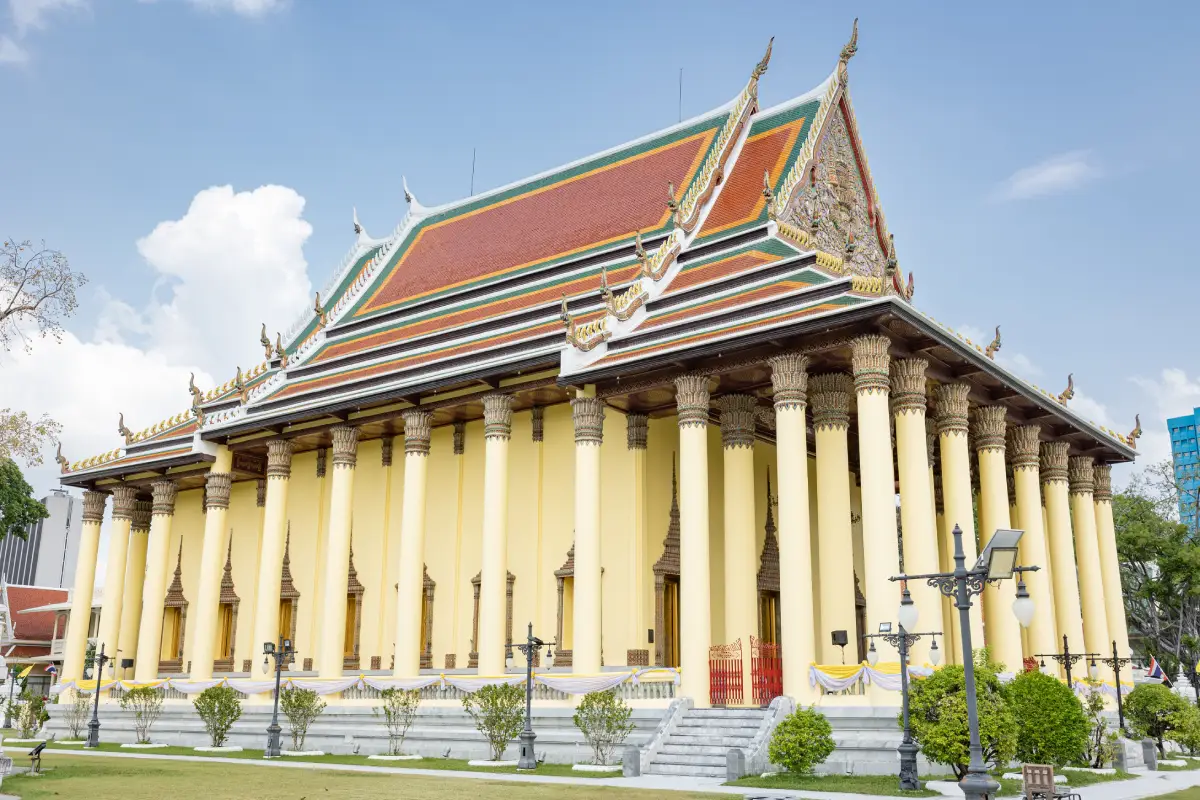
The ordination hall is the principal sacred building within the Buddhavasa area. It is large, dignified, and finely decorated in the manner of a royal monastery. Important decorative elements include lai rot nam lacquer work, ornate door and window frames, and a ceiling carved with royal decorations. These details reflect the temple’s status under royal patronage and reveal the artistic taste of the King Rama 5 period.
Inside the ordination hall are several important Buddha images, including Phra Nirantrai, a Buddha image associated with King Rama 4. Phra Nirantrai was brought to the temple in 1878 according to the royal wish of King Rama 4. The name Nirantrai carries the meaning of being free from danger, so the image is strongly associated with protection, safety, stability, and auspiciousness. Many visitors pay respect to Phra Nirantrai with a calm intention for peace and security in life.
The ordination hall also functions as the central ceremonial space of the temple. Visitors should begin their visit here, as it brings together the temple’s sacred images, royal art, and historical meaning. The hall is best appreciated slowly, with attention to the lacquer decoration, ceiling details, door and window frames, and the overall dignity of the interior. Wat Thepsirintrawat is not only historically important; it also offers significant architectural and artistic value.
The Royal Cemetery is another defining feature of Wat Thepsirintrawat. In 1896, King Rama 5 ordered the construction of the Royal Cemetery within the temple. Its purpose was to serve as a cremation place for members of the royal family who did not receive a royal crematorium at Sanam Luang, and also for important persons and people of various social levels where appropriate. The presence of a cremation ground within a royal monastery is unusual, making Wat Thepsirintrawat distinct from many other royal monasteries.
The Royal Cemetery is therefore an important place for learning about royal history, ceremonial practice, memory, and Buddhist reflection on impermanence. The area contains memorial structures, ceremonial spaces, and places associated with the ashes of important people across different periods. Visitors should behave with restraint, speak quietly, avoid inappropriate photography, and remember that this area is not merely an architectural site but a place of mourning, respect, and remembrance.
The royal crematorium in front of Phlapphla Itsariyaphon is one of the best-known structures at Wat Thepsirintrawat. Phlapphla Itsariyaphon is connected with royal cremation ceremonies and originated from ceremonial use during the reign of King Rama 5. Over time, this area became strongly associated with the royal crematorium of Wat Thepsirin, used for important cremation ceremonies involving members of the royal family, senior officials, distinguished persons, and people granted high ceremonial honor.
The significance of the royal crematorium goes beyond funeral rites. It is a social and ceremonial landmark that reflects the relationship between temple, state, monarchy, and public memory. Many people know Wat Thepsirin through royal cremation ceremonies and memorial events held there. This continuing role gives the temple strong contemporary importance, even though it was founded in the late 19th century.
Debsirin School is another major element in the temple compound. The school stands together with the monastery and is one of Thailand’s notable educational institutions. Its presence reflects the traditional Thai relationship between temple and education. The eastern side of the temple landscape therefore represents learning, youth, and social formation, while the central temple area represents Buddhist practice and the western cemetery represents remembrance and impermanence.
In the history of Bangkok, Wat Thepsirintrawat occupies an important urban position. It is located near Kasat Suek Bridge, Krung Kasem Road, Luang Road, Charoen Krung Road, Phlapphla Chai Road, and Bangkok Railway Station. This area forms a connection between old Bangkok, historic commercial districts, Chinese communities, royal monasteries, and the railway network. Visiting the temple helps reveal how Bangkok developed from a canal-oriented city into a city shaped by roads, railways, schools, and official institutions.
Wat Thepsirintrawat remains an active royal monastery. It has resident monks, Buddhist ceremonies, daily worship, royal Kathin ceremonies, and continuing activities with government agencies. Recent official activities confirm the temple’s current religious and ceremonial role. The current abbot is Somdet Phra Theerayanmuni, also known as Somchai Worachayo, a senior monk of national importance.
The temple’s continuing royal Kathin ceremonies and government-related activities show that Wat Thepsirintrawat is not merely a historic site. It is a living royal monastery. On ordinary days, visitors may experience quiet and solemnity. During major ceremonies, the temple area becomes a formal ceremonial site with stricter organization. Visitors who plan to go during a major event should allow extra time and follow temple instructions carefully.
Important activities at the temple include daily merit-making, Sangha dana offerings, Dhamma listening, candlelight processions on major Buddhist days, royal Kathin ceremonies, funeral merit-making, and ceremonies connected with the Royal Cemetery. The temple serves many groups: regular worshippers, Debsirin students and alumni, families attending ceremonies, people interested in Thai royal history, art-history visitors, and travelers seeking a deeper understanding of royal monasteries in Bangkok.
As a cultural destination, Wat Thepsirintrawat is more complete than many urban temples. It includes the royal foundation by King Rama 5, the dedication to Queen Thepsirindra, the royal ordination hall, Phra Nirantrai, Debsirin School, the Royal Cemetery, the royal crematorium, Phlapphla Itsariyaphon, and continuing ceremonial importance. Visitors should not treat it as a quick photo stop. It is best experienced as a layered historical and religious site.
A good visit should begin at the ordination hall, where the main sacred and artistic elements of the temple are concentrated. Visitors can then continue through the Buddhavasa area and observe the surrounding buildings and temple atmosphere before proceeding, where appropriate, toward the Royal Cemetery and royal crematorium area. If a funeral or formal ceremony is taking place, visitors should avoid unnecessary movement near the ceremony and maintain quiet respect.
Visitors should dress modestly, speak softly, avoid touching important structures, and avoid disturbing monks, worshippers, or people attending ceremonies. Extra care should be taken around the Royal Cemetery, the royal crematorium, and funeral-related spaces. Wat Thepsirintrawat is a royal monastery and a sensitive ceremonial place, so respect should guide every part of the visit.
Getting There is convenient by several routes. MRT users can get off at Hua Lamphong Station and continue by a short local ride or travel toward Krung Kasem Road and Kasat Suek Bridge. Train users can use Bangkok Railway Station, commonly known as Hua Lamphong, as a nearby landmark. Drivers can approach via Krung Kasem Road, Rama IV Road, Luang Road, Phlapphla Chai Road, or nearby streets, then follow the map to Wat Thepsirintrawat Ratchaworawihan.
The temple can be included in a half-day cultural route with nearby places such as Wat Phlapphla Chai, Wat Mangkon Kamalawat, Wat Traimit Witthayaram, Bangkok Railway Station, Wat Saket or the Golden Mount, Jim Thompson House, Bangkok Art and Culture Centre, and Yaowarat. This route combines royal monastery history, old Bangkok neighborhoods, Chinese community heritage, railway history, Buddhist art, and food culture in one area.
Compared with other temples around Pathum Wan, Rong Mueang, Hua Lamphong, and Pom Prap Sattru Phai, Wat Thepsirintrawat has a distinct strength in royal history and ceremonial meaning. Other nearby temples may be known for Chinese-influenced architecture, old community identity, or compact local temple settings, but Wat Thepsirintrawat is distinguished by its royal foundation, its dedication to Queen Thepsirindra, Phra Nirantrai, the Royal Cemetery, and the royal crematorium within the same compound.
For travelers who want to understand Bangkok beyond shopping streets and main roads, Wat Thepsirintrawat is one of the most important temples to study. It tells the story of Bangkok through royal memory, Buddhism, education, death, architecture, ceremony, and urban transformation. Entering the temple is like walking through a living historical lesson that continues to function as a sacred place today.
In summary, Wat Thepsirintrawat Ratchaworawihan is a second-class royal monastery in Pom Prap Sattru Phai District, founded in 1876 by King Rama 5 to honor and dedicate merit to Queen Thepsirindra. The temple contains a royal ordination hall, Phra Nirantrai, Debsirin School, the Royal Cemetery, the royal crematorium in front of Phlapphla Itsariyaphon, and continuing Buddhist and royal ceremonial functions. It is a significant destination for worship, merit-making, King Rama 5 history, royal monastery studies, and understanding Bangkok’s religious, educational, and memorial landscape in one place.
| Name | Wat Thepsirintrawat Ratchaworawihan |
| Common Name | Wat Thepsirin |
| Temple Type | Second-Class Royal Monastery, Ratchaworawihan Type, Under The Dhammayuttika Nikaya Order |
| Location | Wat Thepsirin Subdistrict, Pom Prap Sattru Phai District, Bangkok, near Kasat Suek Bridge and Bangkok Railway Station / Hua Lamphong |
| Address | 1464 Krung Kasem Road, Wat Thepsirin, Pom Prap Sattru Phai, Bangkok 10100, Thailand |
| Coordinates | 13.74711, 100.51383 |
| Founder | King Chulalongkorn, Rama 5 |
| Foundation Year | 1876 |
| Consecrated Boundary / Monastic Establishment | July 3, 1878; King Rama 5 granted the consecrated boundary and invited monks from Wat Bowonniwet Vihara to reside at the temple |
| Purpose Of Foundation | Founded to honor and dedicate royal merit to Queen Thepsirindra, the mother of King Rama 5 |
| Highlights | Royal ordination hall, Phra Nirantrai, Debsirin School, Royal Cemetery, royal crematorium in front of Phlapphla Itsariyaphon, and a symbolic layout linking education, Buddhism, and remembrance |
| Ordination Hall | Large royal ordination hall decorated with lai rot nam lacquer work, ornate door and window frames, and a ceiling carved with royal decorations |
| Important Buddha Image | Phra Nirantrai, a Buddha image associated with King Rama 4, brought to the temple in 1878 |
| Main Areas / Zones | Debsirin School On The East, Buddhavasa And Ordination Hall In The Central Area, Royal Cemetery On The West, Sanghavasa Area, Royal Crematorium, Phlapphla Itsariyaphon, Ceremonial Areas, And Merit-Making Areas |
| Royal Cemetery | Established in 1896 as a cremation place for royal family members who did not receive a royal crematorium at Sanam Luang, and for important persons or people of various social levels where appropriate |
| Royal Crematorium | Royal crematorium in front of Phlapphla Itsariyaphon, used for royal cremation ceremonies and major funeral rites connected with the Royal Cemetery |
| Abbot / Caretaker | Somdet Phra Theerayanmuni, also known as Somchai Worachayo |
| Key Activities | Daily merit-making, Sangha dana, Dhamma listening, candlelight processions, royal Kathin ceremonies, funeral merit-making, and ceremonies connected with the Royal Cemetery |
| Travel Information | Accessible from MRT Hua Lamphong, Bangkok Railway Station, Krung Kasem Road, Rama IV Road, Luang Road, Phlapphla Chai Road, and the Kasat Suek Bridge area |
| Current Status | Open as an active royal monastery with resident monks, royal Kathin ceremonies, Buddhist activities, and continuing cooperation with government agencies |
| Open Days | Daily |
| Opening Hours | 08.00 – 17.00 |
| Facilities | Merit-Making Areas, Ordination Hall, Ceremonial Areas, Royal Cemetery, Restrooms, Parking, And Accessible Entrance |
| Main Contact Number | 02-221-8877 |
| Nearby Tourist Attractions | 1. Wat Phlapphla Chai, about 1 km, Tel. 02-222-5396 2. Wat Mangkon Kamalawat, about 1 km, Tel. 02-226-6553 3. Bangkok Railway Station / Hua Lamphong, about 1 km 4. Wat Traimit Witthayaram, about 2 km, Tel. 089-002-2700 5. Wat Saket / Golden Mount, about 2 km 6. Jim Thompson House, about 3 km, Tel. 02-216-7368 7. Bangkok Art And Culture Centre, about 3 km, Tel. 02-214-6630 |
| Nearby Restaurants | 1. Jay Ama Vegetarian Food, Behind Wat Thepsirin, about 1 km, Tel. 086-314-2354 2. Woo Haa Lo! Phlapphla Chai Road, about 1 km, Tel. 092-524-2626 3. Sit Phochana Si Yaek Wat Duang Khae, about 1 km, Tel. 02-216-1279 4. Pa Khao Banthat Thong, about 2 km, Tel. 090-986-9789 5. Somboon Seafood Banthat Thong, about 2 km, Tel. 02-216-4203, 097-046-4203 6. Chaiyaphram, Behind Wat Thepsirin, about 1 km |
| Nearby Accommodations | 1. W22 by Burasari, about 1 km, Tel. 02-069-6999 2. ASAI Bangkok Chinatown, about 1 km, Tel. 02-220-8999 3. The Quarter Hualamphong by UHG, about 2 km, Tel. 02-092-7999 4. Hotel Royal Bangkok Chinatown, about 2 km, Tel. 02-226-0026 5. Shanghai Mansion Bangkok, about 2 km, Tel. 02-221-2121 6. The Twin Towers Hotel Bangkok, about 2 km, Tel. 02-216-9555 7. Mandarin Hotel Bangkok, about 3 km, Tel. 02-238-0230 |
Frequently Asked Questions (FAQ)
Q: Where is Wat Thepsirintrawat Ratchaworawihan located?
A: Wat Thepsirintrawat Ratchaworawihan is located at 1464 Krung Kasem Road, Wat Thepsirin Subdistrict, Pom Prap Sattru Phai District, Bangkok 10100, near Kasat Suek Bridge, Bangkok Railway Station / Hua Lamphong, and Debsirin School.
Q: What are the opening days and hours of Wat Thepsirintrawat?
A: The temple is open daily from 08.00 to 17.00. Visitors who plan to attend a special ceremony, royal Kathin ceremony, or event in the Royal Cemetery area should contact the temple before traveling.
Q: Why was Wat Thepsirintrawat founded?
A: The temple was founded in 1876 by King Rama 5 to honor and dedicate royal merit to Queen Thepsirindra, his mother.
Q: What is special about the ordination hall?
A: The ordination hall is a major royal temple building decorated with lai rot nam lacquer work, ornate door and window frames, and a ceiling carved with royal decorations. It also houses important Buddha images including Phra Nirantrai.
Q: Why is Phra Nirantrai important?
A: Phra Nirantrai is a Buddha image associated with King Rama 4 and was brought to Wat Thepsirintrawat in 1878. Its name is associated with protection, safety, and auspiciousness.
Q: Why is the Royal Cemetery important?
A: The Royal Cemetery was established in 1896 as a cremation place for royal family members who did not receive a royal crematorium at Sanam Luang, and for important persons or people of various social levels where appropriate.
Q: Who is the current abbot of Wat Thepsirintrawat?
A: The current abbot is Somdet Phra Theerayanmuni, also known as Somchai Worachayo.
Q: How can visitors get to Wat Thepsirintrawat?
A: Visitors can take the MRT to Hua Lamphong Station and continue by a short local ride or travel toward Krung Kasem Road. Train users can use Bangkok Railway Station as a landmark, while drivers can approach via Krung Kasem Road, Rama IV Road, Luang Road, Phlapphla Chai Road, or the Kasat Suek Bridge area.
 Category: ●Places of Worship
 Group: ●Temple
Last Update : 1 MonthAgo
 Last Update : 1 MonthAgo
 Click to Access the Navigation Map GPS
Wat Thepsirintrawat Ratchaworawihan Map
Recommend

 Phra Nakhon(24)Dusit(17)Khlong San(7)Khlong Toei(3)Jatujak(2)Don Muang(5)Taling Chan(26)Thon Buri(23)Bangkok Noi(31)Bangkok Yai(13)Bang Kapi(5)Bang Kun Tien(15)Bang Khen(3)Bang Kholam(10)Bang Sue(9)Bang Plad(23)Bang Rak(6)Chom Thong(16)Bung Kum(5)Pra Wet(6)Patum Wan(6)Pom Prap Sattru Phai(11)Paya Thai(1)Pra Kanong(4)Pa Sri Charoen(23)Min Buri(7)Yan Na Wa(8)Ratchathewi(4)Rat Burana(6)Lat Krabang(13)Nong Chok(16)Lat Phrao(4)Sathorn(4)Sam Phan Tha Wong(12)Nong Khaem(7)Huai Khwang(3)Suan Luang(7)Din Daeng(2)Lak Si(1)Sai Mai(8)Khan Na Yao(2)Wang Thong Lang(1)Klong Sam Wa(10)Watthana(2)Bang Na(4)Thawi Watthana(3)Bang Khae(5)Thung Khru(4)Bang Bon(3)


