
lovethailand home >North Travel Attractions >Chiang Mai Travel Attractions >Mae Wang >Mae Win > Khun Wang Royal Project Development Center
TL;DR: Khun Wang Royal Project Development Center is located at Ban Khun Wang, Mae Win Subdistrict, Mae Wang District, Chiang Mai Province, Thailand, open Daily, hours 08:00 – 16:00 (According to the published business directory listing).

Khun Wang Royal Project Development Center
Open Days: Daily
Opening Hours: 08:00 – 16:00 (According to the published business directory listing)
Khun Wang Royal Project Development Center is located at 112 Moo 12, Mae Win Subdistrict, Mae Wang District, Chiang Mai Province, northern Thailand. Established in 1985, the center operates under the Royal Project Foundation and plays an important role in highland agricultural development, sustainable livelihoods, environmental conservation, and rural community development. Its principal mission is to help highland farmers establish reliable sources of income through suitable agricultural production while reducing dependence on opium cultivation, shifting agriculture, and forest encroachment.
Khun Wang is surrounded by mountainous terrain at elevations of approximately 900 to 1,400 meters above sea level. The area has an average temperature of approximately 18 degrees Celsius, creating favorable conditions for highland vegetables, temperate fruits, flowers, and other economically valuable crops. Its cooler mountain climate distinguishes it from the lowland agricultural areas of Chiang Mai and provides opportunities to cultivate products requiring relatively mild temperatures.
Beyond its agricultural activities, Khun Wang Royal Project Development Center represents an important chapter in Thailand's history of highland development. The center demonstrates how scientific agricultural knowledge, improved production standards, forest conservation, and community participation can work together to address poverty and environmental degradation. Its activities extend beyond crop production to education, public health, social development, and the responsible management of natural resources.
The history of the center began with the royal development initiatives of His Majesty King Bhumibol Adulyadej, King Rama IX. In 1975, the King visited Ban Khun Wang for the first time and initiated cooperation between the Royal Project and the Hill Tribe Development and Welfare Center to improve living conditions for residents. This royal initiative laid the foundation for long-term changes in agricultural practices, economic opportunities, and natural resource management throughout the surrounding highland communities.
At that time, many mountainous communities in northern Thailand faced difficulties associated with opium cultivation, shifting agriculture, limited transportation infrastructure, and a shortage of reliable economic opportunities. Geographic isolation restricted access to markets, services, and agricultural technology. Sustainable development therefore required more than replacing one crop with another. It demanded an integrated approach addressing agricultural productivity, market access, education, health, and environmental protection.
In 1985, Khun Wang Royal Project Development Center was formally established under the royal initiative, with financial support from the United States Embassy. Its principal objectives were to reduce opium-growing areas, introduce more profitable temperate crops, encourage permanent cultivation, and help highland residents establish settled communities. These measures were intended to reduce shifting cultivation and the continued clearing of natural forests while improving household incomes and long-term economic security.
The center's development philosophy emphasizes the importance of applying agricultural research to everyday livelihoods. Farmers are encouraged to cultivate crops suited to local elevation, soil characteristics, and climate. Improved agricultural practices and reliable production standards help increase the economic value of cultivated land, while soil conservation and forest protection maintain the natural resources required for future agricultural activity.
The center's development area covers approximately 29,704 rai and consists largely of mountainous and sloping terrain. It encompasses four villages and seven settlement groups inhabited by Karen, particularly Pga K'nyau communities, and Hmong residents. The Royal Project Foundation's baseline information records a population of more than 2,699 people. These communities are integral to the center's work because successful agricultural development and environmental management depend on cooperation between local residents and project personnel.
Local Karen and Hmong communities possess distinct languages, traditions, and cultural practices shaped by generations of life in northern Thailand's mountains. Their relationship with agriculture, forests, and seasonal environmental conditions contributes to the area's cultural diversity. Agricultural development influences household livelihoods, working practices, and the transfer of knowledge between generations, while creating opportunities for younger residents to pursue sustainable occupations within their home communities.
Today, Khun Wang Royal Project Development Center conducts crop trials and demonstration activities to identify varieties and production techniques suited to local conditions. These activities are intended to generate practical knowledge that can be transferred to participating farmers. Crop selection considers not only the ability of a plant to grow in the mountain climate but also product quality, production consistency, cultivation costs, and market demand.
The Royal Project Foundation identifies the center's main products as cos lettuce, Royal Project tomatoes, broccoli, passion fruit, cape gooseberries, avocados, chrysanthemums, cottony mushrooms, Tea No. 17, and wheat. Each crop requires particular environmental conditions and production techniques. Their diversity illustrates how highland agricultural development can combine vegetables, fruit, flowers, specialty crops, and other products to create multiple economic opportunities for local farming households.
Cool-season vegetables such as cos lettuce and broccoli benefit from the relatively mild temperatures of the highlands. Producing these crops successfully requires appropriate soil preparation, irrigation, plant nutrition, pest management, and postharvest handling. Fresh vegetables are particularly sensitive to poor storage and transportation conditions, making careful harvesting and distribution important for maintaining quality.
Royal Project tomatoes are another important agricultural product associated with the center. Tomato cultivation requires careful management of water, nutrients, plant health, and growing conditions to maintain consistent yields and desirable quality. Supporting farmers in tomato production demonstrates the role of technical agricultural knowledge in improving both product value and the reliability of income-generating activities.
Passion fruit is among the fruit crops cultivated within Thailand's Royal Project system. Its versatility allows the fruit to be consumed fresh or processed into beverages and food products. Successful cultivation requires adequate support structures, regular plant maintenance, and suitable postharvest management. Avocados provide another high-value agricultural option in mountain areas where growing conditions are favorable.
Cape gooseberries are small fruits enclosed in distinctive papery husks. When ripe, they develop a yellow to orange color and a characteristic sweet-tart flavor. Their inclusion among the center's principal products demonstrates the value of agricultural diversification and the introduction of specialty produce that can offer farmers alternatives to conventional crops.
Chrysanthemums represent the ornamental flower sector of the center's agricultural activities. Their production requires appropriate management of daylight, temperature, irrigation, and plant nutrition. Flower cultivation offers another means of taking advantage of the highland climate while diversifying farmers' sources of income beyond vegetables and fruit.
Cottony mushrooms demonstrate that the center's agricultural activities are not limited to conventional outdoor crops. Mushroom production requires suitable environmental conditions and careful hygiene. Tea No. 17 and wheat further illustrate the diversity of crops that can be evaluated and cultivated under cooler highland conditions. Together, these products broaden the range of agricultural skills, production systems, and economic opportunities available to local communities.
A major element of the center's work is the promotion of Good Agricultural Practices, commonly known as GAP. This approach emphasizes food safety, responsible agricultural input management, suitable pesticide use, farm hygiene, production records, and traceability. Applying recognized agricultural standards helps farmers improve product consistency and meet the requirements of markets that prioritize safety and quality.
Production standards are particularly important in mountainous agricultural areas where temperature, humidity, terrain, and seasonal conditions may vary considerably. Systematic farm management helps farmers use resources efficiently, minimize crop losses, and improve production quality. Maintaining appropriate records also makes it possible to evaluate growing methods and introduce improvements over time.
Environmental conservation is another fundamental responsibility of Khun Wang Royal Project Development Center. Much of the surrounding landscape consists of steep mountain slopes that are vulnerable to soil erosion when vegetation is removed or agricultural land is managed improperly. During periods of heavy rainfall, exposed soil can be washed downhill, affecting both cultivated land and water systems.
To address this challenge, the center promotes the planting of vetiver grass as a soil and water conservation measure. Vetiver develops a dense root system that helps stabilize soil and reduce surface runoff when planted appropriately along slopes. Its use demonstrates how relatively simple biological measures can support agricultural productivity while protecting the wider mountain environment.
The center also supports community forestry based on the royal concept of three types of forests providing four benefits. This approach encourages the cultivation and management of useful trees to support household needs while contributing to ecological restoration. Trees grown for food, practical use, and economic value can help reduce pressure on natural forests and strengthen community participation in long-term environmental conservation.
Reducing unnecessary agricultural chemical use and monitoring environmental contamination are further priorities. Improper chemical management can affect soil quality, water resources, farmers' health, and food safety. By encouraging responsible production methods and appropriate pest management, the center seeks to improve agricultural standards while protecting the environmental foundations of local livelihoods.
Khun Wang Royal Project Development Center also serves as a highland agricultural learning center for students, researchers, farmers, and other interested groups. Its activities provide opportunities to understand crop selection, cultivation methods, agricultural input management, food safety standards, and natural resource conservation. The center's work demonstrates the close connection between agricultural science, economics, environmental management, and community development.
For visitors interested in agricultural education, one of the most important aspects of Khun Wang is the relationship between elevation and crop production. Changes in altitude influence temperature, moisture, and the suitability of different plant species. While tropical crops dominate many lowland farming systems in Thailand, cooler highland environments offer opportunities for vegetables, fruits, flowers, and specialty crops with different climatic requirements.
Crop demonstration plots are an important component of the center's agricultural knowledge-transfer activities. These plots support the testing of crop varieties and production methods. Studying such systems can provide an understanding of cultivation practices ranging from field preparation and irrigation to plant maintenance and harvesting. Access to active production and demonstration areas is subject to the center's management and permission to avoid interference with research and farming operations.
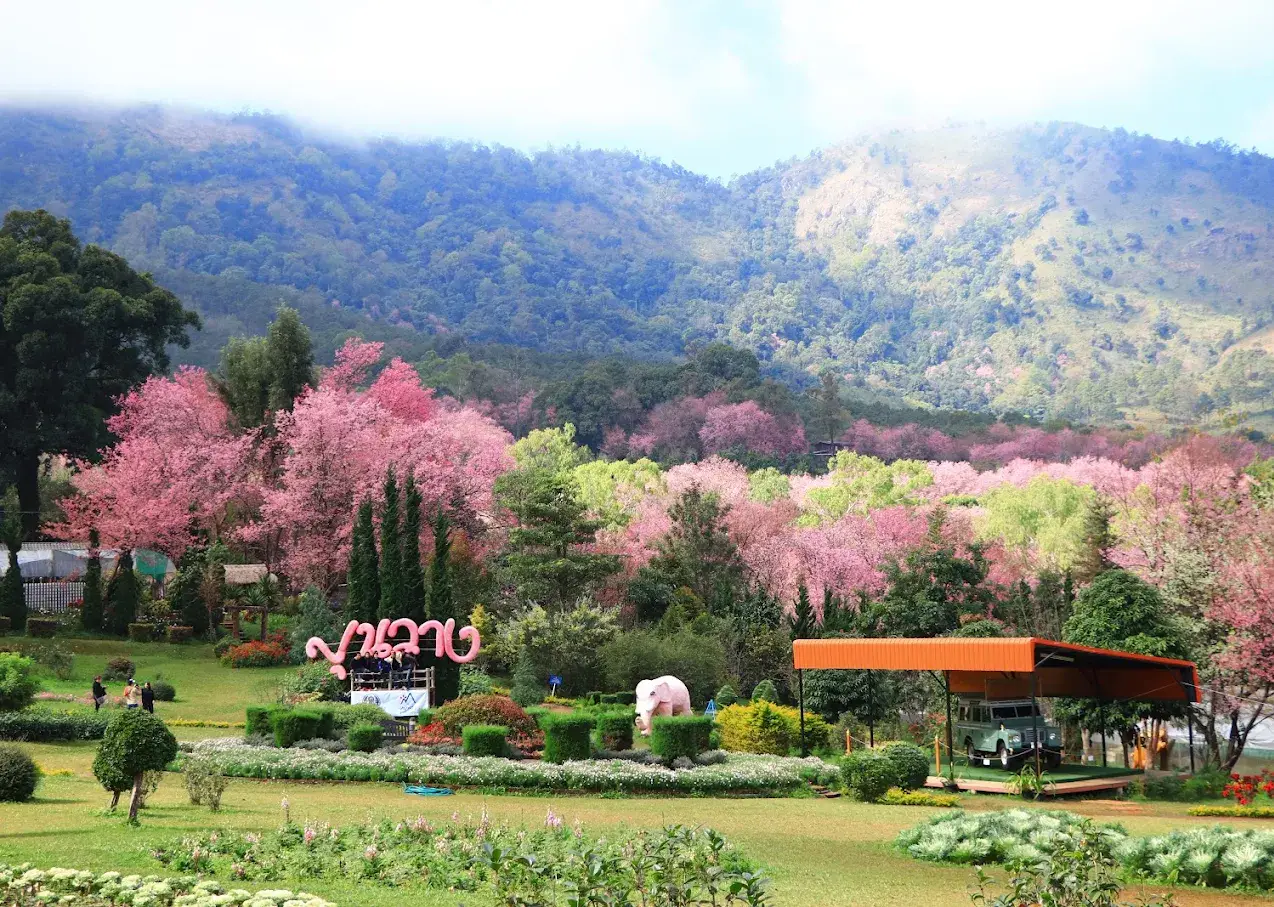
Although Khun Wang is widely associated with pink wild Himalayan cherry blossoms, visitors should distinguish Khun Wang Royal Project Development Center from Chiang Mai Royal Agricultural Research Center (Khun Wang). The latter operates under Thailand's Department of Agriculture, whereas Khun Wang Royal Project Development Center belongs to the Royal Project Foundation. These are separate institutions with different primary responsibilities, operational areas, and visitor arrangements.
Wild Himalayan cherry trees, known locally as Nang Phaya Suea Khrong, are among the best-known seasonal attractions of the wider Khun Wang area. Their pink blossoms create striking mountain scenery when the trees flower during the cool season. January and February are generally associated with blossom viewing, although the actual flowering period changes from year to year according to temperature and local environmental conditions.
Khun Wang's natural appeal is not restricted to the flowering season. During the rainy months, the surrounding mountains become lush and green as vegetation responds to increased moisture. The transition from the rainy season to winter brings progressively cooler conditions, while the dry season reveals another aspect of the mountain landscape. These seasonal changes also influence agricultural production cycles and the appearance of the surrounding countryside.
The forests and mountains surrounding Khun Wang perform important environmental functions. They help retain moisture, protect watersheds, and support local ecological systems. Preserving these resources is closely related to the long-term security of farming communities, which depend on suitable water supplies, productive soil, and a stable natural environment.
The center's community development responsibilities extend into education, social welfare, environmental awareness, and public health. Sustainable improvements in highland living conditions depend on access to agricultural knowledge, healthcare, educational opportunities, and effective community resource management. The value of development therefore extends beyond agricultural output to include community well-being and the ability of residents to maintain secure livelihoods.
Community participation remains essential because residents possess valuable knowledge of local terrain, seasons, agricultural conditions, and traditional resource-use practices. Combining this experience with scientific agricultural methods helps create practical approaches to farming and conservation. Cooperation between local communities and technical personnel also strengthens the long-term continuity of development initiatives.
Tourism in the Khun Wang area contributes to the surrounding economy through local restaurants, accommodation providers, and the sale of agricultural products. Visitors interested in the highland environment can gain a broader appreciation of local crops, food traditions, and rural livelihoods. This educational perspective offers an experience that extends beyond mountain scenery and seasonal photography.
The landscape is characterized by agricultural fields on mountain slopes, surrounding forests, and roads passing through small highland settlements. As travelers leave the lower areas of Chiang Mai and enter the mountains, they encounter changes in temperature, vegetation, and land use. These geographical transitions help explain why Khun Wang has developed as a center for specialized highland agricultural activities.
Khun Wang Royal Project Development Center is especially significant as an example of Thailand's transition from opium cultivation and shifting agriculture toward economically viable alternative crops. The approach demonstrates how agricultural research, reliable markets, farmer training, and environmental conservation can operate together to address long-standing rural development challenges.
Another important contribution is the development of agricultural knowledge suitable for difficult terrain. Mountain slopes and cooler temperatures require crop varieties and production methods different from those used in the lowlands. The center's trial and demonstration activities illustrate how scientific evaluation can support practical farming decisions and help farmers make productive use of existing agricultural land.
Respect for working agricultural areas is essential when visiting the center. Crop plots and experimental facilities are places of employment and agricultural activity. Entering restricted areas, touching experimental plants, or harvesting produce without permission can interfere with ongoing operations. Responsible educational tourism therefore requires consideration for project personnel, participating farmers, local communities, and the surrounding environment.
Visitors exploring the wider Khun Wang region can also include Chiang Mai Royal Agricultural Research Center (Khun Wang) and attractions within the Doi Inthanon mountain area in their itinerary. Although both agricultural institutions are associated with temperate crops and highland environments, their primary functions differ. The Royal Project Development Center focuses on agricultural livelihood development and community well-being, while the agricultural research center conducts crop research and agricultural conservation tourism under the Department of Agriculture.
Mae Wang District also contains other natural and cultural attractions, many of which are scattered across mountainous terrain. Travel between destinations requires consideration of road conditions and driving time rather than straight-line distance alone. Locations situated on opposite sides of mountain ridges may require considerably longer journeys than their apparent geographic proximity suggests.
Winter is one of the most popular periods for exploring Khun Wang because of its cooler temperatures, mountain scenery, and the possibility of viewing wild Himalayan cherry blossoms in designated areas. Morning travel provides more daylight for exploring the region and returning safely. During the rainy season, motorists should take particular care on steep roads and continuous bends, especially in heavy rainfall or dense mist.
Traveling by private vehicle is a practical option for reaching the center because it is situated in a mountainous area away from central Chiang Mai. Public transportation directly serving the site is limited. Travelers using digital maps should enter the full name Khun Wang Royal Project Development Center rather than simply Khun Wang, as the shorter name may lead to the separate agricultural research center or other nearby attractions.
Getting There from Chiang Mai city involves traveling toward Mae Wang District and Mae Win Subdistrict before continuing along mountain roads toward Ban Khun Wang. The center is located at 112 Moo 12, Mae Win, Mae Wang, Chiang Mai 50360. Sections of the journey involve winding roads and steep gradients, requiring careful driving, particularly during rainy or foggy weather. A properly maintained vehicle and experience with mountain roads are beneficial.
Travelers arriving from other provinces can use Chiang Mai city as their starting point and continue by rental car or prearranged private transportation. Combining attractions located in the same mountain area can reduce unnecessary backtracking. A day trip is suitable for those interested primarily in highland agriculture and scenery, while overnight accommodation in Khun Wang or the surrounding area allows visitors to experience cooler mornings and evenings.
Clothing should be selected according to highland weather conditions. Temperatures in Khun Wang are generally cooler than in central Chiang Mai, especially in the mornings and during winter. Warm layers, comfortable footwear suitable for uneven ground, and rain protection during the wet season can make the journey more comfortable. Carrying drinking water and preparing for stretches of mountain road with limited roadside services are also sensible precautions.
Khun Wang Royal Project Development Center represents an important combination of royal development history, scientific agriculture, community livelihoods, and environmental conservation. Its lasting significance lies in providing highland residents with sustainable economic opportunities while helping protect the forests, soil, and water resources on which their communities depend. The center illustrates how rural economic development and natural resource conservation can reinforce one another over time.
| Name | Khun Wang Royal Project Development Center |
| Location | Ban Khun Wang, Mae Win Subdistrict, Mae Wang District, Chiang Mai Province, Thailand |
| Address | 112 Moo 12, Mae Win, Mae Wang, Chiang Mai 50360, Thailand |
| Responsible Organization | Royal Project Foundation |
| History | King Bhumibol Adulyadej visited Ban Khun Wang in 1975 and initiated development activities. The center was established in 1985. |
| Main Objectives | Reduce opium cultivation, promote profitable highland crops, develop sustainable livelihoods, improve community well-being, and conserve natural resources |
| Development Area | Approximately 29,704 rai |
| Elevation | Approximately 900 – 1,400 meters above sea level |
| Average Temperature | Approximately 18 degrees Celsius |
| Local Communities | Pga K'nyau Karen and Hmong communities in four villages and seven settlement groups |
| Population in the Foundation's Baseline Data | More than 2,699 residents |
| Main Agricultural Products | Cos Lettuce, Royal Project Tomatoes, Broccoli, Passion Fruit, Cape Gooseberries, Avocados, Chrysanthemums, Cottony Mushrooms, Tea No. 17, and Wheat |
| Main Activities and Areas | Crop trial and demonstration plots, highland agricultural education, food safety production standards, and soil, water, and forest conservation activities |
| Environmental Conservation | Vetiver grass planting, community forestry, the Three Forests Four Benefits concept, reduced agricultural chemical use, and environmental pollution monitoring |
| Open Days | Daily |
| Opening Hours | 08:00 – 16:00, according to the published business directory listing |
| Current Status | Highland agricultural development center operating under the Royal Project Foundation |
| Getting There | Travel from Chiang Mai through Mae Wang District and Mae Win Subdistrict toward Ban Khun Wang. Private vehicles and rental cars are practical options. |
| Contact Number | +66 91 858 7038 |
| khunwang@royalproject.org | |
| Official Website | www.royalproject.org/devstation/khunwang/ |
| Related Attractions in the Region | 1. Chiang Mai Royal Agricultural Research Center (Khun Wang) 2. Khun Wang Wild Himalayan Cherry Blossom Viewing Areas 3. Doi Inthanon Scenic Mountain Routes 4. Mae Sapok Royal Project Development Center 5. Thung Luang Royal Project Development Center |
| Accommodation in the Khun Wang Area | 1. Po Po & Ping Ping Khun Wang, Tel. +66 87 578 4946 2. Doi Inthanon Tea Farmstay, Tel. +66 86 391 9215 |
Frequently Asked Questions (FAQ)
Q: Where is Khun Wang Royal Project Development Center located?
A: The center is located at 112 Moo 12, Mae Win Subdistrict, Mae Wang District, Chiang Mai Province 50360, northern Thailand. It operates under the Royal Project Foundation.
Q: What days and hours is Khun Wang Royal Project Development Center open?
A: The published business directory lists daily operating hours of 08:00 to 16:00. Arrangements for educational visits or access to working agricultural areas should be confirmed directly with the center.
Q: When was Khun Wang Royal Project Development Center established?
A: It was established in 1985 under the royal initiative of King Bhumibol Adulyadej. The development initiative began after the King's visit to Ban Khun Wang in 1975.
Q: What makes Khun Wang Royal Project Development Center important?
A: It promotes sustainable highland farming, develops alternative livelihoods, improves food safety standards, and supports soil, water, and forest conservation alongside community development.
Q: Are Khun Wang Royal Project Development Center and Chiang Mai Royal Agricultural Research Center (Khun Wang) the same place?
A: No. Khun Wang Royal Project Development Center operates under the Royal Project Foundation, while Chiang Mai Royal Agricultural Research Center (Khun Wang) operates under the Department of Agriculture. They are separate institutions with different responsibilities.
Q: When do wild Himalayan cherry blossoms bloom in Khun Wang?
A: The flowering season generally occurs during the cool months, particularly January and February. Actual flowering dates and duration vary according to weather conditions each year.
Q: What agricultural products are grown at Khun Wang Royal Project Development Center?
A: The main products include cos lettuce, Royal Project tomatoes, broccoli, passion fruit, cape gooseberries, avocados, chrysanthemums, cottony mushrooms, Tea No. 17, and wheat.
Q: How can visitors contact Khun Wang Royal Project Development Center?
A: The Royal Project Foundation publishes the telephone number +66 91 858 7038 and email address khunwang@royalproject.org for the center.
 Category: ●Research and Development
 Group: ●Royal Project
Last Update : 2 WeekAgo
 Last Update : 2 WeekAgo
 Click to Access the Navigation Map GPS
Khun Wang Royal Project Development Center Map
Recommend

 Art, Culture and Heritage
 Historical Sites and Monuments(8)
 Landmarks and Memorials(5)
 Royal Palace(2)
 Art, Craft Centres, Tradition(43)
 Museums(24)
 Educational Places
 Museum for Study(2)
 Educational Gardens, Farm(5)
 Training Center(1)
 Places of Worship
 Temple(79)
 Mosque(2)
 Other Sacred Sites(17)
Royal Project(45)
 Suburban Living
 Village, Community(41)
 Local Market(14)
 Nature and Wildlife
 National Parks and Marine Reserves(18)
 Mountain (Doi)(21)
 Dam, Reservoir, Lake(26)
 Waterfalls(43)
 Hot Springs(12)
 Caves(11)
 River, Canal(6)
 Other natural attractions(14)
 Entertainment and Agricultural
 Zoos and Aquariums(3)
 Animal camps and shows(3)
 Stadium(1)
 Farms, Parks and Ecotourism(19)
 Waterpark(2)
 Theater(1)
 Outdoor and Adventure Activities(10)
 Shopping
 Shopping and Night Market(6)
 Restaurant
 Michelin Star(1)
 Michelin Guide(23)
 Call Customer Service in Tourism
 Call Customer Service in Tourism(1)
 Travel Articles, Recipes
 Travel Review, Food Review(24)
 Food Menu, North Recipes(30)
 Thai Desserts, North Recipes(17)


