
lovethailand home >South Travel Attractions >Songkhla Travel Attractions >Saba Yoi >Ban Not > Khao Nam Khang National Park
TL;DR: Khao Nam Khang National Park is located at Tambon Khlong Kwang, Na Thawi District, Songkhla Province, open Daily, except during announced seasonal recovery closures, hours 08.00 – 17.00.
Khao Nam Khang National Park
Open Days: Daily, except during announced seasonal recovery closures
Opening Hours: 08.00 – 17.00
Khao Nam Khang National Park in Songkhla Province is one of southern Thailand’s most distinctive national parks, combining rainforest, waterfalls, nature trails, and modern political history in one destination. Covering areas of Na Thawi and Sadao districts, the park is known for its humid evergreen forest, mountain streams, wildlife habitats, and the Khao Nam Khang Historical Tunnel, also known as Piyamit 5 Village, a large hand-dug clay tunnel once used as an underground base by communist insurgents before the area was transformed into a nature and history attraction.
Khao Nam Khang National Park is a suitable destination for travelers who want to experience Songkhla beyond beaches, city landmarks, and old-town architecture. The park offers a deeper side of the province: thick forest, mountain air, waterfalls, historical memory, and quiet rural landscapes near the Thai–Malaysian border. Visitors can combine waterfall visits, forest walks, photography, and historical learning in a single trip, making the park valuable for both nature travelers and those interested in Thailand’s political history.
The park is located in Tambon Khlong Kwang, Na Thawi District, Songkhla Province. Its terrain consists of complex mountain ranges, humid evergreen forest, valleys, streams, and watershed areas that support local communities in Na Thawi and Sadao. The forest is dense and moist, especially during the long rainy season of southern Thailand. This high humidity gives the park a cooler and greener character than the surrounding lowland areas, and it is one of the reasons the place is associated with the name “Khao Nam Khang,” meaning a mountain of dew.
The name Khao Nam Khang comes from local stories about the cool, damp air on the mountain summit. People who went up the mountain in earlier times described seeing dew collecting on grass tips like fine threads or spider webs, even during the day. This unusual condition became part of the mountain’s identity and gave the area its memorable name. For travelers, the name captures one of the park’s most important impressions: a green, wet, and misty mountain landscape that feels different from the dry lowlands.
Historically, Khao Nam Khang was a restricted and difficult-to-access area for more than 40 years. Its rugged terrain, thick forest, and complicated mountain routes made it a strategic base for communist insurgent groups during a long period of conflict. The mountains provided shelter, concealment, communication routes, and operational space. This background is essential for understanding the park today, because the area is not only a protected forest but also a landscape shaped by conflict, negotiation, and the later transformation of former battle zones into public learning sites.
After the conflict declined, the forest area was surveyed and developed for conservation because of its strong natural value, evergreen forest, waterfalls, wildlife, and historical sites. Khao Nam Khang is now managed under the Department of National Parks, Wildlife and Plant Conservation. Its role includes forest conservation, wildlife protection, visitor management, environmental education, and the preservation of historical evidence connected with the former insurgent base.
The forest of Khao Nam Khang remains rich in biodiversity. Much of the area is humid evergreen forest, with large trees, layered vegetation, vines, ferns, mosses, and dense undergrowth. Important tree species recorded in the area include lumpho, takhian, agarwood, mangkha, and saya daeng. The forest structure helps maintain soil moisture, watershed functions, stream flow, and habitat quality for wildlife. This makes the park an important ecological area as well as a tourist destination.
Wildlife recorded around Khao Nam Khang reflects the quality of the forest habitat. The area is associated with species such as tapir, mouse deer, civet, wild boar, barking deer, serow, short-tailed macaque, gibbon, turtle, monitor lizard, and many birds, including hornbills, pheasants, junglefowl, hill mynas, and magpie robins. Visitors should not expect wildlife sightings on every trip, but the possibility of hearing birds, seeing tracks, or observing small forest life is part of the appeal. Responsible behavior is essential: do not feed wildlife, do not make loud noise, and do not leave marked trails.
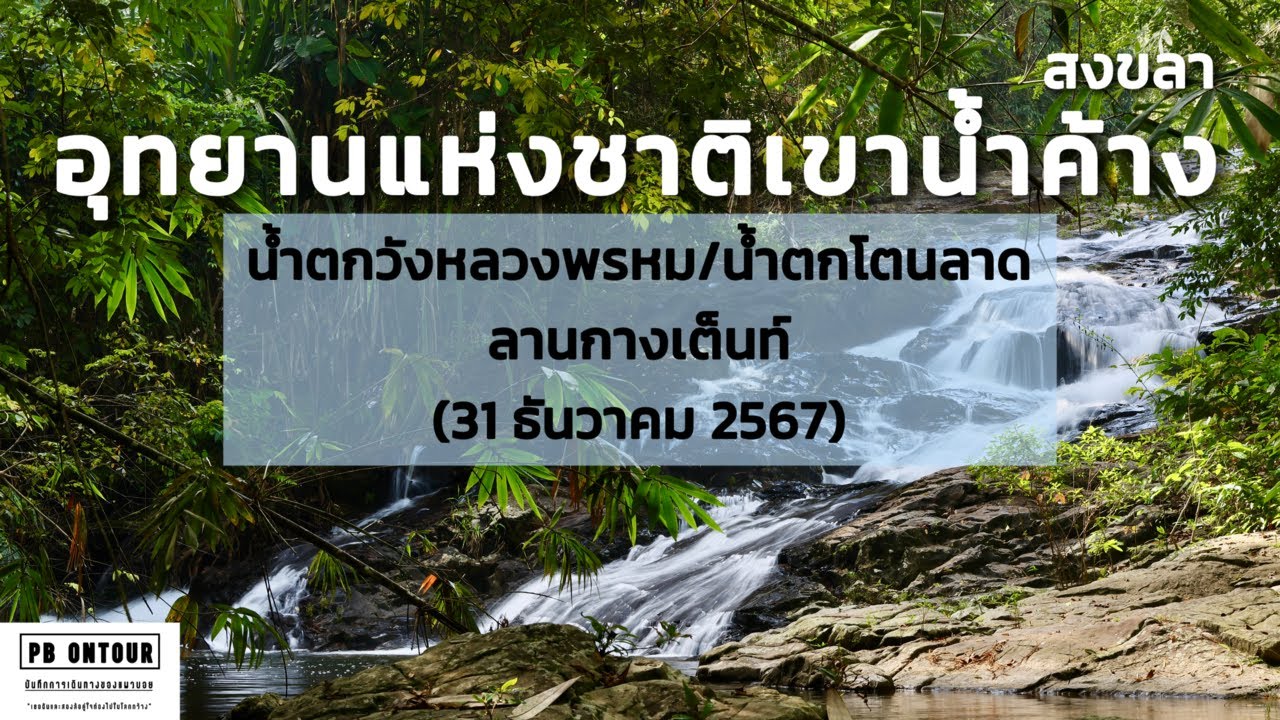
Waterfalls are among the most accessible natural highlights in the park. Namtok Wang Luang Phrom is about 450 meters from the park office and is a small waterfall with a deep pool. Namtok Ton Lat is about 500 meters behind the park office and has a broad rock platform above the falls. Namtok Ton Lat Fa is about 2 kilometers from the park office and is known for its larger cliff and two-tiered appearance. These waterfalls make the park suitable for a relaxed nature visit, especially for travelers who want to enjoy forest streams without committing to a long trek.
Waterfall visits at Khao Nam Khang should be planned with weather and safety in mind. Southern Thailand receives heavy rainfall, and water levels can rise quickly. Visitors should avoid swimming during heavy rain, when the water is cloudy, or when the current is strong. Shoes with good grip, quick-dry clothing, a light rain jacket, and waterproof protection for phones or cameras are useful. Park staff instructions should always be followed because some areas may close temporarily for safety or ecological recovery.
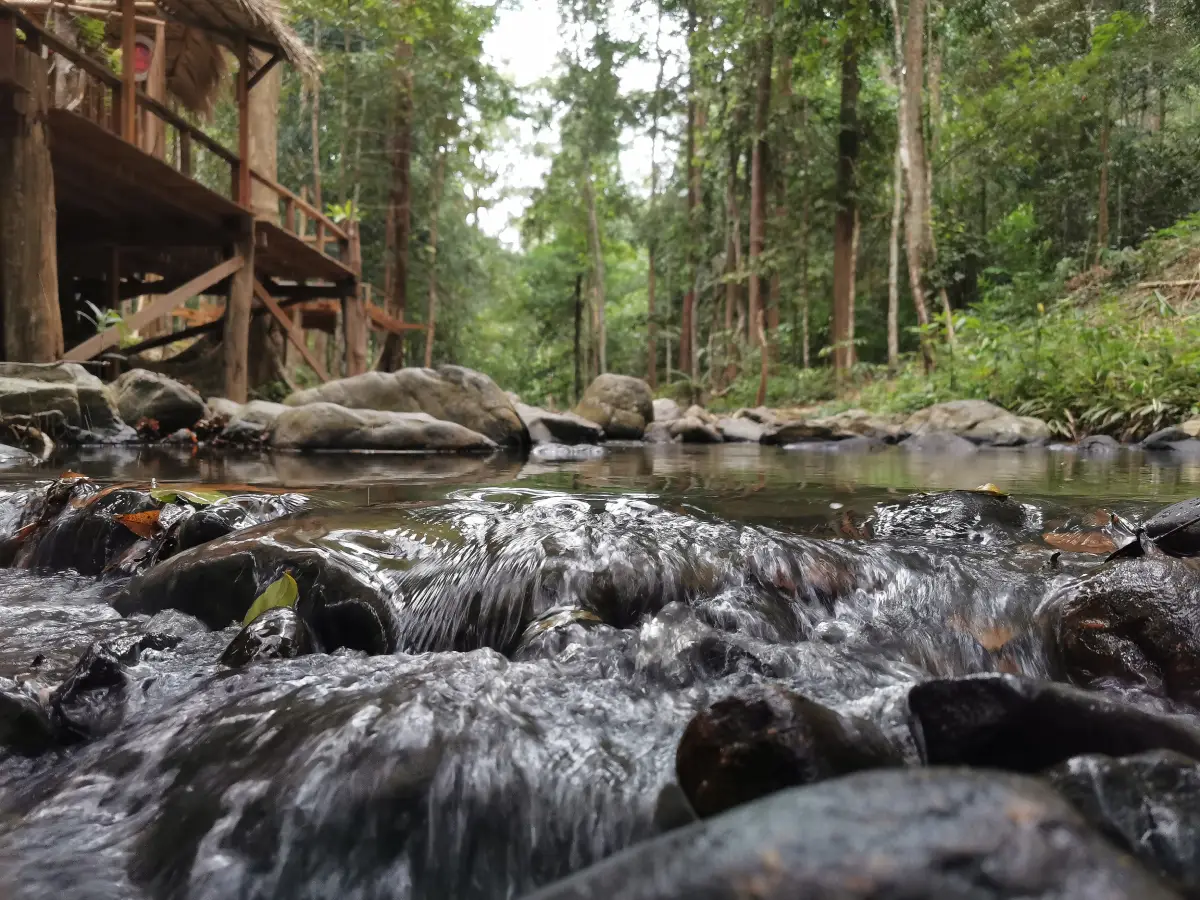
The nature trails at Khao Nam Khang are suitable for travelers who want to understand the forest more closely. A walk through the park reveals the layered structure of humid evergreen forest: large trees, shaded streams, ferns, mosses, roots, fallen leaves, and signs of wildlife movement. The best way to enjoy this environment is to slow down. The forest experience is not only about reaching a waterfall but also about observing humidity, sound, shade, and the small details that make a tropical forest function as a living system.
The Khao Nam Khang Historical Tunnel, or Piyamit 5 Village, is the park’s most important historical attraction. It is located in Moo 1, Tambon Khlong Kwang, about 4 kilometers from the park office. The access road is paved and convenient. Before entering the tunnel, visitors can see displays, photographs, and historical information that explain the background of the site. The tunnel itself preserves the atmosphere of a former underground base and gives a clear sense of how people lived, organized, and operated inside the mountain during the conflict period.
The Khao Nam Khang Historical Tunnel is a large clay tunnel dug by hand beginning in 1972. It took about 2 years to complete and extends for about 1 kilometer. The tunnel has 3 levels, 16 entrances and exits, and stairways connecting its different levels. Inside, the space was divided into functional rooms such as meeting rooms, administrative rooms, a radio room, a medical room, a kitchen, leadership rooms, a wedding room, restrooms, and training areas. The internal layout shows a highly organized underground community rather than a simple hiding place.
In 1987, after decades of conflict, the communist group ended its armed struggle and joined the Thai state as Thai Nation Development Participants. The tunnel was later developed into a historical attraction. Today, walking through the tunnel allows visitors to understand a real physical trace of Thailand’s modern political past. The site should be visited with respect because it represents lived history, conflict, adaptation, and the transition from a military zone to a public learning space.
The strength of Khao Nam Khang National Park is the way it connects nature and history. A well-planned visit can begin with forest and waterfall areas near the park office, continue to the historical tunnel, and end with a meal or coffee in the nearby Na Thawi area. This route gives travelers a complete picture of the park: rainforest ecology in the morning, historical learning in the middle of the day, and local community life before returning to Hat Yai, Sadao, Na Thawi, or Songkhla town.
For a half-day trip, visitors can focus on Namtok Wang Luang Phrom, Namtok Ton Lat, and the Khao Nam Khang Historical Tunnel. For a full-day trip, it is better to leave enough time for the nature trail, exhibition area, photography, lunch, and a less rushed tunnel visit. Khao Nam Khang is not a place to rush through quickly. Its value comes from atmosphere, forest details, and the connection between mountain geography and historical memory.
The best time to visit depends on travel style. The dry and warmer season from February to April is more convenient for road travel and family visits. The long rainy season from May to January makes the forest greener and the waterfalls more active, but it also requires more caution because paths can be slippery and some areas may close for safety or recovery. Travelers should check park announcements before visiting, especially when planning waterfall activities, trekking, or overnight stays.
Khao Nam Khang National Park provides accommodation and camping areas, along with basic visitor facilities such as a visitor center, parking, toilets, staff contact points, and nature trails. Overnight stays are suitable for travelers who want to experience the forest atmosphere in the morning and evening. Accommodation availability can be limited, and seasonal closures may affect overnight services, so travelers should contact the park before planning a stay.
The national park entrance fee is 20 baht for Thai adults and 10 baht for Thai children. For foreign visitors, the fee is 100 baht for adults and 50 baht for children. The Khao Nam Khang Historical Tunnel has a separate admission fee of 40 baht for Thai visitors and 150 baht for foreign visitors. Travelers should carry cash, especially when traveling as a family or group, because payment options in rural park areas can be limited.
Getting There is possible by 2 main routes. From Na Thawi District, drive through Ban Sathon and Ban Na Prang to the park office, a distance of about 27 kilometers. From Sadao District, drive through Ban Muang, Tambon Samnak Taew, and Ban Ko Mi to the park office, also about 27 kilometers. Both routes are paved, but drivers should check the vehicle, fuel level, and weather conditions before traveling, especially during rainy periods.
From Songkhla town, take the Songkhla–Na Thawi route through Pa Ching Junction in Chana District, continue to Na Thawi, and then drive to the park. The total distance is about 86 kilometers. From Hat Yai, take the Hat Yai–Sadao route through Khlong Wa Junction to Sadao District, then continue through Ban Muang and Ban Ko Mi. The total distance is about 84 kilometers. A private car or rental car is the most convenient option because the park is located away from major public transport routes.
Useful items for visiting Khao Nam Khang include shoes with good grip, a hat, breathable clothing, a light rain jacket, drinking water, personal medicine, and a small flashlight for low-light areas such as the tunnel. Travelers who plan to take photographs should bring waterproof protection for cameras or phones because the forest can be humid. Families with children or elderly travelers should choose accessible areas near the park office and the historical tunnel rather than longer or more demanding forest routes.
Responsible travel is important at Khao Nam Khang because the park contains both sensitive ecosystems and historical structures. Visitors should not litter, write on tunnel walls, collect plants, disturb animals, leave trails, or make loud noise in the forest. Inside the tunnel, visitors should stay on the designated path and avoid touching displays unnecessarily. Respectful travel helps preserve both the natural and historical value of the site.
Khao Nam Khang suits many kinds of travelers. Families can use it as a place for children to learn about forests and history. Students can study ecology and modern historical evidence outside the classroom. Photographers can capture waterfalls, forest, mountains, and tunnel interiors. Travelers interested in modern Thai history can see an actual underground site connected with the communist insurgency period. Nature travelers can enjoy a quieter alternative to Songkhla’s more crowded coastal attractions.
Compared with other Songkhla attractions, Khao Nam Khang has a clear identity. Samila Beach represents the sea and city symbol of Songkhla. Songkhla Old Town represents architecture, food, and cultural heritage. Khao Nam Khang represents rainforest, waterfalls, and underground history. Combining these places in one itinerary gives travelers a fuller understanding of Songkhla as a province with coastline, old communities, mountain forest, and borderland history.
The surrounding route also connects well with local food and accommodation in Na Thawi. After visiting the park and tunnel, travelers can stop at local cafés or restaurants around Khlong Kwang, Na Thawi town, or nearby areas. Local food options include noodle shops, made-to-order dishes, cafés, and simple restaurants. Choosing local services supports nearby communities and makes the trip more complete than visiting only the park itself.
For overnight stays, the most direct option is accommodation or camping inside the national park. This is best for travelers who want to stay close to the forest and the main attractions. Private resorts and small hotels in Na Thawi are better for travelers who want more conventional room facilities while still being within driving distance of the park. When choosing accommodation, consider the distance, road conditions, morning travel time, and whether the next day’s plan includes waterfalls, the tunnel, or both.
As an eco-tourism destination, Khao Nam Khang clearly shows why forest conservation matters. The forest is not just scenery; it protects water, soil, air, wildlife, and surrounding communities. Large trees, streams, rocks, mosses, ferns, birds, and mammals all form part of a connected system. Visiting the park helps travelers understand that protecting humid evergreen forest in southern Thailand benefits not only wildlife but also local people who depend on healthy watersheds.
Khao Nam Khang National Park is therefore one of the most meaningful nature and history destinations in Songkhla. It offers real forest, real historical evidence, and a travel experience that connects landscape, memory, and conservation. With careful planning, attention to park announcements, and responsible behavior, a visit to Khao Nam Khang can be one of the most rewarding inland journeys in southern Thailand.
| Name | Khao Nam Khang National Park |
| Location | Tambon Khlong Kwang, Na Thawi District, Songkhla Province |
| Address | Moo 1, Tambon Khlong Kwang, Na Thawi District, Songkhla Province 90160, Thailand |
| Coordinates | 6.5709, 100.5760 |
| Highlights | Humid evergreen forest, waterfalls, nature trails, Khao Nam Khang Historical Tunnel, and historical evidence of the former communist insurgent base |
| History | The Khao Nam Khang area was a restricted mountain zone and an important communist insurgent base for more than 40 years before becoming a conservation and tourism area. |
| Name Origin | The name refers to the cool, humid mountain atmosphere where dew was seen collecting on grass tips in fine threads, giving rise to the name Khao Nam Khang, or “Mountain of Dew.” |
| Distinctive Features | Complex mountain terrain, rich evergreen forest, waterfalls, streams, and a preserved underground historical tunnel system |
| Travel Information | There are 2 main access routes: from Na Thawi through Ban Sathon and Ban Na Prang for about 27 km, or from Sadao through Ban Muang, Tambon Samnak Taew, and Ban Ko Mi for about 27 km. |
| Current Status | Open as a national park, nature attraction, and historical learning site in Songkhla Province, with some areas subject to seasonal recovery closures announced by the park. |
| Open Days | Daily, except during announced seasonal recovery closures |
| Opening Hours | National park: 08.00 – 17.00 Khao Nam Khang Historical Tunnel: 07.00 – 17.00 |
| Fees | National park entrance fee: Thai adults 20 baht, Thai children 10 baht / Foreign adults 100 baht, foreign children 50 baht Khao Nam Khang Historical Tunnel admission: Thai visitors 40 baht / Foreign visitors 150 baht |
| Facilities | Visitor center, accommodation, camping area, parking, toilets, staff contact point, and nature trails |
| Main Areas / Zones | Park office area, Namtok Wang Luang Phrom, Namtok Ton Lat, Namtok Ton Lat Fa, nature trails, and Khao Nam Khang Historical Tunnel |
| Caretaker | Khao Nam Khang National Park, Department of National Parks, Wildlife and Plant Conservation |
| Main Contact Number | 074-805-342 |
| Official Website / Official Page | Department of National Parks, Wildlife and Plant Conservation website and the official Khao Nam Khang National Park Facebook page |
| Nearby Tourist Attractions | 1. Namtok Wang Luang Phrom, about 0.5 km 2. Namtok Ton Lat, about 0.5 km 3. Namtok Ton Lat Fa, about 2 km 4. Khao Nam Khang Historical Tunnel, about 4 km 5. Khao Nam Khang Model / Mae Kampong Na Thawi, about 5 km |
| Nearby Restaurants | 1. Khao Nam Khang Model, about 5 km, Tel. 085-519-4235 2. Nan Yuan Na Thawi, about 27 km, Tel. 074-371-753 3. Kaprow Indy 3, about 27 km, Tel. 086-746-9446 4. Zab Na Khai, about 28 km, Tel. 094-314-1145 5. Thung Dan Boat Noodles Na Thawi, about 28 km, Tel. 063-587-7723 |
| Nearby Accommodations | 1. Khao Nam Khang National Park Accommodation and Camping Area, about 0 km, Tel. 074-805-342 2. Khao Nam Khang Model / Ban Nap Dao 01, about 5 km, Tel. 085-519-4235 3. Mee Sanae Resort Na Thawi, about 30 km, Tel. 086-960-3474 4. The White House Nathawee Resort, about 30 km, Tel. 099-403-0822 5. Chom View Resort Na Thawi, about 30 km, Tel. 081-678-6644 |
Frequently Asked Questions (FAQ)
Q: Where is Khao Nam Khang National Park located?
A: Khao Nam Khang National Park is located in Tambon Khlong Kwang, Na Thawi District, Songkhla Province, covering areas of Na Thawi and Sadao districts.
Q: What are the main highlights of Khao Nam Khang National Park?
A: The park is known for humid evergreen forest, waterfalls, nature trails, and the Khao Nam Khang Historical Tunnel, a former underground base connected with communist insurgent history.
Q: What time does Khao Nam Khang National Park open?
A: The national park is open from 08.00 to 17.00. The Khao Nam Khang Historical Tunnel is open from 07.00 to 17.00.
Q: How much is the entrance fee for Khao Nam Khang National Park?
A: The national park entrance fee is 20 baht for Thai adults, 10 baht for Thai children, 100 baht for foreign adults, and 50 baht for foreign children. The historical tunnel has a separate admission fee of 40 baht for Thai visitors and 150 baht for foreign visitors.
Q: How far is the Khao Nam Khang Historical Tunnel from the park office?
A: The tunnel is about 4 km from the park office, and the access road is paved and convenient for visitors.
Q: What should visitors be careful about when visiting the waterfalls?
A: Visitors should be careful of slippery rocks, strong currents, and heavy rain. Avoid swimming when the water is high, cloudy, or fast-moving, and always follow park staff instructions.
Q: How can travelers reach Khao Nam Khang National Park from Hat Yai?
A: From Hat Yai, travel toward Sadao via Khlong Wa Junction, then continue through Ban Muang, Tambon Samnak Taew, and Ban Ko Mi to the park. The total distance is about 84 km.
Q: Is accommodation available near Khao Nam Khang National Park?
A: Yes. Accommodation and camping are available in the national park area, and nearby private options include Khao Nam Khang Model, Mee Sanae Resort Na Thawi, The White House Nathawee Resort, and Chom View Resort Na Thawi.
 Category: ●Nature and Wildlife
 Group: ●National Parks and Marine Reserves
Last Update : 2 MonthAgo
 Last Update : 2 MonthAgo
 Click to Access the Navigation Map GPS
Khao Nam Khang National Park Map
Recommend

 Art, Culture and Heritage
 Historical Sites and Monuments(2)
 Landmarks and Memorials(7)
 Royal Palace(1)
 Art, Craft Centres, Tradition(4)
 Museums(4)
 Art Gallery(1)
 Educational Places
 Library(1)
 Educational Gardens, Farm(3)
 Places of Worship
 Temple(52)
 Mosque(2)
 Other Sacred Sites(11)
 Suburban Living
 Village, Community(3)
 Local Market(3)
 Floating Market(2)
National Parks and Marine Reserves(5)
 Mountain (Doi)(6)
 Dam, Reservoir, Lake(5)
 Waterfalls(12)
 Caves(4)
 River, Canal(2)
 Bays and Beaches(13)
 Islands(3)
 Other natural attractions(2)
 Entertainment and Agricultural
 Zoos and Aquariums(2)
 Animal camps and shows(1)
 Farms, Parks and Ecotourism(6)
 Waterpark(1)
 Travel Articles, Recipes
 Travel Review, Food Review(1)
 Southern Food Menu, Southern Food Recipes(2)


