
lovethailand home >South Travel Attractions >Pattani Travel Attractions >Muang Pattani >Sa Ba Rang > Pattani City Pillar Shrine
TL;DR: Pattani City Pillar Shrine is located at Sak Seni Field, Sabarang Subdistrict, Mueang Pattani District, Pattani Province 94000, open Daily, hours 08.00 – 17.00.

Pattani City Pillar Shrine
Open Days: Daily
Opening Hours: 08.00 – 17.00
Pattani City Pillar Shrine is one of the most respected sacred landmarks in Pattani Province. It is located at Sak Seni Field in Sabarang Subdistrict, Mueang Pattani District, on the left bank of the Pattani River, beside Benjamarachuthit School Pattani and opposite Pattani Provincial Hall. The shrine is a meaningful place for local residents and visitors who come to pay respect, ask for blessings, and begin their journey in Pattani with good fortune.
The shrine was built on 13 May 1951 during the governorship of Phraya Rattanaphakdi, with Phrom Chukhae serving as district chief of Mueang Pattani. The auspicious city horoscope was given by the Supreme Patriarch from Wat Saket. This makes Pattani City Pillar Shrine more than a small religious structure. It is a symbolic foundation of the city, built to represent stability, prosperity, and protection for Pattani.
The concept of a city pillar shrine comes from old Brahmanical beliefs related to the spiritual foundation of a city. Although modern Pattani is a multicultural province with Buddhist, Muslim, Chinese, and other community traditions living side by side, the city pillar remains an important shared symbol. People visit the shrine before starting important work, accepting new duties, traveling, or making personal wishes. The shrine therefore continues to function as a spiritual anchor for the city.
The location of the shrine is especially significant. It stands close to Pattani Provincial Hall, an important administrative center, and near Benjamarachuthit School Pattani, one of the province’s notable educational institutions. It is also near the Pattani River, a natural axis that has shaped the city’s settlement and history. This setting makes the shrine a useful starting point for understanding Pattani through government, education, river life, faith, and old-town culture.
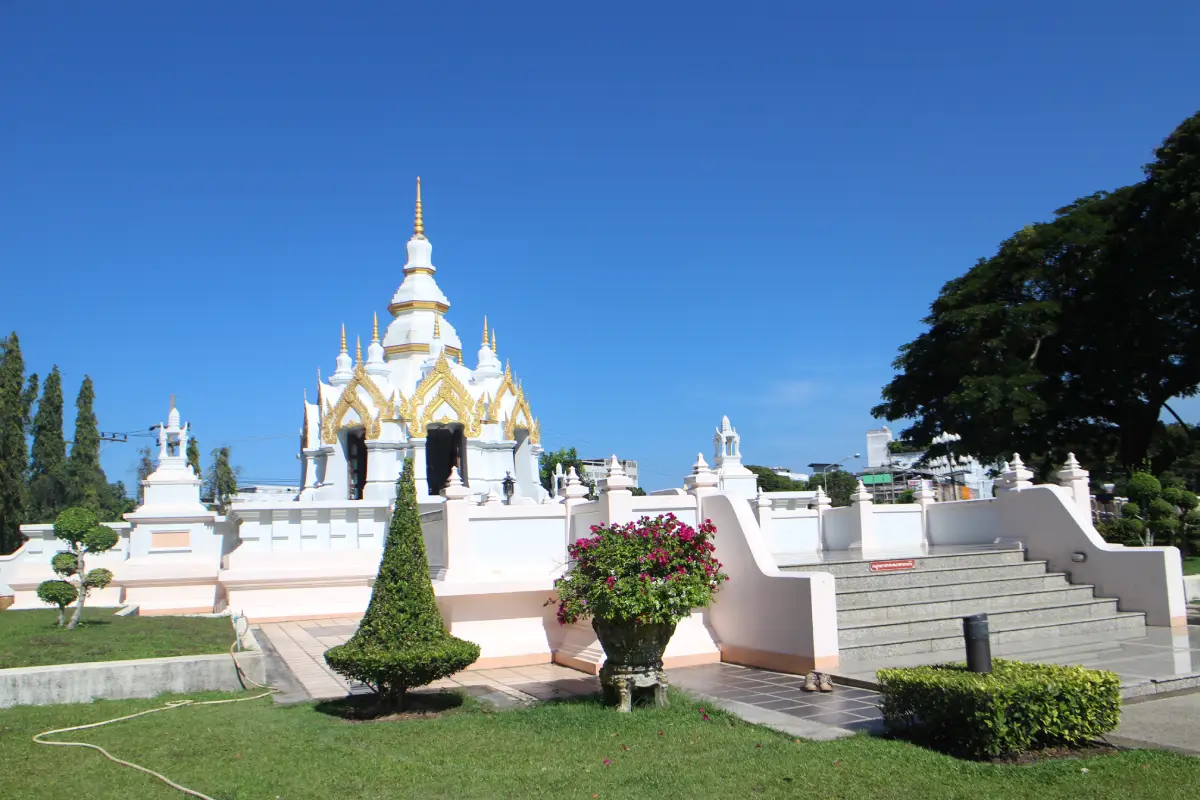
The shrine building is elegant and compact. Its white structure is decorated with gold details and set on a raised base. Inside is the city pillar, the sacred core of the site. The surrounding area includes an open courtyard and walkways for visitors. The white and gold colors create a bright and auspicious appearance, while the raised form gives the shrine a clear presence within the city. It is easy to recognize and is often included in short sightseeing routes through Pattani city.
Pattani City Pillar Shrine is a practical first stop for visitors. It does not require a long visit, but it helps travelers understand Pattani before continuing to other attractions. After paying respect at the shrine, visitors can continue to the Three Cultures Clock Tower, Lim Ko Niao Shrine, Kue Da Chino Old Town, Wat Tanin Narasamoson, Pattani Central Mosque, and Chabang Tiko community. These nearby places reveal Pattani as a city of layered faiths, old trade routes, and multicultural communities.
Culturally, the shrine helps explain why Pattani is often described as a city of three cultures. Within a small urban area, visitors can find a city pillar shrine with Brahmanical roots, Buddhist temples, Chinese shrines, Islamic mosques, and old trading neighborhoods. Pattani City Pillar Shrine is therefore not isolated from the rest of the city. It is part of a wider cultural landscape where different traditions remain visible in daily life.
The area around the shrine also shows the rhythm of everyday Pattani. Students travel to school, local residents visit public offices, travelers stop to pay respect, and nearby roads connect to the old town and riverside areas. This active setting makes the shrine feel connected to real city life rather than separated as a museum-like monument. It remains a living place of respect and local meaning.
First-time visitors should allow about 15 to 30 minutes at the shrine. This is enough time to pay respect, observe the building, walk around the courtyard, and understand its position near the river and civic center. Those with more time can use the shrine as a starting point for a walking or driving route through Pattani old town, where old shophouses, shrines, mosques, food shops, and riverside areas reveal the city’s layered history.
The shrine’s appeal is quiet rather than dramatic. Visitors do not need detailed historical knowledge to understand its role. The act of paying respect, standing in the courtyard, and seeing the shrine within the city center gives a clear sense that this is a place connected to Pattani’s civic identity. Many travelers stop here before continuing their trip because it feels like a proper way to greet the city.
Pattani City Pillar Shrine is suitable for many types of travelers: those interested in sacred places, local history, city walks, old-town culture, and multicultural travel. A half-day route can include the shrine, the Three Cultures Clock Tower, Lim Ko Niao Shrine, and Kue Da Chino Old Town. A full-day route can add Pattani Central Mosque, Chabang Tiko, and Krue Se Mosque. This makes the shrine one of the easiest places to include in a Pattani travel plan.
The shrine also has ceremonial importance. Government officials and local people often pay respect at the city pillar on important occasions, especially when beginning new duties or civic activities. This continuing practice shows that the shrine still serves as a symbolic center of the province. It is not only a tourist attraction but also a place where civic identity and local belief meet.
Visitors should behave respectfully. Dress modestly, speak quietly, avoid climbing or touching inappropriate parts of the shrine, and give space to people who are paying respect. Photography is acceptable around the exterior, but visitors should avoid behavior that looks disrespectful in a sacred place. These simple practices help preserve the dignity and calm atmosphere of the shrine.
The best time to visit is in the morning or late afternoon. Morning is good for those who want to begin the day with a blessing, while late afternoon provides softer light for exterior photos and an easy transition to nearby attractions. Midday can be hot and humid, so visitors should bring water and sun protection if traveling around the city on foot.
Getting There is straightforward from Pattani city center. The shrine is located at Sak Seni Field in Sabarang Subdistrict, opposite Pattani Provincial Hall and beside Benjamarachuthit School Pattani. Travelers can arrive by private car, hired vehicle, motorcycle taxi, or local transport. Tell the driver you are going to Pattani City Pillar Shrine, Sak Seni Field, or the area opposite Pattani Provincial Hall.
From the shrine, nearby attractions are easy to reach. The Three Cultures Clock Tower is close by and is a recognizable city landmark. Lim Ko Niao Shrine on Anoru Road is an important Chinese shrine. Wat Tanin Narasamoson reflects Pattani’s Buddhist heritage, while Pattani Central Mosque and Krue Se Mosque show the province’s Islamic identity. Kue Da Chino Old Town and Chabang Tiko add old urban history and local community life to the route.
As a city route, Pattani City Pillar Shrine is one of the best starting points for understanding Pattani as a multicultural city. From this single point, travelers can connect to shrines, temples, mosques, old-town streets, and historical communities. This route helps visitors see Pattani through real places and everyday life rather than through a single simplified image of the province.
Food options near the shrine are varied. The city center and nearby neighborhoods offer halal restaurants, made-to-order food shops, boat noodle shops, cafés, pizza, and seafood restaurants. Travelers who continue toward Yarang Road and Chabang Tiko can find places such as Suria Pizzeria Pattani and Nawang Kitchen, while other halal and local restaurants are available around Sabarang, Anoru, and Rusamilae.
For accommodation, central Pattani is the most practical base. The shrine is located in the city, and nearby hotels make it easy to visit other attractions without long travel times. Options include The Rooms Residence, River Hotel Pattani, Pattani Pirom Boutique Hotel, The Wood Pattani Hotel, C.S. Pattani Hotel, and Southern View Hotel Pattani. Staying in town is convenient for travelers who want to combine the shrine with Pattani Central Mosque, Lim Ko Niao Shrine, and the old-town area.
In summary, Pattani City Pillar Shrine is a meaningful sacred landmark that combines belief, history, and city identity. Its value does not come from size, but from its role as the symbolic foundation of Pattani. Located near the river, school, provincial hall, old town, and major cultural sites, the shrine is an excellent starting point for anyone who wants to understand Pattani with respect and clarity.
| Name | Pattani City Pillar Shrine |
| Location | Sak Seni Field, Sabarang Subdistrict, Mueang Pattani District, Pattani Province 94000 |
| Address | At Sak Seni Field on the left bank of the Pattani River, beside Benjamarachuthit School Pattani and opposite Pattani Provincial Hall |
| Coordinates | 6.8693855271, 101.261343744 |
| Highlights | Sacred city pillar shrine of Pattani, white-and-gold shrine building, riverside setting, close to the provincial hall, and a convenient starting point for Pattani’s multicultural city route |
| History | Built on 13 May 1951 at 9.28 a.m. during the governorship of Phraya Rattanaphakdi, with the auspicious city horoscope given by the Supreme Patriarch of Wat Saket |
| Name Origin | The name refers to the city pillar, a sacred foundation pillar believed to support the stability and prosperity of the city |
| Distinctive Features | White shrine with gold decoration, raised base, city pillar inside, courtyard for worshippers, and a location connected with Pattani’s river, civic center, and old-town area |
| Travel Information | From Pattani city center, travel to Sak Seni Field in Sabarang Subdistrict, opposite Pattani Provincial Hall. The shrine can be reached by private car, hired vehicle, motorcycle taxi, or local transport |
| Current Status | Open for worship and widely respected by Pattani residents and visitors |
| Open Days | Daily |
| Opening Hours | 08.00 – 17.00 |
| Facilities | Worship courtyard, walkways, open surrounding area, and nearby food and drink options in Pattani city |
| Main Areas / Zones | Shrine building, city pillar, front courtyard, surrounding walkways, and Sak Seni Field area |
| Main Contact Number | 073-312111 |
| Nearby Tourist Attractions | 1. Three Cultures Clock Tower, about 0.3 km 2. Wat Tanin Narasamoson Royal Monastery, about 0.6 km 3. Lim Ko Niao Shrine / Leng Chu Kiang Shrine, about 1 km 4. Kue Da Chino Old Town Area, about 1 km 5. Chabang Tiko Tourism Community, about 1 km 6. Pattani Central Mosque, about 1 km 7. Somdet Phra Srinagarindra Park Pattani, about 4 km 8. Krue Se Mosque, about 8 km |
| Nearby Restaurants | 1. Bama Soup and Made-to-Order Food, about 1 km, Tel. 080-376-8664 2. Suria Pizzeria Pattani, about 1 km, Tel. 096-073-6960, 073-420-323 3. Nawang Kitchen, about 1 km, Tel. 081-615-8296 4. Phra Tra Halal Boat Noodles Pattani, about 3 km, Tel. 082-832-4044 5. P. Prateep Halal Boat Noodles Pattani, about 3 km, Tel. 083-223-8139 6. Seafire Halal Restaurant Pattani, about 3 km, Tel. 061-350-5410 7. Krua Kaksu Halal Restaurant, about 4 km, Tel. 082-822-0943, 086-963-1228 |
| Nearby Accommodations | 1. The Rooms Residence, about 0.5 km, Tel. 073-335-999 2. River Hotel Pattani, about 1 km, Tel. 073-333-333 3. Pattani Pirom Boutique Hotel, about 2 km, Tel. 081-698-3877 4. The Wood Pattani Hotel, about 3 km, Tel. 091-479-0666 5. C.S. Pattani Hotel, about 4 km, Tel. 073-335-093 6. Southern View Hotel Pattani, about 5 km, Tel. 073-450-570 |
Frequently Asked Questions (FAQ)
Q: Where is Pattani City Pillar Shrine located?
A: Pattani City Pillar Shrine is located at Sak Seni Field in Sabarang Subdistrict, Mueang Pattani District, beside Benjamarachuthit School Pattani and opposite Pattani Provincial Hall.
Q: When was Pattani City Pillar Shrine built?
A: The shrine was built on 13 May 1951 at 9.28 a.m. during the governorship of Phraya Rattanaphakdi.
Q: What are the opening hours of Pattani City Pillar Shrine?
A: The shrine is open daily from 08.00 to 17.00. Morning and late afternoon are good times to visit.
Q: What is Pattani City Pillar Shrine famous for?
A: It is famous as Pattani’s sacred city pillar shrine, a white-and-gold landmark near the Pattani River, provincial hall, and old-town area.
Q: What should visitors wear to Pattani City Pillar Shrine?
A: Visitors should dress modestly, speak quietly, and behave respectfully because the shrine is a sacred place for local residents.
Q: What nearby attractions can be visited with Pattani City Pillar Shrine?
A: Nearby attractions include the Three Cultures Clock Tower, Wat Tanin Narasamoson, Lim Ko Niao Shrine, Kue Da Chino Old Town, Chabang Tiko, Pattani Central Mosque, and Krue Se Mosque.
Q: Who should visit Pattani City Pillar Shrine?
A: It is suitable for visitors who want to pay respect, learn about Pattani’s city identity, and begin a cultural route through Pattani’s old town and multicultural landmarks.
Q: Can visitors reach Pattani City Pillar Shrine by local transport?
A: Yes. Visitors can use local transport, hired vehicles, or motorcycle taxis and ask for Pattani City Pillar Shrine, Sak Seni Field, or the area opposite Pattani Provincial Hall.
 Category: ●Places of Worship
 Group: ●Other Sacred Sites
Last Update : 2 MonthAgo
 Last Update : 2 MonthAgo
 Click to Access the Navigation Map GPS
Pattani City Pillar Shrine Map

 Art, Culture and Heritage
 Historical Sites and Monuments(3)
 Landmarks and Memorials(7)
 Royal Palace(2)
 Art, Craft Centres, Tradition(7)
 Historic Homes and Cities(1)
 Educational Places
 Museum for Study(1)
 Training Center(1)
 Temple(13)
 Mosque(5)
Other Sacred Sites(4)
 Research and Development
 Royal Project(2)
 Suburban Living
 Village, Community(5)
 Local Market(2)
 Nature and Wildlife
 National Parks and Marine Reserves(2)
 Mountain (Doi)(3)
 Waterfalls(3)
 River, Canal(2)
 Bays and Beaches(13)
 Islands(2)
 Other natural attractions(1)
 Entertainment and Agricultural
 Farms, Parks and Ecotourism(1)
 Travel Articles, Recipes
 Travel Review, Food Review(1)
 Southern Food Menu, Southern Food Recipes(3)


