
lovethailand home >Northeastern Travel Attractions >Si Sa Ket Travel Attractions >Khu Khan >Prue Yai > Chulaphorn Wildlife Captive Breeding Center
TL;DR: Chulaphorn Wildlife Captive Breeding Center, Si Sa Ket attractions : Nature and Wildlife, National Parks and Marine Reserves.

Chulaphorn Wildlife Captive Breeding Center
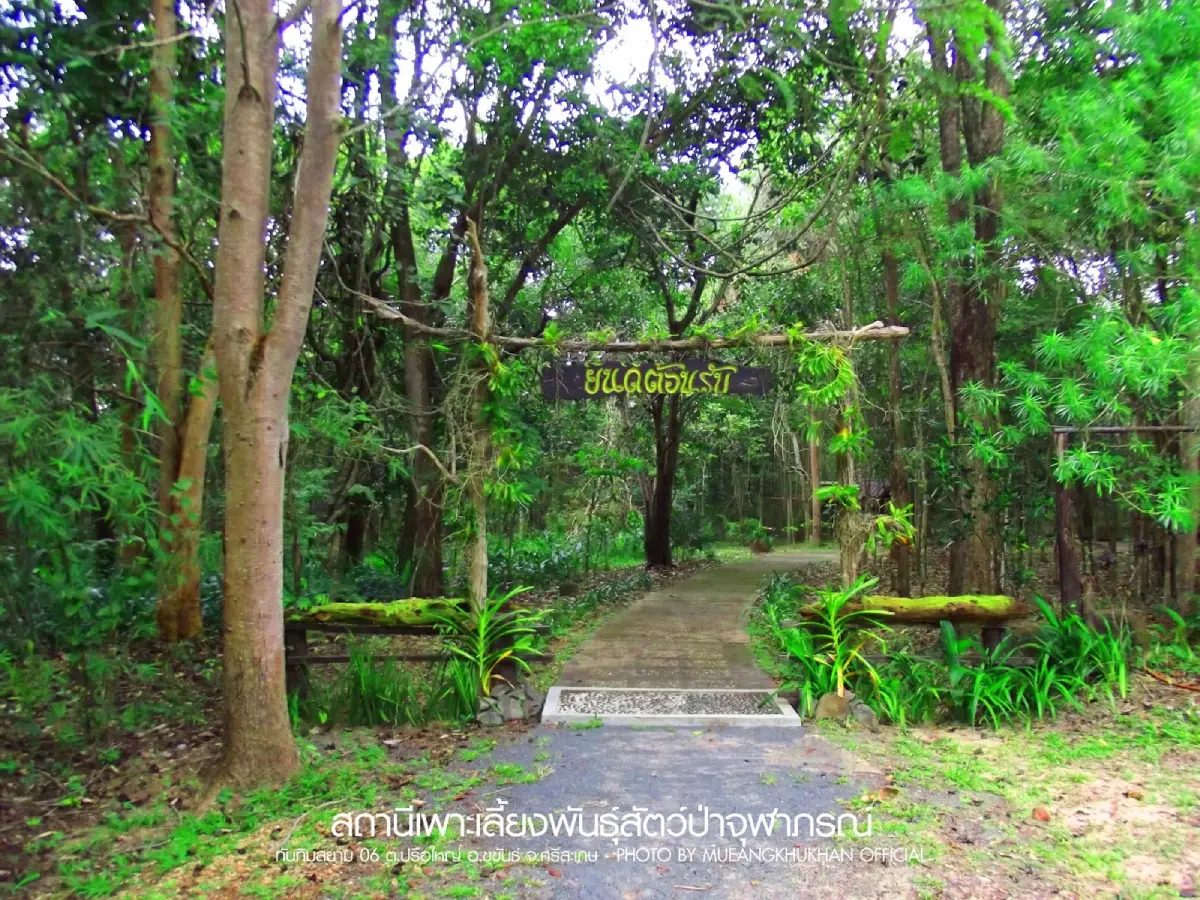
Open Days: General Visitors On Saturday - Sunday / Groups, Schools, Universities, And Agencies On Monday - Friday By Advance Arrangement
Opening Hours: 10.00 - 15.00
Chulaphorn Wildlife Captive Breeding Center, Si Sa Ket, commonly searched in Thai as the Si Sa Ket Wildlife Breeding Station, is located inside the Thap Thim Siam 06 Project at Ban Na Cha Ria, Moo 13, Prue Yai Subdistrict, Khukhan District, Si Sa Ket Province. The center lies on the Phanom Dong Rak mountain range, about 18 kilometers from Khukhan town and about 75 kilometers from Si Sa Ket city. It is one of the most meaningful conservation-based learning destinations in southern Si Sa Ket, combining wildlife breeding, wildlife rehabilitation, ecological education, forest conservation, local community participation, and nature-based tourism in one area.
This place is very different from a typical commercial zoo. Its main identity is conservation work. Many animals at the center are not there for entertainment. They include confiscated wildlife, injured animals, disabled animals, animals rescued from illegal trade, animals that have become a problem around communities, and animals that need long-term care before any decision can be made about returning them to the wild. For visitors, this makes the center a valuable place to understand what wildlife conservation really means in practice.
The origin of Chulaphorn Wildlife Captive Breeding Center is connected with a royal initiative. On 26 August 1993, Her Royal Highness Princess Chulabhorn Walailak, now Her Royal Highness Princess Chulabhorn Krom Phra Srisavangavadhana, accepted the Si Sa Ket wildlife breeding project into the Thap Thim Siam 06 Project and gave it the name “Chulaphorn Wildlife Captive Breeding Center.” The purpose was to improve the area, breed wildlife, expand wildlife populations, and release suitable animals back into nature in order to maintain ecological balance.
A later royal initiative on 2 August 2008 emphasized preparation for wildlife release. The center was directed to breed wildlife, train animals before release, improve water sources, improve food sources, create supplementary feeding areas, and develop water supply systems to support animal food plots. These directions show that the center’s work goes beyond keeping animals in enclosures. It involves water management, food management, habitat improvement, animal behavior training, and the careful preparation of animals before reintroduction.
The Thap Thim Siam 06 area at Ban Na Cha Ria has its own development background as a borderland community project. It is located in Prue Yai Subdistrict, close to forested land, the Phanom Dong Rak range, and Huai Sala Wildlife Sanctuary. The establishment of the wildlife breeding center is therefore linked with forest restoration, ecological recovery, and the improvement of relationships between people and wildlife in an area where villages, forest, and conservation land are closely connected.
The center covers more than 6,000 rai and is situated where three districts meet: Phu Sing, Khukhan, and Khun Han. The area includes forest, animal enclosures, feeding areas, water sources, breeding areas, rehabilitation zones, visitor learning points, and nature-based routes. Because the area is large, some animal groups can be managed in wider spaces than ordinary small cages. This is especially important for hoofed animals, birds, mammals, and large carnivores that require careful care and controlled visitor access.
Wildlife at the center includes several major groups. The hoofed animal zone includes barking deer, deer, Eld’s deer, hog deer, and antelope-like species important to forest ecosystems. The bird zone includes pheasants, eagles, hawks, and other rare birds used for education about breeding and behavior. The mammal zone includes monkeys, slow lorises, civets, small carnivores, and other rescued animals. The tiger and leopard zone is one of the most popular areas, but it is also one of the most strictly controlled because of visitor safety and animal welfare.
The tiger and leopard area attracts many visitors because large predators are powerful symbols of healthy forest ecosystems. Entry to this zone must be managed by officers, usually by vehicle and under staff supervision. This allows visitors to observe the animals at an appropriate distance while keeping both people and animals safe. The controlled system also reduces stress for the animals, especially because some individuals are under rehabilitation or long-term care.
The center’s work includes receiving confiscated wildlife from law-enforcement cases, caring for sick or disabled animals, raising young animals that cannot survive on their own, providing veterinary supervision, preparing suitable food, training animals to reduce dependence on humans, and evaluating whether some animals can return to the wild. Some animals can eventually be released. Others must remain under care because they cannot survive naturally. This makes the center a rehabilitation home, conservation facility, learning center, and wildlife-care institution at the same time.
Tourism access is organized differently from a normal zoo because this is a controlled wildlife conservation area. General visitors can enter on Saturdays and Sundays from 10.00 to 15.00. Groups, schools, universities, and agencies can arrange study visits from Monday to Friday from 10.00 to 15.00 by advance contact. This schedule helps officers manage visitor numbers, protect animal welfare, provide better interpretation, and maintain safety inside the center.
The regular admission fee identified for tourism access is 30 baht for Thai adults, 20 baht for Thai children, 500 baht for foreign adults, and 200 baht for foreign children. Special Pha Morakot routes follow the fees and conditions announced for each trip. A trial group route was announced at 1,200 baht per group of 8 people, or about 150 baht per person, including area access, local transfer service, and simple morning refreshments such as tea, coffee, grilled sticky rice, grilled sweet potatoes, and grilled bananas.
The learning zones inside the center include the visitor reception area, wildlife display zone, hoofed animal zone, bird zone, egg-hatching facility, breeding bird parent-stock zone, insect house, mammal zone, tiger and leopard zone, water source and animal food plot areas, nature learning routes, and the Pha Morakot connection route. These zones help visitors understand that conservation requires more than seeing animals. It requires breeding, feeding, veterinary care, habitat preparation, and patient daily management.
The egg-hatching facility and bird breeding zones are important for understanding captive breeding. Birds and pheasants require suitable parent stock, controlled breeding conditions, egg care, incubation knowledge, and careful chick raising. These processes help maintain populations of rare or vulnerable birds. For students, this is a practical way to learn about biology, reproduction, genetics, animal care, and the relationship between conservation science and field practice.
Water sources and animal food plots are also essential. Wildlife cannot be managed only by feeding from bags or baskets. The center must maintain grass plots, water sources, fruit and plant resources, and supplementary food systems suitable for different animals. These areas reduce dependence on purchased feed, improve nutritional diversity, and allow some animals to maintain more natural foraging behavior. Visitors who observe these areas will understand that wildlife care requires agriculture, water management, science, and discipline.
The center also welcomes support in the form of suitable vegetables and fruit for wildlife. Visitors who wish to donate food should hand items to officers instead of feeding animals directly. Different species have different dietary needs, and inappropriate feeding can cause health problems. Giving through officers ensures that food is checked, divided properly, and given in the right way. This is one of the most practical ways for the public to support wildlife care responsibly.
Chulaphorn Wildlife Captive Breeding Center is now also connected with Pha Morakot, a new nature tourism route inside Huai Sala Wildlife Sanctuary. The cliff was formerly known locally as Pha Chalui because of its open views, and the community later named it Pha Morakot. It is a natural cliff viewpoint with a rocky viewing area stretching for more than 200 meters. The highlight is sunrise over the direction of Khao Phra Wihan and Phu Makheua, together with mist during the late rainy season and early cool season.
The Pha Morakot route adds a strong nature dimension to the wildlife center. Visitors can arrive at the center in the afternoon, learn about wildlife, stay in the arranged area, and leave before dawn to reach the viewpoint for sunrise. The route from the center to Pha Morakot is about 8 kilometers and is managed as a guided or arranged route. This system supports local community income while keeping visitor numbers limited and reducing impact on the wildlife sanctuary area.
The surrounding Ban Na Cha Ria and Thap Thim Siam 06 area also connects with nearby attractions such as Wat Tham Sa Phong, Na Cha Ria Reservoir, forest routes, and local Prue Yai community landscapes. Visitors with limited time can focus on wildlife learning at the center. Those with a full day or overnight trip can combine the center with Pha Morakot and nearby nature routes. This makes the destination suitable for families, students, conservation groups, and travelers who prefer educational nature tourism.
Getting There from Si Sa Ket city is most convenient by private vehicle. Travel toward Khukhan District, then continue to Prue Yai Subdistrict and Ban Na Cha Ria, Moo 13. The distance from Si Sa Ket city is about 75 kilometers, and the distance from Khukhan town is about 18 kilometers. Vans and local hired vehicles are suitable for study groups. Groups should contact the center in advance so officers can prepare the route, timing, and interpretation properly.
From Khukhan town, visitors continue along local roads toward Prue Yai and Ban Na Cha Ria. Roads used by local communities are generally paved, but extra care is needed near forest and hill areas, especially after rain. The route to Pha Morakot is a mountain route inside a conservation area and should be used only as arranged by officers or the community-based trip system. Visitors should not drive independently into restricted wildlife sanctuary areas.
The best time for the wildlife learning route is between 10.00 and 15.00, when officers can manage the visitor round and provide information. The best time for the Pha Morakot trip is the announced sunrise route, which usually begins with arrival at the center in the afternoon, wildlife learning, overnight rest, and pre-dawn departure. This rhythm suits travelers who want a slow, respectful, and educational experience rather than a rushed sightseeing stop.
Visitor conduct is extremely important. Visitors should not make loud noise, knock on enclosures, put hands near animals, feed animals without permission, use flash aggressively, tease animals for photographs, enter restricted zones, collect plants, litter, or separate from the guided route. Many animals are under rehabilitation or stress-sensitive care. Reducing disturbance is part of responsible conservation travel.
For families with children, the center is a strong learning place. Children can learn that wild animals are not pets, not toys, and not objects for illegal trade. Seeing tigers, deer, birds, monkeys, and rescued wildlife under professional care helps children understand respect for life and nature. Parents can use the visit to explain why people should not buy illegal wildlife, keep wild animals at home, or support tourism that harms animals.
For students and study groups, the center is suitable for lessons in biology, ecology, animal behavior, wildlife veterinary care, food systems, animal rehabilitation, captive breeding, law enforcement, and release preparation. The place turns textbook knowledge into real observation. Students can see the actual facilities, animals, officers, feeding systems, and conservation challenges that exist behind wildlife protection work.
For international visitors, Chulaphorn Wildlife Captive Breeding Center shows another side of Si Sa Ket beyond Khmer ruins, temples, and border viewpoints. It introduces wildlife rescue, community-linked conservation, and the ecological value of the Phanom Dong Rak range. It is a meaningful place for travelers interested in practical conservation, wildlife rehabilitation, ethical animal observation, and local conservation work in Thailand.
The beauty of this place is not luxury or spectacle. It lies in the reality of conservation. Some animals here come from illegal trade. Some are injured. Some are being trained for a more natural life. Some are important breeding stock. Some will never return to the wild and must be cared for long term. A visit to the center helps visitors see the relationship between humans, wildlife, forest, and responsibility in a direct and memorable way.
In summary, the Si Sa Ket Wildlife Breeding Station, officially Chulaphorn Wildlife Captive Breeding Center, is one of the province’s most important conservation learning destinations. It combines a royal initiative, wildlife breeding, rehabilitation, ecological education, forest recovery, local community participation, and controlled nature tourism. Visitors leave with knowledge, awareness, and a deeper respect for wildlife and the forests of the Phanom Dong Rak range.
| Place Name | Si Sa Ket Wildlife Breeding Station / Chulaphorn Wildlife Captive Breeding Center |
| Related Names | Chulaphorn Wildlife Captive Breeding Center, Thap Thim Siam 06 Project, Ban Na Cha Ria, Huai Sala Wildlife Sanctuary, Pha Morakot |
| Place Type | Wildlife Breeding Center, Conservation Learning Site, Nature Education Area, Wildlife Rehabilitation Facility, And Controlled Eco-Tourism Destination |
| Location | 5 Moo 13, Ban Na Cha Ria, Prue Yai Subdistrict, Khukhan District, Si Sa Ket Province 33140, Thailand |
| Setting | Located inside the Thap Thim Siam 06 Project on the Phanom Dong Rak mountain range, linking Phu Sing, Khukhan, and Khun Han districts |
| Area | More Than 6,000 Rai |
| Distance From Key Points | About 18 km from Khukhan town and about 75 km from Si Sa Ket city |
| Significance | A center for breeding, rehabilitating, preparing, and releasing wildlife back into nature, while also serving as a wildlife and ecosystem learning site for the public, students, and agencies |
| Historical Summary | On 26 August 1993, Her Royal Highness Princess Chulabhorn accepted the Si Sa Ket wildlife breeding project into the Thap Thim Siam 06 Project and gave it the name “Chulaphorn Wildlife Captive Breeding Center” to breed wildlife and release suitable animals back into nature. |
| Caretaker | Chulaphorn Wildlife Captive Breeding Center under the Department of National Parks, Wildlife and Plant Conservation / Protected Area Regional Office 9 (Ubon Ratchathani), together with Huai Sala Wildlife Sanctuary and Prue Yai community |
| Station Chief | Sathit Phanthumat |
| Current Status | Open as a conservation-based wildlife learning destination with controlled visitor rounds |
| Open Days | General Visitors: Saturday - Sunday Groups, Schools, Universities, And Agencies: Monday - Friday By Advance Arrangement Pha Morakot Trips: According To Announced Booking Rounds |
| Opening Hours | 10.00 - 15.00 |
| Admission Fee | Thai Visitors: Adult 30 Baht, Child 20 Baht Foreign Visitors: Adult 500 Baht, Child 200 Baht Pha Morakot Announced Trip: 1,200 Baht Per Group Or About 150 Baht Per Person For A Group Of 8 |
| Wildlife Seen At The Center | Barking Deer, Deer, Eld’s Deer, Hog Deer, Pheasants, Eagles, Hawks, Monkeys, Slow Lorises, Civets, Tigers, Leopards, Confiscated Wildlife, And Animals Under Rehabilitation |
| Main Areas / Zones | 1. Visitor Reception And Coordination Zone 2. Wildlife Display Zone 3. Hoofed Animal Zone 4. Bird Zone 5. Breeding Bird Parent-Stock Zone 6. Egg-Hatching Facility Zone 7. Insect House And Animal Food Zone 8. Mammal Zone 9. Tiger And Leopard Zone 10. Water Source And Animal Food Plot Zone 11. Nature Learning Route Zone 12. Pha Morakot Sunrise Route Connection Zone |
| Facilities | Reception area, parking area, officer-guided visitor route, toilets, study-visit area, waiting area, accommodation or resting area according to announced trips, and basic services in Ban Na Cha Ria and Khukhan town |
| Related Contact | Chulaphorn Wildlife Captive Breeding Center, Tel. 080-010-1632 Pha Morakot Trip Information And Booking, Tel. 086-879-7788 |
| Travel Information | From Si Sa Ket city, travel to Khukhan District, then continue to Prue Yai Subdistrict and Ban Na Cha Ria Moo 13. The distance is about 75 km from Si Sa Ket city and about 18 km from Khukhan town. Private car, van, or hired local transport is recommended. |
| Visitor Etiquette | Enter only during assigned rounds, do not feed animals without permission, do not knock on enclosures, do not put hands near animals, do not make loud noise, do not use flash in a disturbing way, do not enter restricted zones, do not litter, and follow all officer instructions. |
| Nearby Tourist Attractions | 1. Thap Thim Siam 06 Project, Ban Na Cha Ria, about 0 km 2. Pha Morakot, about 8 km 3. Wat Tham Sa Phong, about 3 km 4. Na Cha Ria Reservoir, about 4 km 5. Khukhan Town, about 18 km 6. Wat Khian Burapharam / Wat Burapha Maha Phuttharam, about 23 km 7. Prasat Wat Sa Kamphaeng Yai, about 35 km 8. Wat Pa Maha Chedi Kaew / Million Bottle Temple, about 36 km, Tel. 084-524-3770 9. Wat Phrai Phatthana / Luang Pu Suang Mondop, about 40 km, Tel. 099-625-3859 10. Samrong Kiat Waterfall, about 45 km, Tel. 063-565-9399 |
| Nearby Restaurants | 1. Loft House Café Khukhan, about 18 km, Tel. 086-364-9492 2. El Fante Cafe Khukhan, about 18 km, Tel. 094-557-0578, 094-268-9666 3. Ran Lao @Khukhan, about 18 km, Tel. 082-515-1626 4. Jiab Taban Tam, Khukhan District, about 22 km, Tel. 061-034-9564 5. Pongsin Resort & Restaurant, Phran Subdistrict, about 35 km, Tel. 088-375-5199 6. BJ Coffee House, Khun Han, about 42 km, Tel. 098-214-6024 7. Cho Cher Coffee & Bakery, Khun Han, about 42 km, Tel. 091-014-0622 |
| Nearby Accommodations | 1. Cheyenne Resort, Khukhan, about 20 km, Tel. 085-024-4829 2. Bansuansrisuparb Hotel, Khukhan, about 20 km, Tel. 080-240-7090 3. Honeymoon Resort, Phu Sing, about 33 km, Tel. 093-567-1285 4. Phungluang Resort, Phu Sing, about 35 km, Tel. 092-992-9952 5. Peace Pool Resort, Khun Han, about 42 km, Tel. 081-879-5822 6. Rerawadi Resort & Spa, Khun Han, about 42 km, Tel. 087-128-0095 7. B2 Sisaket Boutique & Budget Hotel, Mueang Si Sa Ket, about 75 km, Tel. 052-009-161, 088-263-2897 |
Frequently Asked Questions (FAQ)
Q: Where is Chulaphorn Wildlife Captive Breeding Center located?
A: Chulaphorn Wildlife Captive Breeding Center is located at 5 Moo 13, Ban Na Cha Ria, Prue Yai Subdistrict, Khukhan District, Si Sa Ket Province, inside the Thap Thim Siam 06 Project on the Phanom Dong Rak mountain range.
Q: What are the opening days and hours?
A: General visitors can visit on Saturdays and Sundays from 10.00 to 15.00. Groups, schools, universities, and agencies can arrange study visits from Monday to Friday from 10.00 to 15.00 by advance contact.
Q: What is the admission fee?
A: The admission fee is 30 baht for Thai adults, 20 baht for Thai children, 500 baht for foreign adults, and 200 baht for foreign children. Pha Morakot trips follow the fees announced for each booking round.
Q: What animals can visitors see at the center?
A: Visitors can see hoofed animals such as deer and Eld’s deer, birds such as pheasants, hawks, and eagles, mammals such as monkeys, slow lorises, civets, and special controlled zones for tigers and leopards under officer supervision.
Q: Who should visit this wildlife center?
A: The center is suitable for families, students, study groups, conservation learners, wildlife enthusiasts, and travelers who want to understand the ecology and wildlife conservation work of the Phanom Dong Rak forest landscape.
Q: How is Pha Morakot connected with the center?
A: Pha Morakot is a nature viewpoint route connected with Chulaphorn Wildlife Captive Breeding Center and Huai Sala Wildlife Sanctuary. It is about 8 km from the center and is visited through announced and booked sunrise trips.
Q: What should visitors do during the visit?
A: Visitors should follow assigned rounds, avoid loud noise, never knock on enclosures, never feed animals without permission, avoid flash disturbance, stay out of restricted zones, keep the area clean, and follow all officer instructions.
Q: How can visitors get there?
A: From Si Sa Ket city, travel to Khukhan District, then continue to Prue Yai Subdistrict and Ban Na Cha Ria Moo 13. The distance is about 75 km from Si Sa Ket city and about 18 km from Khukhan town. Private car, van, or hired local transport is convenient.
 Category: ●Nature and Wildlife
 Group: ●National Parks and Marine Reserves
Last Update : 3 MonthAgo
 Last Update : 3 MonthAgo
 Click to Access the Navigation Map GPS
Chulaphorn Wildlife Captive Breeding Center Map

 Art, Culture and Heritage
 Historical Sites and Monuments(12)
 Landmarks and Memorials(1)
 Art, Craft Centres, Tradition(8)
 Places of Worship
 Temple(13)
 Other Sacred Sites(3)
 Suburban Living
 Village, Community(2)
National Parks and Marine Reserves(2)
Village, Community(2)
National Parks and Marine Reserves(2)
 Dam, Reservoir, Lake(7)
 Waterfalls(5)
 River, Canal(5)
 Bays and Beaches(2)
 Entertainment and Agricultural
 Zoos and Aquariums(1)
 Farms, Parks and Ecotourism(3)
 Travel Articles, Recipes
 Travel Review, Food Review(1)


