
lovethailand home >Northeastern Travel Attractions >Nakhon Ratchasima Travel Attractions >Pak Chong >Mu Si > Pha Kluai Mai Waterfall
TL;DR: Pha Kluai Mai Waterfall is located at Khao Yai National Park, Pak Chong District, Nakhon Ratchasima Province, Thailand, open Daily, hours 06.00 – 18.00.

Pha Kluai Mai Waterfall
Open Days: Daily
Opening Hours: 06.00 – 18.00
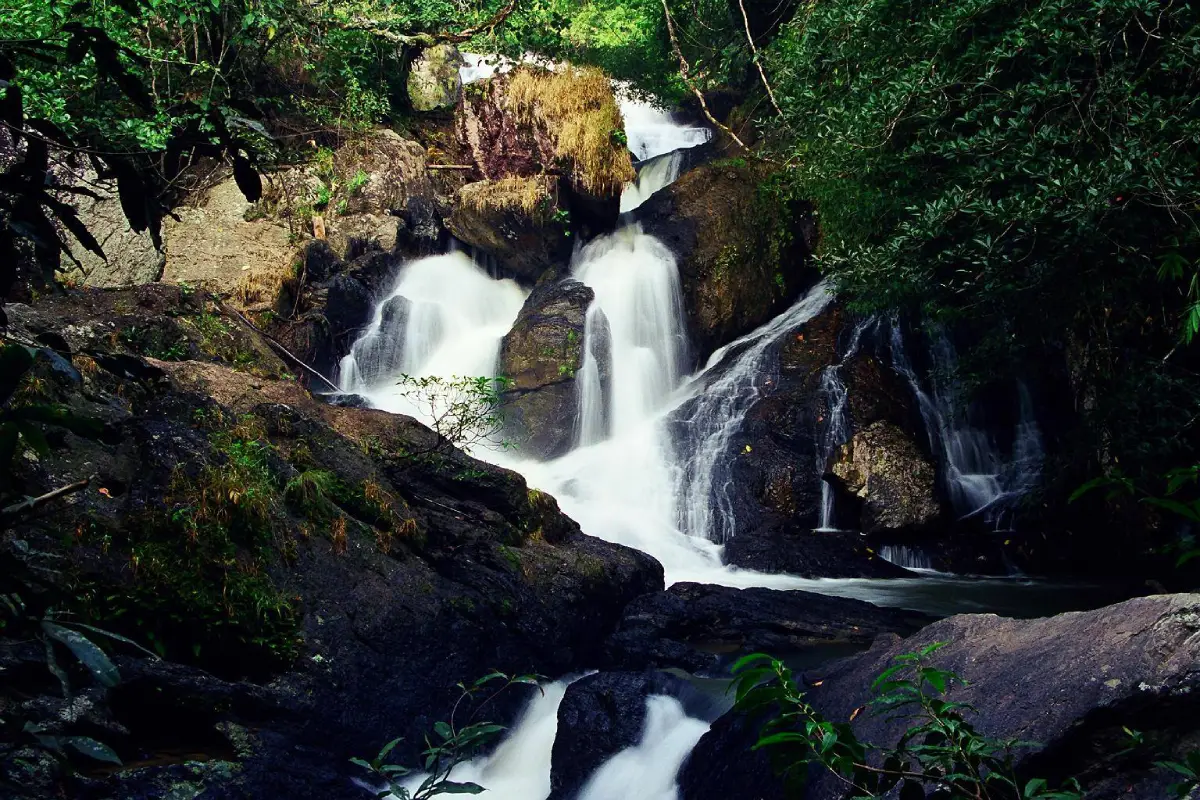
Pha Kluai Mai Waterfall in Nakhon Ratchasima is a medium-sized waterfall inside Khao Yai National Park. It lies along Lam Takhong Stream, about 7 km from the Khao Yai Visitor Center. The waterfall is known for layered rock cascades, a broad pool below the fall, shaded rainforest scenery, and the red dendrobium orchid that grows on cliffs and tree branches around the waterfall. From Pha Kluai Mai, travelers can continue on a 3 km nature trail to Haew Suwat Waterfall, making it one of the most rewarding short hiking routes in Khao Yai.
Pha Kluai Mai Waterfall is one of the most distinctive waterfalls in Khao Yai National Park, Nakhon Ratchasima Province. It is located in the Lam Takhong watershed, a major stream system flowing through the forested interior of the park. Compared with the dramatic height of Haew Narok Waterfall or the broad curtain-like view of Haew Suwat Waterfall, Pha Kluai Mai offers a more intimate and detailed nature experience. Its charm comes from shaded forest, flowing water, layered rocks, orchids, mosses, ferns, birds, butterflies, and a walking route that lets visitors experience Khao Yai at a slower pace.
The name “Pha Kluai Mai” literally refers to an orchid cliff. This name reflects the natural character of the waterfall area, where wild orchids grow on cliffs and tree branches. The most iconic orchid associated with the waterfall is the red dendrobium orchid, locally known as wai daeng. When in bloom, its red flowers add a vivid natural accent to the humid green environment around the waterfall. This orchid has become the symbol of Pha Kluai Mai and one of the main reasons many travelers remember the site even after visiting other waterfalls in the park.
The waterfall is formed by the water of Lam Takhong Stream flowing over natural rock layers. The cascade is approximately 10 meters high, and the water descends step by step through the rock formations before reaching a broad pool below. The visual beauty of Pha Kluai Mai is not based on a single powerful vertical drop, but on the gentle rhythm of water moving across rocks, the darker tones of wet stone, and the green texture of moss and plants around the stream. This creates a quiet, balanced atmosphere that appeals to travelers who enjoy subtle natural scenery.
Pha Kluai Mai is best experienced as a nature-viewing and short hiking destination. The official visitor information for Khao Yai National Park identifies the site as suitable for sightseeing, photography, and nature walking, while swimming is not permitted. This distinction is important for foreign travelers who may expect waterfalls in Thailand to allow bathing. At Pha Kluai Mai, the focus is on observing the waterfall, walking through the forest, appreciating the stream ecosystem, and respecting the protected national park environment.
The path to the waterfall is part of what makes the destination special. Pha Kluai Mai is about 7 km from the Khao Yai Visitor Center. Visitors can reach the area by car and then continue on foot for around 1 km from the Pha Kluai Mai campsite area or parking point. The walking route follows Lam Takhong Stream through a shaded forest with large trees, humid air, and dense vegetation. Although the distance is not long, the path can be damp and slippery, especially during the rainy season. Proper footwear makes the visit safer and more comfortable.
Along the walking route, travelers can observe many small details that reveal the richness of Khao Yai’s ecosystem. The area is home to forest birds, insects, butterflies, reptiles, and streamside plants. Birdwatchers may find the route especially interesting because the official park information mentions species such as hornbills, the slaty-backed forktail, the black-throated laughingthrush, and other forest birds along the area. The stream corridor also provides habitat for smaller wildlife and reptiles, including water dragons that may appear on sunlit rocks near the stream.
The route from Pha Kluai Mai to Haew Suwat Waterfall is one of the well-known short nature trails in Khao Yai National Park. The trail covers about 3 km one way and takes approximately 2 hours. It begins at the Pha Kluai Mai campsite area and ends at Haew Suwat Waterfall. According to the park’s trail information, a guide is not required for this route. For visitors who want to go beyond simply viewing a waterfall from a roadside stop, this trail offers a deeper experience of Khao Yai’s forest, stream, and terrain.
Walking from Pha Kluai Mai to Haew Suwat allows travelers to understand how the stream system connects different waterfalls in the park. Instead of seeing each waterfall as an isolated attraction, visitors experience the continuity of Lam Takhong Stream, forest shade, rock formations, and riparian vegetation. The route passes through a living forest environment, where the sounds of water, birds, insects, and moving leaves become part of the journey. For many nature-focused travelers, the trail itself is as meaningful as the destination.
The geology of Pha Kluai Mai also adds depth to the experience. Khao Yai National Park explains that the waterfall developed through natural erosion involving volcanic rocks. The rock at Pha Kluai Mai is associated with rhyolite and visible flow-banding features formed by ancient lava. Over a long period of time, running water eroded cracks, joints, and rock structures, shaping the waterfall, rapids, pools, and moist habitats around the stream. This geological background explains why the rock surfaces and water channels at Pha Kluai Mai have such distinctive forms.
For visitors interested in botany, Pha Kluai Mai is a valuable site for observing epiphytes and moisture-loving plants. Wild orchids, ferns, mosses, and lichens depend on humidity, shaded tree trunks, rock surfaces, and flowing water. These plants help create the layered green character of the waterfall area. Observing them closely turns a simple waterfall visit into a small lesson in tropical forest ecology, showing how water, rock, shade, and plant life interact in a protected rainforest environment.
The best season to visit depends on what travelers want to see. The rainy season and early cool season are the best periods for stronger water flow and lush green forest scenery. During this time, the waterfall looks more active and the surrounding vegetation becomes fresh and dense. The dry season offers a different experience, especially for visitors hoping to see the red dendrobium orchid in bloom between February and April. The waterfall may have less water during drier months, but the orchid and forest details can still make the area rewarding.
Travelers should treat Pha Kluai Mai as a protected natural area rather than a casual picnic site. The rocks can be slippery, the forest environment is sensitive, and wildlife uses the stream and surrounding trees as habitat. Visitors should stay on designated paths, avoid climbing on unsafe rocks, keep noise low, take all trash out, and avoid disturbing plants or animals. These actions help preserve both the waterfall and the broader ecological integrity of Khao Yai National Park.
Pha Kluai Mai also has a strong connection with the camping culture of Khao Yai. The name is widely associated with the Pha Kluai Mai campsite area and the trailhead to Haew Suwat. Current overnight stays inside the national park must follow the official booking system and the campsite areas opened by the park. The official camping fee is 30 baht per adult per night and 10 baht per child per night for approved camping areas. Travelers who want to camp should book through the national park accommodation system and follow park rules on noise, lighting, cleanliness, food storage, and wildlife safety.
The early morning atmosphere around Khao Yai’s camping areas is one of the memorable experiences for nature travelers. Cool air, soft light, bird calls, and the movement of wildlife around open grassy areas create a very different mood from a standard hotel stay. Visitors who wake early may see birds perching on trees around the camping zone and may hear the forest becoming active before the day’s visitors arrive. This is one reason why many travelers remember Pha Kluai Mai not only as a waterfall, but also as part of a broader forest camping experience.
For travelers coming from Bangkok or nearby provinces, the most practical route is to travel to Pak Chong District, Nakhon Ratchasima, then enter Khao Yai National Park through the Chao Por Khao Yai Shrine Gate on Thanarat Road. After paying the national park entrance fee, visitors continue along the internal park road toward the visitor center and the waterfall area. A private car or rental car is the most convenient option because public transport does not operate comprehensively inside the park. Travelers relying on train or bus connections to Pak Chong should arrange local transport before entering the park.
A half-day itinerary for Pha Kluai Mai can begin at the Khao Yai Visitor Center, where travelers can check the day’s conditions, use facilities, and prepare for the walk. From there, continue by car to the Pha Kluai Mai area, walk approximately 1 km to the waterfall, spend time photographing and observing the stream environment, and then return to the starting point. Travelers with more time and energy can continue on the 3 km trail to Haew Suwat Waterfall, allowing at least 2 extra hours for walking, resting, and returning or arranging transport at the end of the route.
What makes Pha Kluai Mai especially suitable for foreign travelers is that it represents Khao Yai’s quiet side. Many first-time visitors know Khao Yai for wildlife, scenic viewpoints, and famous waterfalls. Pha Kluai Mai offers a more detailed view of the same national park: a streamside forest, orchids, rocks shaped by water, a short trail, and a living ecosystem that rewards patient observation. It is not a place for rushing. It is a place to walk slowly, listen carefully, and notice what grows, flies, flows, and moves around the stream.
Families can also enjoy Pha Kluai Mai, provided they approach it as a nature walk rather than a swimming trip. Children can learn about forest plants, water flow, insects, birds, and responsible national park behavior. Parents should supervise children closely, especially near wet rocks and stream edges. Turning the visit into a simple nature-learning experience makes the trip more meaningful and helps younger travelers understand that national parks are living habitats, not amusement areas.
Photographers will find Pha Kluai Mai useful for close-up nature images and atmospheric forest scenes. Interesting subjects include water flowing over layered rock, moss-covered stones, wild orchids, tree roots, stream curves, butterflies, and filtered light through the forest canopy. Morning light is especially useful for soft forest photography. After rain, the rocks and plants become more vivid, but camera equipment should be protected from moisture and visitors should not leave safe areas just to capture a difficult angle.
Pha Kluai Mai can be combined with several nearby attractions inside Khao Yai National Park. The most direct continuation is Haew Suwat Waterfall via the 3 km nature trail. Other suitable stops include the Khao Yai Visitor Center, Kong Kaeo Waterfall, Sai Sorn Reservoir, Nong Phak Chi Wildlife Watchtower, and the Km. 30 Viewpoint. With one full day, travelers can build an itinerary around the visitor center, Pha Kluai Mai, Haew Suwat, and one viewpoint. With an overnight stay, early morning birdwatching and night safari activities can add more depth to the trip.
Food and accommodation options can be divided into services inside the park and services outside the park. Inside the park, facilities are simpler and closer to nature, with food, drinks, toilets, parking, campsites, and official visitor services in designated areas. Outside the park, especially around Mu Si, Pak Chong, and Thanarat Road, travelers will find more restaurants, cafes, hotels, and resorts. The best choice depends on the travel style. Nature-focused travelers may prefer staying inside or close to the park, while travelers seeking comfort and dining options may prefer accommodation in Mu Si.
In conclusion, Pha Kluai Mai Waterfall is one of the most worthwhile nature stops in Khao Yai National Park for travelers who want more than a quick photo stop. It combines a medium-sized waterfall, Lam Takhong Stream, red orchids, shaded forest, birdlife, volcanic rock formations, a short hiking trail, and access to Haew Suwat Waterfall in one route. With proper timing, respectful behavior, and enough time to walk and observe, Pha Kluai Mai offers a quiet but memorable encounter with the living forest of Khao Yai.
| Name | Pha Kluai Mai Waterfall |
| Location | Khao Yai National Park, Pak Chong District, Nakhon Ratchasima Province, Thailand |
| Address | Khao Yai National Park, P.O. Box 9, Pak Chong Post Office, Mu Si Subdistrict, Pak Chong District, Nakhon Ratchasima 30130, Thailand |
| Highlights | Medium-sized waterfall on Lam Takhong Stream, red dendrobium orchids, shaded rainforest, short hiking route, and the 3 km trail to Haew Suwat Waterfall |
| History / Importance | An important waterfall within the Lam Takhong stream system of Khao Yai National Park, valued for forest ecology, orchid habitat, short nature trails, and tropical streamside biodiversity |
| Name Origin | The name refers to wild orchids growing on cliffs and tree branches around the waterfall, especially the red dendrobium orchid that symbolizes the site |
| Distinctive Features | Water cascades over layered rocks about 10 meters high, with a broad pool below, mossy stones, humid forest, ferns, orchids, and shaded streamside vegetation |
| Travel Information | Located about 7 km from the Khao Yai Visitor Center. Visitors can travel by car to the Pha Kluai Mai area and continue on foot for about 1 km along Lam Takhong Stream. |
| Current Status | Open for visits during Khao Yai National Park operating hours. Use of trails and activities must follow national park regulations. |
| Open Days | Daily |
| Opening Hours | Park gate access 06.00 – 18.00 / Visitor information 08.30 – 16.30 |
| Fees | Khao Yai National Park entrance fee: Thai adults 40 baht, Thai children 20 baht / Foreign adults entering through Pak Chong or Noen Hom gates 400 baht, foreign children 200 baht / Motorcycle 20 baht, 4-wheel car 30 baht, 6-wheel vehicle 100 baht, vehicle over 6 wheels but not over 10 wheels 200 baht |
| Camping Fee In The Park | Adults 30 baht/person/night and children 10 baht/person/night for campsite areas officially opened by the national park booking system |
| Facilities | Toilets, parking, restaurants, convenience stores, and official visitor service points in designated areas of the national park |
| Main Areas / Zones | Walking route from the Pha Kluai Mai area to the waterfall, about 1 km Waterfall viewing zone and layered rock cascade Lam Takhong Stream and natural pool zone Red dendrobium orchid viewing area on cliffs and tree branches Pha Kluai Mai – Haew Suwat Nature Trail, about 3 km Camping and overnight areas opened through the official park booking system |
| Caretaker | Khao Yai National Park, Department of National Parks, Wildlife and Plant Conservation / Head of Khao Yai National Park: Mr. Chaiya Huaihongthong |
| Main Contact Number | Khao Yai National Park Office Tel. 086-092-6527 / Visitor Center Tel. 086-092-6529 / Chao Por Khao Yai Shrine Gate Tel. 086-092-6531 |
| Official Website / Official Page | khaoyainationalpark.com / Khao Yai National Park Official Page |
| Nearby Tourist Attractions | 1. Pha Kluai Mai – Haew Suwat Nature Trail, about 3 km, Visitor Center Tel. 086-092-6529 2. Haew Suwat Waterfall, about 3 km, Visitor Center Tel. 086-092-6529 3. Khao Yai Visitor Center, about 7 km, Tel. 086-092-6529 4. Kong Kaeo Waterfall, about 7 km, Visitor Center Tel. 086-092-6529 5. Sai Sorn Reservoir, about 9 km, Visitor Center Tel. 086-092-6529 6. Nong Phak Chi Wildlife Watchtower, about 12 km, Visitor Center Tel. 086-092-6529 7. Km. 30 Viewpoint, about 14 km, Visitor Center Tel. 086-092-6529 |
| Nearby Restaurants | 1. Restaurants And Drink Shops Inside Khao Yai National Park, about 1 km, Visitor Center Tel. 086-092-6529 2. Restaurants Around Khao Yai Visitor Center, about 7 km, Tel. 086-092-6529 3. The Chocolate Factory Khao Yai, about 25 km, Tel. 092-443-8881 4. Midwinter Khaoyai, about 30 km, Tel. 082-452-8888, 098-414-4199 5. Kuni Kuni At dusitD2 Khao Yai, about 32 km, Tel. 044-003-000 6. Bucolic Khaoyai, about 34 km, Tel. 065-669-5497 |
| Nearby Accommodations | 1. Lam Takhong Campsite, Khao Yai National Park, about 4 km, Visitor Center Tel. 086-092-6529 2. Khao Yai National Park Bungalows Around Visitor Center / Kong Kaeo Camp Zone, about 7 km, Tel. 086-092-6529 3. Kirimaya / Muthi Maya Khao Yai, about 31 km, Tel. 044-426-000 4. dusitD2 Khao Yai, about 32 km, Tel. 044-003-000 5. Thames Valley Khao Yai, about 33 km, Tel. 044-009-999 6. Lacol Khao Yai - A Chatrium Collection, about 34 km, Tel. 044-001-896 |
Frequently Asked Questions (FAQ)
Q: Where is Pha Kluai Mai Waterfall located?
A: Pha Kluai Mai Waterfall is located inside Khao Yai National Park in Pak Chong District, Nakhon Ratchasima Province, about 7 km from the Khao Yai Visitor Center.
Q: Is Pha Kluai Mai Waterfall open every day?
A: Yes. It is open during Khao Yai National Park gate hours, from 06.00 to 18.00 daily, with all activities subject to national park regulations.
Q: Is there an entrance fee for Pha Kluai Mai Waterfall?
A: The waterfall is inside Khao Yai National Park, so visitors pay the national park entrance fee. Thai adults pay 40 baht and Thai children pay 20 baht. Foreign adults entering through Pak Chong or Noen Hom gates pay 400 baht and foreign children pay 200 baht. Vehicle fees are charged separately.
Q: What is Pha Kluai Mai Waterfall famous for?
A: It is famous for Lam Takhong Stream, layered rock cascades, shaded forest, the red dendrobium orchid, birdwatching opportunities, and the nature trail connecting it with Haew Suwat Waterfall.
Q: Can travelers hike from Pha Kluai Mai to Haew Suwat Waterfall?
A: Yes. The Pha Kluai Mai – Haew Suwat Nature Trail is about 3 km one way and takes around 2 hours. The route starts at the Pha Kluai Mai campsite area and ends at Haew Suwat Waterfall.
Q: Is swimming allowed at Pha Kluai Mai Waterfall?
A: No. The official visitor information identifies Pha Kluai Mai as a place for sightseeing, photography, and nature walking, and swimming is not permitted.
Q: When is the best time to visit Pha Kluai Mai Waterfall?
A: The rainy season to early cool season is best for stronger water flow and lush forest scenery, while February to April is the best period to see the red dendrobium orchid in bloom.
Q: Who should visit Pha Kluai Mai Waterfall?
A: It is ideal for travelers who enjoy short hikes, rainforest scenery, birdwatching, orchids, nature photography, and quieter areas of Khao Yai National Park.
 Category: ●Nature and Wildlife
 Group: ●Waterfalls
Last Update : 3 MonthAgo
 Last Update : 3 MonthAgo
 Click to Access the Navigation Map GPS
Pha Kluai Mai Waterfall Map
Recommend

 Art, Culture and Heritage
 Historical Sites and Monuments(20)
 Landmarks and Memorials(5)
 Art, Craft Centres, Tradition(7)
 Museums(6)
 Art Gallery(1)
 Educational Places
 Educational Gardens, Farm(4)
 Places of Worship
 Temple(29)
 Mosque(1)
 Other Sacred Sites(6)
 Research and Development
 Royal Project(3)
 Suburban Living
 Village, Community(6)
 Local Market(4)
 Floating Market(1)
 National Parks and Marine Reserves(3)
 Mountain (Doi)(5)
 Dam, Reservoir, Lake(8)
Waterfalls(9)
Dam, Reservoir, Lake(8)
Waterfalls(9)
 Hot Springs(1)
 Caves(2)
 Flower Field(1)
 River, Canal(8)
 Bays and Beaches(2)
 Other natural attractions(3)
 Entertainment and Agricultural
 Zoos and Aquariums(2)
 Animal camps and shows(1)
 Farms, Parks and Ecotourism(21)
 Waterpark(4)
 Outdoor and Adventure Activities(6)
 Shopping
 Shopping and Night Market(2)
 Travel Articles, Recipes
 Travel Review, Food Review(6)


