
lovethailand home >Northeastern Travel Attractions >Nakhon Phanom Travel Attractions >Muang Nakhon Phanom >Nai Muang > Nakhon Phanom City Pillar Shrine
TL;DR: Nakhon Phanom City Pillar Shrine is located at In front of the Nakhon Phanom Provincial Administrative Organization, opposite Nakhon Phanom Provincial Hall on Aphiban Bancha Road, open Daily, hours 07:00 – 20:00.
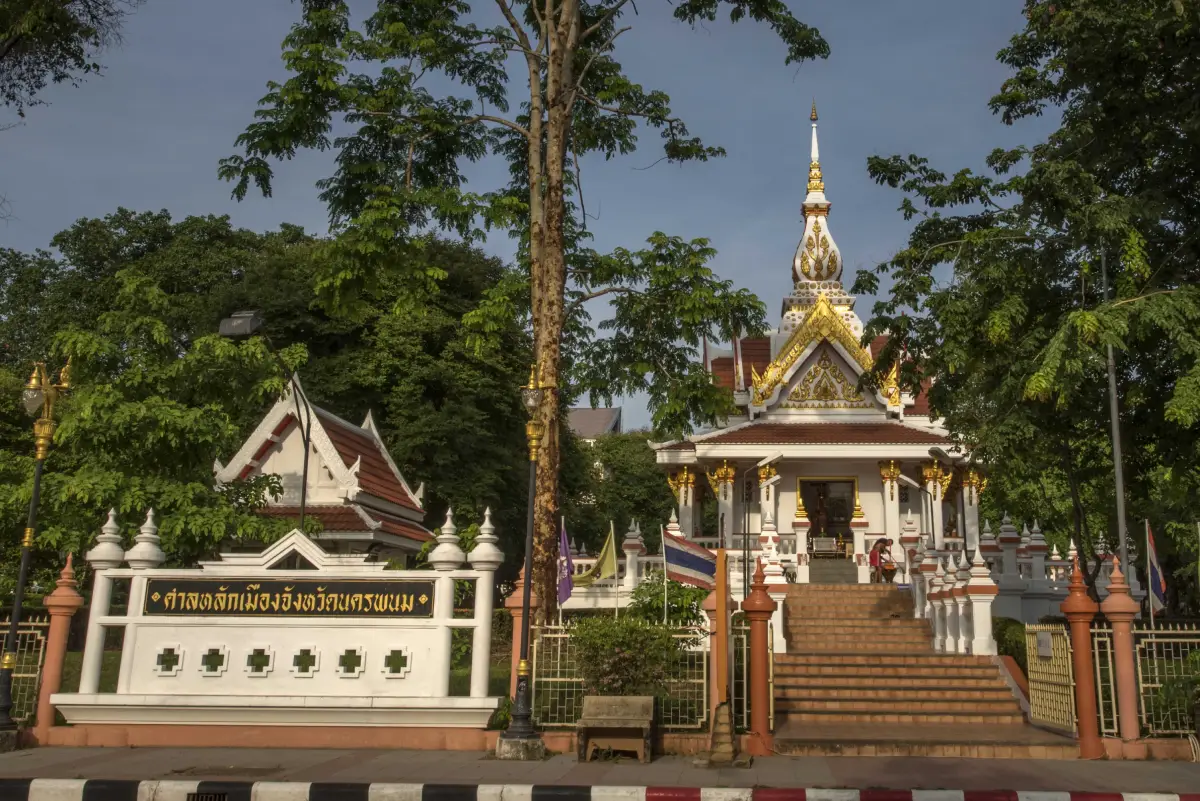
Nakhon Phanom City Pillar Shrine
Open Days: Daily
Opening Hours: 07:00 – 20:00
Nakhon Phanom City Pillar Shrine is a major spiritual landmark and civic shrine in the center of Nakhon Phanom. It stands on Aphiban Bancha Road in front of the Nakhon Phanom Provincial Administrative Organization, directly opposite Nakhon Phanom Provincial Hall and next to the H.M. Queen Sirikit National Library. Nakhon Phanom was formerly one of the Thai provinces without an official provincial city pillar shrine. The current monument was consequently established as a sacred home for the city pillar, an auspicious symbol of the province and a shared spiritual center for local residents. The shrine is open to residents and travelers every day from 07:00 to 20:00, with no admission fee.
The most distinctive feature is the applied Thai-style pavilion with a four-sided or cruciform plan. Rising to a height of 17.05 meters, the building is crowned by a pinnacle inspired by the form of Phra That Phanom, the most revered stupa and one of the principal cultural symbols of Nakhon Phanom Province. This design gives the shrine an identity clearly different from city pillar shrines elsewhere in Thailand. It also expresses the close connection between the civic tradition of the city pillar and the Buddhist faith of communities throughout the Mekong region. Inside the pavilion stands a pillar made from Tembusu, locally known as Kan Krao or Man Pla wood, the official provincial tree of Nakhon Phanom.
The shrine is not used only for individual prayers. It also functions as a venue for important provincial ceremonies. Governors, public officials, representatives of private organizations and residents commonly gather here to perform worship ceremonies before major festivals and official events. These include the Illuminated Boat Procession, the Nakhon Phanom Red Cross Fair, tourism activities and ceremonies marking the assumption of public office. Its continued use for provincial events demonstrates that the city pillar shrine remains a living sacred space closely connected with the administration and daily life of the province.
The history of the shrine begins with the fact that Nakhon Phanom did not previously possess an officially designated provincial city pillar, despite the long history of the settlement and the presence of many important temples and sacred monuments. The project was created to provide the province with a place for ceremonies associated with the traditional foundation of a city and a spiritual point of unity for residents from different communities. In 1992, the construction initiative began under a broader policy encouraging provinces to establish city pillars appropriate to their local histories, landscapes and cultural identities.
Creating a city pillar shrine involved much more than erecting a building. The project required careful consideration of the location, architectural design, selection of timber for the pillar and performance of ceremonies in accordance with tradition. The site on Aphiban Bancha Road was selected because it lies within the provincial government district, close to both the current Provincial Hall and the Provincial Administrative Organization. The location connects the city pillar with the concepts of stability, orderly administration and public responsibility, while remaining close to the historic town and several architecturally important buildings.
Thailand’s Fine Arts Department participated in designing the pavilion to harmonize with the local arts of Nakhon Phanom. The resulting structure is an applied Thai pavilion with projecting façades on all four sides, allowing the pillar to be approached and viewed from several directions. Its symmetry creates an impression of balance, permanence and dignity. The pinnacle adapts the recognizable profile of Phra That Phanom to represent the cultural and religious roots of the province. Rather than copying the original monument exactly, the architects selected visual elements that immediately communicate a sense of Nakhon Phanom.
At 17.05 meters high, the building is sufficiently prominent to serve as a landmark without overpowering the government and heritage architecture around it. The layered Thai roof, four projecting sides and Phra That Phanom-inspired pinnacle form a clear architectural rhythm visible from Aphiban Bancha Road. When viewed from Provincial Hall, the shrine acts as a visual focus for the government district. Morning and late-afternoon light emphasize the rooflines and upper pinnacle, making the pavilion one of the most interesting architectural photography locations in central Nakhon Phanom.
The sacred center of the shrine is the city pillar made from Tembusu wood, known in Thai as Kan Krao or Man Pla. The species was chosen because Kan Krao is the provincial tree of Nakhon Phanom and its Thai name is regarded as auspicious. Tembusu is a perennial tree found in several parts of northeastern Thailand. Its durable timber was traditionally used for construction and household objects. Selecting it for the city pillar therefore combined a suitable physical material with a powerful botanical symbol of the province.
The search for an appropriate Kan Krao tree extended across several areas of Nakhon Phanom, including Na Kae, Tha Uthen and other districts. A suitable tree was eventually identified beside the Tha Dok Kaeo–Si Song Khram route near Ban Patirup in Si Song Khram District. A ceremonial cutting and invitation of the tree took place on October 21, 1995, at 11:39. Provincial administrators, officials and residents participated in the occasion. The ceremony reflected respect for nature and the belief that timber intended to become a sacred civic pillar should be obtained with solemnity and auspicious rites.
The pillar has a total length of 4.675 meters. A section measuring 1.975 meters is embedded beneath the ground, while 2.70 meters remains visible above the surface. The exposed section is equivalent to approximately 108 inches. The number 108 is connected with a traditional concept of 108 auspicious qualities found in Thai and Buddhist culture. The proportions therefore respond not only to structural requirements but also to ideas of completeness, abundance and good fortune for the province.
After the timber and building had been prepared, the city pillar was ceremonially installed on September 25, 1996. This date marked the completion of Nakhon Phanom’s official provincial city pillar shrine. The event was significant in the province’s modern history because it created a shared sacred institution through the cooperation of public authorities, religious figures, community leaders, merchants and residents. Since its installation, the shrine has continuously served as a place of worship and an official ceremonial site.
The Phra That Phanom-inspired pinnacle carries meaning beyond decorative beauty. Phra That Phanom has been the principal focus of devotion for people in Nakhon Phanom and communities on both banks of the Mekong for generations. Its form communicates sacredness, continuity and regional unity. Placing a related architectural profile above the city pillar shrine establishes a direct visual link with the province’s most recognizable religious monument and affirms Nakhon Phanom’s identity within the wider Mekong cultural landscape.
Aphiban Bancha Road connects the shrine with the government district and the historical center of the city. The site is within easy reach of the Mekong riverside, Sunthon Wichit Road, the Vietnamese Memorial Clock Tower, the walking-street district and groups of old buildings reflecting Nakhon Phanom’s development as a border city. A visit to the city pillar can therefore become the starting point for a walking tour of the old town, colonial-influenced architecture and communities shaped by Thai, Lao, Vietnamese and other ethnic traditions.
Immediately beside the shrine stands the H.M. Queen Sirikit National Library. This building formerly served as Nakhon Phanom Provincial Hall and was constructed in 1915. Its three-storey design combines Thai and French colonial influences, with masonry walls and wooden floors and stairways. The Fine Arts Department later restored the property for use as a national library, and the building received recognition for architectural conservation. Seeing the library together with the city pillar allows visitors to understand the relationship between the former seat of provincial administration and the modern government district.
The shrine grounds can be understood through several functional areas. The most important is the four-sided Thai pavilion and the city pillar at its center. Other areas include the front worship courtyard, offering points and incense containers, walkways around the pavilion, shaded garden spaces and the Mahesak City Guardian Shrine associated with local beliefs concerning protectors of the city. The grounds are compact and can normally be explored in approximately 30–45 minutes. Visitors wishing to sit quietly or examine the architectural details should allow additional time.
The pavilion containing the pillar is the area where silence and restraint are most important. Visitors should remove hats, reduce the volume of phones and avoid standing directly in front of people who are praying. They should not touch, lean against or place personal objects on the city pillar or its base. When an official ceremony is taking place, travelers should remain outside temporary barriers and follow instructions from provincial personnel. Respectful conduct allows visitors of different beliefs to share the sacred space appropriately.
The front courtyard is normally used for offerings and provides space for participants during important ceremonies. On an ordinary day, it is an open area from which visitors can view and photograph the architecture. During a worship ceremony, tables of ritual offerings may be arranged for Brahmin officiants, provincial administrators, public servants and residents. Travelers should not walk between ceremonial participants or move any offerings. Although the shrine is easy to access in the middle of the city, it should be treated with the same respect as an important religious site whenever a ceremony is underway.
The Mahesak City Guardian Shrine within the grounds is associated with local traditions concerning supernatural protectors of Nakhon Phanom. Some residents connect the place with Chao Pho Sammati, regarded in local belief as a guardian associated with the historic settlement of Marukkha Nakhon. This tradition illustrates the way local respect for ancestral spirits and civic guardians has become integrated with Buddhist and Brahmanical practices. Visitors may pay respect according to personal belief without participating in an elaborate ritual.
Beliefs surrounding city pillars generally emphasize stability, peace and the orderly condition of the community. Individual worshippers frequently pray for professional progress, family security, successful business, protection during travel and a favorable beginning to new responsibilities. Public servants and people beginning work in Nakhon Phanom may visit the shrine to acknowledge the province’s sacred landmark and pray for a smooth and responsible life in their new community.
Prayer at the city pillar is best understood as a cultural and spiritual practice that provides encouragement while reminding worshippers of their responsibilities. A prayer for professional success should be accompanied by honesty, the development of useful skills and fair treatment of colleagues. A request for family stability should encourage care, communication and thoughtful solutions to difficulties. Faith becomes more meaningful when it leads to constructive action in daily life.
Common offerings include three incense sticks, one candle, fresh flowers or a marigold garland. Some worshippers also prepare silk cloth or seven-colored fabric for attachment at a specifically designated external point. Fabric should not be tied directly to the actual city pillar or architectural elements without permission. A complete offering set is not required. Visitors may simply place their palms together, calm their minds and express a respectful prayer.
A simple worship sequence begins by arranging offerings neatly and lighting incense or a candle only at the designated point. The worshipper may then sit or stand facing the city pillar, recite Namo Tassa three times and respectfully recall the Triple Gem, the sacred guardians of the city and those believed to protect Nakhon Phanom. The person may state their name and make a clear, concise aspiration. Packaging, incense wrappers and plastic should be removed afterward rather than left as devotional objects.
People visiting before beginning a new position or important project may pray for the wisdom and integrity to fulfill their duties, rather than seeking only personal advancement. This approach is consistent with the symbolic meaning of the city pillar as a representation of stability and unity among residents. A prayer connected with public responsibility gives the ceremony a broader and more meaningful purpose.
When a prayer has been fulfilled, worshippers may return with flowers or a garland, or express gratitude by supporting a community activity. Large quantities of offerings and waste-producing materials are unnecessary. Anyone planning an elaborate offering ceremony, a dance performance or another organized activity should first coordinate with Nakhon Phanom Provincial Office or personnel responsible for the site. This prevents damage to the building and disruption to traffic or other visitors.
Modest clothing is appropriate even though the shrine does not impose the same strict entry rules as a royal temple. Shirts should cover the shoulders, while trousers or skirts should be of a suitable length. Clothing printed with offensive images or messages should be avoided. People arriving while exercising or cycling should make their appearance orderly before entering the pavilion. Respectful behavior is more important than wearing expensive or ceremonial clothing.
Parents should prevent children from running on the steps, climbing the base or touching offerings. The shrine provides a useful opportunity to teach local history. Adults can explain how a city pillar symbolizes settlement and stability, why Kan Krao wood was selected and why the roof pinnacle resembles Phra That Phanom. Learning through the actual site allows young visitors to understand local history more clearly than memorizing isolated facts.
International visitors are welcome regardless of religion. They should remove hats, speak quietly and avoid posing with their backs pressed against the sacred pillar. Photography from the outer courtyard is normally acceptable, but visitors should maintain a respectful distance when people are praying or an official ceremony is taking place. Describing the place as both a civic shrine and a spiritual landmark helps foreign travelers understand the role of a city pillar within Thai society.
The most comfortable visiting periods are approximately 07:00–09:00 and 16:00–19:00. Morning is peaceful and suitable for worship before beginning the day, while late afternoon and early evening provide attractive light and convenient access to the Mekong riverside, the clock tower and walking-street district. The shrine can also be visited at midday, although a hat or umbrella is useful during the hotter months.
The cool season from November to February is particularly suitable for exploring central Nakhon Phanom on foot. Morning and evening temperatures are generally pleasant, allowing visitors to walk from the city pillar to the National Library, Suan Chom Khong, the clock tower and the historic district. During New Year, the Illuminated Boat Procession and long holiday periods, visitor numbers increase and parking around the government center fills earlier than usual.
From March to May, temperatures are high, especially between 11:00 and 15:00. Elderly visitors and children should avoid remaining outdoors for extended periods. During the rainy season, care is required on wet steps and paved surfaces. Although the pavilion is roofed, parts of the courtyard and walkways are exposed to rain. A compact umbrella and footwear with a secure grip are useful.
Photography enthusiasts can obtain a full view of the four-sided pavilion from the Provincial Hall side of the road. Another useful position is beside the National Library, where the composition can include both the city pillar shrine and the colonial-influenced heritage building. Such photographs demonstrate the coexistence of several architectural periods in Nakhon Phanom. Morning provides soft light, while the upper pinnacle is often clearly illuminated in the late afternoon.
Drones should not be flown over the city pillar shrine, Provincial Hall or government offices without authorization, as the area may be subject to official security restrictions. Large tripods should not block steps or entrances. Commercial photography, documentary production or filming involving a large team should be arranged in advance with Nakhon Phanom Provincial Office so that work does not interfere with public administration or ceremonies.
The shrine is open every day from 07:00 to 20:00 and charges no admission fee. Individual visitors can enter without advance booking. Organized groups, formal ceremonies, dance troupes and professional filming teams should notify the coordinating authority beforehand. Access to a particular section may be temporarily organized differently when the province conducts a major ceremony.
The principal coordinating authority is Nakhon Phanom Province through Nakhon Phanom Provincial Office, since the shrine stands within the government district and is used for provincial ceremonies. Questions concerning formal ceremonies or use of the site can be directed to the Provincial Office at 042-511-287, 042-511-574 or 042-532-888. The nearby Nakhon Phanom Provincial Administrative Organization can be contacted at 042-512-955.
Roadside parking and government parking areas are available at permitted locations around the shrine. On weekday mornings, many people visit nearby offices, so drivers should avoid entrances, official spaces and traffic lanes. Parking is often easier in the evening or on holidays, except during provincial events. Temporary signs and instructions from traffic personnel should always be followed.
The surrounding area is relatively level and manageable for elderly visitors, although steps and raised thresholds occur at the pavilion. Wheelchair users may require assistance or may worship from the courtyard when access to the interior is difficult. Elderly passengers can be dropped close to the entrance before the vehicle is moved to an approved parking space. Morning visits reduce heat exposure and traffic congestion.
Getting There from Nakhon Phanom Airport involves a journey of approximately 18 kilometers and normally takes 25–30 minutes by car. Travelers can use a taxi, rental vehicle or prearranged transfer and should identify the destination as “Nakhon Phanom City Pillar Shrine on Aphiban Bancha Road, opposite Provincial Hall.” The shrine is approximately 4 kilometers from Nakhon Phanom Bus Terminal, a drive of around 10–15 minutes.
Drivers can enter central Nakhon Phanom via Chayangkun Road and turn onto Aphiban Bancha Road. The shrine stands in front of the Provincial Administrative Organization and opposite Provincial Hall. Its Thai pavilion and Phra That Phanom-inspired pinnacle are easily recognizable. The approximate coordinates are 17.408183, 104.780515. Driving from the Phaya Si Sattanakharat landmark normally takes around 5–10 minutes depending on traffic.
Travelers staying in the historic center can walk or cycle to the shrine. Roads around the government district connect with Suan Chom Khong and the Mekong promenade. Distances are short, but care is required when crossing intersections. Morning and evening are more comfortable for walking than midday. Bicycles should be parked where they do not obstruct pedestrians and should not be leaned against the shrine building or railings.
A short itinerary can begin at the City Pillar Shrine, followed by the H.M. Queen Sirikit National Library approximately 0.1 kilometer away and Suan Chom Khong approximately 0.2 kilometer away. This route is suitable for visitors with one or two hours and combines worship, colonial-influenced architecture and a relaxing green space without repeated use of a vehicle.
A half-day route can add the Vietnamese Memorial Clock Tower and Nakhon Phanom Walking Street, both approximately 0.9 kilometer away. The clock tower represents the relationship between the Vietnamese community and Nakhon Phanom, while the walking-street district contains old commercial buildings, restaurants, cafés and local products. On market days, visitors can continue into the evening with food and a walk beside the Mekong.
With a full day, travelers can continue to Wat Okat Si Bua Ban, the Indochina Market and the Phaya Si Sattanakharat landmark. Wat Okat Si Bua Ban is an old temple containing Phra Tio and Phra Thiam, respected Buddha images of the city. The Indochina Market offers goods connected with Thailand, Laos, Vietnam and China, while the riverside naga monument is popular for worship and photography. This itinerary introduces belief, history, trade and contemporary urban life within a single day.
On Friday mornings, the Nakhon Phanom Suk Jai Community Market operates from 07:00 to 12:00 in front of Provincial Hall opposite the shrine. It sells agricultural products, local food and community goods. Visitors arriving during these hours can support local producers after worshipping at the city pillar. Parking regulations should be observed because the government district is busier than on an ordinary day.
Restaurants near the shrine include northeastern Thai, Vietnamese and Mekong fish establishments. Som Tam Khun Tae is approximately 0.6 kilometer away. Champasak Restaurant and Rabiang Khong are each about 0.7 kilometer away, serving Thai dishes and fish. Phon Thep Breakfast Restaurant is about 1.3 kilometers away and is well known for Vietnamese-influenced breakfast dishes, including pan-fried eggs, noodle soup, khao piak sen and Vietnamese pork sausage.
Travelers looking for breakfast may worship at the shrine early and continue to Phon Thep on Si Thep Road, which can be contacted at 093-546-1596. Those seeking an evening meal near the river can consider Rabiang Khong at 092-865-5889. Calling ahead is useful during festivals and long holiday weekends.
Several accommodations are within walking distance. Dalha Renovtel is approximately 0.3 kilometer from the shrine, Nonrada Boutique Hotel is around 0.4 kilometer away and The Nest Hotel is approximately 0.7 kilometer away. Guests staying in this part of the city can walk to the shrine, National Library and historic district without relying on transportation for every journey.
Nonrada Boutique Hotel can be contacted at 095-695-8789, while The Nest Hotel can be reached at 092-858-5559. Travelers seeking larger hotels near the Mekong may consider Fortune View Khong Nakhon Phanom at 042-513-564 or 083-989-1465, and Fortune River View Nakhon Phanom at 042-522-333 through 042-522-340. Accommodation should be selected according to distance, parking, elevators and the needs of individual travelers.
Visitors without a car benefit from staying near the government district or walking-street area, where several attractions can be reached on foot. Travelers accompanying elderly family members should confirm elevators, ground-floor rooms and convenient parking. Guests wishing for a Mekong view should check the exact room category before booking, since not every room faces the river.
Responsible tourism begins with not leaving waste, lighting incense only at the designated point, avoiding marks on the building and tying fabric only where permitted. Feeding birds or stray animals in the courtyard should be avoided because it can create stains and disturb worshippers. Refillable water bottles and removing personal waste help reduce the burden of maintaining the site.
Visitors can support the local community by eating in independent restaurants, purchasing products at the community market, using registered transport and visiting museums or conservation sites nearby. Distributing time and expenditure across several places ensures that tourism benefits are not concentrated only at major landmarks and supports the preservation of historic architecture, food culture and local knowledge.
The shrine is also suitable for slow travel. Visitors may sit quietly in front of the pavilion, observe its four-sided form and Phra That Phanom-inspired pinnacle, examine the Kan Krao pillar and then walk to the National Library and Suan Chom Khong. Taking time in this way reveals that important urban sites are connected through history, administration, architecture and community life.
The importance of Nakhon Phanom City Pillar Shrine lies both in the pillar and in its urban context. The pillar symbolizes stability, Kan Krao represents the province, the stupa-shaped pinnacle reflects Mekong Buddhist faith, and the location opposite Provincial Hall connects the shrine with civic administration. Together, these elements give the shrine a meaning extending far beyond that of an ordinary place of worship.
Although the shrine was built in the late twentieth century rather than centuries ago, it is valuable evidence of modern provincial identity. The selection of local timber, architectural references to regional art and participation of residents demonstrate how an ancient civic tradition can be adapted to modern society. The city pillar shrine is therefore both a contemporary structure and a continuing expression of older beliefs.
Travelers interested in urban history should compare the shrine with the former Provincial Hall, the National Library, the current Provincial Hall and commercial buildings near the walking street. Each represents a different stage in the development of Nakhon Phanom, from colonial-influenced architecture and modern administration to contemporary public spaces and provincial spiritual identity. Exploring these buildings together creates a clear and continuous picture of the city’s history.
Weather and provincial event announcements should be checked before travel, especially during the Illuminated Boat Procession, the Red Cross Fair and official worship ceremonies. The shrine may retain its normal opening hours, but part of the grounds can be reserved for a ceremony, and parking or traffic routes may be temporarily adjusted. Arriving early and following official directions will provide a more orderly experience.
Nakhon Phanom City Pillar Shrine is therefore an appropriate first stop after arriving in the provincial capital. Travelers may come to pray for professional stability, safe travel and family well-being, or to study local architecture and modern history. Its central location and proximity to multiple attractions make it easy to reach and simple to combine with a wider Mekong riverside itinerary.
From a province that once lacked an official city pillar shrine, Nakhon Phanom created this landmark through cooperation among provincial authorities, the Fine Arts Department and local residents. The Kan Krao pillar represents more than a piece of timber inside a pavilion. It embodies collective effort, hope and attachment to the province. The Phra That Phanom-inspired pinnacle affirms the cultural roots of the Mekong region, while continuing provincial ceremonies preserve the shrine’s role as a spiritual center for the people of Nakhon Phanom.
| Name | Nakhon Phanom City Pillar Shrine |
| Thai Name | ศาลหลักเมืองนครพนม |
| Location | In front of the Nakhon Phanom Provincial Administrative Organization, opposite Nakhon Phanom Provincial Hall on Aphiban Bancha Road |
| Address | Aphiban Bancha Road, Nai Mueang, Mueang Nakhon Phanom, Nakhon Phanom 48000, Thailand |
| Coordinates | 17.408183, 104.780515 |
| Current Status | Open and active as a place of worship and a venue for important provincial ceremonies |
| Construction History | The project began in 1992, and the city pillar was ceremonially installed on September 25, 1996 |
| Design | Designed with assistance from Thailand’s Fine Arts Department to reflect the local arts of Nakhon Phanom |
| Architecture | Applied Thai-style four-sided pavilion, 17.05 meters high, with a pinnacle inspired by Phra That Phanom |
| City Pillar Material | Tembusu or Kan Krao wood, an auspicious species and the provincial tree of Nakhon Phanom |
| City Pillar Dimensions | Total length 4.675 meters, with 1.975 meters beneath the ground and 2.70 meters or approximately 108 inches above the surface |
| Tree Invitation Ceremony | October 21, 1995, at 11:39 |
| Pillar Installation Date | September 25, 1996 |
| Highlights | Kan Krao city pillar, four-sided pavilion with a Phra That Phanom-inspired pinnacle and a location among government and historic buildings |
| Traditional Beliefs | Visitors commonly pray for stability, professional progress, successful business, family well-being, safe travel and peace for the province |
| Main Areas / Zones | 1. Four-sided Thai pavilion 2. Kan Krao city pillar 3. Worship courtyard and offering area 4. Mahesak City Guardian Shrine 5. Garden and shaded areas 6. Walkway connecting to the National Library and Suan Chom Khong |
| Common Offerings | Three incense sticks, one candle, fresh flowers, marigold garlands and seven-colored cloth at the designated point |
| Facilities | Permitted roadside parking, shaded sitting areas, restaurants and shops within walking distance and nearby government offices |
| Open Days | Daily |
| Opening Hours | 07:00 – 20:00 |
| Admission Fee | Free admission |
| Recommended Visiting Time | 07:00–09:00 and 16:00–19:00 |
| Caretaker / Coordinating Authority | Nakhon Phanom Province through Nakhon Phanom Provincial Office and relevant government authorities |
| Contact Numbers | Nakhon Phanom Provincial Office: 042-511-287, 042-511-574, 042-532-888 Nakhon Phanom Provincial Administrative Organization: 042-512-955 |
| Travel Information | Approximately 18 km or 25–30 minutes from Nakhon Phanom Airport and approximately 4 km or 10–15 minutes from Nakhon Phanom Bus Terminal |
| Visitor Etiquette | Dress modestly, remain quiet, do not touch or lean against the city pillar, attach cloth only at designated points and avoid obstructing ceremonies |
| Nearby Tourist Attractions | 1. H.M. Queen Sirikit National Library, about 0.1 km 2. Suan Chom Khong, about 0.2 km 3. Vietnamese Memorial Clock Tower, about 0.9 km 4. Nakhon Phanom Walking Street, about 0.9 km 5. Wat Okat Si Bua Ban, about 1.1 km 6. Phaya Si Sattanakharat Landmark, about 1.4 km |
| Nearby Restaurants | 1. Som Tam Khun Tae Nakhon Phanom, about 0.6 km 2. Champasak Restaurant, about 0.7 km 3. Rabiang Khong Nakhon Phanom, about 0.7 km, Tel. 092-865-5889 4. Phon Thep Breakfast Restaurant, Si Thep Road, about 1.3 km, Tel. 093-546-1596 5. In The Haus, about 2 km, Tel. 096-142-4663, 081-166-9826 |
| Nearby Accommodations | 1. Dalha Renovtel, about 0.3 km 2. Nonrada Boutique Hotel Nakhon Phanom, about 0.4 km, Tel. 095-695-8789 3. The Nest Hotel Nakhon Phanom, about 0.7 km, Tel. 092-858-5559 4. Fortune View Khong Hotel Nakhon Phanom, about 3 km, Tel. 042-513-564, 083-989-1465 5. Fortune River View Hotel Nakhon Phanom, about 3 km, Tel. 042-522-333 to 042-522-340 |
Frequently Asked Questions (FAQ)
Q: Where is Nakhon Phanom City Pillar Shrine located?
A: It is located on Aphiban Bancha Road in front of the Nakhon Phanom Provincial Administrative Organization, opposite Provincial Hall and next to the H.M. Queen Sirikit National Library.
Q: What are the opening hours?
A: The shrine is open daily from 07:00 to 20:00.
Q: Is there an admission fee?
A: Admission is free. Residents and travelers can enter to worship and view the architecture without purchasing a ticket.
Q: What type of wood was used for the Nakhon Phanom city pillar?
A: The pillar is made from Tembusu or Kan Krao wood, an auspicious species and the official provincial tree of Nakhon Phanom. Its total length is 4.675 meters.
Q: When was Nakhon Phanom City Pillar Shrine established?
A: The construction initiative began in 1992, and the city pillar was ceremonially installed on September 25, 1996.
Q: What do people pray for at the city pillar shrine?
A: Common prayers concern stability, professional advancement, successful business, family well-being, new responsibilities, safe travel and peace for the province.
Q: What offerings should visitors prepare?
A: Common offerings include three incense sticks, one candle, fresh flowers or a marigold garland. A complete offering set is not required, and visitors may simply pray respectfully.
Q: Which attractions can be combined with a visit?
A: Nearby places include the H.M. Queen Sirikit National Library, Suan Chom Khong, the Vietnamese Memorial Clock Tower, Nakhon Phanom Walking Street, Wat Okat Si Bua Ban and the Phaya Si Sattanakharat landmark.
 Category: ●Places of Worship
 Group: ●Other Sacred Sites
Last Update : 3 MonthAgo
 Last Update : 3 MonthAgo
 Click to Access the Navigation Map GPS
Nakhon Phanom City Pillar Shrine Map
Recommend

 Art, Culture and Heritage
 Historical Sites and Monuments(3)
 Landmarks and Memorials(2)
 Art, Craft Centres, Tradition(3)
 Museums(3)
 Educational Places
 Library(1)
 Temple(23)
 Church(1)
Other Sacred Sites(11)
 Suburban Living
 Village, Community(5)
 Nature and Wildlife
 National Parks and Marine Reserves(1)
 Dam, Reservoir, Lake(5)
 Waterfalls(2)
 River, Canal(3)
 Bays and Beaches(3)
 Other natural attractions(2)
 Entertainment and Agricultural
 Zoos and Aquariums(1)
 Farms, Parks and Ecotourism(2)
 Shopping
 Shopping and Night Market(1)
 Travel Articles, Recipes
 Travel Review, Food Review(1)


