
lovethailand home >Northeastern Travel Attractions >Buri Ram Travel Attractions >Non Din Daeng >Non Din Daeng > Non Din Daeng Royal Project Agricultural Research ..
TL;DR: Non Din Daeng Royal Project Agricultural Research and Development Station.

Non Din Daeng Royal Project Agricultural Research and Development Station
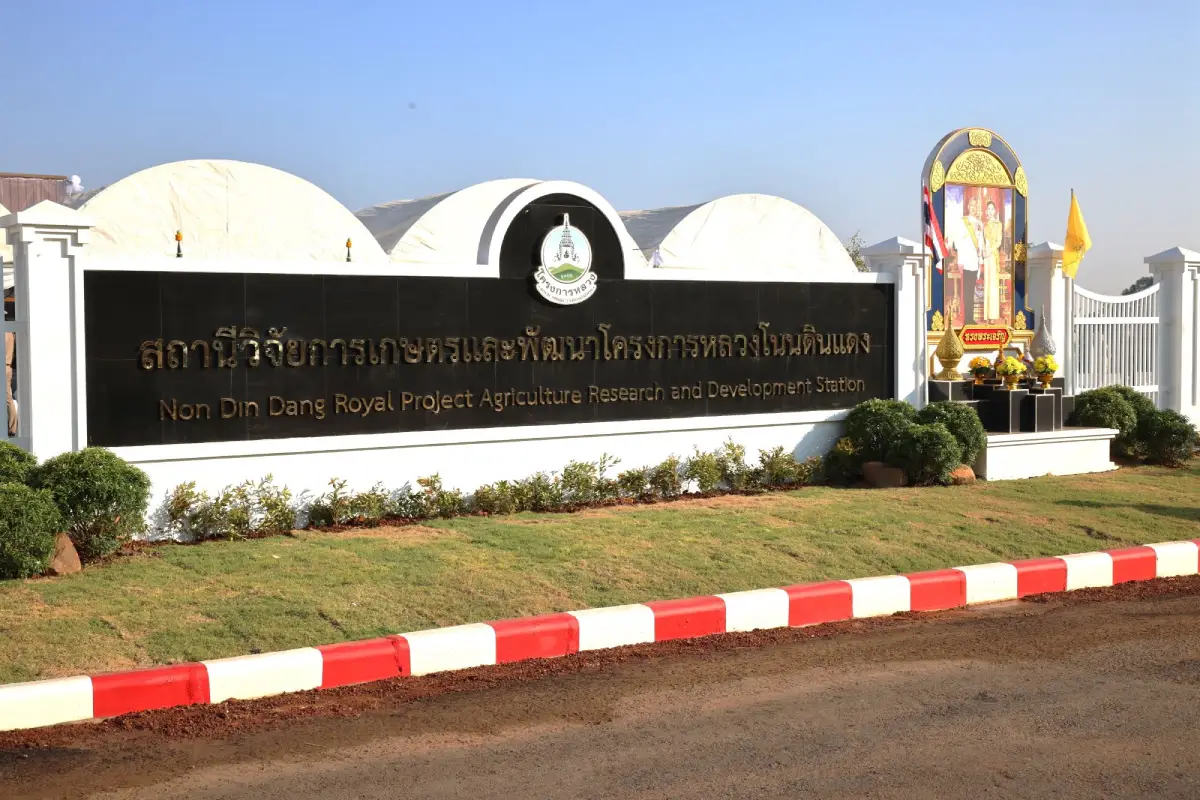
Operational Status: Active Agricultural Research and Development Station
Educational Visits: Prior arrangements with the Royal Project Foundation are required.
Non Din Daeng Royal Project Agricultural Research and Development Station, Buriram Province, is the 40th research and development station of the Royal Project Foundation. Officially established on 4 May 2025, the station is located in Non Din Daeng District, Buriram Province, in northeastern Thailand. It holds particular significance as the first Royal Project station established to extend the foundation's agricultural development model from Thailand's northern highlands into the upland landscape of the Northeast. Its principal missions include agricultural research, high-value crop development, farmers' livelihood improvement, soil and water resource management, environmental conservation, and sustainable rural development.
Unlike conventional agricultural tourist attractions, Non Din Daeng Royal Project Agricultural Research and Development Station is primarily a working research and development facility. Its significance lies in the connection between Thailand's long history of royal-initiative rural development and the application of modern agricultural science. Experimental cultivation, greenhouse technologies, soil improvement, water-resource development, and agricultural knowledge transfer are brought together within a coordinated regional development programme. Rather than focusing exclusively on increasing crop yields, the station places importance on product value, efficient resource use, environmental responsibility, and agricultural systems adapted to the particular conditions of Buriram Province.
The history of the station is closely connected with the challenges faced by communities in the southern part of Buriram during the late 1970s. At that time, parts of Lahan Sai District and the surrounding border region experienced serious difficulties associated with security, agricultural livelihoods, limited water supplies, and inadequate economic and social infrastructure. Armed conflict and instability affected the daily lives of local residents, restricting agricultural activities and creating considerable hardship for communities whose livelihoods depended on farming and access to natural resources.
During 1978–1979, His Majesty King Bhumibol Adulyadej the Great, King Rama IX, became aware of the hardships experienced by residents in the area. Royal development initiatives subsequently directed the relevant government agencies, particularly the Royal Irrigation Department, to survey and develop water resources for agricultural and domestic use. The wider programme also addressed economic development, social welfare, public health, education, and improvements in living conditions. These efforts formed part of the Royal-Initiated Lahan Sai District Development Project, which established important foundations for the subsequent development of the Non Din Daeng area.
A central feature of the original development approach was the establishment of model villages that could demonstrate practical improvements in agricultural livelihoods, infrastructure, and community security. Water-resource development was understood as more than the construction of reservoirs or irrigation channels. Reliable access to water was essential to restoring economic activity, making agricultural production more dependable, improving living standards, and strengthening communities affected by instability in the border region.
As the development programme progressed, a royal initiative led to the construction of Royal Food Processing Factory No. 4 in the Lahan Sai area. Construction began in December 1981. The factory was intended to purchase local agricultural produce and create employment opportunities for farming families. By processing crops grown in surrounding communities, it helped connect agricultural production with manufacturing, product development, and market opportunities. This approach reflected a broader vision of rural development in which farmers would benefit not only from cultivating crops but also from the additional economic value generated through processing and distribution.
The establishment of the royal food processing factory represented an important development in the local agricultural economy. Instead of treating cultivation, processing, and marketing as entirely separate activities, the programme sought to bring them into a more integrated economic system. Farmers supplied agricultural raw materials, the factory processed these products into marketable goods, and value-added production created additional opportunities for employment and income generation. The underlying principle remains relevant to contemporary agricultural development, particularly for rural communities seeking greater economic resilience and more stable markets for their produce.
The original factory site was administratively part of Lahan Sai District. However, the area's administrative status subsequently changed. Non Din Daeng became a minor district in 1996 and was elevated to a full district in 1997. These changes established a clearer framework for local administration and public services, while also providing a distinct administrative identity for communities that had previously formed part of a larger district.
The operations of Royal Food Processing Factory No. 4 were severely affected by Thailand's economic crisis during the late 1990s. Financial pressures led to reductions in operating expenditure, and the factory eventually ceased operations in 2000. Following its closure, portions of the surrounding land were no longer used as originally intended. Problems involving land management and occupation emerged, creating a need for renewed coordination among the Royal Project Foundation, public agencies, and local communities to restore appropriate and beneficial use of the site.
In 2003, the Royal Project Foundation assigned King Mongkut's University of Technology Thonburi to coordinate with relevant agencies concerning land use and community development. The objective was to promote productive activities and improve local livelihoods through community-based enterprise development. An enterprise incubation initiative was established, providing a foundation for activities involving agricultural processing, technical knowledge, and local economic organisation. On 25 February 2008, the Royal Food Processing Factory Community Enterprise Group of Non Din Daeng District was formally registered.
The community enterprise initiative played an important role in preserving the development purpose of the original royal project. By supporting cooperation among local residents, it encouraged communities to organise agricultural production, develop processing activities, share practical knowledge, and make more effective use of available resources. The initiative also demonstrated the importance of community participation in long-term rural development. Durable progress depends not only on infrastructure and external assistance but also on the capacity of residents to manage and improve their own livelihoods.
A new stage in the area's development began on 1 February 2025, when His Majesty King Maha Vajiralongkorn, King Rama X, graciously granted royal permission for the successful highland development approach of the Royal Project Foundation to be adapted to an upland area in northeastern Thailand. This represented a significant extension of agricultural knowledge and rural development practices beyond the foundation's traditional highland areas in the North. The new station was named Non Din Daeng Royal Project Agricultural Research and Development Station.
The station was formally established on 4 May 2025, becoming the Royal Project Foundation's 40th station. Its establishment marked a major milestone because it introduced the Royal Project development model into a landscape with markedly different climatic, geographical, agricultural, and resource conditions from the northern highlands. The station's role is therefore not to reproduce northern agricultural practices without modification, but to test and adapt scientific knowledge, production methods, and community development approaches to suit the realities of the northeastern uplands.
This adaptation is particularly important because agricultural systems that perform successfully in one region do not necessarily achieve the same results elsewhere. Soil conditions, seasonal temperatures, rainfall patterns, water availability, crop suitability, and market access all influence the success of agricultural production. The research undertaken at Non Din Daeng helps establish which crops and cultivation techniques are most appropriate for the area, while supporting the development of agricultural systems that farmers can apply under local conditions.
Non Din Daeng District is characterised by a combination of upland terrain, gently rolling hills, and mountainous areas. The Banthat mountain range extends along parts of the southern and western landscape. These geographical characteristics influence the distribution of water resources, patterns of land use, and agricultural production in nearby communities. The station's broader operational area lies at approximately 208–233 metres above sea level, with an average temperature of around 30 degrees Celsius. Such conditions require crop research and water management strategies suited to a warm upland environment.
Water availability is one of the defining considerations in local agricultural development. The Lam Nang Rong water system, including Lam Nang Rong Dam and smaller reservoirs throughout the surrounding area, supports agricultural production and community water needs. The management of these resources is particularly important in a region where seasonal water availability influences cropping patterns and economic opportunities. The station's research and development programme is therefore closely connected with improvements in irrigation infrastructure, water distribution, soil conditions, and long-term resource conservation.
The station operates on three parcels of land authorised for use within Thailand's agricultural land reform system. Together, these parcels cover 94 rai and 75 square wah, equivalent to approximately 15.07 hectares. The individual areas measure 7 rai, 3 ngan and 27 square wah; 45 rai, 1 ngan and 19 square wah; and 41 rai and 49 square wah. These areas support agricultural research, demonstration activities, experimental cultivation, and the development of appropriate land-use models. Their management also demonstrates the application of agricultural land reform regulations to productive research and community development.
The station's work is associated with five surrounding villages: Ban Sap Sombun, Ban Pa Mai Sahakon, Ban Khlong Hin, Ban Khlong Pong, and Ban Nong Samet. These communities are connected through agricultural livelihoods, local resource management, and the wider history of royal-initiative development in the area. The station's significance consequently extends beyond its buildings and experimental plots. Its research and development activities are intended to support practical improvements in the lives of farming households and provide locally appropriate knowledge for communities across the district.
A principal focus of the agricultural programme is the development of high-value crops that can generate greater economic returns from relatively small areas of land. Production approaches include Good Agricultural Practices, organic farming principles, and coordinated large-plot agricultural systems. The wider objective is to help farmers improve product quality, use resources more efficiently, respond to market opportunities, and reduce the economic risks associated with limited water supplies and declining soil fertility.
Traditional agricultural activities in the surrounding communities include the cultivation of rice, rubber, cassava, and passion fruit. Locally grown crops used in processing also include passion fruit, mulberry, and roselle. These crops form part of the area's agricultural economy and provide a connection between historical community enterprise development and contemporary value-added agricultural production. Alongside established crops, the station investigates additional commercial species with the potential to diversify agricultural livelihoods.
Research and experimental crops include Royal Project tomatoes, red and yellow cherry tomatoes, melons, Japanese cucumbers, Hong Kong kale, blackberries, raspberries, figs, and coffee. Other crops evaluated for their agricultural potential include passion fruit, papaya, guava, manuka, and robusta coffee. These investigations are designed to examine growth, productivity, and suitability under local conditions before promising cultivation methods are considered for broader agricultural promotion.
The experimental cultivation of different crops is an essential element of agricultural research because each plant species responds differently to temperature, humidity, water availability, soil conditions, nutrient supply, and production methods. Conducting experiments under actual local conditions provides valuable information about crop performance and helps identify the practices that offer appropriate combinations of productivity, quality, and resource efficiency. The resulting knowledge can support more informed agricultural decisions and reduce the risk of introducing unsuitable crops into local farming systems.
Greenhouse cultivation forms an important part of the station's agricultural research. Greenhouses provide an environment in which selected production factors can be managed more systematically than in open fields. This makes them suitable for research involving crop quality, growing media, irrigation, nutrient supply, and the response of plants to different cultivation practices. The facilities also support demonstration activities that help communicate practical agricultural techniques to farmers, students, and other groups involved in agricultural learning.
One of the approaches being applied at the station is cultivation using growing substrates rather than conventional field soil. This method can support more precise management of irrigation and plant nutrients, especially for crops requiring careful production control. Substrate-based systems provide opportunities to examine water-use efficiency, root-zone conditions, nutrient management, and agricultural production under resource constraints. Their application at Non Din Daeng is particularly relevant to the challenges of cultivating high-value crops in areas with limited water availability or unsuitable natural soil conditions.
During 2026, the station reported progress in the cultivation of high-quality vegetables and fruit crops within greenhouses and outdoor growing areas. Cherry tomatoes and Japanese cucumbers were among the crops successfully produced, while further experimental work involved additional potentially valuable species. These activities contribute to the evaluation of agricultural technologies and the identification of production systems that can support future livelihood development and the transfer of practical knowledge to local farmers.
Outdoor experimental cultivation is another essential component of the station's work. Preparations and land improvements have been undertaken to support demonstration plots outside greenhouses, particularly in the Khlong Pong area. Field-based trials allow researchers to study how crops perform under natural climatic conditions while assessing production requirements, resource needs, and practical suitability for conventional farming. Such comparisons are useful for identifying which cultivation methods are economically and technically appropriate for wider adoption.
The station's agricultural research is closely connected with environmental and infrastructure development. Reliable water supplies, suitable soil conditions, and dependable utilities are fundamental requirements for productive agricultural systems. Improvements to water storage, pumping systems, groundwater supply, and irrigation distribution are therefore important components of the wider development programme. Solar-powered water distribution systems are also among the infrastructure approaches associated with supporting agricultural water management in the area.
Resource conservation represents another important dimension of the programme. Environmental activities have included the planting of approximately 150,000 vetiver grass plants around reservoir areas, alongside fruit trees and Dendrocalamus sericeus bamboo. These activities contribute to soil and water conservation, the expansion of green areas, and improved long-term land management. They also illustrate the integration of agricultural development with ecological restoration rather than treating crop production and environmental protection as competing objectives.
Vetiver grass is particularly valuable in soil conservation because of its extensive root system, which helps stabilise soil and reduce erosion when used appropriately. Planting vetiver around water resources and vulnerable areas can complement other land management measures. Combined with trees, bamboo, and irrigation improvements, this approach supports a broader model of agricultural development that recognises soil and water as essential resources requiring long-term protection.
In August 2026, the Royal Project Foundation reported that work to improve 13 royal-initiative reservoirs in Lam Nang Rong Subdistrict had reached an overall progress level of 92.46 percent. The programme was intended to benefit more than 710 households. These figures highlight the close relationship between agricultural development and regional water security. Improving the efficiency of water resources can support agricultural production, strengthen the reliability of community water supplies, and provide essential infrastructure for future economic activities.
In addition to agricultural plots and infrastructure, the station has an administrative building that serves as a centre for management, coordination, and training activities. Construction began on 20 July 2025 and was completed on 15 December 2025. The building was formally inaugurated on 14 January 2026. It has a usable floor area of 505 square metres and includes working spaces for executives and staff, meeting facilities, and a small training area.
The administrative building supports coordination between the Royal Project Foundation, government agencies, researchers, and local communities. Meeting rooms and training facilities provide an organisational foundation for research planning and knowledge-sharing activities. The development of suitable buildings and supporting utilities is particularly important during the early establishment of a research station, enabling research, demonstrations, and community development programmes to be managed in a coordinated and effective manner.
The inauguration ceremony on 14 January 2026 was presided over by General Kampanat Ruddit, Privy Councillor and Chairman of the Executive Board of the Royal Project Foundation. Representatives of provincial authorities, government departments, and the foundation participated in the ceremony. The occasion marked a significant stage in the station's early development and demonstrated cooperation among the public organisations supporting the agricultural research and rural development programme.
The station's principal operational areas include its administrative building, experimental greenhouse facilities, agricultural demonstration plots, outdoor cultivation areas, and supporting water and utility infrastructure. These areas serve distinct purposes in research, practical experimentation, and agricultural knowledge transfer. Because the station is an active research facility, access to operational zones is subject to arrangements and requirements established by the responsible organisation rather than the unrestricted access generally associated with public tourist attractions.
The development programme also reflects the principles of Thailand's Sufficiency Economy Philosophy, which emphasises moderation, appropriate decision-making, resilience, and responsible resource use. Applied to agricultural development, these principles encourage production systems that respond to the realities of local conditions and the capacities of participating communities. The overall aim is to establish a sustainable balance between economic opportunities, social development, and environmental protection.
The station's contribution to surrounding communities includes the development of agricultural livelihoods and improved access to practical knowledge. Farmers can benefit from research findings and technology transfer concerning crop selection, cultivation systems, product quality, soil and water management, and market-oriented agricultural planning. Such knowledge becomes particularly valuable when it is adapted to the constraints and opportunities of the local environment rather than applied as a uniform solution across different regions.
Cooperation among farmers is another important element of the development approach. Community-based organisation can facilitate the sharing of agricultural knowledge, coordinated production planning, resource management, and the marketing of agricultural products. The historical experience of community enterprise development in Non Din Daeng provides a relevant foundation for these activities. Stronger local cooperation can also help rural communities develop greater economic resilience and benefit more effectively from investment in agricultural technology and infrastructure.
For people interested in agricultural education, Non Din Daeng Royal Project Agricultural Research and Development Station provides a significant example of adapting an established regional development model to a different physical and economic environment. Its activities demonstrate the relationship between experimental agriculture, water security, soil improvement, crop diversification, and community development. Understanding these connections is particularly valuable for students, researchers, agricultural professionals, and those studying sustainable rural development in Thailand.
The station continued its development and monitoring activities throughout 2026. On 16 September 2026, a working committee meeting was held to review and advance the station's operations. The programme included an inspection of demonstration plots involving fruit cultivation both inside and outside greenhouses, including crops such as melon and passion fruit. These activities reflected continuing progress in experimental cultivation and the practical development of agricultural research areas.
The importance of the station extends across several decades of Thailand's rural development history. Its origins are linked to the water-resource projects and food processing initiatives introduced to improve livelihoods in an area once affected by serious economic and security challenges. Its contemporary development as an agricultural research station represents a continuation of that purpose through scientific experimentation, technology transfer, and sustainable management of local resources.
Getting There: Non Din Daeng Royal Project Agricultural Research and Development Station is located in Non Din Daeng District in southern Buriram Province, northeastern Thailand. Non Din Daeng District is approximately 93 kilometres from the provincial centre of Buriram. Travellers can reach the district by private car and continue to the station according to directions or meeting arrangements provided by the responsible organisation. Because the station's operational areas are distributed across several parcels of land, visitors arranging official educational activities should distinguish the administrative office from experimental agricultural plots and demonstration areas.
The surrounding district is also home to natural, historical, and royal-initiative development sites. Among the notable places associated with Non Din Daeng are Lam Nang Rong Dam, Lam Nang Rong Beach, the Rao Su Monument, Prasat Nong Hong, and Pha Daeng Viewpoint. Together, these locations reflect different aspects of the district's landscape and history, including water-resource management, regional security, Khmer cultural heritage, and the natural environment of the Thai border uplands.
Lam Nang Rong Dam is one of the district's most significant landmarks. In addition to its role in water storage and agricultural irrigation, it is recognised as a recreational destination with broad reservoir views and waterside facilities. Its history is connected with the royal-initiative development programmes that helped transform the local region. Understanding the importance of the dam provides useful context for appreciating why water-resource development remains central to agricultural research and rural livelihoods in Non Din Daeng.
The Rao Su Monument commemorates civilians, police officers, and military personnel who lost their lives during periods of conflict affecting the area. It is an important historical landmark for understanding the security challenges that influenced local development during the late 1970s. The monument also provides a connection between the region's history and the infrastructure programmes that subsequently improved transport, water access, and community livelihoods.
Prasat Nong Hong represents another dimension of Buriram's history through its Khmer architectural heritage, while Pha Daeng Viewpoint highlights the district's natural landscape and upland scenery. These sites offer a broader understanding of Non Din Daeng as a district shaped by cultural history, geographical conditions, and decades of rural development. Each location has its own significance distinct from the agricultural research activities of the Royal Project station.
Non Din Daeng Royal Project Agricultural Research and Development Station is not a Buddhist temple or religious establishment. It is an agricultural research and development institution administered through the Royal Project Foundation. Its activities and access arrangements therefore differ from those of conventional sightseeing destinations. Educational visits and access to experimental agricultural areas should be coordinated with the responsible organisation in advance, allowing visits to be arranged in accordance with ongoing research activities and site requirements.
Today, the station represents the continued development of a royal-initiative programme whose foundations were established decades earlier. Its work addresses contemporary agricultural challenges, including limited water supplies, soil degradation, changing climatic conditions, and the need for higher-value agricultural production. By combining scientific research, appropriate technologies, environmental protection, and cooperation among public agencies and local communities, the station provides an important example of sustainable agricultural and rural development in northeastern Thailand.
| Name | Non Din Daeng Royal Project Agricultural Research and Development Station |
| Category | Agricultural Research and Development Station |
| Responsible Organisation | Royal Project Foundation |
| Office Address | 119/53 Moo 9, Non Din Daeng Subdistrict, Non Din Daeng District, Buriram 31260, Thailand |
| Official Establishment | 4 May 2025 |
| Station Number | 40th Station of the Royal Project Foundation |
| Historical Significance | First Royal Project station to extend the highland development model to an upland area of northeastern Thailand |
| Land Area | 94 Rai and 75 Square Wah, Across Three Parcels |
| Landscape | Rolling Upland Terrain, Approximately 208–233 Metres Above Sea Level |
| Primary Activities | Crop Research, Agricultural Demonstrations, Farmer Development, Technology Transfer, and Soil and Water Conservation |
| Research Crops | Cherry Tomatoes, Melons, Japanese Cucumbers, Passion Fruit, Hong Kong Kale, Mulberries, Figs, Coffee, and Other Experimental Crops |
| Main Operational Areas | Administrative Building, Experimental Greenhouses, Agricultural Demonstration Plots, Outdoor Growing Areas, and Water Infrastructure |
| Administrative Building | 505 Square Metres; Officially Inaugurated on 14 January 2026 |
| Associated Villages | Ban Sap Sombun, Ban Pa Mai Sahakon, Ban Khlong Hin, Ban Khlong Pong, and Ban Nong Samet |
| Foundation Executive Leadership | General Kampanat Ruddit, Chairman of the Executive Board of the Royal Project Foundation |
| Operational Status | Active Agricultural Research and Development Operations |
| Educational Visits | Prior Coordination with the Royal Project Foundation Is Required |
| Getting There | By Private Car to Non Din Daeng District, Buriram Province; Follow Site-Specific Arrangements Provided by the Responsible Organisation |
| Official Website | https://royalproject.org/page/NonDinDaeng/ |
| Nearby District Attractions | 1. Lam Nang Rong Dam 2. Lam Nang Rong Beach 3. Rao Su Monument 4. Prasat Nong Hong 5. Pha Daeng Viewpoint |
| Restaurants in Non Din Daeng District | 1. Krua Khun Pan 2. Khun Det Phochana 3. Krua Non Thong 4. Tam Mua PTT Non Din Daeng 5. Lam Nang Rong Dam Welfare Restaurant |
| Accommodations in Non Din Daeng District | 1. Non Din Daeng Hotel, Tel. +66 81 393 5008 2. Non Thong, Tel. +66 61 973 9687 |
Frequently Asked Questions (FAQ)
Q: Where is Non Din Daeng Royal Project Agricultural Research and Development Station located?
A: The station is located in Non Din Daeng District, Buriram Province, northeastern Thailand. Its office address is 119/53 Moo 9, Non Din Daeng Subdistrict, Non Din Daeng District, Buriram 31260.
Q: When was Non Din Daeng Royal Project Station established?
A: It was officially established on 4 May 2025 as the 40th station of the Royal Project Foundation.
Q: Why is Non Din Daeng Royal Project Station important?
A: It is the first Royal Project station established to apply the foundation's successful highland agricultural and community development model to an upland environment in northeastern Thailand.
Q: What crops are grown and studied at the station?
A: Research and development activities include cherry tomatoes, melons, Japanese cucumbers, passion fruit, Hong Kong kale, figs, coffee, and other crops with agricultural and commercial potential.
Q: Can tourists visit Non Din Daeng Royal Project Station?
A: The station operates as an agricultural research and development facility with educational and demonstration activities. Visits to its operational areas must be arranged in advance through the responsible organisation.
Q: How large is Non Din Daeng Royal Project Station?
A: Its authorised operational land covers a total of 94 rai and 75 square wah, divided into three parcels.
Q: What is the connection between the station and Royal Food Processing Factory No. 4?
A: The station's history is closely associated with the royal-initiative development programme and Royal Food Processing Factory No. 4, which was established to purchase and process agricultural produce from local communities. These earlier initiatives helped provide the foundation for the area's subsequent agricultural research and development programme.
Q: What other places of interest are found in Non Din Daeng District?
A: Important sites in the district and surrounding area include Lam Nang Rong Dam, Lam Nang Rong Beach, the Rao Su Monument, Prasat Nong Hong, and Pha Daeng Viewpoint.
 Category: ●Research and Development
 Group: ●Royal Project
Last Update : 2 WeekAgo
 Last Update : 2 WeekAgo
 Click to Access the Navigation Map GPS
Non Din Daeng Royal Project Agricultural Research and Development Station Map
Recommend

 Art, Culture and Heritage
 Historical Sites and Monuments(14)
 Landmarks and Memorials(2)
 Art, Craft Centres, Tradition(6)
 Museums(3)
 Educational Places
 Museum for Study(1)
 Places of Worship
 Temple(74)
 Other Sacred Sites(5)
Royal Project(1)
 Suburban Living
 Village, Community(3)
 Nature and Wildlife
 National Parks and Marine Reserves(2)
 Mountain (Doi)(1)
 Dam, Reservoir, Lake(14)
 River, Canal(1)
 Bays and Beaches(1)
 Other natural attractions(2)
 Entertainment and Agricultural
 Animal camps and shows(1)
 Stadium(2)
 Farms, Parks and Ecotourism(2)
 Waterpark(2)
 Travel Articles, Recipes
 Travel Review, Food Review(1)


