
lovethailand home >North Travel Attractions >Phetchabun Travel Attractions >Khao Kho >Sado Phong > Khao Kho National Park
TL;DR: Khao Kho National Park is located at Parts of Khao Kho, Lom Sak, Lom Kao, and Mueang Phetchabun districts, Phetchabun Province, Thailand, open Daily, in areas operating under normal visitor conditions, hours 08:00–16:30 at the National Park Headquarters.
Khao Kho National Park
Open Days: Daily, in areas operating under normal visitor conditions
Opening Hours: 08:00–16:30 at the National Park Headquarters
Khao Kho National Park in Phetchabun Province, Thailand, is the country's 125th national park, officially established on May 18, 2012. Covering approximately 301,698 rai, equivalent to 482.71 square kilometers, the protected area encompasses extensive mountain forests, watersheds, waterfalls, sandstone cliffs, and landscapes of considerable ecological and historical importance. Located in Thailand's lower northern region, Khao Kho National Park is particularly significant for its mountain ecosystems, biological diversity, natural water resources, and connections with the history of the Khao Kho highlands.
The park's distinctive appeal lies in the remarkable variety of its terrain. Forested ridges extend across the highlands, separating deep valleys and streams that descend toward lower elevations. Waterfalls flow over natural rock formations, while mountain viewpoints reveal layers of hills stretching toward the horizon. These landscapes offer opportunities for nature observation, photography, environmental education, and peaceful outdoor recreation in one of Phetchabun Province's most recognizable mountainous regions.
Khao Kho National Park should be distinguished from the wider tourist destination commonly known as Khao Kho. The name Khao Kho is often used to describe the entire highland district, including its viewpoints, temples, cafés, restaurants, resorts, memorials, and agricultural attractions. The national park, however, is a legally protected conservation area with designated management boundaries, ranger stations, visitor regulations, and specific facilities. Understanding this distinction is important when planning a journey, particularly because not every popular attraction in Khao Kho lies within the national park.
The National Park Headquarters is located at 67 Moo 1, Sado Phong Subdistrict, Khao Kho District, Phetchabun Province 67270. The protected area extends across parts of Khao Kho, Lom Sak, Lom Kao, and Mueang Phetchabun districts. Because of its substantial size and mountainous topography, individual attractions are widely dispersed. Travelers visiting a waterfall, viewpoint, royal residence, or historical site should navigate directly to their chosen destination rather than assuming that every attraction is situated near the park headquarters.
The name Khao Kho originates from the kho palm, a type of palm historically found in substantial numbers throughout the surrounding highlands. Naming mountains and settlements after locally prominent vegetation is a longstanding feature of Thai geographical traditions. The association between Khao Kho and this distinctive palm reflects the relationship between the natural environment and local cultural identity. Although land use and vegetation have changed over time, the name continues to preserve an important element of the area's natural heritage.
History of Khao Kho National Park begins with efforts to protect the mountainous forests and important water sources of Phetchabun Province. On May 1, 1995, part of the area was designated Than Thip Waterfall Forest Park, initially covering approximately 14 square kilometers, or 8,750 rai, within the Khao Plok Lon National Reserved Forest. This early protected area centered on Than Thip Waterfall and its surrounding forests, recognizing both their ecological importance and their potential for carefully managed nature tourism.
The establishment of Than Thip Waterfall Forest Park represented an important early step toward protecting a much larger forest landscape. The waterfall was not an isolated natural feature. It formed part of a broader network of streams, mountain slopes, and forest habitats that influenced the quality and movement of water throughout the surrounding highlands. Protecting this environment therefore required attention to the wider watershed rather than the waterfall alone.
On February 15, 2000, authorities initiated further consideration of the surrounding forest areas for national park designation. The proposed expansion reflected the recognition that the wider Khao Kho landscape contained interconnected mountain ecosystems, significant natural resources, and extensive forest areas suitable for long-term conservation. The process involved assessing geographical conditions, ecological value, and the practical requirements of establishing a nationally protected area.
Another important stage occurred on August 16, 2001, when forestry authorities undertook further surveys and management activities involving national reserved forests in Phetchabun Province. These included the Khao Plok Lon, Khao Pang Ko, and Wang Chomphu forest areas. The forests were significant not only because of their vegetation and wildlife but also because they contributed to important regional river systems. Assessing their condition and geographical continuity was an essential part of the national park establishment process.
Following the necessary administrative and legal procedures, Khao Kho National Park was officially established on May 18, 2012, under an announcement published in the Royal Thai Government Gazette, Volume 129, Part 43 Kor. The designated protected area covered approximately 301,698 rai, or 482.71 square kilometers. It became Thailand's 125th national park, giving this extensive highland landscape formal legal protection under the country's national park framework.
The establishment of Khao Kho National Park was especially important for protecting mountain watersheds. Rainwater falling across the forested ridges flows into numerous natural streams before reaching lower agricultural and residential areas. Healthy forests help regulate the movement of this water, retain soil moisture, reduce erosion, and maintain ecological processes that support both wildlife and human communities.
Forest conservation also preserves the distinctive mountain scenery for which Phetchabun is widely known. The combination of sandstone ridges, steep slopes, valleys, and elevated plateaus gives Khao Kho a different geological character from limestone mountain regions elsewhere in Thailand. Over long periods, rainfall and flowing water have shaped these formations into waterfalls, gullies, cliffs, and natural drainage systems.
Geography and Mountain Landscapes are central to understanding the national park. Its mountains generally extend along a north-south orientation, with elevations ranging from approximately 155 meters to 1,593 meters above mean sea level. The terrain includes long mountain ridges, relatively flat summit areas, steep sandstone slopes, and deeply incised valleys. These differences in elevation and exposure create a variety of environmental conditions within the same protected area.
Sandstone plays a particularly important role in shaping the local landscape. Certain sandstone formations are susceptible to weathering and erosion over time, especially where rainfall and flowing streams act upon exposed surfaces. These processes contribute to the development of cliffs, valleys, rocky channels, and waterfalls. The scenic appearance of Khao Kho is therefore the result of long-term geological changes as well as the continued influence of water and vegetation.
During the rainy season, abundant moisture encourages vigorous plant growth across the mountains. Forests become particularly green, streams receive more water, and waterfalls become more prominent. In the cooler season, lower temperatures and suitable atmospheric conditions encourage mist formation in some valleys. Together, these seasonal changes create the dramatically different landscapes that visitors associate with Khao Kho throughout the year.
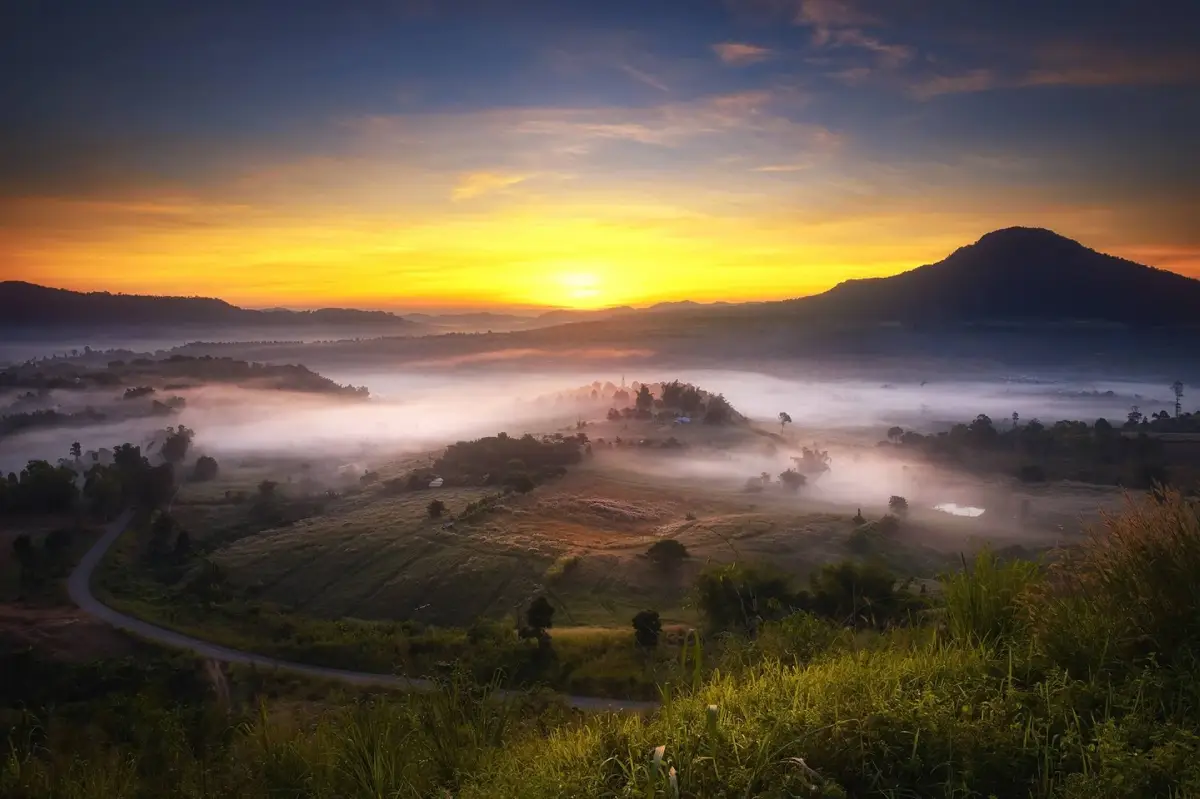
Sea of mist scenery is one of the area's most famous natural attractions. Mist develops when moist air cools sufficiently for water vapor to condense into tiny suspended droplets. In mountainous terrain, cool air can accumulate in valleys, allowing layers of fog to form below the surrounding ridges. Viewed from a higher elevation, these clouds of mist resemble a white sea stretching between distant mountains.
However, mist is a weather-dependent phenomenon rather than a permanent feature of the landscape. Its appearance is influenced by humidity, temperature, wind, recent rainfall, and local topography. On some mornings, valleys are covered by thick mist; on others, the mountain views remain clear. Both conditions offer different photographic opportunities and ways to appreciate the highland environment.
Although misty viewpoints have become symbolic of Khao Kho, the national park's natural value extends much further. Its forests, waterfalls, streams, mountains, and habitats demonstrate how several environmental systems operate together. A visit centered on these relationships provides a deeper understanding of the region than sightseeing alone.
Forests and Biodiversity are among the most important reasons for protecting Khao Kho National Park. Vegetation varies according to elevation, moisture, slope orientation, and local soil conditions. Forest environments in the wider protected landscape include evergreen formations, mixed deciduous forest, dry dipterocarp forest, and areas where pine trees occur. Each habitat contributes differently to the ecological character of the mountains.
Evergreen forest environments generally retain greater humidity and support relatively dense vegetation. Tree canopies help moderate temperatures near the forest floor and reduce the direct impact of sunlight on the soil. Mixed deciduous and dry dipterocarp forests undergo more visible seasonal changes, with many trees losing their leaves during drier periods and producing new growth when rainfall returns.
These variations in vegetation explain why the forests of Khao Kho can look strikingly different throughout the year. Green hillsides dominate during periods of abundant rain, while certain deciduous forests take on a drier appearance in the warmer months. Such changes are part of the natural seasonal cycle and contribute to the diversity of habitats available to wildlife.
The park's ecosystems provide habitat for mammals, birds, reptiles, insects, and other organisms. Different species occupy different environmental niches, depending on available food, vegetation, water, and shelter. Preserving continuous forest habitats is important because wildlife requires suitable areas for feeding, breeding, movement, and protection from disturbance.
Birds and butterflies are particularly interesting subjects for visitors studying forest ecology. Certain birds assist in seed dispersal, while many insects participate in pollination and other ecological processes. Their presence reflects the complex relationships among plants, animals, water, and seasonal conditions. Wildlife should always be observed quietly and from a respectful distance without feeding or attempting to handle animals.
The biological value of the national park is therefore much greater than the presence of any single species. Its significance lies in preserving functioning ecosystems, native vegetation, natural habitats, and the environmental processes that maintain biodiversity across the mountains of Phetchabun Province.
Than Thip Waterfall is one of the natural attractions most closely associated with the origins of Khao Kho National Park. The waterfall formed the focal point of Than Thip Waterfall Forest Park, established in 1995, before the surrounding conservation area was expanded and eventually designated a national park. Located within the forested mountain landscape of Lom Sak District, it is an important destination for visitors interested in waterfalls and forest environments.
Than Thip Waterfall features water flowing across natural rock formations surrounded by mountain vegetation. The interaction between streams, boulders, slopes, and forest creates an attractive natural setting. Its appearance changes with seasonal water levels, particularly after rainfall in the surrounding watershed. The landscape offers opportunities to observe the relationship between flowing water and the geological formations through which it travels.
The waterfall also illustrates the ecological importance of upstream forest conservation. Water reaching the falls is part of a network of streams fed by rainfall across elevated terrain. Forest cover influences soil retention, moisture storage, and the movement of water through the landscape. Protecting the surrounding environment helps maintain these natural processes and reduces damage associated with inappropriate land use.
Visitor safety is especially important at Than Thip Waterfall during periods of heavy rainfall. Mountain streams can rise quickly, and increased water volume may create powerful currents. Sudden changes in water color, particularly unusually muddy water, can indicate dangerous upstream conditions. Visitors must comply with ranger instructions and temporary closure announcements rather than assuming that normal access remains possible throughout every season.
Other Waterfalls and Streams add to the natural diversity of the park. Beyond Than Thip, the protected mountain landscape includes other waterfall systems and natural watercourses, including Tat Fa Waterfall, Huai Yai Waterfall, and streams associated with different ranger station areas. These features occur in separate parts of the mountains and should not be regarded as attractions along one continuous walking route.
Waterfall environments provide valuable examples of erosion, sediment movement, and the adaptation of plants to humid conditions. Water flowing over rock surfaces gradually influences their shape, while moisture supports specialized vegetation along streambanks. Visitors interested in geology or environmental science can learn a great deal by observing these processes from safe, designated areas.
The appearance and accessibility of waterfalls change considerably throughout the year. A waterfall with powerful flows during the rainy season can look very different during a dry period. Increased water volume may be visually impressive, but it also creates greater safety risks. Appropriate travel planning should therefore consider current weather, park announcements, and the condition of individual access routes.
Khao Ya and Khao Kho Royal Palace form another important part of the wider mountain landscape. Khao Ya is a prominent mountain area associated with scenic views and the royal residence constructed for use during royal visits to the Khao Kho region. Its setting among forested highlands connects the area's natural beauty with an important chapter in the development and historical significance of the region.
The importance of Khao Kho Royal Palace extends beyond its setting. It reflects the historical relationship between Thailand's royal institution and the development of the mountainous Phetchabun region. The surrounding highlands also provide an opportunity to appreciate the complex terrain that has shaped settlement, transportation, land use, and conservation throughout Khao Kho.
Forested mountain ridges dominate the scenery around Khao Ya. Their elevation creates cooler conditions than those experienced across lower parts of Phetchabun, particularly during early mornings and the winter season. Visitors traveling to areas open for public access can enjoy broad mountain scenery while learning about the historical and geographical importance of this part of the highlands.
Main Zones and Ranger Station Areas within Khao Kho National Park are distributed across the extensive protected landscape. The principal areas identified in the park accommodation and management system include the National Park Headquarters Zone, Khao Ya Ranger Station Zone, Pha Sorn Kaew Ranger Station Zone, Than Thip Ranger Station Zone, and Nam Phiang Din Ranger Station Zone.
The Headquarters Zone serves as the central administrative and visitor coordination area. Travelers can use the park's official contact channels to obtain information about designated visitor locations, accommodation, access regulations, and current operating arrangements. Facilities are provided according to the functions and capacity of the relevant area.
The Khao Ya Zone is associated with the mountainous landscape and the vicinity of Khao Kho Royal Palace. It is notable for its combination of natural scenery and historical significance. The Pha Sorn Kaew Zone is another designated administrative area. It should not be confused with Wat Phra That Pha Sorn Kaew, the famous Buddhist temple elsewhere in Khao Kho District, which operates as a separate religious attraction.
The Than Thip Zone is historically significant because of its association with the original Than Thip Waterfall Forest Park. Its forest streams and mountain ecosystems are closely connected with the history of the national park's establishment. The Nam Phiang Din Zone represents another component of the park's distributed ranger management network.
Dividing such a large protected area into management zones enables park personnel to supervise conservation activities, visitor access, accommodation, and natural resource protection across different geographical locations. Travelers should plan around actual road access and destination points, as traveling between zones can involve separate routes and considerable distances.
Accommodation and Camping in Khao Kho National Park are closely associated with the highland atmosphere. Cool weather, mountain scenery, and forest surroundings make overnight stays particularly appealing. The Department of National Parks maintains accommodation information for Khao Kho National Park, including park houses and group accommodation in the Headquarters Zone and selected ranger station areas.
Overnight accommodation within a national park differs from a conventional resort stay. Park facilities operate under conservation regulations designed to protect natural resources and maintain appropriate conditions for visitors and wildlife. Rules governing noise, waste disposal, cooking, campsite use, and restricted areas should be followed carefully.
Temperatures in mountain areas can fall significantly after sunset, particularly during the cooler months. Travelers staying overnight should prepare suitable clothing, personal equipment, and supplies. Those planning to stay inside the park should use the Department of National Parks' reservation system to check which accommodation units are currently available.
The wider Khao Kho area also offers numerous privately operated resorts, hotels, lodges, and guesthouses. Properties are distributed across Sado Phong, Khao Kho, Khaem Son, and other communities. Some emphasize panoramic views and morning mist, while others provide convenient access to historical monuments, temples, or major roads. Accommodation should be selected according to the specific attractions included in the travel itinerary.
The Historical Significance of Khao Kho forms an essential part of the region's identity. During the twentieth century, the mountainous areas of Khao Kho became strategically important during the conflict between the Thai government and communist insurgents. The combination of forest cover, steep terrain, and difficult access influenced military operations and the development of infrastructure throughout the region.
During the period of conflict, mountains and forests were strategically important for movement, concealment, and control of territory. Military operations affected both the landscape and the lives of surrounding communities. Following the end of the conflict, Khao Kho entered a period of rehabilitation, infrastructure development, settlement changes, and increasing tourism activity.
Khao Kho Sacrifice Memorial commemorates those who lost their lives while serving in the area. The memorial provides an important place for remembrance and historical reflection. Its location within the highland landscape also allows visitors to connect the historical events with the geographical conditions that influenced them.
The Khao Kho Weapon Museum and related historical attractions preserve aspects of the area's military history. Visiting these places can help travelers understand the transformation of Khao Kho from a former conflict zone into a region associated with tourism, environmental conservation, and highland communities.
The area's history also provides context for the development of mountain roads, settlements, and public infrastructure. Improvements in accessibility gradually contributed to the growth of tourism and local economic activity. The modern Khao Kho landscape therefore combines natural scenery with evidence of profound social and historical changes.
The National Park's Relationship with Local Communities is important from both environmental and economic perspectives. Protected forests help maintain watersheds and ecological resources, while tourism supports demand for local accommodation, restaurants, transport services, and agricultural products. The relationship between environmental protection and local livelihoods is a central consideration for sustainable tourism development.
Highland communities maintain close connections with the natural conditions of their surroundings. Agricultural activities, local businesses, and tourism services are influenced by elevation, rainfall, temperature, and road accessibility. Tourism provides economic opportunities, but increasing visitor numbers also create challenges involving waste management, water use, land development, and environmental protection.
The national park contributes to the long-term protection of forest resources while providing opportunities for people to understand their ecological importance. Healthy mountain ecosystems benefit not only wildlife and visitors but also communities in lower elevations that depend on water and other environmental services originating in the highlands.
Best Time to Visit Khao Kho National Park depends on the type of experience travelers are seeking. The rainy season, generally extending from May to October, brings abundant green vegetation and stronger waterfall flows. Mountain forests become particularly lush, while mist and clouds frequently move among the ridges. Nevertheless, heavy rainfall can create dangerous conditions on mountain roads, walking routes, and near waterways.
The cooler season, generally from November to February, is particularly popular for mountain sightseeing, mist photography, and overnight stays. Early mornings can be cold, especially at higher elevations. On some days, clear skies reveal long mountain panoramas; on others, mist blankets the valleys. Warm clothing is especially important for children, older visitors, and those spending the night outdoors.
During the warmer season, approximately March to April, certain deciduous forests become drier and daytime temperatures increase. The highland landscape remains suitable for sightseeing and visits to historical attractions. Travelers should consider prevailing weather, air quality, and any relevant announcements affecting forest access during this period.
For visitors hoping to photograph a sea of mist, early morning is generally the most suitable part of the day because lower temperatures often favor mist formation. However, no season guarantees fog on every morning. Conditions can change quickly, and different viewpoints provide different perspectives depending on wind, cloud cover, and visibility.
Things to Do in Khao Kho National Park include observing mountain landscapes, photographing forests and valleys, visiting accessible waterfalls, learning about local ecosystems, and staying overnight in authorized areas. The range of experiences makes the park appealing to nature enthusiasts, families, photographers, and travelers interested in environmental education.
Landscape photography is one of the region's most rewarding activities. Soft morning light can emphasize layers of ridges and mist, while afternoon light reveals the shapes and textures of forested mountains. Changes in weather, seasonal vegetation, and cloud formations give the same location a different appearance from one visit to another.
Visitors interested in ecology can observe differences in vegetation along mountain slopes, the behavior of water flowing through natural channels, and the relationships between habitats and wildlife. Such experiences encourage a deeper appreciation of forests as functioning environmental systems rather than simply attractive backgrounds for photographs.
Historical sightseeing can also be combined with a nature-focused itinerary. Khao Kho Royal Palace, Khao Kho Sacrifice Memorial, and the Weapon Museum provide cultural and historical context for the mountain landscape. Together, they offer insight into the region's transformation and the significance of its geography in Thailand's modern history.
Nearby Attractions Around Khao Kho National Park cover a wide variety of interests. Khao Kho Royal Palace is associated with Khao Ya and the area's royal history. Khao Kho Sacrifice Memorial and the Weapon Museum provide opportunities to learn about the historical conflict. Khao Takhian Ngo Viewpoint is known for its elevated mountain panoramas, while Wat Phra That Pha Sorn Kaew offers a distinctive religious and architectural experience.
Wat Phra That Pha Sorn Kaew is one of the best-known Buddhist attractions in Khao Kho District. Its unusual architectural forms and decorative details make it especially memorable. The temple occupies a mountain setting and offers an experience very different from that of the national park. Visitors should dress respectfully and follow the rules governing access to its religious buildings and grounds.
Khao Kho Wind Farm is another well-known attraction, featuring large wind turbines within a highland landscape that also includes agricultural areas. The striking appearance of the turbines makes the location popular for photography. Visiting the wind farm alongside natural viewpoints provides an opportunity to observe different ways the highland landscape is used.
Sri Dit Waterfall is another natural attraction within the wider Khao Kho District, with associations to the area's history. Its scenery and surrounding landscape attract visitors interested in nature as well as the historical background of the mountains. Sri Dit Waterfall and Than Thip Waterfall are different destinations, and their respective locations and access routes should not be confused.
Getting to Khao Kho National Park is most convenient by private car or rental vehicle. Travelers starting in Phetchabun city can use roads connecting the provincial center with the Khao Kho highlands and continue toward Sado Phong Subdistrict. Travelers approaching from Phitsanulok can follow Highway 12 through the Khaem Son area before joining connecting roads toward Khao Kho.
Visitors traveling from Bangkok generally approach Phetchabun through the Saraburi region before continuing north and selecting an appropriate mountain access road. The most suitable route depends on the destination, since park headquarters, waterfalls, viewpoints, temples, and historic monuments are located in different parts of the wider region.
Mountain roads in Khao Kho include steep sections, curves, and areas where visibility can be limited by rain or fog. Drivers should ensure that their vehicles are in good condition and pay particular attention to brakes and tires. Appropriate low-gear driving techniques should be used on long downhill sections, and speeds should be adjusted to prevailing road and weather conditions.
Because Khao Kho National Park covers a large geographical area, travelers should navigate to the precise attraction they intend to visit. Searching only for the national park name may lead to the headquarters rather than a waterfall, viewpoint, or historical attraction. Identifying the exact destination in advance makes route planning more efficient and helps avoid unnecessary driving between separate mountain areas.
Travelers using public transportation can reach Phetchabun Province or Lom Sak District by intercity transport before arranging onward travel into the mountains. A private vehicle, rental car, or prearranged local transfer is generally more practical for visiting multiple attractions because public transportation services do not directly connect all of the region's dispersed destinations.
Visitor Rules and Responsible Tourism are especially important in a protected natural area. Visitors should avoid collecting plants or natural materials, leaving litter, disturbing wildlife, feeding wild animals, or entering restricted areas. All signs, ranger instructions, and safety notices should be respected.
Extra precautions are necessary near waterfalls and streams during periods of heavy rainfall. Slippery rocks, powerful currents, unstable ground, and sudden changes in water levels can create serious hazards. Travelers should remain on authorized paths and avoid approaching dangerous cliffs or watercourses without appropriate safety measures.
For nature walks, suitable footwear, drinking water, weather-appropriate clothing, and awareness of route conditions are essential. Travelers should follow designated trails and respect restrictions established to protect sensitive habitats or prevent accidents. Overnight visitors must also comply with regulations concerning camping, noise, cooking, and waste disposal.
Responsible tourism extends beyond the park boundaries. Respect for local communities, careful parking, proper waste disposal, and considerate use of restaurants and accommodation help reduce the environmental impact of tourism. These practices contribute to preserving the qualities that make Khao Kho attractive while supporting the people who live and work in the region.
Khao Kho National Park represents a remarkable combination of ecological, geographical, and historical heritage. Its mountain forests protect important watersheds and diverse habitats, while its waterfalls, sandstone landscapes, and scenic highlands reveal the natural character of Phetchabun Province. At the same time, the wider Khao Kho region preserves memories of Thailand's modern history and the transformation of a former conflict area into a destination for conservation, cultural learning, and tourism. For travelers wishing to understand the deeper significance of Khao Kho, the national park provides an essential perspective on the connections between Thailand's mountains, forests, communities, and historical landscape.
| Name | Khao Kho National Park, Phetchabun Province, Thailand |
| Location | Parts of Khao Kho, Lom Sak, Lom Kao, and Mueang Phetchabun districts, Phetchabun Province, Thailand |
| Headquarters Address | 67 Moo 1, Sado Phong Subdistrict, Khao Kho District, Phetchabun 67270, Thailand |
| Category | National Park, Protected Forest, Nature and Historical Tourism Destination |
| Total Area | 301,698 rai, approximately 482.71 square kilometers |
| Establishment Date | May 18, 2012 |
| National Park Designation | Thailand's 125th National Park |
| Managing Authority | Department of National Parks, Wildlife and Plant Conservation, Thailand |
| Landscape | Highlands, Forested Mountain Ridges, Valleys, Sandstone Cliffs, Waterfalls and Natural Streams |
| Elevation Range | Approximately 155–1,593 meters above mean sea level |
| Name Origin | Named after the kho palm, historically abundant in the surrounding mountains |
| Conservation Importance | Protection of mountain watersheds, forest habitats, biodiversity and historically significant highland landscapes |
| Highlights | Mountain scenery, forests, Than Thip Waterfall, Khao Ya, Khao Kho Royal Palace and historical attractions of the Khao Kho region |
| Main Zones | 1. National Park Headquarters Zone 2. Khao Ya Ranger Station Zone 3. Pha Sorn Kaew Ranger Station Zone 4. Than Thip Ranger Station Zone 5. Nam Phiang Din Ranger Station Zone |
| Activities | Mountain Sightseeing, Nature Observation, Waterfall Visits, Photography, Historical Learning and Camping in Authorized Areas |
| Open Days | Daily in normally operating visitor areas |
| Opening Hours | 08:00–16:30 at the National Park Headquarters |
| Thai Visitor Entrance Fees | Adults: THB 20; Children: THB 10 |
| Foreign Visitor Entrance Fees | Adults: THB 100; Children: THB 50 |
| Facilities | Park Administration Office, Parking, Public Toilets and Designated Accommodation and Camping Areas |
| Park Accommodation | Park houses and group accommodation are listed in the Department of National Parks reservation system for the headquarters and selected ranger station areas |
| Best Time to Visit | Cool Season for mountain scenery and mist; Rainy Season for green forests and waterfalls when conditions are safe |
| Getting There | By private car or rental vehicle from Phetchabun city toward Khao Kho and Sado Phong; alternatively approach via Highway 12 through Khaem Son from Phitsanulok |
| Contact Number | +66 81 284 5223 |
| Official Website | https://booking.dnp.go.th/parksdetail.php?id=77 |
| Nearby Attractions in the Khao Kho Region | 1. Khao Kho Royal Palace 2. Khao Kho Sacrifice Memorial 3. Khao Kho Weapon Museum 4. Khao Takhian Ngo Viewpoint 5. Wat Phra That Pha Sorn Kaew 6. Khao Kho Wind Farm 7. Sri Dit Waterfall 8. Than Thip Waterfall |
| Restaurants in the Khao Kho Region | 1. Malee Restaurant, Sado Phong, Tel. +66 63 782 9353 2. Krua Khao Kho Restaurant 3. Tanrak Talaymok Restaurant 4. Boranniyom Restaurant Khao Kho 5. Rai Chan Raem Restaurant 6. Krua Mong Meng Restaurant |
| Accommodation in the Khao Kho Region | 1. Baan Chuthamanee Khao Kho Resort, Sado Phong, Tel. +66 85 732 3264 2. Sabaidee Khao Kho Resort, Sado Phong, Tel. +66 88 496 9402 3. Sky Glamper Khao Kho, Sado Phong, Tel. +66 61 229 5385 4. Charm Talaymok Khao Kho, Sado Phong, Tel. +66 81 913 0728 5. Anya Hill Khao Kho, Sado Phong, Tel. +66 94 429 1581 6. Baan Nernnam Resort Khao Kho, Tel. +66 80 684 3036 |
Frequently Asked Questions (FAQ)
Q: Where is Khao Kho National Park located?
A: Khao Kho National Park is located in Phetchabun Province, Thailand. It covers parts of Khao Kho, Lom Sak, Lom Kao, and Mueang Phetchabun districts. Its headquarters is at 67 Moo 1, Sado Phong Subdistrict, Khao Kho District, Phetchabun 67270.
Q: Is Khao Kho National Park open every day?
A: The park headquarters normally operates daily from 08:00 to 16:30. Access to individual waterfalls, forest trails, and other natural attractions can be restricted temporarily when weather or safety conditions require closures.
Q: How much is the entrance fee to Khao Kho National Park?
A: Admission fees are THB 20 for Thai adults and THB 10 for Thai children. Foreign visitors pay THB 100 for adults and THB 50 for children. Separate charges may apply for vehicles and certain facilities or services.
Q: What are the main attractions in Khao Kho National Park?
A: The park is known for its forested mountain landscapes, waterfalls, natural streams, and the Khao Ya area. Visitors can also explore nearby attractions such as Khao Kho Royal Palace, Khao Kho Sacrifice Memorial, and scenic viewpoints throughout the wider Khao Kho region.
Q: Why is Khao Kho historically important?
A: The Khao Kho highlands were strategically important during the conflict between the Thai government and communist insurgents. Today, Khao Kho Sacrifice Memorial and the Weapon Museum provide opportunities to learn about this period of Thailand's modern history.
Q: When was Khao Kho National Park established?
A: Khao Kho National Park was officially established on May 18, 2012, becoming Thailand's 125th national park. It covers approximately 301,698 rai, equivalent to 482.71 square kilometers.
Q: What is the best time of year to visit Khao Kho National Park?
A: November to February is popular for cooler temperatures, mountain scenery, and mist photography. The rainy season brings lush forests and stronger waterfalls, although some areas may be temporarily closed for safety. Sea of mist conditions depend on daily weather patterns.
Q: Can visitors stay overnight in Khao Kho National Park?
A: The Department of National Parks lists accommodation and camping-related facilities for Khao Kho National Park. Visitors should check available units, reservation arrangements, and current operating conditions through the official booking system or contact the park at +66 81 284 5223.
 Category: ●Nature and Wildlife
 Group: ●National Parks and Marine Reserves
Last Update : 2 WeekAgo
 Last Update : 2 WeekAgo

 Click to Access the Navigation Map GPS
Khao Kho National Park Map
Recommend

 Art, Culture and Heritage
 Historical Sites and Monuments(4)
 Landmarks and Memorials(3)
 Art, Craft Centres, Tradition(4)
 Art Gallery(1)
 Educational Places
 Library(1)
 Educational Gardens, Farm(3)
 Places of Worship
 Temple(31)
 Other Sacred Sites(8)
 Suburban Living
 Village, Community(4)
National Parks and Marine Reserves(5)
 Mountain (Doi)(11)
 Dam, Reservoir, Lake(14)
 Waterfalls(21)
 Hot Springs(1)
 Caves(11)
 Flower Field(1)
 River, Canal(12)
 Other natural attractions(13)
 Entertainment and Agricultural
 Zoos and Aquariums(1)
 Farms, Parks and Ecotourism(4)
 Outdoor and Adventure Activities(2)
 Travel Articles, Recipes
 Travel Review, Food Review(1)


