
lovethailand home >North Travel Attractions >Tak Travel Attractions >Muang Tak >Mae Tho > Lan Sang National Park
TL;DR: Lan Sang National Park is located at Mae Tho Subdistrict, Mueang Tak District, Tak Province, open Daily, hours 08.30 – 16.30.

Lan Sang National Park
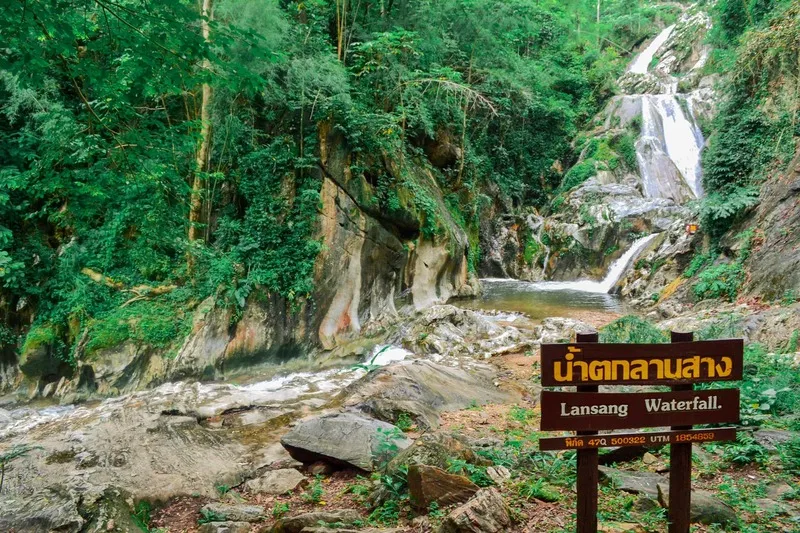
Open Days: Daily
Opening Hours: 08.30 – 16.30
Lan Sang National Park in Tak Province is one of the most accessible and meaningful natural attractions near Tak town. Located in Mae Tho Subdistrict, Mueang Tak District, the park is about 19–20 kilometers from the city center and covers an area of approximately 65,000 rai, or about 104 square kilometers. It was officially declared a national park on May 14, 1979. Lan Sang National Park is known for its mountain scenery, layered waterfalls, cool forest atmosphere, streams, diverse forest ecosystems, wildlife, nature trails, and a local legend connected with King Taksin the Great. For travelers visiting Tak, the park is a valuable destination because it combines natural beauty, historical storytelling, and a peaceful forest environment within a short drive from the city.
The most memorable image of Lan Sang National Park is its series of waterfalls flowing through rock terraces, forest valleys, and narrow mountain streams. The park is home to several important waterfalls, including Pha Lat Waterfall, Lan Liang Ma Waterfall, Lan Sang Waterfall, Pha Phueng Waterfall, Pha The Waterfall, Pha Noi Waterfall, and Tha Le Waterfall. Each waterfall has its own character. Some flow gently over broad stone platforms, some drop from steep cliffs, and some pass through narrow rock channels before reaching deep natural pools. This variety makes the park suitable for visitors who enjoy waterfall photography, forest walks, family recreation, and nature study.
The landscape of Lan Sang National Park consists mainly of connected mountain ranges. The highest areas are in the western and southern parts of the park, then the terrain gradually slopes downward toward the east. This mountain structure creates several streams and watercourses, including Huai Lan Sang, Huai Tha Le, Khlong Huai Sai, and Huai Um Yom. These streams form the waterfalls and help maintain the moisture of the forest. They also support plants, wildlife, and the overall ecological balance of the park.
The forest inside Lan Sang National Park is diverse and changes according to elevation, slope, and moisture. Major forest types include tropical evergreen forest, pine forest, hill evergreen forest, dry dipterocarp forest, and mixed deciduous forest. This diversity allows visitors to observe different forest conditions within one protected area. Some sections are shaded and humid, while others are more open and dry. Along nature trails, visitors can see large trees, shrubs, ferns, streamside vegetation, grasses, and plants adapted to different habitats.
Wildlife recorded in the park includes wild boar, barking deer, big-headed turtle, serow, civet, black-crested bulbul, and flying lizard. These animals reflect the ecological richness of the forest and its water sources. Most wildlife is not easy to see during a normal visit, but quiet travelers may hear bird calls, see reptiles, or notice tracks and signs along forest paths. Visitors should walk calmly, avoid loud noises, and never feed wild animals, as this can disturb natural behavior and damage the balance of the forest ecosystem.
Lan Sang National Park is also known for its distinctive waste-management approach. The park does not provide trash bins for general dumping inside the tourist areas. Instead, staff provide black plastic bags to visiting groups and ask them to carry their own waste back out to the checkpoint, where it can be collected and handled properly. This system helps reduce litter in the forest, prevents wildlife from scavenging human waste, and reminds visitors that responsible travel begins with taking responsibility for what they bring into a natural area.
The legend of Lan Sang gives the park a cultural and historical dimension. According to local tradition, when King Taksin the Great led his army for the second campaign to Chiang Mai, he stopped at Ban Rahaeng in the old Tak area. Many Mon people had come to pledge loyalty to him, and Burmese soldiers followed them. King Taksin then led troops to drive the Burmese forces away. During the operation, he became separated from his army at night in a dense mountainous forest where tracking was difficult.
While the Thai troops were resting, a bright light suddenly rose into the sky and the sound of a war horse was heard. The soldiers hurried toward the light and found King Taksin mounted on his horse in the middle of a stone terrace. Light was said to be shining from his body, while Burmese soldiers were kneeling around him. At that moment, dawn was breaking. The place was therefore called “Lan Sang,” meaning a stone terrace at daybreak. The site associated with the king and his horse is believed to be around Lan Sang Waterfall, where a mark traditionally regarded as the hoofprint of the royal war horse is still remembered in local storytelling.
This legend makes Lan Sang National Park more than a waterfall destination. Visitors walking around Lan Sang Waterfall are not only seeing water, rocks, and forest. They are also entering a place connected with Tak’s historical memory and reverence for King Taksin the Great. The combination of nature, legend, and local faith gives the park a special identity that distinguishes it from many other waterfall sites in Thailand.
Pha Lat Waterfall is one of the first major attractions inside the park. It has the form of a broad rock slope where water flows over layered stone surfaces. The waterfall is about 25 meters wide and 40 meters long, with a gentle gradient. Water from Huai Lan Sang spreads across the rock terrace before gathering into small pools below. Because of its open stone surface and easy atmosphere, Pha Lat Waterfall is a good place for walking, photography, and observing how stream water shapes natural rock formations.
Lan Liang Ma Waterfall, also called the first level, is located upstream from Pha Lat Waterfall by about 200 meters. It is formed by a low rock ledge with a hollow channel in the middle, about 6 meters wide. When the stream reaches this rocky section, water flows through the gap and drops into the pool below. The waterfall is approximately 5 meters high. Although it is not very tall, its rock form and flowing water make it an attractive stop along the waterfall trail.
Lan Sang Waterfall, or the second level, is the most famous and most visited waterfall in the park. It is located upstream from Lan Liang Ma Waterfall by about 2 kilometers and about 200 meters from the visitor center. The waterfall is approximately 40 meters high. Water rushes out from a mountain gap, cascades down in 3 levels, gathers in a natural pool, and continues downstream toward Lan Liang Ma Waterfall. Lan Sang Waterfall is especially significant because it is closely connected with the legend of King Taksin the Great.
The area around Lan Sang Waterfall is popular because it is relatively easy to reach from the visitor center, has a cool atmosphere, and offers the relaxing sound of falling water. Visitors should still be careful on wet rocks, especially during the rainy season or after rainfall. Climbing near cliffs or strong currents should be avoided. Following staff instructions is important for both safety and environmental protection.
Pha Phueng Waterfall, or the third level, lies higher in the valley about 750 meters from Lan Sang Waterfall. It is located deep in a mountain hollow and has a smooth cliff surface with a slope of about 70 degrees. The waterfall is approximately 30 meters high. When Huai Lan Sang reaches the cliff, water spreads into a fine sheet and mist, flowing down small rock steps before reaching the pool below. Its beauty is especially delicate when the water volume is moderate and sunlight filters through the trees onto the spray.
Pha The Waterfall is located farther upstream, about 1.2 kilometers from Pha Phueng Waterfall. The trail to this waterfall passes Huai Lan Sang, dry dipterocarp forest, and mixed deciduous forest, allowing visitors to observe different forest conditions and plant communities. Pha The is a single-tier waterfall with a steep cliff about 25 meters high. As water flows quickly through the mountain channel and reaches the sudden drop, it shoots from the cliff into the pool below with strong force, creating loud echoes that can be heard from a distance.
Pha Noi Waterfall flows through a narrow mountain gap and winds along rock channels before descending in several small levels into a broad and deep pool. Its landscape is different from Pha Lat and Lan Sang because it has more narrow rock corridors and channel-like features. Visitors should be cautious near deep pools and avoid entering the water where safety is uncertain.
Tha Le Waterfall is a steep waterfall dropping from a cliff about 50 meters high amid rich natural surroundings. Its height and forest setting make it suitable for visitors who want to see a quieter and more natural waterfall landscape. As with other deeper natural sites in the park, visitors should ask staff about trail conditions and safety before going, especially during the rainy season.
The viewpoint on Yod Khao Noi is another interesting place inside Lan Sang National Park. From this point, visitors can see attractive views of Tak town and the surrounding landscape. The trail begins near the spirit shrine beside the visitor center. This viewpoint is suitable for travelers who want a higher perspective of the area and a better understanding of how the city, forest, hills, and lowlands are connected. Morning and late afternoon are especially good times for photography because the light is softer.
Getting There to Lan Sang National Park is convenient from Tak town. Take Highway 105, the Tak–Mae Sot route, for about 19–20 kilometers. At around kilometer markers 12–13, turn left and continue for about 3 kilometers to reach the visitor center. A private car or rental car is the most convenient option because it allows visitors to control their schedule and visit several points in the park comfortably.
Travelers using public transport can take a Bangkok–Tak bus to Tak Bus Terminal, then continue by a Tak–Mae Sot van and get off at the park entrance road. From there, they must walk about 3 kilometers to the park headquarters. This option is better suited to travelers with light luggage and good walking ability. Families, older visitors, or those carrying camping gear may find private transport or a hired vehicle from Tak town more practical.
General entrance fees are 40 Baht for Thai adults and 20 Baht for Thai children. Foreign visitors pay 200 Baht for adults and 100 Baht for children. The 4-wheel vehicle fee is 30 Baht. Visitors should prepare cash for entrance fees, camping fees, or other park services, as mobile signal and electronic payment options may not be reliable in all natural areas. On holidays, extra time should be allowed for the checkpoint and parking.
Lan Sang National Park provides several visitor facilities, including a visitor center, park accommodation, camping ground, camp areas, toilets, welfare shop, parking areas, and nature trails. Older information notes that the park has around 10 bungalows, 2 camp buildings, and tent rental services, while current visitors should contact the park directly for the latest accommodation, tent, and camping availability. Advance contact is recommended, especially during the cool season and long holiday periods.
Overnight stays in the park are suitable for visitors who want to enjoy the cool forest atmosphere. During the cool season, nights can be chilly, so warm clothing, socks, blankets, or sleeping bags should be prepared. During the rainy season, raincoats, shoes with good grip, and waterproof bags for electronic devices are useful. Good preparation makes camping or staying in the park safer and more comfortable.
Visitors who plan a day trip can focus on the main accessible sites such as Pha Lat Waterfall, Lan Liang Ma Waterfall, Lan Sang Waterfall, and the viewpoint near the visitor center. These can be visited within half a day to 1 day. Those who want to continue to Pha Phueng Waterfall, Pha The Waterfall, or longer nature trails should start early, bring drinking water, and check current trail conditions with park staff before walking.
Lan Sang National Park is suitable for many types of travelers. Families can enjoy waterfalls, stream areas, and short nature walks. Students can learn about forest ecosystems, streams, and park waste management. Photographers can capture waterfalls, rock terraces, water spray, and views of Tak town. Hikers can choose more challenging trails according to physical readiness and staff advice.
Visitors should strictly respect nature. Do not litter, collect plants, disturb wildlife, make loud noises, use soap or shampoo in streams, leave food waste in the forest, or remove natural objects from the park. If wildlife or reptiles are seen, visitors should keep a safe distance and avoid disturbing them. These rules help preserve the forest and keep the park suitable for long-term nature tourism.
Nearby attractions that can be combined with Lan Sang National Park include Taksin Maharat National Park, Muser Market or Doi Muser Market, the Highland People Development Center in Tak Province, the Black Lahu Museum, King Taksin the Great Shrine, and Tak town. With 2 days and 1 night, travelers can combine Tak town, Lan Sang National Park, and the Tak–Mae Sot route for a well-rounded trip.
Food options near the park include the park welfare shop, local restaurants, cafés near Lan Sang, and restaurants in Tak town. Visitors should bring drinking water and snacks, especially if they plan to walk to several waterfall levels. Those who want more comfortable seating and wider menu choices can return to Tak town, where riverside restaurants, local food shops, and cafés are available.
For accommodation, visitors can stay inside the park to be close to nature, or stay in Tak town where hotels and resorts are more varied. Staying in the park is suitable for travelers who want cool air, early morning forest atmosphere, and direct access to nature. Staying in Tak town is more convenient for families, older visitors, or travelers who prefer easier access to restaurants and city services.
The best season to visit Lan Sang National Park depends on the purpose of the trip. The rainy season through early cool season is beautiful for waterfalls and lush green forest, but trails may be slippery and water levels can change quickly. The cool season from November to January is best for overnight stays, comfortable walking, and cool weather. The hot season is suitable for relaxing near streams, but visitors should prepare enough drinking water and sun protection.
Overall, Lan Sang National Park is one of Tak Province’s most complete natural attractions. It has waterfalls, streams, several forest types, wildlife, a viewpoint, a historical legend connected with King Taksin the Great, and basic facilities for nature-based recreation. Because it is located only a short distance from Tak town, the park is suitable for half-day trips, full-day visits, and overnight stays. Visitors who come prepared and follow park rules will experience the best of Lan Sang: shaded forest, flowing waterfalls, cool streams, mountain views, and a historical story still remembered by the people of Tak.
| Name | Lan Sang National Park |
| Location | Mae Tho Subdistrict, Mueang Tak District, Tak Province |
| Address | Lan Sang National Park, P.O. Box 8, Mae Tho Subdistrict, Mueang Tak District, Tak Province 63000 |
| Area | Approximately 65,000 Rai Or About 104 Square Kilometers |
| Declared As A National Park | May 14, 1979 |
| Highlights | Pha Lat Waterfall, Lan Liang Ma Waterfall, Lan Sang Waterfall, Pha Phueng Waterfall, Pha The Waterfall, Pha Noi Waterfall, Tha Le Waterfall, Yod Khao Noi Viewpoint, King Taksin The Great Legend, and the park’s carry-out waste system |
| Geography | Connected mountain ranges cover most of the park. The highest areas are in the west and south, then the land slopes downward to the east. Important streams include Huai Lan Sang, Huai Tha Le, Khlong Huai Sai, and Huai Um Yom. |
| Forest Types | Tropical Evergreen Forest, Pine Forest, Hill Evergreen Forest, Dry Dipterocarp Forest, and Mixed Deciduous Forest |
| Wildlife | Wild Boar, Barking Deer, Big-Headed Turtle, Serow, Civet, Black-Crested Bulbul, and Flying Lizard |
| Historical Legend | The Lan Sang legend is connected with King Taksin the Great during his second campaign to Chiang Mai. The story tells of a bright light at dawn on a stone terrace, which became the origin of the name “Lan Sang.” |
| Important Sites Inside The Park | 1. Pha Lat Waterfall, about 25 meters wide and 40 meters long 2. Lan Liang Ma Waterfall, about 5 meters high 3. Lan Sang Waterfall, about 40 meters high 4. Pha Phueng Waterfall, about 30 meters high 5. Pha The Waterfall, about 25 meters high 6. Pha Noi Waterfall 7. Tha Le Waterfall, about 50 meters high 8. Yod Khao Noi Viewpoint |
| Recommended Activities | Waterfall visits, nature walks, safe stream recreation, nature photography, birdwatching, Tak town viewpoint, camping, park accommodation, and learning about waste management in a protected area |
| Travel Information | From Tak town, take Highway 105, the Tak–Mae Sot route, for about 19–20 km. Around kilometer markers 12–13, turn left and continue about 3 km to the visitor center. Public-van travelers can get off at the park entrance road and walk about 3 km to the park headquarters. |
| Current Status | Open as a national park, natural attraction, camping area, and nature study site near Tak town |
| Open Days | Daily |
| Opening Hours | 08.30 – 16.30 |
| Fees | Thai Visitors: Adults 40 Baht, Children 20 Baht / Foreign Visitors: Adults 200 Baht, Children 100 Baht / 4-Wheel Vehicle Fee: 30 Baht |
| Facilities | Visitor center, park accommodation, camping ground, camp buildings, toilets, welfare shop, parking area, nature trails, and a black-bag system requiring visitors to carry waste back out of the park |
| Park Accommodation | Around 10 bungalows, 2 camp buildings, camping ground, and tent rental service. Visitors should contact the park in advance before traveling. |
| Main Areas / Zones | Visitor center, Pha Lat Waterfall, Lan Liang Ma Waterfall, Lan Sang Waterfall, Pha Phueng Waterfall, Pha The Waterfall, Pha Noi Waterfall, Tha Le Waterfall, Yod Khao Noi Viewpoint, camping ground, park accommodation, and nature trails |
| Caretaker / Information Contact | Lan Sang National Park, Tel. 084-048-9977 / Accommodation Inquiry, Tel. 062-461-5120 |
| Central Agency Information | Department of National Parks, Wildlife and Plant Conservation, Tel. 02-562-0760 |
| Nearby Tourist Attractions | 1. Pha Lat Waterfall, about 0.2 km 2. Lan Sang Waterfall, about 0.5 km 3. Yod Khao Noi Viewpoint, about 1 km 4. Wat Lan Sang, about 2 km 5. King Taksin The Great Shrine, about 20 km 6. Taksin Maharat National Park, about 23 km 7. Muser Market / Doi Muser Market, about 30 km |
| Nearby Restaurants | 1. Lan Sang National Park Welfare Shop, about 0.1 km, Tel. 084-048-9977 2. Ban Suan Lan Sang Café, about 2 km, Tel. 096-670-0556 3. Ban Phak Rak Tawan, about 17 km, Tel. 064-353-1718, 099-282-8280 4. Ban Kiang Nam Restaurant, Tak, about 22 km, Tel. 055-894-069, 081-953-9441 5. Pridi Phochana, about 24 km, Tel. 081-707-3800, 082-595-8145 |
| Nearby Accommodations | 1. Lan Sang National Park Accommodation, about 0.1 km, Tel. 062-461-5120, 084-048-9977 2. Lan Sang National Park Campground, about 0.1 km, Tel. 062-461-5120, 084-048-9977 3. Ban Suan Lan Sang Café In Farm, about 2 km, Tel. 064-461-5459 4. Viang Tak Riverside Hotel, about 22 km, Tel. 055-512-507 to 055-512-508, 081-887-2905 5. SOHO Boutique Hotel Tak, about 24 km, Tel. 055-513-123, 055-039-988, 095-939-2871 6. Berich Hotel, about 24 km, Tel. 082-444-6242 7. Silayok Grand Hotel, about 25 km, Tel. 055-515-555, 096-636-6414 |
Frequently Asked Questions (FAQ)
Q: Where is Lan Sang National Park located?
A: Lan Sang National Park is located in Mae Tho Subdistrict, Mueang Tak District, Tak Province. It is about 19–20 km from Tak town. Travelers can use Highway 105, the Tak–Mae Sot route, then turn into the park around kilometer markers 12–13.
Q: What are the opening hours of Lan Sang National Park?
A: Lan Sang National Park is open daily from 08.30 to 16.30. Visitors who want to stay in park accommodation or camp overnight should contact the park in advance.
Q: What is the entrance fee for Lan Sang National Park?
A: General entrance fees are 40 Baht for Thai adults and 20 Baht for Thai children. Foreign visitors pay 200 Baht for adults and 100 Baht for children. The 4-wheel vehicle fee is 30 Baht.
Q: What are the main waterfalls in Lan Sang National Park?
A: Important waterfalls include Pha Lat Waterfall, Lan Liang Ma Waterfall, Lan Sang Waterfall, Pha Phueng Waterfall, Pha The Waterfall, Pha Noi Waterfall, and Tha Le Waterfall. Each has a different character, from broad rock terraces to high cliff waterfalls and forest streams.
Q: Who is the Lan Sang legend connected with?
A: The Lan Sang legend is connected with King Taksin the Great. Local tradition tells of the king appearing on a stone terrace at dawn, which became the origin of the name “Lan Sang.”
Q: Can travelers visit Lan Sang National Park without a private car?
A: Yes. Travelers can take transport to Tak Bus Terminal, continue by Tak–Mae Sot van, and get off at the park entrance road. From there, they must walk about 3 km to the park headquarters, so this option is best for travelers with light luggage.
Q: Does Lan Sang National Park have accommodation?
A: Yes. The park has bungalows, camp buildings, a camping ground, and tent rental service. Visitors should contact the park in advance at 084-048-9977 or accommodation inquiry number 062-461-5120.
Q: Why does Lan Sang National Park not provide trash bins in tourist areas?
A: The park encourages visitors to reduce waste and keep nature clean. Staff provide black bags and ask visitors to carry their trash back out to the checkpoint, where it can be collected and managed properly.
Q: When is the best time to visit Lan Sang National Park?
A: The cool season is ideal for overnight stays, walking, and enjoying cool weather. The rainy season through early cool season is beautiful for waterfalls and lush forest, but visitors should be careful of slippery trails and changing water levels.
Tel : 025620760
 Tel : 025620760
Mobile : 0840489977
 Mobile : 0840489977
 Category: ●Nature and Wildlife
 Group: ●National Parks and Marine Reserves
Last Update : 5 MonthAgo
 Last Update : 5 MonthAgo
 Click to Access the Navigation Map GPS
Lan Sang National Park Map
Recommend

 Art, Culture and Heritage
 Historical Sites and Monuments(2)
 Landmarks and Memorials(3)
 Art, Craft Centres, Tradition(6)
 Historic Homes and Cities(2)
 Educational Places
 Educational Gardens, Farm(2)
 Places of Worship
 Temple(22)
 Other Sacred Sites(9)
 Research and Development
 Royal Project(1)
 Suburban Living
 Village, Community(5)
 Local Market(3)
National Parks and Marine Reserves(11)
Local Market(3)
National Parks and Marine Reserves(11)
 Mountain (Doi)(9)
 Dam, Reservoir, Lake(14)
 Waterfalls(23)
 Hot Springs(2)
 Caves(6)
 River, Canal(1)
 Bays and Beaches(1)
 Islands(1)
 Other natural attractions(1)
 Entertainment and Agricultural
 Farms, Parks and Ecotourism(5)
 Outdoor and Adventure Activities(4)
 Travel Articles, Recipes
 Travel Review, Food Review(1)


