
lovethailand home >North Travel Attractions >Chiang Mai Travel Attractions >Mae Taeng >Mae Ho Phra > Bua Tong Waterfall–Seven-Color Spring National Par..
TL;DR: Bua Tong Waterfall–Seven-Color Spring National Park is located at Moo 8, Mae Ho Phra Subdistrict, Mae Taeng District, Chiang Mai Province 50150, Thailand, open Daily, hours 08:00–17:00.

Bua Tong Waterfall–Seven-Color Spring National Park
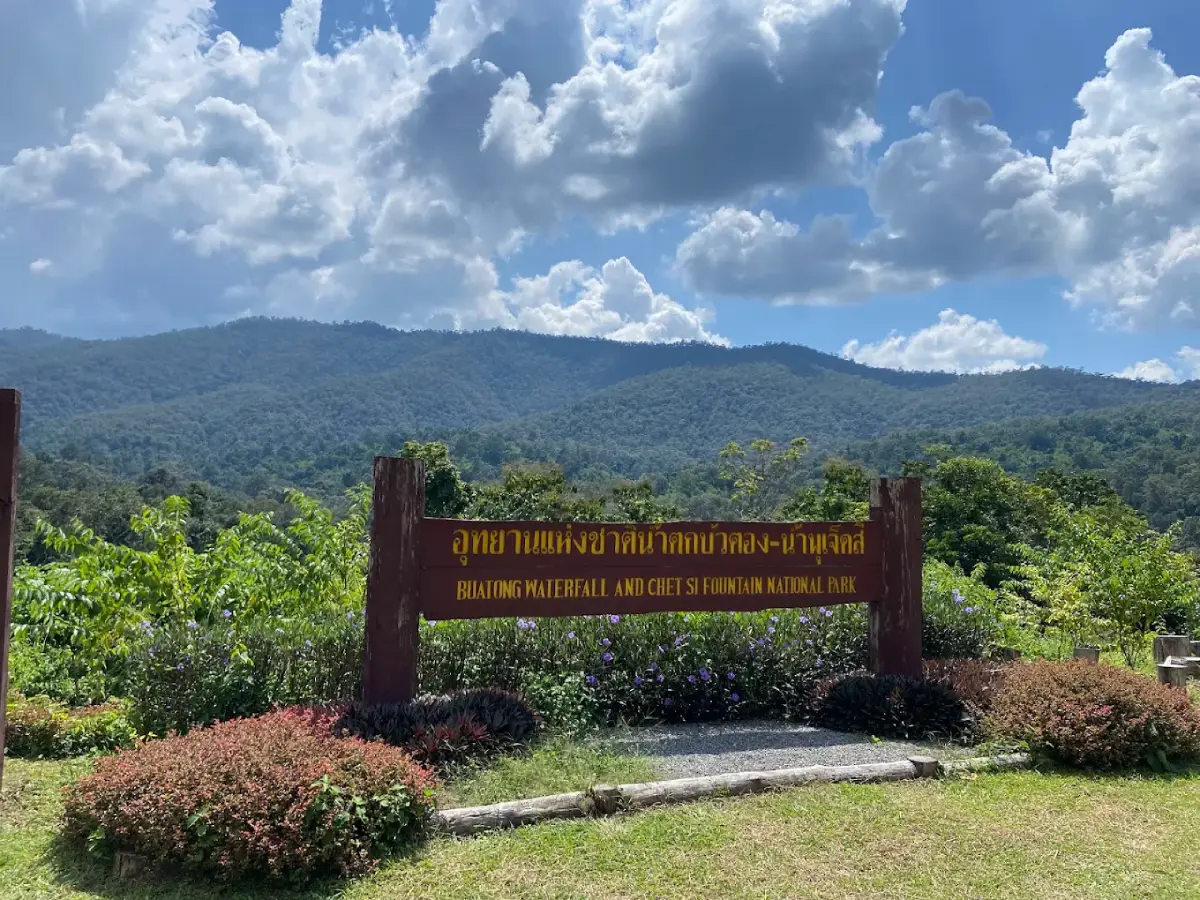
Open Days: Daily
Opening Hours: 08:00–17:00
Bua Tong Waterfall–Seven-Color Spring National Park, Chiang Mai Province, Thailand, is a remarkable natural attraction famous for its pale limestone waterfall, which visitors can climb in designated areas. Located in Moo 8, Mae Ho Phra Subdistrict, Mae Taeng District, Chiang Mai Province, approximately 60 kilometers north of Chiang Mai city, the site is distinguished by its rough-textured limestone surface, which provides unusually good traction underfoot. The waterfall is fed by the Seven-Color Spring, a natural underground water source whose mineral-rich water flows through a stream before descending over the distinctive limestone cascades.
Bua Tong Waterfall is popular with both Thai and international travelers because of a relatively unusual natural feature. Ordinary waterfalls often contain smooth, slippery rocks, making them difficult to walk on. At Bua Tong, mineral deposits have formed a rough limestone surface that can offer better grip than smooth wet rock. In the sections specifically designated for climbing, visitors can experience the moving water and surrounding geology directly rather than simply viewing the waterfall from a distance. Safety restrictions remain essential despite this natural traction.
The waterfall and spring belong to a forested landscape in northern Mae Taeng District, where mountains alternate with valleys and streams. Underground water emerges at the spring and flows through a natural channel before descending across pale limestone. From the upper area, visitors can see water spreading over the rock surface. Lower sections contain rocks, pools and channels connecting with the surrounding watershed. The scenery combines forest vegetation, flowing water and distinctive geological formations within a compact visitor destination.
Although the attraction is often described using a national park name, its administrative history includes several stages. The site was historically known as Bua Tong Waterfall and Seven-Color Spring Forest Park before becoming part of the proposed Bua Tong Waterfall–Seven-Color Spring National Park. The Department of National Parks, Wildlife and Plant Conservation has been working on the establishment process to strengthen management of the wider forest and watershed, while maintaining safe visitor access to the waterfall and spring.
History of Bua Tong Waterfall and Seven-Color Spring is closely associated with the Mae Taeng National Reserved Forest, an important natural and watershed area for the district. The spring and waterfall developed through underground water movement and limestone geology, creating a distinctive freshwater environment. As roads and access improved, the area became increasingly familiar to Chiang Mai residents and travelers interested in nature.
During its administration as a forest park, conservation authorities focused on protecting the surrounding woodland and managing access around the waterfall. Paths and visitor facilities were gradually organized to allow public use while limiting damage to the natural environment. This management is particularly important because the limestone deposits are part of an active natural process and can be affected by excessive disturbance.
On September 12, 2022, the Department of National Parks reported progress on public consultation for establishing Bua Tong Waterfall–Seven-Color Spring National Park. The surveyed area comprised approximately 53,333.53 rai, or about 85.33 square kilometers, within the San Sai and Mae Taeng national reserved forests. The broader landscape extends from roughly 350 to 947 meters above sea level and includes mountains, valleys and streams contributing to northern Thailand's watershed systems.
The proposed national park area is considerably larger than the waterfall visitor site. It is therefore important to distinguish the surveyed conservation landscape from the recreational zone containing pathways, resting areas and waterfall viewpoints. Managing the wider forest involves boundary assessment, watershed protection and conservation planning, while visitor services focus on recreation, access and safety at the natural attraction.
The Department of National Parks has emphasized the geological significance of the area near the Mae Pon fault zone. Fractures in the rocks allow water to move underground and later emerge as springs. As groundwater passes through mineral-bearing rock, it dissolves certain substances. When it reaches the surface and environmental conditions change, minerals can precipitate and build up along streams and rock surfaces. This process explains the unusual limestone characteristics of Bua Tong Waterfall.
The Origin of the Name Bua Tong is associated with the name traditionally used for the waterfall and with a local legend about Princess Bua Tong. One version of the story describes a princess praying for water to help her companions, after which a spring appeared. The legend forms part of local cultural tradition rather than a scientific explanation for the waterfall. Its actual formation is understood through the geology of limestone and the movement of groundwater.
The Seven-Color Spring takes its name from the changing colors and shimmering reflections visible when sunlight falls on the water. It is a natural cool-water spring that flows continuously from underground. The appearance of the water is influenced by its clarity, reflections, refraction, the pool bottom and dissolved minerals. It is not a hot spring or a geothermal bathing pool but a freshwater source emerging through natural openings in the rock.
The Seven-Color Spring is important for much more than its visual beauty. It is the source of the water that eventually flows over Bua Tong Waterfall. Protecting the spring from contamination and disturbance is therefore essential to the wider water system. As the water moves through the channel and across limestone, chemical and physical changes continue, making the spring and waterfall different parts of one connected natural process.
The Geography of Bua Tong Waterfall and Seven-Color Spring consists of mountains, valleys and streams among forested slopes. The spring and waterfall occupy a relatively sheltered depression within this terrain. Underground channels bring water from the mountain catchment toward the surface. After emerging, the water follows the natural gradient, descending across the limestone and joining the Mae Pon stream system.
The combination of hills and valleys affects forest distribution and local humidity. Streamside areas have a more continuous supply of moisture, supporting plants that may differ from those on exposed slopes. Observing the landscape from the designated walkways demonstrates the relationships among forests, groundwater and limestone terrain.
The Geology of Bua Tong Waterfall is closely connected with limestone and calcium carbonate. As rainwater moves through the atmosphere and soil, it can absorb carbon dioxide and form weak carbonic acid. This slightly acidic water dissolves limestone gradually as it passes through cracks and openings, carrying calcium and carbonate-related substances through the underground water system.
When mineral-bearing water reaches the open air, the chemical conditions may change and calcium carbonate can precipitate onto surfaces the water passes over. Repeated deposits gradually produce porous, rough-textured limestone. These mineral layers are a major reason why Bua Tong Waterfall has a pale appearance and why certain parts of its rock surface provide better traction than smooth wet stone.
Why Visitors Can Climb Bua Tong Waterfall can be explained by the texture of the limestone. Mineral deposits create a surface with small irregularities and pores that can produce friction against the soles of the feet. Compared with polished rock, appropriately textured limestone can be easier to grip. However, traction varies across the site, and some areas may contain algae, loose deposits or stronger currents. Climbing must be restricted to authorized routes.
The grip provided by limestone does not mean every section is safe. Some parts of the waterfall are steep, contain deep channels or experience faster-moving water. Visitors must assess their balance carefully and follow designated routes. Slipping and injuries remain possible, particularly for people unfamiliar with using their feet and hands on inclined wet surfaces.
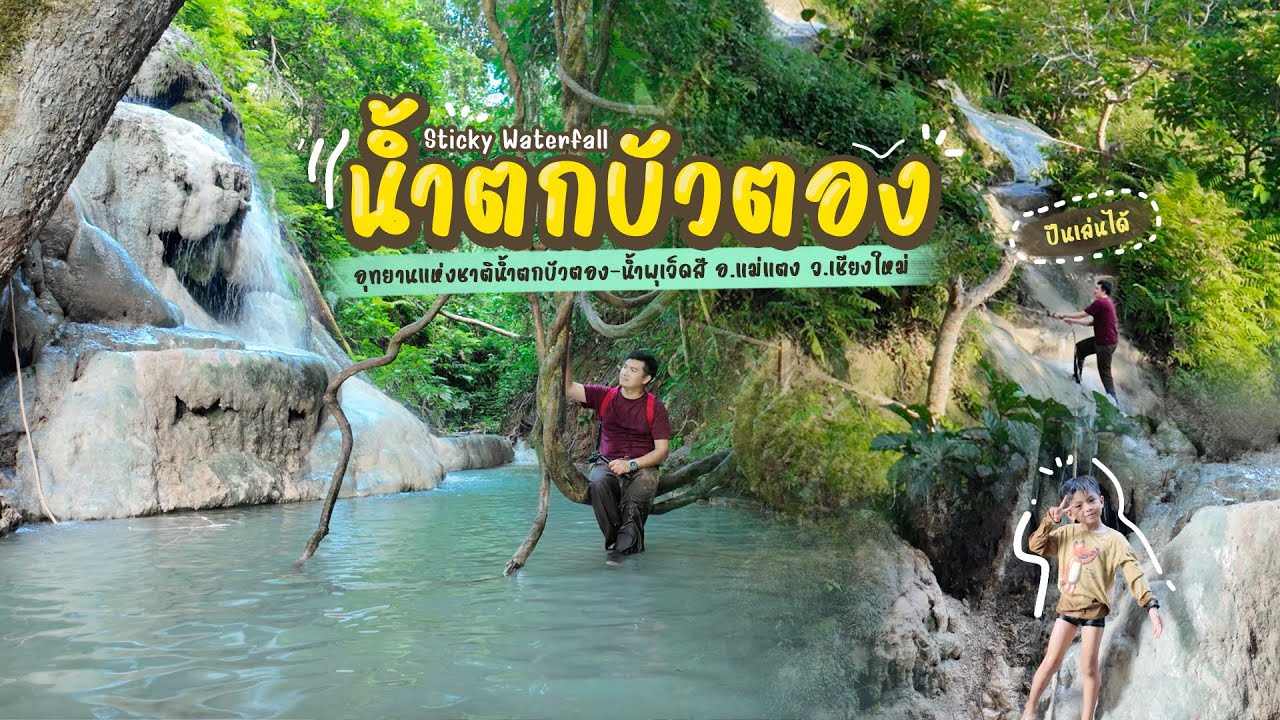
Bua Tong Waterfall is a medium-sized limestone cascade descending along a forested hillside. Published tourism information describes an overall vertical descent of approximately 100 meters, with certain slopes approaching 50 degrees. Water spreads over pale limestone, creating bright flowing surfaces against the green forest. The contrast between the white rock, moving water and vegetation is one of the waterfall's most recognizable features.
The waterfall is divided into different sections for visitor access. Some geological descriptions identify two principal tiers, while tourism information commonly refers to three accessible sections or levels. These descriptions use different methods of dividing the same connected waterfall. All refer to the water descending from Seven-Color Spring toward the Mae Pon stream.
The Upper Section of Bua Tong Waterfall connects with the visitor facilities and upper walking paths. Here, the water begins spreading over limestone before descending farther downhill. The area is useful for observing the color and texture of the mineral deposits and the transition from a relatively gentle stream into a steeper waterfall.
The Middle Section contains inclined limestone and flowing water that descend through a series of natural steps. Visitors can compare the mineral-coated surface with the surrounding soil and rock. Careful footing and the use of designated handholds are important. Those who prefer not to climb the wet limestone can use the adjacent stairway or walking paths.
The Lower Section of Bua Tong Waterfall lies where the descending water connects with the stream farther downhill. Natural rocks and small pools provide views of the waterfall from below. Walking down via the path and climbing back up the designated limestone route is a popular activity, but visitors should consider their fitness and the conditions on the day. It is not necessary to climb every section to enjoy the scenery.
The Seven-Color Spring is a natural cool-water spring with a pool approximately 6 by 8 meters in size. Water rises from underground throughout the year and flows toward Bua Tong Waterfall. Under suitable conditions, the water is clear enough to reveal parts of the pool bottom. Surrounding forest vegetation provides shade, giving the spring a quieter atmosphere than the more exposed waterfall.
Much of the spring's beauty comes from its calm surface and the changing light. When sunlight passes between branches, reflections and colors appear differently according to the time of day. The name refers to this shimmering appearance, not to seven separate waters or a permanent sequence of seven distinct colors.
The spring requires careful protection because its water directly feeds the waterfall. Walking into the pool or disturbing bottom sediments can affect the clarity and condition of the source. Visitors should observe the spring from designated paths, avoid entering the water and protect its natural environment.
The Connection Between Seven-Color Spring and Bua Tong Waterfall is central to understanding the attraction. Groundwater carries dissolved minerals from limestone layers before emerging at the spring. As the water flows downhill, it comes into greater contact with the atmosphere and different surfaces, allowing mineral precipitation under suitable conditions. The upstream feature is a clear spring, while the downstream environment contains extensive pale limestone deposits.
The limestone formation process continues after water reaches the waterfall. In suitable locations, mineral deposits slowly accumulate, changing the surface over time. Rainfall and flowing water can also erode or carry away existing material. The present waterfall therefore reflects an ongoing balance among limestone dissolution, mineral deposition and moving water.
Huai Mae Pon is part of the stream network receiving water from the waterfall and nearby natural sources. After passing through the limestone cascades, the water joins the lower stream system and continues through the landscape. These waterways support drainage from the forest and connect with the wider Ping River basin.
A spring-fed stream differs from a watercourse that receives substantial flow only after rainfall because groundwater can provide a more continuous supply. Nevertheless, discharge still varies with rainfall, groundwater storage and broader environmental conditions. Protecting the surrounding watershed helps preserve the natural water cycle.
The Forests Around Bua Tong Waterfall and Seven-Color Spring help maintain humidity and shade over the watershed. Tourism descriptions refer to evergreen and mixed forests, with vegetation changing according to soil, elevation and water availability. Moist streamside areas support different plants from more exposed slopes, contributing to the ecological diversity of the site.
Large trees intercept rainfall, while their roots stabilize the soil and help reduce rapid runoff on slopes. Fallen leaves gradually decompose into organic matter that supports soil fertility. Healthy watershed forests therefore contribute to the conditions needed for natural springs and streams to function.
The forests surrounding the waterfall also provide habitats for birds, insects, reptiles and small animals. Some species depend on streamside environments, while others occupy forested areas away from visitor paths. Reducing noise and avoiding discarded food help protect wildlife and prevent changes in natural behavior.
The Ecology of Limestone Streams is influenced by water containing dissolved minerals. Mineral deposits create surfaces different from ordinary rocks or soil. Plants growing near the channel must tolerate moisture and moving water, while small aquatic and streamside organisms may use the crevices and sheltered areas among the rocks.
Preventing contamination is especially important because the spring and waterfall form one connected water system. Cleaning products, litter and waste can affect freshwater organisms and the condition of natural mineral deposits. Visitors should not use soap or shampoo in the stream or leave food waste in the water.
Climbing Bua Tong Waterfall is the activity for which the site is internationally known. Visitors can place their feet on the limestone along approved routes and use their hands for balance on steeper sections. Ropes or designated handholds may be available where additional support is needed. Moving upstream requires concentration and careful placement of each step because the rock surface and water force change along the route.
Before climbing, visitors should observe the route from above and choose an activity suited to their ability to balance. Those unfamiliar with inclined wet surfaces may prefer the gentler sections. Steeper parts require particular care and strict adherence to the authorized path. The existence of climbable limestone does not mean unrestricted access to the entire waterfall.
Using Support Ropes can be helpful where the cascade becomes steep or secure footholds are limited. A rope assists with balance and controlled movement, but it cannot replace good footing or physical judgment. Anyone uncomfortable with a particular section can choose the side walkway instead.
Descending Bua Tong Waterfall presents different challenges from climbing upward. Gravity encourages movement downhill, and wet inclines can cause a loss of balance. Many visitors therefore use the stairs or side trail to reach lower levels before attempting the permitted upward climb. This also provides an opportunity to examine the route and decide which sections are appropriate.
The side paths are suitable for visitors who wish to enjoy the scenery without climbing the limestone itself. They provide views of the moving water and different tiers while accommodating people with varying interests and abilities.
Rest Areas and Visitor Facilities are located near the upper entrance. Facilities include parking, toilets, changing areas and places to rest, with food and beverage services available according to current operations. These areas allow families to prepare before descending to the waterfall and to rest afterward.
Upper visitor facilities also help manage crowds, especially on weekends and during popular holiday periods. Keeping parking separate from the waterfall paths reduces pressure on the natural area. Toilets and changing facilities reduce the need for activities that could contaminate the stream, making visitor infrastructure part of the conservation effort.
Visiting Seven-Color Spring from the Main Visitor Area involves walking along the designated connecting path. Actual walking arrangements depend on which routes are open. The spring is comparatively peaceful, with clear water and forest vegetation, while the waterfall is characterized by moving water and more active recreation. Seeing both reveals the relationship between the source and the downstream cascade.
Responsible Behavior Around the Spring involves keeping the area clean and undisturbed. Visitors should remain on established paths, avoid stirring up sediments and never throw coins, food or other objects into the water. The spring can be photographed from the designated viewpoints without entering the pool.
Safety at Bua Tong Waterfall remains essential even though the limestone provides unusually good traction. Visitors must be alert to uneven surfaces, stronger water flow, algae and sudden changes in elevation. Jumping from high rocks, running on wet stone or pushing others on the inclined surface can cause injuries and must be avoided.
People with ankle or leg injuries, mobility limitations or balance difficulties should consider the side paths instead of climbing. Children require close adult supervision, especially on steeper sections. Older visitors can enjoy suitable upper-level facilities and viewpoints without attempting demanding routes.
Footwear and Limestone Walking influence stability. Some visitors prefer bare feet to experience the natural texture of the rock, while loose or slippery footwear can be difficult to control on wet inclines. Regardless of footwear, visitors should follow current ranger instructions and stay within the permitted activity zones.
At narrow sections and near support ropes, visitors should allow others enough space to complete each movement securely. Maintaining appropriate spacing reduces collisions and falls, particularly when the waterfall is crowded.
Visiting During the Cool Season is popular because Chiang Mai generally experiences more comfortable outdoor temperatures. November through February is a particularly busy period for the waterfall and spring. The surrounding forest remains inviting, and cooler conditions make walking and nature observation more comfortable than during the hottest months.
Morning visits offer a peaceful atmosphere and attractive light filtering through the trees. Sunlight gradually illuminates the pale limestone, revealing its texture, while the spring's reflections change as the angle of light shifts. The visual character of the two attractions therefore varies throughout the day.
Visiting During the Hot Season offers a different experience. Daytime temperatures outside the forest may be high, while shaded sections near the water feel cooler. Exposed limestone can receive direct sunlight, so hydration and suitable timing are important for outdoor comfort and safety.
Visiting During the Rainy Season brings lush vegetation and continuous water movement through the stream system. However, heavy rain can make walking paths wet, increase water force and reduce visibility. Sections that are manageable in ordinary conditions may become unsuitable for climbing during storms or periods of strong flow. Visitors must respect ranger restrictions and temporary closures.
The amount and strength of water influence the difficulty of climbing the limestone. Stronger currents make balance and rope use more challenging, while rain can transport loose materials into the channels. Safety assessments must consider weather and water conditions rather than relying on the rough rock texture alone.
Conservation of the Waterfall's Limestone requires cooperation from visitors. The pale formations are created by gradual mineral deposition. Forceful impacts or entering unauthorized areas can damage delicate surfaces. Remaining on approved routes helps protect the deposits and minimize additional erosion caused by human activity.
Keeping the limestone and streams free of waste also benefits visitor safety. Food, chemicals and rubbish can affect the water environment and introduce hazards. Avoiding cleaning products in the natural water and removing rubbish help preserve both the landscape and the quality of the visitor experience.
Photography at Bua Tong Waterfall is distinctive because pale limestone contrasts strongly with green forest. From above, the water spreads downhill across a broad surface. From below, the height and layered shape of the cascade become more apparent. These views differ considerably from waterfalls dominated by dark exposed rock.
Photography during climbing must be approached carefully. Carrying a camera or phone on a steep wet slope reduces the ability to use both hands for support. Flat areas and designated viewpoints are more appropriate places to stop for photographs. Visitors should avoid blocking narrow climbing routes.
Photography at Seven-Color Spring emphasizes calm water, reflections and the forest surroundings. Light passing through the canopy changes the visible colors and reflections. Observing and photographing the water from designated points protects the clarity and condition of the pool.
Getting to Bua Tong Waterfall from Chiang Mai City is possible via Highway 1001 toward Phrao, followed by signed local roads leading toward Mae Ho Phra in Mae Taeng District. The total distance is approximately 60 kilometers, depending on the starting point and route. The journey passes communities and gradually transitions from relatively level land toward forested hills.
Another approach connects through Mae Taeng District and local roads leading toward Mae Ho Phra. The preferred route depends on where the journey begins and which additional attractions are included. Travelers commonly use a private car, rental vehicle or hired driver because convenient direct public transportation to the waterfall entrance is limited.
The access roads form part of Mae Taeng's rural road network, passing villages and forested sections. Drivers should take care at curves and junctions and during periods of rain or reduced visibility. Daytime travel allows clearer views of the route and leaves sufficient time to visit the spring and waterfall during operating hours.
Nearby Attractions in Mae Taeng District include Buddhist temples, reservoirs, national park landscapes and riverside communities. Wat Ban Den, Mae Ngat Somboon Chon Dam, Si Lanna National Park and the wider Mae Taeng River area offer experiences different from the climbable limestone waterfall and can form part of a broader visit to northern Chiang Mai.
Wat Ban Den Sali Si Mueang Kaen is a striking Buddhist temple in Mae Taeng District. The complex is known for substantial religious buildings, elaborate decoration and a carefully organized temple landscape. Its importance lies in Buddhist devotion, community connections and Lanna-influenced religious art. Visiting the temple offers a cultural contrast to the natural formations of Bua Tong Waterfall.
Mae Ngat Somboon Chon Dam is a major reservoir in Mae Taeng District associated with irrigation and water management. Its wide water surface and surrounding hills offer scenery very different from a limestone waterfall. The reservoir belongs to the wider Ping River region and demonstrates another important role of water in the lives and landscapes of northern Thailand.
Si Lanna National Park is another protected area in northern Chiang Mai. It contains mountainous forests and important freshwater landscapes associated with the Ping River basin. Although it is part of the same wider region as Bua Tong Waterfall, it has its own administrative boundaries and visitor facilities. The entrances and attractions should therefore be distinguished from those of the waterfall.
Wat Tham Bua Tong is a Buddhist temple in Mae Ho Phra Subdistrict, Mae Taeng District, associated with a cave and the surrounding natural landscape. A visit highlights the connections between religious sites and mountain environments in northern Thailand. Visitors should dress respectfully and observe the temple's rules.
Mae Taeng Community Attractions include farmland, cafés, accommodation and riverside recreation. Traveling through Mae Ho Phra, Cho Lae and nearby subdistricts reveals a landscape of plains, hills and rural settlements. Agriculture, trade and tourism services contribute to the livelihoods of these communities.
Restaurants Around Bua Tong Waterfall include community eateries, resort restaurants and cafés along the Mae Taeng tourism routes. Cho Lae and the Mae Ngat Dam area contain various dining options, including Thai dishes, northern Thai food and coffee. Eating in local communities adds a rural dimension to the visit and contributes to the area's tourism economy.
Accommodation Near Bua Tong Waterfall includes resorts in Mae Ho Phra, rural properties in Cho Lae and hotels around Mae Taeng town. Some offer peaceful countryside surroundings near farmland or hills, while others are conveniently located along main roads. Staying within Mae Taeng allows visitors to enjoy the waterfall and connect with other attractions without returning to central Chiang Mai on the same day.
Overnight stays in the district also provide opportunities to experience the local landscape beyond the waterfall. The surrounding countryside includes rice fields, agricultural communities and mountain scenery that change with the seasons. Staying nearby gives travelers greater flexibility to enjoy nature and explore the region.
The Importance of Bua Tong Waterfall and Seven-Color Spring to Local Communities includes natural water resources, forest conservation and tourism. The surrounding watershed supports streams, while the waterfall attracts visitors to Mae Taeng District. Restaurants, accommodation providers and transport operators benefit from this activity, creating connections between environmental protection and local livelihoods.
As tourism grows, visitor numbers and cleanliness require careful management. The waterfall has limited climbing and walking space, and crowding can create congestion on the inclined limestone. Respectful use of shared paths reduces disturbance to the natural environment and helps visitors enjoy the attraction safely.
Environmental Education for Children and Families is another important aspect of the destination. The site provides visible examples of underground springs, limestone dissolution, calcium carbonate deposition, freshwater movement and the formation of rough mineral-coated surfaces. Children can learn how landscapes develop through natural processes that continue over long periods.
The attraction also provides practical opportunities to learn about outdoor safety, balance, safe route selection and following ranger instructions. Family members who do not climb the waterfall can still enjoy the side paths and viewpoints. Each visitor should choose activities suited to their own abilities.
Long-Term Conservation of Seven-Color Spring is directly connected to preserving Bua Tong Waterfall. The spring supplies the water and dissolved minerals essential to the limestone-forming process. Changes in the watershed can affect both water quantity and quality. Forest protection, pollution prevention and appropriate tourism management are therefore all important to conserving the complete natural system.
Bua Tong Waterfall offers a particularly clear example of the relationship between geology and tourism. The chemistry of the spring water and the structure of the limestone directly shape the visitor experience. Without mineral-rich groundwater and the deposition of calcium carbonate, the waterfall would not have the distinctive surface that sets it apart from many other cascades. Conservation must therefore protect not only the visible scenery but also the underlying natural processes.
Bua Tong Waterfall–Seven-Color Spring National Park in Chiang Mai Province is a destination of outstanding geological, ecological and educational interest. Its remarkable climbable limestone waterfall, clear cool-water spring and surrounding watershed forests create a natural environment quite different from conventional waterfall attractions. The designated climbing routes offer a distinctive visitor experience, while the spring and forest demonstrate the importance of protecting natural water systems.
Visiting Bua Tong Waterfall and Seven-Color Spring provides an opportunity to observe how rock, water, minerals and forests are connected. From the spring where groundwater emerges, the water flows downhill and forms pale limestone cascades with an unusual texture. These continuing natural processes are the defining value of the site and the reason it deserves careful conservation for future generations.
| Place Name | Bua Tong Waterfall–Seven-Color Spring, Chiang Mai, Thailand |
| Protected Area Name | Bua Tong Waterfall and Seven-Color Spring Forest Park; Proposed Bua Tong Waterfall–Seven-Color Spring National Park |
| Address | Moo 8, Mae Ho Phra Subdistrict, Mae Taeng District, Chiang Mai Province 50150, Thailand |
| Waterfall Reference Coordinates | 19.067350, 99.075254 |
| Managing Authority | Department of National Parks, Wildlife and Plant Conservation, Thailand |
| Proposed National Park Survey Area | Approximately 53,333.53 rai, or 85.33 sq km |
| Visitor Status | Open for General Visits During Published Hours; Waterfall Activity Routes Are Subject to On-Site Safety Restrictions |
| Open Days | Daily |
| Opening Hours | 08:00–17:00 |
| Entrance Fee | Free General Admission to the Waterfall and Spring Visitor Areas |
| Site Contact Number | +66 93 139 3556 |
| Tourism Authority of Thailand Contact Number | +66 53 479 079 |
| Distinctive Features | Rough-Textured Pale Limestone Cascade That Can Be Climbed Along Authorized Routes; Clear Natural Cool-Water Spring |
| Waterfall Height | Approximately 100 meters of overall descent |
| Seven-Color Spring Dimensions | Approximately 6 x 8 meters |
| Source of the Water | Seven-Color Spring and the Local Limestone Groundwater System |
| Associated Stream | Huai Mae Pon, Connected with the Wider Ping River Basin |
| Main Visitor Zones | 1. Visitor Services and Parking 2. Waterfall Access Paths 3. Upper Bua Tong Waterfall 4. Middle Bua Tong Waterfall 5. Lower Bua Tong Waterfall 6. Seven-Color Spring and Source-Water Walkway 7. Designated Resting Areas |
| Facilities | Parking, Toilets, Changing Areas, Stairs, Walking Paths, Rest Areas and Food Services When Operating |
| Activities | Authorized Waterfall Climbing, Spring Observation, Nature Study, Photography and Relaxation |
| Getting There from Chiang Mai City | Approximately 60 km, generally via Highway 1001 toward Phrao and signed local roads toward Mae Ho Phra, Mae Taeng District |
| Nearby Attractions | 1. Seven-Color Spring – Within the Same Attraction 2. Wat Tham Bua Tong – Mae Ho Phra, Tel. +66 62 690 9112 3. Wat Ban Den Sali Si Mueang Kaen – Approximately 25 km 4. Mae Ngat Somboon Chon Dam – Approximately 30 km 5. Si Lanna National Park – Mae Taeng Area 6. Mok Fa Waterfall – Approximately 40 km 7. Chiang Dao Cave – Approximately 55 km 8. Baan P Tong – Mae Taeng Area, Tel. +66 86 116 0277 |
| Restaurants and Cafés Along Nearby Travel Routes | 1. Doona Resort Restaurant – Cho Lae, Mae Taeng 2. Kramfeine – Approximately 28 km, Tel. +66 88 137 0543 3. Krua Sai Nathi – Mae Ngat Dam Area, Approximately 30 km, Tel. +66 90 891 0805 4. PHU Forest Cafe & Restaurant – Approximately 40 km, Tel. +66 85 449 2888 5. Pankled Coffee – Approximately 40 km, Tel. +66 81 881 7308 6. Baan P Tong – Cho Lae, Mae Taeng, Tel. +66 86 116 0277 |
| Accommodation Near the Waterfall and Along Travel Routes | 1. Bua Tong Resort – Mae Ho Phra, Tel. +66 81 952 3259 2. Doona Resort – Cho Lae, Mae Taeng, Tel. +66 93 275 3888 3. Monmaetang Resort – Approximately 30 km, Tel. +66 97 925 9581 4. CherPue Chiangmai – Approximately 30 km, Tel. +66 95 451 0095 5. Phusanfah Resort – Approximately 45 km, Tel. +66 87 702 9888 6. Wasana Guesthouse – Mae Taeng, Tel. +66 85 708 4650 7. Ban Akeela Homestay – Cho Lae, Mae Taeng, Tel. +66 64 684 8767 |
Frequently Asked Questions (FAQ)
Q: Where is Bua Tong Waterfall–Seven-Color Spring located?
A: It is located in Moo 8, Mae Ho Phra Subdistrict, Mae Taeng District, Chiang Mai Province, approximately 60 kilometers north of Chiang Mai city.
Q: What are the opening hours, and is there an entrance fee?
A: Published general visiting hours are 08:00–17:00 daily, and general admission to the waterfall and spring is free.
Q: Why is Bua Tong Waterfall climbable?
A: Mineral-rich water deposits calcium carbonate on the rock, creating a rough-textured pale limestone surface that offers better traction in suitable areas. Visitors must climb only on authorized routes.
Q: Is Seven-Color Spring a hot spring?
A: No. It is a natural cool-water spring that flows continuously from underground and supplies the water that forms Bua Tong Waterfall.
Q: How many tiers does Bua Tong Waterfall have?
A: Visitor routes commonly describe upper, middle and lower sections, while some geological records describe two main levels. The overall descent is approximately 100 meters.
Q: Is the attraction suitable for children and older visitors?
A: General visitor facilities and designated viewpoints can be suitable depending on individual mobility. Climbing the waterfall requires balance and involves steep slopes. Children need adult supervision, and visitors with mobility limitations may prefer the side paths.
Q: What is the best season to visit?
A: November through February generally offers cooler weather for outdoor activities. The rainy season brings greener forests, but slippery paths and stronger water flow require additional caution.
Q: What attractions are near Bua Tong Waterfall?
A: Connected destinations include Wat Tham Bua Tong, Wat Ban Den Sali Si Mueang Kaen, Mae Ngat Somboon Chon Dam, Si Lanna National Park, Mok Fa Waterfall and Chiang Dao Cave.
 Category: ●Nature and Wildlife
 Group: ●National Parks and Marine Reserves
Last Update : 2 WeekAgo
 Last Update : 2 WeekAgo
 Click to Access the Navigation Map GPS
Bua Tong Waterfall–Seven-Color Spring National Park Map
Recommend

 Art, Culture and Heritage
 Historical Sites and Monuments(8)
 Landmarks and Memorials(5)
 Royal Palace(2)
 Art, Craft Centres, Tradition(43)
 Museums(24)
 Educational Places
 Museum for Study(2)
 Educational Gardens, Farm(5)
 Training Center(1)
 Places of Worship
 Temple(79)
 Mosque(2)
 Other Sacred Sites(17)
 Research and Development
 Royal Project(45)
 Suburban Living
 Village, Community(41)
 Local Market(14)
National Parks and Marine Reserves(18)
 Mountain (Doi)(21)
 Dam, Reservoir, Lake(26)
 Waterfalls(43)
 Hot Springs(12)
 Caves(11)
 River, Canal(6)
 Other natural attractions(14)
 Entertainment and Agricultural
 Zoos and Aquariums(3)
 Animal camps and shows(3)
 Stadium(1)
 Farms, Parks and Ecotourism(19)
 Waterpark(2)
 Theater(1)
 Outdoor and Adventure Activities(10)
 Shopping
 Shopping and Night Market(6)
 Restaurant
 Michelin Star(1)
 Michelin Guide(23)
 Call Customer Service in Tourism
 Call Customer Service in Tourism(1)
 Travel Articles, Recipes
 Travel Review, Food Review(24)
 Food Menu, North Recipes(30)
 Thai Desserts, North Recipes(17)


