
lovethailand home >South Travel Attractions >Trang Travel Attractions >Huai Yot >Khao Kop > Tham Le Khao Kob
TL;DR: Tham Le Khao Kob is located at Moo 1, Khao Kob Subdistrict, Huai Yot District, Trang Province, open Daily, Except During High-Water Periods Or Temporary Safety Closures, hours 08.00 – 18.00.
Tham Le Khao Kob
Open Days: Daily, Except During High-Water Periods Or Temporary Safety Closures
Opening Hours: 08.00 – 18.00
Tham Le Khao Kob in Trang Province is located in Moo 1, Khao Kob Subdistrict, Huai Yot District. It is a limestone river cave explored by local paddle boat along an underground stream beneath Khao Kob hill. The cave route is about 4 km and includes beautiful stalactites and stalagmites, named chambers such as Chao Sao Cave, Rak Sai Cave, and Khon Than Cave, and the famous low-ceiling passage known as Tham Lot or the Dragon’s Belly. Visitors must lie flat in the boat while experienced local boatmen guide it through the narrow passage. The boat fee is 300 Baht per boat for up to 5 people, and the trip takes about 45–50 minutes. This cave is suitable for travelers interested in limestone caves, eco-tourism, community boat guiding, and inland Trang beyond beaches and islands.
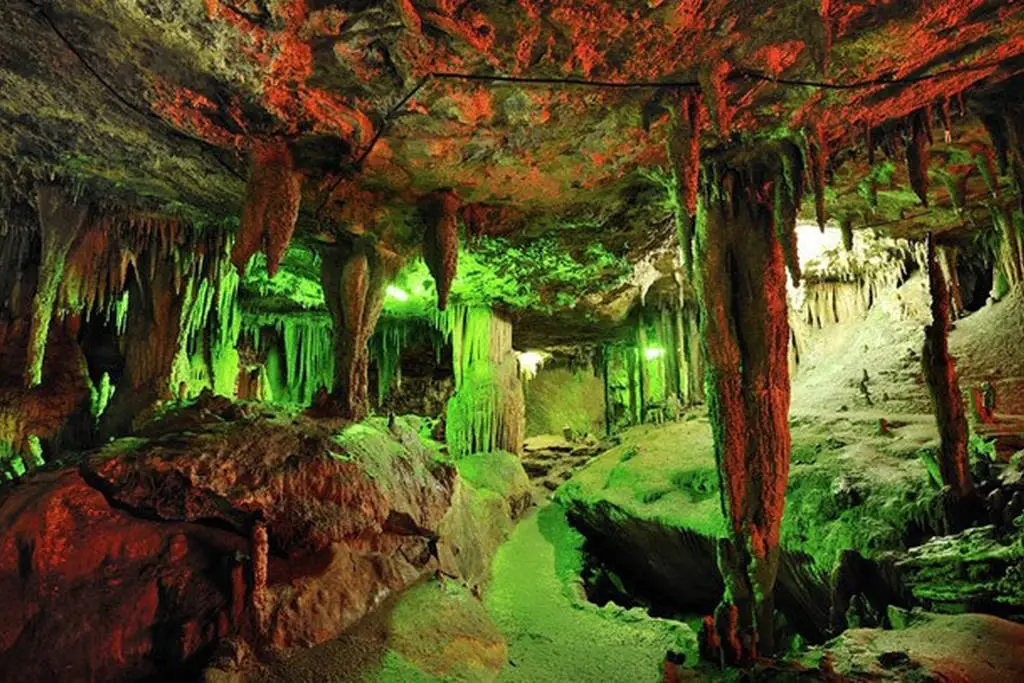
Tham Le Khao Kob is one of Trang Province’s most distinctive natural attractions. It is not a cave that visitors simply walk into and explore independently. The main experience is a guided paddle-boat journey along an underground stream through a limestone cave system. Inside are water passages, narrow openings, cave chambers, stalactites, stalagmites, rock curtains, hanging roots, local legends, and the famous low-ceiling section that has become the cave’s signature experience.
The cave is located in Moo 1, Khao Kob Subdistrict, Huai Yot District, Trang Province. The surrounding landscape consists of limestone hills, streams, local village areas, rubber-growing land, and the inland route of Huai Yot. Water flows around the hill and through the limestone cave system, creating the route that visitors use today. Because the cave depends on water level and cave conditions, the trip is led by local boatmen who understand the channel, the safe water height, and the correct way to pass through each section.
The core travel description of Tham Le Khao Kob explains that it is a cave with a stream flowing through and around the hill. Inside the cave are beautiful and well-preserved stalactites and stalagmites visible during the boat journey and in certain chambers where visitors can walk. Important named sections include Chao Sao Cave, Rak Sai Cave, Khon Than Cave, and the most famous section, Tham Lot or Dragon Cave. The full exploration route is about 4 km, and the most thrilling moment comes when everyone lies flat in the boat to pass beneath the lowest cave ceiling.
The word “Le” in the local name does not mean a sea cave on the coast. In southern Thai usage, it can refer to water or a broad watery place. This meaning fits Khao Kob Cave because water is the defining element of the site. The cave is inland, far from the sea, but it has water flowing through the limestone hill. The name therefore directly reflects the cave’s real character: a large watery cave in the Khao Kob area.
The landscape around Khao Kob is formed by limestone. Streams from the wider mountain and watershed area divide around the hill, with part of the water flowing around the rock mass and part flowing beneath it. Over time, water dissolved the limestone and created passages, chambers, cavities, and underground routes. This combination of water and limestone makes Tham Le Khao Kob different from many dry caves in southern Thailand.
Inside the cave, visitors see many limestone formations, especially soda-straw stalactites that represent an early stage of stalactite formation. These delicate formations develop when mineral-rich water drips from the cave ceiling and deposits calcium carbonate over a long period. Some forms resemble curtains, some appear as columns, and some hang as narrow tubes from the ceiling. The cave’s beauty is entirely natural and should be protected carefully.
The cave system includes several named chambers and sections such as Khon Than Cave, Rak Sai Cave, Thong Phra Rong Cave, Phra Sawan Cave, Taphap Nam Cave, Phet Cave, Phloi Cave, Paeng Cave, Chao Sao Cave, and Tham Lot or Dragon Cave. Actual visitor access can vary according to water level, safety conditions, and local management decisions. Visitors should follow the boatmen’s instructions because some parts of the cave require precise handling and local experience.
Khon Than Cave is remembered for its local legend and sound. Local stories say that celestial musicians once played music for a kinnari bathing in the cave. Some stones in this chamber can produce a resonant sound when gently tapped, which supports the musical character of the legend. Whether visitors approach it as folklore or natural acoustics, the chamber adds narrative value to the trip.
Chao Sao Cave is another memorable chamber. Its formations resemble a curtain and a stone bed, giving rise to local stories about love, marriage, and good fortune. The chamber is often described as one of the cave’s most photogenic and story-rich sections. Its appeal lies not only in limestone formations but also in the way local imagination has shaped the visitor experience.
Rak Sai Cave is known for banyan roots that extend through the cave environment. These roots show the connection between the world above the hill and the hidden underground spaces. Trees growing outside still reach downward toward moisture inside the cave. This makes the cave feel like one continuous natural system of rock, water, soil, and plant life rather than a closed underground chamber.
Thong Phra Rong Cave gives a stronger sense of spaciousness. Its name suggests a grand hall, and the chamber helps balance the journey between narrow water passages and wider cave rooms. Stopping or slowing through a wider chamber allows visitors to observe the structure of the limestone cave more clearly before returning to lower and tighter passages.
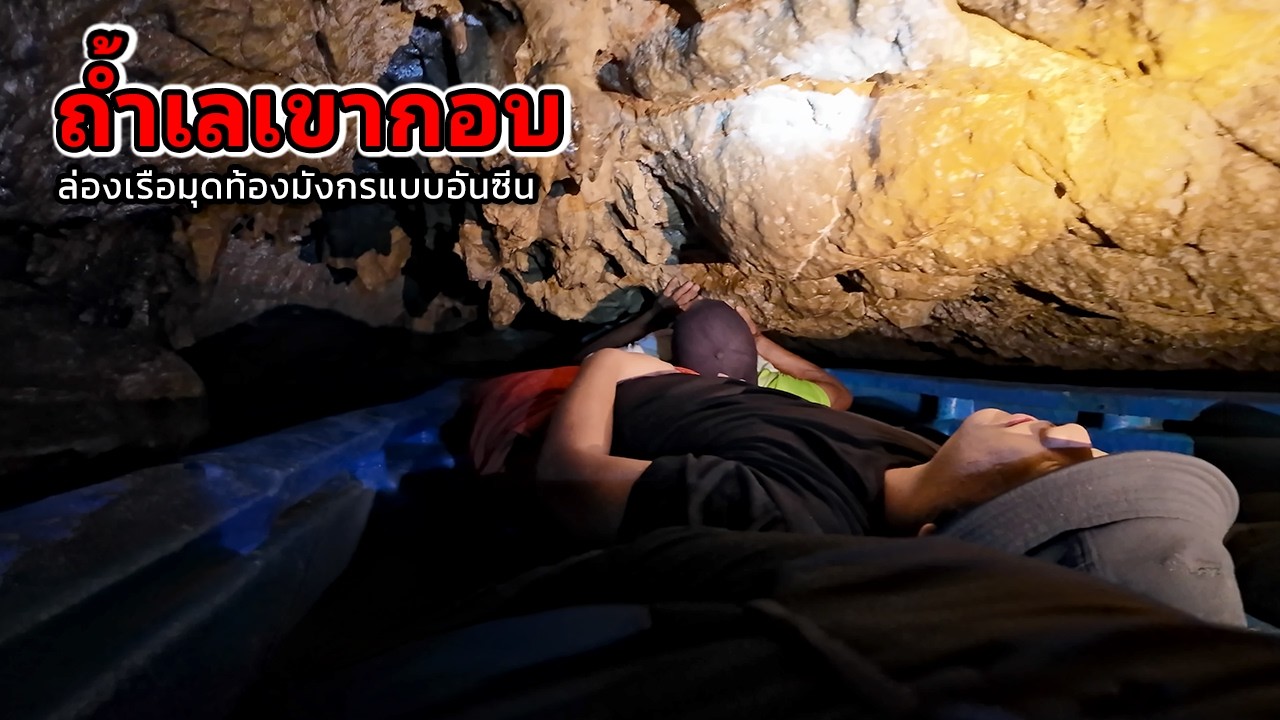
The most famous highlight is Tham Lot, also known as Dragon Cave or the Dragon’s Belly. In this section, the cave ceiling drops so low that visitors must lie flat in the boat. The boatmen then guide the boat carefully through the narrow passage. The Dragon’s Belly section is often described as around 350 meters long. It is dark, tight, silent, and dramatic, creating the experience that has made Tham Le Khao Kob famous across Thailand.
The Dragon’s Belly experience combines adventure and belief. Visitors must remain still, keep their bodies low, and trust the boatmen’s skill. Local belief connects the passage with good fortune and cleansing away misfortune. Even for travelers who view it simply as an adventure, the passage is the defining moment of the cave because it requires direct physical participation rather than passive sightseeing.
The cave visit is managed by Khao Kob Subdistrict Administrative Organization, with local paddle boats and community boatmen providing the cave tour. The boat fee is 300 Baht per boat for up to 5 people, and the journey takes around 45–50 minutes. Paddle boats help reduce noise, fumes, and disturbance inside the cave. This also keeps local people directly involved in the tourism economy and conservation of the cave route.
Tham Le Khao Kob can normally be visited throughout the year, but trips are suspended during high-water periods or unsafe weather. Because a stream flows through the cave, heavy rain can change water level quickly. If the water becomes too high, the low-ceiling passage can become unsafe. During the rainy season, travelers should contact Khao Kob Subdistrict Administrative Organization before making the trip.
Visitors should prepare for both cave and water conditions. Wear comfortable clothes, avoid carrying bulky bags, protect phones and cameras in a dry bag, and listen carefully to the boatmen before entering the Dragon’s Belly section. Visitors with claustrophobia, fear of darkness, back or neck problems, or difficulty lying flat in a moving boat should tell staff before joining the boat trip.
During the boat ride, visitors should not touch stalactites or stalagmites, shine strong lights unnecessarily, stand up in the boat, make loud noise, or move suddenly. The cave is narrow in places, and the boat must remain balanced. A safe and respectful cave trip depends on cooperation between visitors and local boatmen.
The area outside the cave retains a clear community character. The boat-service point is in Khao Kob Subdistrict and connects easily with other nearby attractions such as Khao Hua Taek, Wang Thep Taro, Wat Khao Kob, Tham Khao Pina, and Huai Yot town. This makes the cave suitable for a half-day or full-day Huai Yot itinerary rather than a single quick stop.
Getting There from Huai Yot District Office is straightforward. Take Phetkasem Road for about 8 km, pass Andaman Intersection, continue about 3 km, then turn left and follow the side road for about 700 meters to Tham Le Khao Kob. From Trang city, travel toward Huai Yot and continue to Khao Kob Subdistrict. The distance from Trang city is around 30 km, and normal driving time is about 40 minutes.
Private car, rental car, or motorcycle is the most convenient option. Travelers without private transport can take a Trang–Huai Yot public van or local transport, then continue by local vehicle to the cave. It is best to confirm return transport in advance, especially if traveling without a car.
The best time to visit is in the morning or before noon. The air is cooler, and there is enough time to continue to nearby attractions afterward. During the rainy season, visitors should avoid days with continuous heavy rain because water conditions inside the cave can change quickly.
Khao Hua Taek is a nearby nature stop that pairs well with Tham Le Khao Kob. It is known for a split-looking limestone hill, emerald-colored water, and light kayaking activity in some periods. The site gives travelers another water-and-limestone experience close to Khao Kob Cave.
Wang Thep Taro is also commonly combined with the cave route. It is known for artistic woodwork using the fragrant thep taro wood, especially dragon-themed carving. The dragon theme connects naturally with the Dragon’s Belly experience at Tham Le Khao Kob, making the route more memorable.
Tham Khao Pina is another strong nearby cave destination in Huai Yot District. Unlike Tham Le Khao Kob, which is explored by boat through a water cave, Tham Khao Pina is a multi-level dry cave inside a limestone hill at Wat Khao Pina. Visiting both caves in one day helps travelers understand the variety of limestone cave landscapes in inland Trang.
A relaxed half-day plan can start with Tham Le Khao Kob in the morning, followed by lunch in Khao Kob or Huai Yot, then Wang Thep Taro or Khao Hua Taek in the afternoon. Travelers interested in history and temples can add Wat Khao Kob, Wat Khiri Wihan, or Tham Khao Pina depending on time and transport.
Tham Le Khao Kob suits families, student groups, nature travelers, and people who enjoy mild adventure. It may not suit travelers who are strongly uncomfortable with tight spaces or darkness. The Dragon’s Belly section is only part of the trip, but it is intense enough that visitors should decide before boarding whether they are comfortable with lying flat inside a narrow cave passage.
The cave also shows the role of community-based tourism in Trang. Local boatmen are not only drivers. They are route specialists who understand water levels, cave turns, safe passage, and local stories. The boat fee supports local participation in tourism and helps keep the cave experience connected with the community that manages it.
From a conservation perspective, Tham Le Khao Kob is a sensitive limestone cave. Stalactites, stalagmites, soda-straw formations, cave walls, and mineral deposits form slowly and can be damaged by careless touching, smoke, graffiti, and uncontrolled visitor behavior. Paddle boats, route management, water-level closures, and local supervision help reduce damage while allowing visitors to experience the cave safely.
In conclusion, Tham Le Khao Kob deserves a place in any Trang itinerary that goes beyond beaches and islands. The cave combines underground water, limestone formations, community boat guiding, local legends, and the unforgettable Dragon’s Belly passage. With proper timing, respect for staff instructions, and awareness of water-level safety, it offers one of the most memorable eco-adventure experiences in inland Trang.
| Name | Tham Le Khao Kob |
| Related Names | Khao Kob Cave / Tham Thale / Tham Lot / Dragon Cave / Dragon’s Belly |
| Location | Moo 1, Khao Kob Subdistrict, Huai Yot District, Trang Province |
| Address | Khao Kob Subdistrict, Huai Yot District, Trang 92130, Thailand |
| Coordinates | 7.79381, 99.57222 |
| Highlights | Paddle-boat cave journey, underground stream, limestone formations, Chao Sao Cave, Rak Sai Cave, Khon Than Cave, and the low-ceiling Dragon’s Belly passage |
| Background | A community-managed eco-tourism cave in Khao Kob Subdistrict, with an underground stream flowing beneath a limestone hill |
| Name Origin | “Le” in southern Thai usage refers to a watery place or broad water area, not a coastal sea cave |
| Landscape | Limestone hill with an underground stream, cave chambers, water passages, and many stalactites and stalagmites; the cave area is about 200 rai |
| Cave Route | About 4 km of cave exploration by paddle boat, with some chambers accessible on foot depending on the open route and water level |
| Main Cave Sections | Khon Than Cave, Chao Sao Cave, Rak Sai Cave, Thong Phra Rong Cave, Phra Sawan Cave, Taphap Nam Cave, Phet Cave, Phloi Cave, Paeng Cave, And Tham Lot / Dragon Cave |
| Main Activities | Paddle-boat cave tour, limestone formation viewing, short chamber walks, and lying flat in the boat through the Dragon’s Belly passage |
| Trip Duration | About 45–50 minutes per boat trip |
| Travel Information | From Huai Yot District Office, take Phetkasem Road for about 8 km, pass Andaman Intersection, continue about 3 km, then turn left and follow the side road for about 700 meters to the cave |
| Current Status | A community paddle-boat eco-tourism cave; service is suspended when water level or weather conditions are unsafe |
| Open Days | Daily, Except During High-Water Periods Or Temporary Safety Closures |
| Opening Hours | 08.00 – 18.00 |
| Entrance Fee / Boat Fee | Free Admission / Paddle Boat 300 Baht Per Boat For Up To 5 People |
| Facilities | Boat-service point, local boatmen, boarding area, paddle-boat route inside the cave, and visitor-service area near the entrance |
| Main Areas / Zones | Boat pier, stream in front of the hill, cave entrance, underground water route, accessible cave chambers, Tham Lot / Dragon Cave, and boat exit route |
| Caretaker / Related Authority | Khao Kob Subdistrict Administrative Organization And The Local Boatmen Community Of Tham Le Khao Kob |
| Contact Numbers | Khao Kob Subdistrict Administrative Organization, Tel. 075-500117, 075-500088 Ext. 107 |
| Local Authority Email | info@kaokob.go.th, saraban_06920607@dla.go.th |
| Visitor Rules | Sit still as instructed, do not touch stalactites or stalagmites, do not stand in the boat, do not leave trash, keep noise low, and do not enter when water level is unsafe |
| Nearby Tourist Attractions | 1. Wat Khao Kob, About 1 km 2. Khao Hua Taek, About 2 km 3. Wang Thep Taro, About 2 km 4. Huai Yot Town Area, About 8 km 5. Tham Khao Pina, About 15 km |
| Nearby Restaurants | 1. Jungle Cafe Andaman Intersection Trang Khao Kob, About 3 km, Tel. 094-6805154 2. Mu Yang Trang Ko Duang Andaman Intersection, About 3 km, Tel. 095-0067121 3. Khanom Che Da, About 4 km, Tel. 075-577228 4. Ruen Phu Karn, About 5 km, Tel. 075-577227 5. Krua Manee, About 9 km, Tel. 075-823883, 088-7512712 |
| Nearby Accommodations | 1. Ruen Phu Karn Resort, About 5 km, Tel. 075-577227 2. Andaman View Resort, About 7 km, Tel. 083-1831702 3. Prangthong Garden Home, About 9 km, Tel. 083-5909427 4. Phuphayaot Resort, About 9 km, Tel. 083-0807541 5. Pak Chaem Resort, About 23 km, Tel. 062-8249693 |
Frequently Asked Questions (FAQ)
Q: Where Is Tham Le Khao Kob Located?
A: Tham Le Khao Kob is located in Moo 1, Khao Kob Subdistrict, Huai Yot District, Trang Province. It is a limestone river cave explored by local paddle boat.
Q: What Are The Opening Hours?
A: The cave normally operates daily from 08.00 to 18.00, except during high-water periods or temporary safety closures.
Q: How Much Does The Boat Trip Cost?
A: The paddle-boat fee is 300 Baht per boat for up to 5 people. A trip takes about 45–50 minutes.
Q: What Is The Dragon’s Belly Passage?
A: The Dragon’s Belly is the low-ceiling section of Tham Lot or Dragon Cave where visitors lie flat in the boat while local boatmen guide it through a very narrow cave passage.
Q: What Cave Chambers Can Visitors See?
A: The cave system includes several named sections such as Khon Than Cave, Chao Sao Cave, Rak Sai Cave, Thong Phra Rong Cave, Phra Sawan Cave, Taphap Nam Cave, Phet Cave, Phloi Cave, Paeng Cave, and Tham Lot or Dragon Cave.
Q: Is Tham Le Khao Kob Suitable For Children And Older Visitors?
A: It can be suitable when visitors are comfortable sitting in a boat and lying flat for the low-ceiling passage. People with claustrophobia, fear of darkness, back or neck problems, or difficulty lying flat should inform staff before boarding.
Q: How Do Travelers Get To Tham Le Khao Kob?
A: From Huai Yot District Office, take Phetkasem Road for about 8 km, pass Andaman Intersection, continue about 3 km, then turn left and follow the side road for about 700 meters to the cave.
Q: What Should Visitors Prepare Before Going?
A: Visitors should wear comfortable clothes, protect phones and cameras in a dry bag, follow boatmen’s instructions, avoid standing in the boat, avoid touching cave formations, and check water conditions before traveling during the rainy season.
 Category: ●Nature and Wildlife
 Group: ●Caves
Last Update : 1 MonthAgo
 Last Update : 1 MonthAgo
 Click to Access the Navigation Map GPS
Tham Le Khao Kob Map
Recommend

 Art, Culture and Heritage
 Historical Sites and Monuments(1)
 Landmarks and Memorials(2)
 Art, Craft Centres, Tradition(3)
 Museums(2)
 Places of Worship
 Temple(15)
 Mosque(1)
 Other Sacred Sites(7)
 Research and Development
 Royal Project(1)
 Suburban Living
 Village, Community(5)
 National Parks and Marine Reserves(6)
 Mountain (Doi)(8)
 Dam, Reservoir, Lake(1)
 Waterfalls(20)
 Hot Springs(1)
Caves(11)
 Bays and Beaches(11)
 Islands(12)
 Other natural attractions(3)
 Entertainment and Agricultural
 Farms, Parks and Ecotourism(8)
 Outdoor and Adventure Activities(1)
 Travel Articles, Recipes
 Travel Review, Food Review(1)
 Southern Food Menu, Southern Food Recipes(1)


