
lovethailand home >Eastern Travel Attractions >Chon Buri Travel Attractions >Bang Lamung >Bang Lamung > Tiger Park Pattaya
TL;DR: Tiger Park Pattaya is located at 349/9 Moo 12, Sukhumvit Road, Bang Lamung District, Chon Buri Province 20150, Thailand, open Daily, hours 09:00 – 18:00.

Tiger Park Pattaya
Open Days: Daily
Opening Hours: 09:00 – 18:00
Tiger Park Pattaya is a privately operated tiger attraction located at 349/9 Moo 12, Sukhumvit Road, Bang Lamung District, Chon Buri Province, Thailand. It opens daily from 09:00 to 18:00 and offers different packages for observing tigers according to their size and coat characteristics, together with a forest safari vehicle experience. Published prices begin at THB 510 for the safari ride and THB 710 for small or medium tiger encounters. The attraction is accessible by private car, taxi, or arranged transportation and is situated near Pattaya Floating Market and the Jomtien tourism area.
Tiger Park Pattaya is a distinctive tiger-focused attraction located along Sukhumvit Road in the southern part of Pattaya, Bang Lamung District, Chon Buri Province. Its principal feature is the opportunity to observe Bengal-type and other captive tigers of different ages and sizes through separately priced visitor experiences. Activities include encounters associated with small, medium, and large tigers, displays of tigers with unusual coat coloration, and vehicle-based sightseeing through part of the park. The attraction presents large predatory mammals as its central subject, with facilities and staff arrangements intended to manage the movement of guests and the risks associated with close proximity to the animals.
Tiger Park is situated on Sukhumvit Road, one of the most important transport corridors in Chon Buri Province. This road connects Pattaya with Jomtien, Na Jomtien, Sattahip, and other destinations along Thailand's eastern seaboard. The surrounding area contains family attractions, hotels, restaurants, and recreational facilities on both sides of the road. Visitors can therefore combine a trip to the tiger park with other experiences in Pattaya without traveling to remote forests or mountain areas.
The park specializes in one principal animal group but offers several ways to experience it. This differs from a conventional large zoo that displays numerous species across extensive walking routes. Visitors to Tiger Park encounter activities centered on tiger observation, understanding differences in tiger anatomy and behavior, photography, and viewing the animal areas from different locations within the property.
Tiger Park Pattaya became known to visitors in early 2017, with documented visits dating to January of that year. Its development took place within Pattaya's established international tourism industry, where attractions range from beaches and water parks to museums, markets, and animal-oriented destinations. Tiger Park developed its tiger-focused visitor activities within this wider network of leisure experiences.
Tigers are large carnivorous mammals belonging to the cat family. Their scientific name is Panthera tigris. They are among the largest terrestrial predators and possess powerful muscles, broad heads, prominent canine teeth, substantial paws, and distinctive dark stripes. Each individual has a unique arrangement of stripes, making coat patterns useful for recognizing and identifying particular tigers.
Wild tigers inhabit parts of Asia and can survive in different ecosystems, including tropical forests, deciduous woodlands, and colder environments. Their survival depends on sufficient habitat, freshwater, and adequate populations of prey animals. Maintaining healthy wild tiger populations is therefore closely connected with protecting forests and ensuring that natural habitats remain connected.
Tigers generally live and hunt alone rather than forming permanent social groups. Individual animals occupy territories and communicate with other tigers through scent, vocalizations, and marks left in their surroundings. Their natural lives involve patrolling territories, stalking prey, and managing encounters with other tigers. These characteristics distinguish them from domestic animals that have been selectively bred to live closely with humans.
A typical tiger has an orange or reddish-orange coat with black stripes and white markings around the face, underside, and other areas. This coloration assists camouflage in landscapes where sunlight, shadows, grass, and vegetation create complex visual patterns. Although the orange coat may appear conspicuous to human observers, the combination of colors and stripes helps break up the animal's outline in its natural environment.
Separating tiger encounters into different size categories allows visitors to observe changes in anatomy as animals mature. Younger tigers have different head and body proportions from adults. Medium-sized animals display increasing muscle development and body length, while fully grown tigers possess much greater physical strength and mass. These differences are relevant both to the nature of the exhibits and to visitor safety arrangements.
The small tiger experience introduces the anatomy and development of tigers during earlier stages of growth. Differences between young and mature animals can be observed through facial proportions, coat characteristics, leg development, and movement. Nevertheless, even younger tigers are members of a predatory wildlife species and must not be treated as ordinary household pets. Close activities require supervision and controlled procedures.
Medium-sized tigers display more developed body proportions and muscular strength. At this stage, their physical characteristics increasingly resemble those of adult predators. Observing medium tigers helps visitors understand the growth of large cats and the differences between carnivorous mammals and herbivores, particularly in their teeth, paws, and overall body structure.
Large tigers are among the most striking features of the park. Mature animals have powerful bodies, substantial muscle mass, and clearly visible coat patterns. Their strength is associated with anatomical adaptations for sudden movement, leaping, and capturing prey in the wild. Even when captive tigers are familiar with their caretakers, their biological characteristics as large predators remain unchanged.
The park also advertises packages involving golden and silver-colored tigers. These appearances are related to variations in the pigmentation and inherited characteristics of tigers rather than representing entirely separate animal species. Their unusual coloration offers an opportunity to learn about genetics and the ways in which inherited traits influence coat patterns among animals of the same species.
Golden tigers have lighter underlying coat coloration and modified stripe patterns compared with the typical orange tiger. The term silver tiger is used in the park's promotional material for another unusual coat appearance involving pale coloration and contrasting markings. Observing these cats can introduce the relationship between inherited genetic variation and the appearance of large mammals.
Unusual coat coloration does not mean that a tiger is naturally gentler or safer than a normally colored animal. Behavior depends on numerous factors, including age, experiences, physical condition, surroundings, and responses to environmental stimuli. Safety management must therefore assess the characteristics of each animal rather than assuming that coat color indicates temperament.
One of the park's main activities involves entering a designated area to encounter a tiger under staff supervision. Visitors choose from the available packages according to the size or category of animal. Each activity has rules governing duration, participation, movement, and photography. Guests must receive instructions before entering, and they are not permitted to move freely through the animals' spaces without authorization.
Staff supervision is essential because tigers are powerful animals capable of reacting rapidly to changes in their surroundings. Attendants direct where visitors may stand or sit and control movement during scheduled activities. Assessing an animal's suitability for participation involves considering its behavior, condition, and readiness at the time, rather than simply fulfilling the wishes of guests.
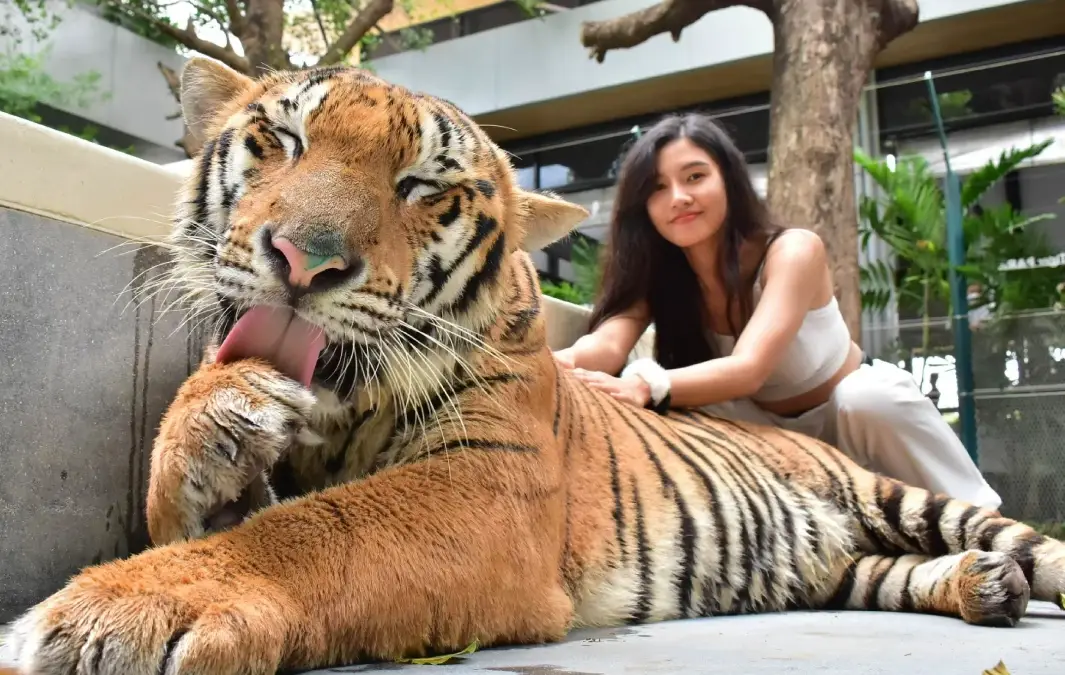
Tiger photography is one of the attraction's best-known experiences. It provides opportunities to record the animals' scale, markings, and physical characteristics at closer range than conventional observation from outside an enclosure. Photography must nevertheless take place only from authorized positions. Animals should not be pressured to change their behavior or posture merely to create a particular image.
Close-contact tiger tourism has attracted attention from wildlife conservation and animal welfare organizations. Tigers are wild predators with specialized environmental and behavioral requirements, and the suitability of tourist interaction depends on enclosure conditions, resting periods, the animals' behavior, and measures intended to prevent stress. Responsible assessment of animal attractions must consider the animals' living conditions alongside the experiences offered to visitors.
In addition to direct tiger encounters, Tiger Park offers a forest safari experience. This activity allows visitors to observe parts of the park from a vehicle without participating in direct physical contact with a tiger. It offers an alternative for people who prefer viewing animals from a greater distance or for groups who wish to explore the park together.
The forest safari uses a golf-cart-style vehicle with a driver in packages described by tourism providers. The published sightseeing experience lasts approximately 15 minutes. A designated vehicle route allows guests to view animal areas and the park's surroundings from another perspective while remaining within the visitor arrangements established by the operator.
Vehicle-based sightseeing is different from entering an enclosure for direct interaction. Guests remain on the arranged sightseeing route and can observe tiger movement and resting behavior from designated viewing positions. Maintaining distance from wild animals is one way to reduce unnecessary disturbance while supporting opportunities for wildlife observation.
The park's official website lists separately priced activity packages. A large tiger encounter costs THB 810, a medium tiger encounter THB 710, and a small tiger encounter THB 710. The forest safari package costs THB 510, while the golden or silver tiger package costs THB 1,010. These are individual experience prices rather than a single admission fee covering all available activities.
The distinction between animal categories helps visitors understand the experiences being offered. Guests interested in mature tiger anatomy may prefer the large tiger package, while those curious about development at younger ages may consider the small or medium categories. Participation remains subject to the park's age requirements, safety restrictions, and the suitability of individual animals.
Close tiger activities are arranged for limited periods. This allows staff to manage groups, supervise the animals, and coordinate the use of the visitor areas. The total duration of a visit can exceed the time spent near a tiger because registration, safety instructions, and movement between areas also take time. Visitor demand at different times of day may affect the overall experience.
Tigers at different stages of life have different care and rest requirements. Young animals are still developing physically, while mature adults possess far greater strength and require surroundings appropriate to their size. Captive tiger management must therefore consider nutrition, access to water, movement, shelter, shade, and activities that do not excessively interfere with natural behavioral patterns.
Tigers are obligate carnivores whose teeth and digestive systems are adapted to animal-based food. Their prominent canines help grasp prey, while specialized cheek teeth cut flesh. Powerful jaw and neck muscles support these functions. Studying tiger dentition helps explain the difference between carnivores and herbivores such as cattle and deer, whose teeth are adapted for processing vegetation.
Tiger paws have padded surfaces that help reduce sound during movement, while retractable claws provide grip when capturing prey. The tail contributes to balance during movement and changes in direction. These characteristics illustrate anatomical adaptations that developed in response to the tiger's natural role as a large predator.
Tigers possess senses adapted to hunting, particularly acute hearing and vision in low-light environments. Their whiskers provide sensory information close to the face, while scent plays an important role in communication with other tigers. These abilities mean that a tiger can respond to sounds and movements that people may not immediately notice, emphasizing the importance of avoiding unnecessary disturbances.
Resting is a normal and important part of tiger behavior. Tigers may spend many hours resting to conserve energy, since hunting and rapid physical activity require substantial exertion. A tiger lying down or remaining still is not necessarily displaying unusual behavior. Wildlife observation should respect periods of rest rather than attempting to keep animals continuously active for visitors.
Unlike the common assumption that all cats avoid water, tigers are capable swimmers. Water is important for drinking, cooling down, and moving through certain habitats. This behavior demonstrates diversity within the cat family and illustrates how different feline species have adapted to the environmental conditions in which they live.
The unique stripe patterns of tigers are especially interesting from a biological perspective. Even when two animals have similar coat colors, the arrangement of markings along their flanks and heads differs. Wildlife researchers can use such patterns to identify individual wild tigers in photographs collected during population surveys.
Camera traps have become valuable tools in wild tiger conservation. They capture images of animals moving through forests without requiring researchers to approach them directly. Photographs help scientists study the presence, movement, and population characteristics of tigers. This conservation method differs from captive animal exhibition but relies on understanding the same species' appearance and behavior.
Wild tiger populations across Asia face pressures from habitat destruction, forest fragmentation, and illegal hunting. Maintaining viable populations requires protecting both tigers and the animals they naturally prey upon, as well as conserving large connected landscapes. Learning about tiger biology can therefore lead to a broader understanding of wildlife conservation at regional and international levels.
Thailand remains home to wild tigers in selected protected landscapes, including important forest complexes where wildlife monitoring is carried out. As apex predators, tigers play significant ecological roles and are associated with healthy forest ecosystems. Protecting their habitats also benefits other animals and contributes to the preservation of biological diversity.
Understanding tigers also involves recognizing the distinction between wild animals and domestic pets. An individual born in captivity or accustomed to familiar caretakers remains a tiger with the anatomy and instincts of its species. Familiarity with humans cannot guarantee that close contact with a large predator will be free from risk.
Tiger photography and observation should take animal welfare and visitor safety into consideration. Guests must follow the rules of each activity, avoid equipment that could frighten animals, refrain from making loud noises to attract attention, and avoid attempting to control a tiger's position. Respecting designated distances helps reduce the risk of unexpected incidents.
Families need to consider the age and safety restrictions attached to each experience. Activities involving large predators differ fundamentally from feeding familiar domestic animals at a family farm. Parents can select appropriate experiences for their group, including observation from outside the enclosures or the vehicle-based safari rather than direct interaction.
Older visitors and those who prefer to limit walking may find vehicle sightseeing a useful alternative. Traveling along a designated route provides views of different parts of the attraction within a relatively short period. Boarding, exiting, and movement during the activity must still follow staff instructions and the park's operating procedures.
Pattaya has a tropical coastal climate, with hot conditions during parts of the year and rainfall during the rainy season. Visitors taking part in outdoor activities benefit from comfortable, breathable clothing and appropriate sun protection. Weather conditions may also influence the suitability of some experiences within the attraction.
Tiger Park is conveniently located for visits to Pattaya Floating Market. This attraction recreates aspects of traditional Thai waterside commerce through wooden buildings, walkways, shops, restaurants, and activities associated with market life. It offers food and products representing different regions of Thailand, providing a cultural and culinary contrast to the tiger-focused activities of the park.
Pattaya Floating Market is especially interesting for its presentation of traditional market architecture and regional Thai food. Guests can walk through waterside shopping areas and observe the design of buildings inspired by Thai communities. Combining the market with a tiger park visit adds another dimension to a southern Pattaya itinerary.
Underwater World Pattaya is another animal attraction along Sukhumvit Road. Its aquarium exhibits and underwater viewing tunnel allow guests to observe freshwater and marine species from within an enclosed underwater environment. Unlike Tiger Park, it focuses on aquatic ecosystems and animals adapted to living in water.
Visiting Underwater World alongside Tiger Park offers opportunities to compare animals from different ecosystems. Tigers are terrestrial carnivorous mammals, while sharks, rays, and other aquatic species have specialized respiratory and locomotor adaptations. The contrast can make a family outing particularly interesting for visitors who enjoy biology and nature.
Jomtien Beach is one of the main coastal destinations south of central Pattaya. Its long shoreline is bordered by restaurants, hotels, and recreational activities. Visitors can enjoy the sea and coastal atmosphere after spending time at an inland attraction along Sukhumvit Road. This combination allows a day trip to include both wildlife-related activities and beachside relaxation.
Na Jomtien extends southward from Jomtien toward Sattahip and contains beach resorts, restaurants, and leisure attractions. Its location makes it useful for travelers planning a coastal holiday while exploring attractions along Sukhumvit Road. Accommodation ranges from large beachfront hotels to smaller properties, and local dining often emphasizes seafood.
Columbia Pictures Aquaverse is another family attraction in the Na Jomtien area. This movie-themed water park offers waterslides and entertainment inspired by popular films. Its activities emphasize physical recreation and water-based excitement rather than animal observation. Families staying for several days can arrange visits to the water park and Tiger Park on separate days according to their interests.
Nong Nooch Tropical Garden is a well-known botanical and landscape attraction in Chon Buri Province. It features extensive themed gardens and cultural recreational facilities. Visiting a major botanical garden introduces different aspects of nature and landscape design, complementing the study of predators at Tiger Park while illustrating the range of attractions between Pattaya and Sattahip.
Khao Chi Chan, often called Buddha Mountain, is a notable religious and scenic destination south of Pattaya. It is recognized for its large Buddha image created on a rock cliff. The site combines Buddhist art with the surrounding natural landscape and is of particular interest to visitors wishing to include a quieter cultural experience within a Na Jomtien or Sattahip itinerary.
Pattaya provides a wide range of dining options, including Thai cuisine, seafood, international food, cafés, and hotel restaurants. Choosing a restaurant along Sukhumvit Road or in Jomtien can make it easier to organize meals between sightseeing activities without returning to the city center. Travelers looking for a seaside setting can continue toward restaurants on the Na Jomtien coast.
Seafood is an important part of the culinary culture of coastal Chon Buri. Local dining commonly features fish, shrimp, crab, and squid prepared through grilling, steaming, stir-frying, and spicy Thai recipes. A Tiger Park visit can therefore be combined with a seafood meal and an introduction to the area's coastal lifestyle.
Visitors planning an overnight stay can choose accommodation in South Pattaya, Jomtien, or Na Jomtien according to their itinerary. Hotels close to Sukhumvit Road are convenient for travelers with cars who wish to visit several attractions, while beachfront resorts suit those looking for a more relaxed coastal holiday. Options range from family-oriented hotels to larger full-service resorts.
Travelers driving from Bangkok can reach Tiger Park Pattaya via Motorway 7, followed by Sukhumvit Road toward the southern part of the city. The attraction is located along the main corridor connecting Pattaya Floating Market and Na Jomtien. Drivers can use the venue's name in a navigation system to identify the appropriate entrance and access roads.
From central Pattaya, travel south along Sukhumvit Road toward Jomtien and Pattaya Floating Market before continuing to the Tiger Park area. Visitors approaching from Sattahip or Na Jomtien can travel north along Sukhumvit Road. The main highway provides access from both beachside accommodation areas and inland transport connections.
Taxis and app-based car services provide another option for travelers without private vehicles. Guests can set Tiger Park Pattaya as their destination and arrange onward travel to the floating market, Jomtien, or other nearby attractions. Groups can select a vehicle appropriate to their number of passengers and the activities planned for the day.
Visitors arriving in Pattaya by intercity coach can continue to Tiger Park by taxi or other hired transport. This arrangement is useful for travelers without rental cars. The final journey should be planned separately because long-distance buses do not necessarily stop at the attraction's entrance.
A southern Pattaya sightseeing route can combine Tiger Park with Pattaya Floating Market before continuing toward Jomtien Beach or Underwater World along Sukhumvit Road. Selecting destinations along connected roads reduces unnecessary backtracking and allows families to organize their time around the different activities they wish to experience.
Tiger Park Pattaya operates daily from 09:00 to 18:00. Activities are sold according to the separately advertised packages. Travelers can arrange their visit based on the selected experience and allow additional time for travel between attractions, especially during busy traffic periods in Pattaya.
The attraction's address is 349/9 Moo 12, Sukhumvit Road, Bang Lamung District, Chon Buri Province 20150. The contact number is +66 38 255 221. Its official website provides information about the Pattaya branch and currently advertised activity packages. The separate ticket categories allow visitors to identify the experience that best matches their interests.
Overall, Tiger Park Pattaya is a tiger-focused attraction with activities divided by animal size, distinctive coat coloration, and vehicle-based forest safari sightseeing. The destination offers opportunities to learn about the biology, physical development, and genetic variation of large predatory cats while also raising important considerations relating to safety and animal welfare. Its location near Pattaya Floating Market and the Jomtien area makes it accessible as part of a wider holiday on Thailand's eastern coast.
Getting There Tiger Park Pattaya is located at 349/9 Moo 12, Sukhumvit Road, Bang Lamung District, Chon Buri Province 20150, Thailand. From Bangkok, follow Motorway 7 toward Pattaya and continue along Sukhumvit Road. From central Pattaya, travel south toward the Pattaya Floating Market area; from Na Jomtien or Sattahip, travel north along Sukhumvit Road. Contact the attraction at +66 38 255 221 or visit https://tigerpark.com/branch.php?id=3 for its Pattaya branch information.
| Name | Tiger Park Pattaya |
| Category | Private Tiger Park and Wildlife Tourism Attraction |
| Address | 349/9 Moo 12, Sukhumvit Road, Bang Lamung District, Chon Buri Province 20150, Thailand |
| Operator | Tiger Park, Pattaya Branch |
| History | Documented Visitor Activity Dates Back to Early 2017 |
| Highlights | Tigers of Different Sizes, Golden and Silver Tiger Packages, Supervised Photography Experiences, and Forest Safari Vehicle Sightseeing |
| Main Areas and Activities | 1. Small Tiger Area 2. Medium Tiger Area 3. Large Tiger Area 4. Golden and Silver Tiger Area 5. Supervised Tiger Encounter Activities 6. Forest Safari Vehicle Experience 7. Visitor Service and Rest Areas |
| Open Days | Daily |
| Opening Hours | 09:00 – 18:00 |
| Activity Prices | Large Tiger: THB 810 Medium Tiger: THB 710 Small Tiger: THB 710 Forest Safari: THB 510 Golden or Silver Tiger: THB 1,010 Prices Apply to Individual Activity Packages and Do Not Represent a Single All-Inclusive Admission Ticket |
| Activity Duration | Standard Tiger Encounters Are Commonly Described as Approximately 10 Minutes Per Session; the Forest Safari Ride Is Approximately 15 Minutes |
| Getting There | Via Sukhumvit Road in Southern Pattaya, With Connections From Central Pattaya, Pattaya Floating Market, Jomtien, and Na Jomtien |
| Telephone | +66 38 255 221 |
| crtigerpark2017@gmail.com | |
| Official Website | https://tigerpark.com/branch.php?id=3&lang=en |
| Current Status | Open Daily |
| Nearby Attractions and Places Along Connecting Routes | 1. Pattaya Floating Market, Sukhumvit Road, Tel. +66 88 444 7777 2. Underwater World Pattaya, Sukhumvit Road, Tel. +66 81 575 1006 3. Jomtien Beach, Pattaya 4. Pattaya Dolphinarium, Tel. +66 64 778 8999 5. Columbia Pictures Aquaverse, Na Jomtien, Tel. +66 33 004 999 6. Nong Nooch Tropical Garden, Sattahip District 7. Khao Chi Chan, Sattahip District |
| Nearby Restaurants and Dining Along Connecting Routes | 1. Restaurant at Tiger Park Pattaya, Tel. +66 38 255 221 2. Dining at Pattaya Floating Market, Tel. +66 88 444 7777 3. ChezMango, Pattaya Floating Market, Tel. +66 92 374 4724 4. Jomtien Foodmedia, Sukhumvit Road, Tel. +66 87 108 5460 5. Mimosa Pizzeria, Jomtien Beach Road, Tel. +66 87 142 7642 |
| Nearby Hotels and Accommodation Along Connecting Routes | 1. Wyndham Jomtien Pattaya, Sukhumvit Road, Tel. +66 38 222 555 2. P&P Jomtien Beach, Na Jomtien, Tel. +66 81 613 1311 3. Ambassador City Jomtien Pattaya, Sukhumvit Road, Tel. +66 38 255 501 4. Mövenpick Siam Na Jomtien Pattaya, Tel. +66 33 078 888 5. Cozy Resort Pattaya, Tel. +66 63 830 9363 |
Frequently Asked Questions (FAQ)
Q: Is Tiger Park Pattaya still open?
A: Yes. Tiger Park Pattaya operates daily from 09:00 to 18:00 on Sukhumvit Road in the southern Pattaya area of Chon Buri Province.
Q: How much does Tiger Park Pattaya cost?
A: The forest safari package costs THB 510. Small and medium tiger encounters cost THB 710 each, large tiger encounters cost THB 810, and golden or silver tiger packages cost THB 1,010. Activities are priced separately.
Q: What kinds of tigers can visitors see at Tiger Park Pattaya?
A: The park advertises activities involving small, medium, and large tigers, as well as tigers with distinctive golden or silver coat coloration.
Q: Can visitors see tigers without participating in physical contact?
A: Yes. The forest safari vehicle package provides an alternative way to observe the park and its tiger areas without booking a direct-contact encounter.
Q: How long do the tiger activities last?
A: Standard tiger encounters are commonly described as approximately 10 minutes per session, while the forest safari ride lasts approximately 15 minutes.
Q: Is Tiger Park Pattaya suitable for children?
A: Participation in tiger encounters depends on the age and safety restrictions of each package. Families can choose observation from a distance or vehicle sightseeing instead of direct animal contact.
Q: How can visitors reach Tiger Park Pattaya?
A: The park is accessible via Sukhumvit Road in southern Pattaya, close to the route connecting Pattaya Floating Market and Jomtien. From Bangkok, visitors can use Motorway 7 before continuing toward the attraction along Sukhumvit Road.
Q: What attractions are near Tiger Park Pattaya?
A: Nearby and connecting-route attractions include Pattaya Floating Market, Underwater World Pattaya, Jomtien Beach, Pattaya Dolphinarium, Columbia Pictures Aquaverse, and destinations in the Na Jomtien area.
 Category: ●Entertainment and Agricultural
 Group: ●Zoos and Aquariums
Last Update : 1 WeekAgo
 Last Update : 1 WeekAgo

 Click to Access the Navigation Map GPS
Tiger Park Pattaya Map
Recommend

 Art, Culture and Heritage
 Historical Sites and Monuments(4)
 Landmarks and Memorials(4)
 Royal Palace(1)
 Art, Craft Centres, Tradition(5)
 Museums(11)
 Art Gallery(1)
 Educational Places
 Educational Gardens, Farm(2)
 Training Center(2)
 Places of Worship
 Temple(42)
 Church(1)
 Mosque(2)
 Other Sacred Sites(15)
 Suburban Living
 Village, Community(5)
 Local Market(4)
 Floating Market(1)
 Nature and Wildlife
 National Parks and Marine Reserves(2)
 Mountain (Doi)(2)
 Dam, Reservoir, Lake(4)
 Waterfalls(3)
 Caves(3)
 Bays and Beaches(20)
 Islands(7)
 Other natural attractions(1)
Zoos and Aquariums(7)
 Animal camps and shows(2)
 Stadium(9)
 Farms, Parks and Ecotourism(9)
 Amusement Park(3)
 Waterpark(5)
 Theater(5)
 Cinema(1)
 Outdoor and Adventure Activities(4)
 Shopping
 Shopping and Night Market(1)
 Travel Articles, Recipes
 Travel Review, Food Review(1)


