
lovethailand home >Central Travel Attractions >Suphan Buri Travel Attractions >Muang Suphan Buri >Sa Kaeo > Tha Sadet Bird Garden
TL;DR: Tha Sadet Bird Garden is located at Ban Tha Sadet, Sa Kaeo Subdistrict, Mueang Suphan Buri District, Suphan Buri Province, Thailand, open Daily, hours 08.00 – 17.00.

Tha Sadet Bird Garden
Open Days: Daily
Opening Hours: 08.00 – 17.00
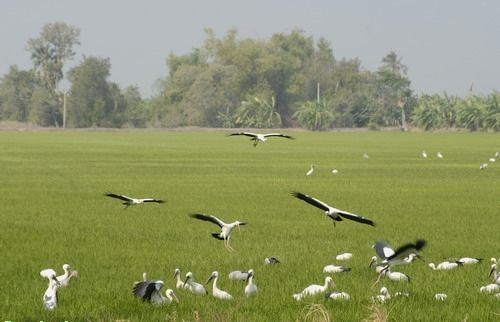
Tha Sadet Bird Garden, also known as Tha Sadet Bird Conservation Unit, is an important natural birdwatching site in Suphan Buri Province. Located at Ban Tha Sadet in Sa Kaeo Subdistrict, Mueang Suphan Buri District, about 15 km from the city center, the site is known as a large natural roosting and nesting area for tens of thousands of waterbirds. Commonly observed birds include Asian openbill storks, egrets, herons, ibises, cormorants, and other wetland-related species. Tha Sadet Bird Garden is not a conventional zoo or a place where birds are kept in cages. It is a natural refuge where birds came by themselves, found safety, and gradually turned a former fruit orchard into one of Suphan Buri’s most meaningful conservation attractions.
The garden is located along the Suphan Buri – Don Chedi route, using Highway 322 from Suphan Buri city. Around kilometer 6 – 7, visitors turn into the canal-side road for about 2 km, then turn left for another 200 meters to reach the site. The surrounding landscape is rural, with canals, gardens, fields, trees, and local village scenery. This setting gives the place a quieter and more natural mood than major attractions in the city. For travelers who want to see a softer side of Suphan Buri, Tha Sadet Bird Garden offers a peaceful nature-based experience not far from the urban area.
The origin of Tha Sadet Bird Garden is closely connected with kindness and coexistence between people and wildlife. The land was originally a fruit orchard belonging to Pa Nok Phanphueak and Lung Chom with Pa Thanom Malai. At first, only a small number of birds came to the area. Over time, because the orchard had trees, quiet surroundings, and owners who did not disturb or drive the birds away, more birds began to arrive. They used the trees for resting and nesting, and their numbers increased steadily. The landowners allowed the birds to stay naturally, and after many years the orchard became a large bird habitat with thousands upon thousands of birds.
This story is important because Tha Sadet Bird Garden did not begin as a planned tourist attraction. It began from tolerance, compassion, and the decision not to disturb nature. The birds chose the place because the environment was suitable: trees for nesting, nearby wetlands and fields for feeding, and a safe atmosphere. This makes the garden different from artificial bird displays. Visitors come here to observe wild birds in a natural setting, not to watch trained animals or captive birds. That difference gives the place strong value for conservation, education, and nature tourism.
For more than 40 years, Tha Sadet Bird Garden has gradually become a habitat for many species of waterbirds and wetland birds. The species associated with the area include Asian openbill storks, herons, egrets, ibises, cormorants, and other birds that rely on trees, water, fields, and wetlands. Their presence reflects the ecological richness of the surrounding agricultural landscape. Rice fields, canals, waterlogged areas, trees, and rural spaces all support the life cycle of these birds. The garden therefore helps visitors understand the relationship between agriculture, water, trees, and wildlife in central Thailand.
Later, government agencies became involved in developing and protecting the area so that it could serve as a conservation-based tourist attraction for Suphan Buri Province. The site was established as Tha Sadet Bird Conservation Unit and placed under the care of the Royal Forest Department. This official conservation role helped strengthen the site’s identity as a place for nature learning rather than ordinary recreation. Facilities such as a birdwatching tower were developed so visitors could observe the birds from a higher viewpoint while reducing disturbance to nesting areas.
The birdwatching tower is one of the key features of Tha Sadet Bird Garden. From the tower, visitors can look over the trees, nesting areas, and movement of birds from above. This elevated viewpoint helps people see the scale of the habitat and the way birds use the landscape. It is also useful for photography and birdwatching because visitors do not need to approach the nesting trees too closely. Those interested in nature photography should bring a telephoto lens or binoculars to observe bird behavior in more detail without disturbing the animals.
The best time of day for birdwatching depends on bird behavior. During the daytime, visitors may still see birds resting on trees, flying in and out, or moving around the area. However, the most impressive time is usually late afternoon to evening, when large numbers of birds return to their roosts. Watching the sky gradually fill with returning birds is one of the most memorable experiences at Tha Sadet. The movement can be dramatic, as flocks fly in from different directions and gather on the trees until the area feels alive with wings and sound.
The period with the highest number of birds is around October. Visitors who want to see the largest gatherings should consider planning a visit during this season. Even outside the peak period, the garden remains valuable as a nature-learning site. Birdwatching should not be judged only by the number of birds seen. Small behaviors such as perching, feeding, circling, calling, returning to nests, and interacting with other birds all reveal the life of the habitat. A patient visitor will often notice more than a hurried one.
The Asian openbill stork is one of the birds most commonly associated with Tha Sadet Bird Garden. This species has a distinctive bill, with a gap between the upper and lower mandibles when the bill is closed. This shape is related to its feeding habits, especially eating snails and aquatic prey. Asian openbills are often found in rice fields, wetlands, and shallow water areas. Their presence at Tha Sadet suggests that the surrounding landscape still provides suitable food sources and habitat. Watching them perch in trees or fly back to roost helps visitors understand the connection between wetland agriculture and wildlife.
Egrets and herons add visual beauty to the garden. Egrets, with their white plumage, often stand out clearly against green foliage or darker tree branches. Herons and storks bring a sense of quiet elegance through their long legs, long necks, and slow, deliberate movements. Seeing these birds in a natural setting is different from seeing images in a book. Their beauty comes from behavior, habitat, and movement. Visitors can observe how they fly, rest, call, and settle into the trees, gaining a more direct understanding of nature.
Ibises are also interesting because of their long, curved bills, which are adapted for feeding in mud or shallow water. Their shape helps explain how animals evolve or adapt to specific food sources and environments. Families, students, and teachers can use the birds at Tha Sadet as real-life examples for learning about ecology, adaptation, and biodiversity. Birdwatching therefore becomes more than a pleasant activity. It becomes an outdoor classroom where visitors can learn from living animals in their actual habitat.
Tha Sadet Bird Garden is suitable for many types of visitors. Families can bring children to observe birds and learn about wildlife. Students can use the site for lessons about ecosystems, wetlands, and conservation. Nature photographers can practice observing light, bird movement, and long-distance photography. Elderly visitors can enjoy the peaceful atmosphere. Travelers interested in conservation can see how private land, community tolerance, and government support can together create a meaningful wildlife refuge.
Visitors should remember that Tha Sadet is not a zoo and the birds are not performers. The birds are wild animals that move according to season, weather, time of day, food availability, and their sense of safety. A good visit requires patience and quiet observation. Visitors should not expect controlled displays. Instead, they should allow time to watch natural behavior. The quieter and more respectful visitors are, the better the chance of seeing the birds behave naturally.
Basic preparation can improve the experience. Visitors should bring a hat, drinking water, comfortable shoes, a camera, and binoculars if available. Those who want to photograph birds in the evening should arrive before sunset to choose a viewing position and prepare equipment. Evening light can make the returning flocks especially atmospheric. Flash photography, loud noises, and sudden movement should be avoided because they may disturb the birds. Visitors should also avoid feeding birds, littering, or entering nesting areas without permission.
The garden also has value as a community story. Its development began not from a large tourism project, but from ordinary people who allowed birds to live on their land. Over time, nature created its own value, and the community and authorities recognized the importance of the site. This story shows that conservation can begin with simple acts of kindness. Protecting a place where animals feel safe can gradually create ecological, educational, and tourism value.
Compared with major attractions in Suphan Buri such as Wat Pa Lelai Worawihan, Sam Chuk Market, or Bueng Chawak, Tha Sadet Bird Garden offers a quieter and more natural atmosphere. It may not have many shops or entertainment activities, but it offers something different: calm, fresh air, rural surroundings, and the chance to see large numbers of wild birds. For travelers who want to step away from crowded attractions, this is a good place to slow down and observe nature.
Tha Sadet Bird Garden can be combined with attractions in Mueang Suphan Buri District and Don Chedi District because it is located not far from the city and along the route toward Don Chedi. Travelers can visit the bird garden in the afternoon or evening, then continue to Don Chedi Monument, or combine it with Wat Pa Lelai Worawihan, Suphan Buri National Museum, Si Prachan Market, Thai Buffalo Conservation Village, or Sam Chuk 100-Year Market. A route like this gives a balanced trip that includes nature, history, culture, and local community experiences.
Getting There from Suphan Buri city is straightforward. Use the Suphan Buri – Don Chedi route on Highway 322 for about 15 km from the city. Around kilometer 6 – 7, turn into the canal-side road for about 2 km, then turn left for another 200 meters to reach the bird conservation area. The route includes rural and canal-side roads, so drivers should proceed carefully, especially in the evening or after rain. Using an online map with the destination set as Tha Sadet Bird Conservation Unit or Ban Tha Sadet, Sa Kaeo Subdistrict can help with navigation.
The recommended visiting time is late afternoon to evening because this is when birds return to roost and the weather is less hot. Visitors who want to study the area or take photographs of the tower and landscape can arrive earlier in the day. The most memorable scene, however, usually occurs near dusk when flocks begin to gather in the trees. Allowing at least 1 – 2 hours is recommended so visitors can walk around, climb the birdwatching tower, observe the environment, and wait calmly for the return of the birds.
Responsible behavior is essential. Visitors should avoid loud noises, throwing objects, approaching nests, feeding birds, or doing anything that may frighten the birds. Photographs should be taken from suitable points without disturbing nesting areas. The value of the place depends on birds feeling safe enough to continue using the site as their home. If visitors help preserve the quiet and respect the habitat, Tha Sadet Bird Garden can remain both a wildlife refuge and a learning destination for future generations.
Overall, Tha Sadet Bird Garden is a simple but highly meaningful natural attraction in Suphan Buri Province. Its story of a fruit orchard becoming a home for tens of thousands of birds shows that conservation does not always begin with large projects. Sometimes it begins with the compassion of ordinary people who allow nature to take its course. From private orchard to bird conservation unit, from a few visiting birds to a large natural roosting site, Tha Sadet is a place to visit with quietness, respect, and a willingness to learn from nature.
| Name | Tha Sadet Bird Garden / Tha Sadet Bird Conservation Unit |
| Location | Ban Tha Sadet, Sa Kaeo Subdistrict, Mueang Suphan Buri District, Suphan Buri Province, Thailand |
| Address | Ban Tha Sadet, Sa Kaeo Subdistrict, Mueang Suphan Buri District, Suphan Buri Province, about 15 km from Suphan Buri city on the Suphan Buri – Don Chedi route |
| Highlights | Natural roosting and nesting area for tens of thousands of waterbirds, including Asian openbill storks, herons, egrets, ibises, and other species, with a birdwatching tower for elevated viewing |
| History | Formerly a fruit orchard owned by Pa Nok Phanphueak and Lung Chom with Pa Thanom Malai. The landowners allowed birds to stay and nest naturally, and the area gradually became a major bird habitat before being developed as Tha Sadet Bird Conservation Unit |
| Name Origin | The name comes from its role as a birdwatching and bird habitat area in Ban Tha Sadet, Sa Kaeo Subdistrict |
| Distinctive Features | A natural birdwatching site where wild birds arrived and nested by themselves, with large trees, quiet surroundings, a birdwatching tower, and rural scenery suitable for ecology learning and nature photography |
| Travel Information | From Suphan Buri city, take Highway 322 on the Suphan Buri – Don Chedi route. Around kilometer 6 – 7, enter the canal-side road for about 2 km, then turn left for another 200 meters |
| Current Status | Open as a conservation-based tourist attraction and natural birdwatching site in Suphan Buri Province |
| Open Days | Daily |
| Opening Hours | 08.00 – 17.00 |
| Facilities | Birdwatching tower, nature viewing points, walking areas around the garden and rural community scenery |
| Main Areas / Zones | 1. Birdwatching Tower Zone 2. Large Tree And Nesting Area Zone 3. Evening Bird Return Viewing Zone 4. Nature Walking Area 5. Garden And Ban Tha Sadet Community Area |
| Caretaker | Royal Forest Department / Tha Sadet Bird Conservation Unit |
| Best Viewing Time | Late afternoon to evening is best for seeing birds return to roost. October is the peak period when bird numbers are especially high |
| Nearby Tourist Attractions | 1. Don Chedi Monument, about 16 km 2. Wat Pa Lelai Worawihan, about 17 km 3. Suphan Buri National Museum, about 18 km 4. Si Prachan Market, about 22 km 5. Thai Buffalo Conservation Village, about 23 km 6. Sam Chuk 100-Year Market, about 40 km |
| Nearby Restaurants | 1. Oho Khao Kha Moo Tha Sadet, about 3 km, Tel. 089-2423656 2. Local Restaurants In Ban Tha Sadet, about 2 km 3. Restaurants In Suphan Buri City, about 15 km 4. Restaurants Near Wat Pa Lelai Worawihan, about 17 km 5. Restaurants Near Don Chedi Monument, about 16 km |
| Nearby Accommodations | 1. Lert Sri Hotel, about 8 km 2. Muaan Resort, about 10 km 3. Lamoon Boutique Hotel, about 11 km 4. K2 Green Hotel Suphan Buri, about 12 km 5. The Scene Suphan Buri, about 12 km 6. Songphanburi Hotel, about 14 km 7. Sri U-Thong Grand Hotel, about 14 km |
Frequently Asked Questions (FAQ)
Q: Where is Tha Sadet Bird Garden located?
A: Tha Sadet Bird Garden is located at Ban Tha Sadet, Sa Kaeo Subdistrict, Mueang Suphan Buri District, about 15 km from Suphan Buri city.
Q: What is interesting about Tha Sadet Bird Garden?
A: It is a natural habitat for tens of thousands of waterbirds, including Asian openbill storks, herons, egrets, ibises, and other species, with a birdwatching tower for viewing flocks from above.
Q: What is the best time to visit Tha Sadet Bird Garden?
A: Late afternoon to evening is best because many birds return to roost, creating an impressive natural scene.
Q: When is the peak birdwatching season?
A: October is the period when bird numbers are especially high and is ideal for birdwatching and nature photography.
Q: What are the opening days and hours of Tha Sadet Bird Garden?
A: It opens daily from 08.00 to 17.00.
Q: Who should visit Tha Sadet Bird Garden?
A: It is suitable for families, students, nature photographers, birdwatchers, conservation travelers, and visitors who want a quiet natural attraction near Suphan Buri city.
Q: What should visitors prepare before going?
A: Visitors should bring a hat, drinking water, camera, binoculars if available, and comfortable shoes. They should avoid loud noises and keep away from nesting areas.
Q: What nearby attractions can be visited with Tha Sadet Bird Garden?
A: Visitors can combine it with Don Chedi Monument, Wat Pa Lelai Worawihan, Suphan Buri National Museum, Si Prachan Market, Thai Buffalo Conservation Village, and Sam Chuk 100-Year Market.
 Category: ●Nature and Wildlife
 Group: ●National Parks and Marine Reserves
Last Update : 5 MonthAgo
 Last Update : 5 MonthAgo
 Click to Access the Navigation Map GPS
Tha Sadet Bird Garden Map
Recommend

 Art, Culture and Heritage
 Historical Sites and Monuments(2)
 Landmarks and Memorials(4)
 Art, Craft Centres, Tradition(2)
 Museums(5)
 Educational Places
 Educational Gardens, Farm(4)
 Training Center(2)
 Places of Worship
 Temple(36)
 Other Sacred Sites(4)
 Suburban Living
 Village, Community(6)
 Local Market(7)
 Floating Market(1)
National Parks and Marine Reserves(4)
 Mountain (Doi)(2)
 Dam, Reservoir, Lake(3)
 Caves(1)
 Bays and Beaches(1)
 Entertainment and Agricultural
 Farms, Parks and Ecotourism(6)
 Theater(1)
 Travel Articles, Recipes
 Travel Review, Food Review(1)


