
lovethailand home >Central Travel Attractions >Kanchanaburi Travel Attractions >Muang Kanchanaburi >Pak Phraek > Kanchanaburi City Pillar Shrine
TL;DR: Kanchanaburi City Pillar Shrine is located at Lak Mueang Road, Pak Phraek Subdistrict, Mueang Kanchanaburi District, Kanchanaburi 71000, Thailand, open Daily, hours 05:00 – 20:00.

Kanchanaburi City Pillar Shrine
Open Days: Daily
Opening Hours: 05:00 – 20:00
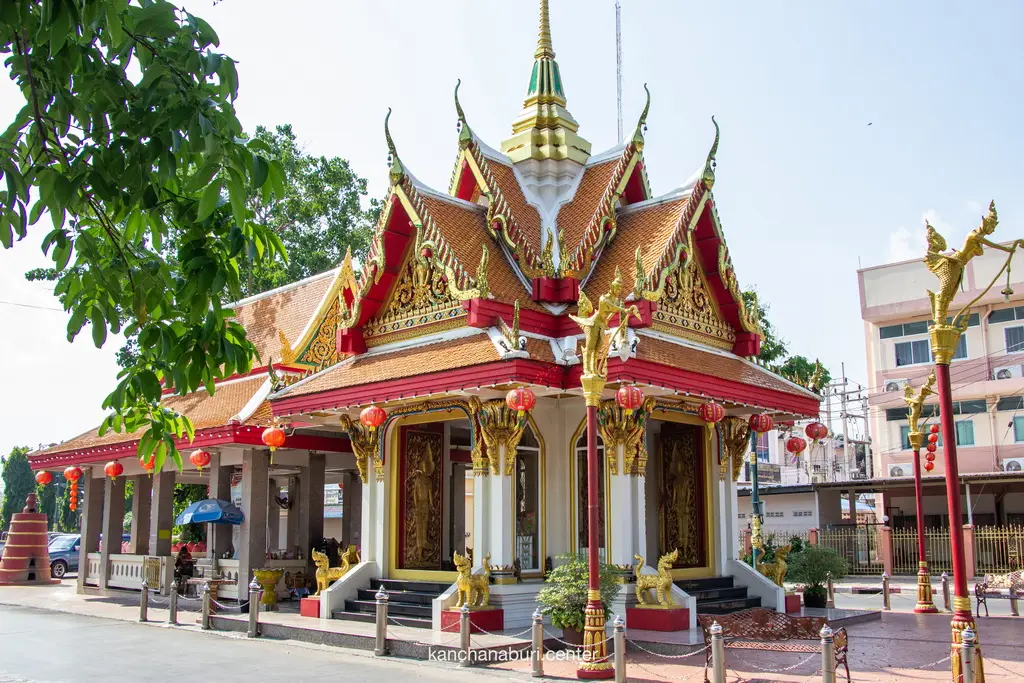
Kanchanaburi City Pillar Shrine, known in Thai as San Lak Mueang Kanchanaburi, is one of the most important spiritual and historical landmarks in Kanchanaburi Province, western Thailand. Located on Lak Mueang Road in Pak Phraek Subdistrict, Mueang Kanchanaburi District, the shrine stands close to the historic Kanchanaburi City Gate and the monument dedicated to King Rama III. It serves both as a sacred place of worship for local residents and as a valuable destination for travelers interested in the history of the city. Inside the shrine stands the revered city pillar, while nearby stone and teakwood inscriptions preserve records of the city's construction, defensive fortifications, and historical development during the early Rattanakosin period.
The significance of Kanchanaburi City Pillar Shrine extends well beyond its religious function. Its history is closely connected with the geography, administration, transportation networks, and settlement patterns of old Kanchanaburi. The surrounding Pak Phraek area occupies a strategically important location near the confluence of the Khwae Noi and Khwae Yai rivers, where their waters form the Mae Klong River. This geographical setting contributed to the development of Kanchanaburi as both a defensive frontier town and a center of river-based trade. Exploring the shrine therefore provides an opportunity to understand the city's foundations alongside the traditional Thai beliefs associated with city pillars.
The shrine lies within Kanchanaburi's historic urban district, surrounded by places associated with the city's earlier development. Nearby landmarks include the surviving city gate, remnants of the former defensive walls, long-established communities, and a royal monument commemorating King Nangklao, or King Rama III. Together, these sites create a compact historical landscape where visitors can examine the relationship between a sacred civic landmark and the physical infrastructure of an early nineteenth-century Thai town.
To appreciate the history of the shrine, it is important to understand the historical role of Kanchanaburi itself. For centuries, the province occupied a strategic position between the central plains of Siam and the mountainous territory along the western frontier. This location made Kanchanaburi significant for military movements, territorial defense, trade routes, and the administration of border settlements. Its geographical position influenced the placement of administrative centers, fortifications, and transport routes across different historical periods.
The original center of Kanchanaburi was situated farther north, in the area around Khao Chon Kai. Over time, the administrative center shifted toward Pak Phraek, an area better suited for communication and trade with Ratchaburi and communities along the Mae Klong River basin. In earlier centuries, rivers served as major transportation corridors for people, merchandise, construction materials, and military supplies. A town established near the meeting point of important waterways benefited from connections with both upstream settlements and downstream commercial centers.
During the early Rattanakosin period, Kanchanaburi remained an important defensive center on the western approaches to Siam. Military concerns, particularly those associated with possible movements through the western mountain passes, influenced the development of settlements around Lat Ya, Khao Chon Kai, and Pak Phraek. The relocation and development of the city were therefore more than changes in residential geography. They formed part of a broader adjustment of military defenses, administrative organization, and regional communications.
The year 1831, corresponding to Buddhist Era 2374, represents an important milestone in Kanchanaburi's history. During the reign of King Rama III, permanent defensive walls and fortifications were constructed at the new town site. This development strengthened Kanchanaburi's position as a fortified frontier center and established a recognizable urban layout with gates, bastions, and protective walls. These structures reflected contemporary approaches to town planning, territorial control, and military security.
Historical descriptions indicate that the former walled town followed a rectangular plan approximately 210 meters wide and 480 meters long. Defensive structures included bastions at the four corners, additional fortifications along the front and rear walls, and eight entrances. These consisted of six principal city gates and two smaller openings. The planned arrangement shows how Kanchanaburi's defenses were organized around the surrounding landscape, access routes, and practical requirements of the settlement.
Most of the original fortifications have disappeared through environmental deterioration, urban development, and changes in land use. Nevertheless, the surviving front city gate and sections of the walls remain important physical reminders of the old town. Their continued presence makes it possible to connect written historical accounts with structures that can still be examined today. The gate near the City Pillar Shrine is especially valuable because it represents a surviving element of the urban defenses described in the historical inscriptions.
Kanchanaburi City Pillar Shrine is directly associated with the establishment and development of the town at Pak Phraek during the reign of King Rama III. In Thai cultural tradition, the city pillar represents a symbolic center of civic stability and protection. Establishing a shrine for the pillar gives the location both an administrative-historical meaning and a spiritual role. Local residents have long regarded the shrine as a place associated with the well-being, security, and prosperity of their community.
Although the city's early nineteenth-century history dates to 1831, the shrine building seen today is considerably younger. The present structure was built in 1960, or Buddhist Era 2503, to replace an older shrine that had deteriorated. The earlier shrine was associated with the period of Phraya Prasit Songkhram (Ram Phakdi Si Wiset), the second governor of Kanchanaburi. Distinguishing the original history of the city pillar from the construction date of the current building is essential for understanding the site's historical development accurately.
The reconstruction of the shrine in 1960 demonstrated an effort to preserve a significant cultural and spiritual landmark for future generations. Replacing the deteriorated building did not diminish the historical and ceremonial importance of the pillar. Instead, it allowed the sacred site to continue serving the public while preserving its association with the city's origins. The surviving inscriptions remain particularly important because they connect the present-day shrine with the construction of Kanchanaburi during the earlier Rattanakosin period.
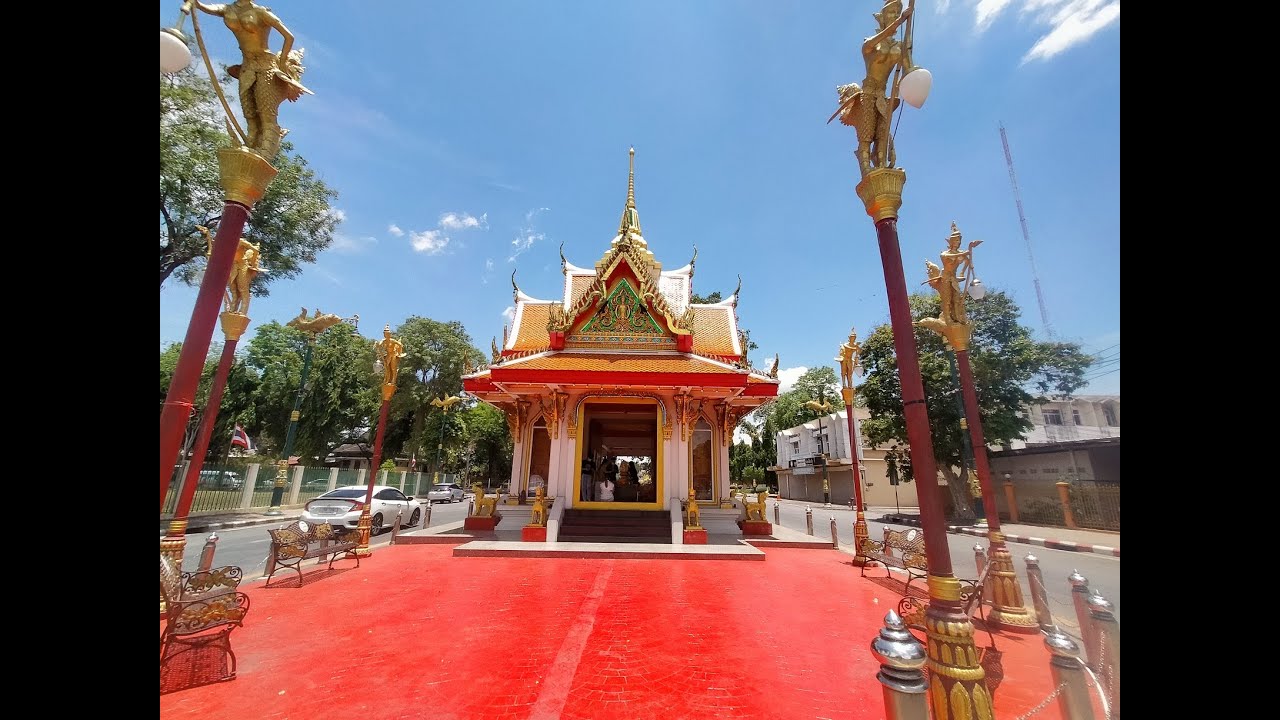
One of the shrine's defining architectural features is its traditional Thai four-gabled design, known as a chaturamuk structure. The building has projecting sections oriented toward four directions, creating a balanced and symmetrical appearance. This design has long been associated with important ceremonial and religious structures in Thai architecture. Its rooflines and traditional proportions distinguish the shrine from the surrounding modern urban buildings and give it a recognizable identity within Kanchanaburi's old town.
The shrine is designed with an open architectural arrangement that emphasizes the central sacred object. Its symmetrical roof and four-sided configuration direct attention toward the city pillar, which occupies the principal position within the structure. The building therefore provides a ceremonial setting while allowing worshippers to approach and pay their respects. The relationship between the central pillar and the surrounding architectural elements expresses the symbolic importance of the shrine as a focal point of the community.
The city pillar itself is approximately one meter tall and features a rounded, ornamented finial. Its surface is lacquered and gilded, reflecting the decorative treatment commonly associated with revered ceremonial objects in Thailand. The pillar is the principal sacred feature of the shrine, and its placement at the center of the building reinforces the symbolic idea of stability and protection. Although modest in physical size, the pillar carries considerable cultural meaning for the local community.
Within traditional Thai culture, a city pillar is more than a physical post marking a location. It represents the spiritual foundations of a town and is associated with ideas of civic order, collective security, and communal continuity. A city pillar shrine creates a symbolic connection between administrative territory and religious belief. Worshippers who come to pay their respects participate in a cultural practice that links personal hopes and aspirations with the historical identity of the wider community.
Another remarkable feature of Kanchanaburi City Pillar Shrine is the historical stone inscription located near its front. This inscription records information about the construction of the town, fortifications, and defensive walls at Pak Phraek. It is not simply an old monument displayed for decorative purposes. Rather, it is an important historical document that preserves evidence of the city's development during the early Rattanakosin period.
The Kanchanaburi City Pillar stone inscription is written in Thai using a script associated with the Thonburi and Rattanakosin periods. Its content concerns the establishment of the town and the construction of defensive infrastructure. The inscription has been studied by scholars and published in a recognized collection of Thai inscriptions, where it is identified as Inscription No. 142. Its presence gives the shrine particular educational value by allowing visitors to connect historical written evidence with the actual place where those events occurred.
The stone inscription is a rectangular slab of red sandstone measuring approximately 32 centimeters wide, 100 centimeters high, and 17 centimeters thick. It bears 32 lines of Thai writing on one face. These physical details are important for understanding the inscription as a historical artifact. The effort involved in recording the construction of the city on stone reflects the significance attached to the establishment and defense of Kanchanaburi during that period.
In addition to the stone inscription, the shrine preserves an inscription on a teakwood panel containing related information about the city's construction. The teakwood inscription closely corresponds to the text of the sandstone inscription and preserves a more complete version of the historical account. It is particularly valuable for studying references to dates and details associated with the city's development.
In academic records, the teakwood inscription is identified as Inscription No. 143. Its reading was published in Volume 6, Part 1 of the collected Thai inscriptions in 1974. Studying the two inscriptions together allows researchers to compare the texts and better understand the historical record. The presence of both stone and wooden documents at the shrine makes the site especially interesting for visitors concerned with epigraphy, archaeology, historical literature, and local history.
The inscriptions also illustrate the scale and importance of town construction as a state undertaking in the early nineteenth century. Building defensive walls, bastions, and gates required labor, materials, organization, and administrative oversight. These records consequently offer insight into the relationship between royal authority, provincial administration, military security, and the development of a frontier settlement.
Close to the shrine stands the historic Kanchanaburi City Gate, one of the most important surviving architectural reminders of the old town. Built from brick and mortar, the gate reflects defensive architecture from the early Rattanakosin era. Its distinctive form provides a tangible impression of how entry and exit points were controlled within the fortified settlement. Standing near the gate allows visitors to imagine the defensive walls and bastions that once surrounded the historic urban center.
The surviving city gate was restored in 2006, helping preserve an important feature of Kanchanaburi's architectural heritage. Today, the gate is a major stop on historical walking routes through the old town. Its relationship with the nearby City Pillar Shrine is particularly significant. While the shrine represents the city's spiritual and ceremonial foundations, the gate represents its former defensive system and administrative control over movement into the settlement.
Behind the city gate stands a royal monument dedicated to King Nangklao, or King Rama III, commemorating the monarch's role in the development of Kanchanaburi's fortified town. The monument creates a direct connection between the surviving defensive structures and the royal administration responsible for major developments during the early nineteenth century. Together, the monument and the gate provide a broader context for understanding the shrine's association with the city's history.
The monument features a bronze representation of King Rama III seated on a royal throne, reflecting Thai traditions of commemorating monarchs through public sculpture. Its location within the historic city gate area reinforces the connection between royal authority and the construction of the town. The monument is also a place where visitors and residents can pay their respects while learning about the historical development of Kanchanaburi.
Considering the City Pillar Shrine, the old city gate, and the royal monument together reveals three complementary dimensions of local history. The shrine represents spiritual beliefs and civic rituals. The gate provides physical evidence of defensive architecture and urban planning. The monument commemorates royal leadership and the broader political circumstances of the city's development. Visiting all three sites helps create a more complete picture than examining any one landmark in isolation.
The surrounding river landscape is another important element of Kanchanaburi's identity. The city developed close to the point where the Khwae Noi and Khwae Yai rivers meet to form the Mae Klong River. Such a location offered practical advantages for communication, trade, and transportation. Before the development of modern highways, river routes were especially important for moving people, commercial goods, building materials, and supplies through the region.
The two rivers also influenced the city's defensive geography. Waterways created natural boundaries and transportation corridors that shaped movement through the surrounding territory. A settlement close to their confluence could maintain connections with communities upstream and downstream while occupying a strategically advantageous location. These geographical conditions help explain why Pak Phraek became an important center of Kanchanaburi's historical development.
Understanding the shrine therefore involves understanding the wider Mae Klong River basin. River transport influenced the growth of local markets, settlement patterns, and connections with other towns. The historical relationship between the city and its waterways remains visible in the streets, riverside communities, and urban landscape of central Kanchanaburi. For visitors interested in geography, the shrine offers a meaningful starting point for exploring how rivers shaped the history of western Thailand.
For residents of Kanchanaburi, the City Pillar Shrine holds profound spiritual significance. Traditional beliefs concerning the guardian spirit of the city are closely connected with prayers for safety, peace, prosperity, stability, and good fortune. Worshippers visit during important personal and family occasions as well as when beginning new endeavors. These practices make the shrine an active place of faith rather than a historical monument with no continuing ceremonial role.
According to local belief, paying respect to the city's guardian spirit expresses gratitude and reverence while offering an opportunity to pray for personal and communal well-being. Similar customs can be found at city pillar shrines throughout Thailand, although the history, architecture, and details of individual ceremonies vary from one province to another. Kanchanaburi's shrine is distinguished by its association with the city's nineteenth-century construction and its surviving documentary evidence.
Visitors traditionally approach the shrine with respect and a sincere intention. For many worshippers, the purpose of the visit is to seek encouragement and symbolic blessings before important life events, including professional changes, family celebrations, or new beginnings. These customs form part of Thailand's living cultural heritage. The significance lies in the spiritual meaning of the practice and the expression of respect rather than any guaranteed outcome from a particular prayer.
Appropriate behavior is important when visiting the shrine. Visitors should maintain a respectful atmosphere, avoid disturbing people engaged in prayer, and follow any instructions displayed at the site. Incense, candles, offerings, or other ceremonial items should be used only in designated areas. Keeping the site clean and allowing other worshippers sufficient space are simple ways of respecting a landmark that remains important to the local community.
The City Pillar Shrine also illustrates the interaction between traditional Thai spiritual beliefs and wider cultural practices. Although it is not a Buddhist temple, the shrine occupies a familiar place within the religious and ceremonial life of Thai society. Worship at city pillars often exists alongside Buddhist traditions and other local forms of reverence. This relationship demonstrates how the spiritual geography of a Thai town can include different types of sacred sites serving different purposes.
The most significant annual tradition associated with the shrine is the Kanchanaburi City Pillar Worship and Celebration Festival. The principal ceremonial observance traditionally takes place on the sixth waxing-moon day of the sixth lunar month. The event expresses communal respect for the city pillar and maintains traditions associated with the spiritual well-being of Kanchanaburi's residents. It serves as both a religious ceremony and an important occasion in the city's cultural calendar.
The annual ritual brings together representatives of government agencies, community leaders, and members of the public. Ceremonial activities include the presentation of offerings, Brahmanical invocations, the scattering of rice and flowers, and traditional observances associated with honoring the city pillar. The continuation of these practices demonstrates how the community maintains ceremonial heritage while adapting public celebrations to contemporary life.
The festival also functions as a gathering place for local residents. Alongside the religious ceremonies, festival activities have included cultural performances, local food vendors, community products, and entertainment. The event therefore brings together spirituality, social interaction, and local economic activity. Its importance extends beyond the shrine itself because it creates opportunities for residents to participate in traditions shared across generations.
In 2026, Kanchanaburi Municipality organized the annual City Pillar Shrine celebration from April 23 to May 4 along Lak Mueang Road. The program included ceremonial events and public festivities, reaffirming the shrine's continuing role as a center of civic and cultural life. The festival remains an important example of how historical sacred places can continue serving active functions within a modern provincial town.
The deeper significance of the annual celebration lies in the participation of the community. By maintaining the ceremony, local authorities and residents help younger generations understand the shrine's historical role. At the same time, the festival offers older residents an opportunity to pass on memories and knowledge of local customs. The event therefore contributes to cultural continuity, community identity, and the preservation of Kanchanaburi's intangible heritage.
Kanchanaburi Municipality plays an important role in the care of the shrine and the organization of related public activities. Municipal involvement reflects the status of the site as a shared cultural landmark rather than a privately operated attraction. The shrine's continued use demonstrates the relationship between local administration, historical conservation, religious practices, and civic identity in contemporary Kanchanaburi.
Travelers interested in Thai architecture will find the shrine's chaturamuk form especially appealing. Its four-sided structure, carefully arranged rooflines, and centrally positioned city pillar provide a useful example of how traditional architectural principles can be applied to civic sacred buildings. Unlike a Buddhist ordination hall or viharn, whose main purposes relate to monastic ceremonies or the enshrinement of Buddhist images, a city pillar shrine is specifically dedicated to the sacred pillar and the traditions surrounding the city's guardian spirit.
One particularly interesting aspect of the site is the difference in age between its various historical elements. The current shrine building dates from 1960, while the documented construction of the town's permanent fortifications belongs to 1831. The inscriptions preserve records of those earlier developments, and the restored city gate provides surviving architectural evidence. Recognizing these separate historical layers helps visitors understand how a cultural landscape can contain structures and artifacts from different periods while remaining part of a single historical narrative.
Kanchanaburi City Pillar Shrine is also well suited to educational visits. Students and travelers can examine an active place of worship, study important historical inscriptions, and see surviving structures associated with an earlier fortified town. The site provides a direct way to explore topics such as urban relocation, river transport, early Rattanakosin administration, traditional architecture, and the role of religious belief in community life.
Another important dimension is the survival of traditional faith within a changing urban environment. As Kanchanaburi has developed, modern roads, buildings, businesses, and residential districts have transformed the city. Yet the City Pillar Shrine continues to connect residents with local historical memory. It demonstrates that heritage is preserved not only through museums and written records but also through rituals, public gatherings, and everyday acts of respect.
For international visitors, the shrine provides an opportunity to discover a side of Kanchanaburi that is less frequently emphasized in travel itineraries focused on World War II. Although the province is internationally known for the Bridge over the River Kwai and the Death Railway, its historical importance extends much further into the past. The City Pillar Shrine and nearby city gate reveal an earlier period associated with Siamese frontier defense, river trade, provincial administration, and the establishment of the modern town.
A visit during the morning offers an opportunity to experience the atmosphere of the old town before the streets become busier. Daylight is particularly useful for appreciating the traditional architecture of the shrine, the inscriptions, and the surviving city gate. The site is not primarily a destination requiring many hours of sightseeing. Its value comes from the historical context behind the structures and from understanding how the different landmarks are connected.
One of the practical advantages of visiting the shrine is the opportunity to explore several types of attractions in the same historical district. Travelers can begin by paying their respects at the city pillar, continue to the old gate, and examine the monument to King Rama III. From there, the wider city offers additional riverside, cultural, and historical attractions. This creates an itinerary combining spiritual traditions, architecture, geographical history, and urban heritage.
Wat Chai Chumphon Chana Songkhram is another important religious landmark in Kanchanaburi town. The temple has its own Buddhist significance and is also associated with historical traces of the former town. Visiting both places provides an opportunity to compare the functions of a Buddhist temple with those of a city pillar shrine. While both sites hold religious importance, their traditions, architecture, and ceremonial purposes reflect different aspects of Thai cultural life.
The JEATH War Museum offers a contrasting historical perspective. Its principal subject concerns the experiences of prisoners of war during World War II, a period much later than the construction of Kanchanaburi's early Rattanakosin fortifications. Visiting the museum alongside the shrine demonstrates how the province remained strategically important across very different eras. It also helps travelers recognize that Kanchanaburi's heritage includes both nineteenth-century Siamese history and twentieth-century international events.
Visitors interested in World War II history can also explore Kanchanaburi War Cemetery, commonly known as Don Rak War Cemetery, and the Thailand–Burma Railway Centre. These sites preserve memories of prisoners of war and the construction of the wartime railway. When combined with the City Pillar Shrine, they create a broader historical route that follows different phases in the development of Kanchanaburi, from the building of the old town to events of global significance during the twentieth century.
Kanchanaburi Skywalk provides another perspective on the city's history through its geographical setting. Located near the meeting point of the Khwae Yai and Khwae Noi rivers, the elevated viewpoint allows visitors to appreciate the surrounding river landscape. Seeing the confluence helps explain why Pak Phraek was historically such a valuable location for a town. The relationship between rivers, transportation, settlement, and defense becomes easier to understand when viewed in the context of the landscape itself.
Central Kanchanaburi also offers a wide variety of restaurants and accommodation. Visitors will find traditional Thai restaurants, riverside dining establishments, small guesthouses, and modern hotels across the town. This range of services makes it convenient to combine a visit to the City Pillar Shrine with other sightseeing activities. Travelers can explore the historic district, enjoy local cuisine, or stay overnight before continuing to attractions elsewhere in the province.
The shrine is suitable for several types of travelers. Those interested in culture can learn about Thai city pillar traditions, while history enthusiasts can examine the inscriptions and surviving city defenses. Families can include the site as part of an educational trip through Kanchanaburi's old town. The combination of living spiritual practices and historical evidence gives the shrine a broader significance than that of a brief ceremonial stop.
Visitors should dress respectfully and be considerate of those participating in religious activities. Although the shrine is located in an accessible urban area, it remains a sacred place in active use. Loud behavior, obstruction of worshippers, and unnecessary touching of historical artifacts should be avoided. Respecting the site helps preserve both its ceremonial atmosphere and its physical heritage.
The exterior of the shrine and the nearby city gate offer interesting photographic subjects, particularly for travelers interested in traditional Thai architecture. The contrast between the four-gabled shrine and the brick-and-mortar defensive gateway is visually distinctive. When taking photographs, visitors should respect people engaged in prayer and follow any posted restrictions or instructions issued by site staff.
Getting There Kanchanaburi City Pillar Shrine is located on Lak Mueang Road, Pak Phraek Subdistrict, Mueang Kanchanaburi District, Kanchanaburi Province, Thailand. Travelers driving from Bangkok can reach Kanchanaburi via routes through Nakhon Pathom and Ratchaburi provinces before entering the city center. From the urban area, follow directions toward the old town and the historic Kanchanaburi City Gate, which is a useful landmark for locating the shrine.
Travelers using public transportation can take an intercity bus or other available service into central Kanchanaburi and continue by local transport or taxi to Lak Mueang Road. Those arriving by train can similarly travel onward from the Kanchanaburi urban railway area. Because the shrine is within the city rather than a remote rural location, it can be included conveniently in a day of sightseeing around central Kanchanaburi.
Visitors staying in the city center can connect their trip with nearby roads and neighborhoods, including Song Khwae Road and the historic Pak Phraek area. These districts illustrate the transition from Kanchanaburi's earlier riverside settlement to the modern provincial town. Exploring the surrounding streets adds a further dimension to the visit by connecting the shrine with the everyday life and built environment of the local community.
Kanchanaburi City Pillar Shrine brings together several important dimensions of local heritage: spiritual belief, historical documentation, architecture, and community identity. The present building, constructed in 1960, continues to house the revered city pillar, while the inscriptions and nearby city gate preserve the story of Kanchanaburi's development under King Rama III. The shrine therefore remains both an active sacred place and a meaningful historical landmark.
Visiting Kanchanaburi City Pillar Shrine is more than an opportunity to pay respects and seek traditional blessings. It is a chance to explore the foundations of Kanchanaburi through a living cultural landscape. The city pillar, inscriptions, historic gate, and royal monument together illuminate the importance of Pak Phraek and the history of the town. For Thai and international travelers alike, the shrine offers a memorable introduction to the cultural identity, historical continuity, and local traditions of Kanchanaburi Province.
| Name | Kanchanaburi City Pillar Shrine (San Lak Mueang Kanchanaburi) |
| Type | Sacred Civic Landmark, Historical Site and Cultural Attraction |
| Address | Lak Mueang Road, Pak Phraek Subdistrict, Mueang Kanchanaburi District, Kanchanaburi 71000, Thailand |
| Highlights | Traditional Four-Gabled Thai Shrine Housing the City Pillar, Near the Historic City Gate and King Rama III Monument |
| Historical Background | Associated with the Development of Kanchanaburi and Its Defensive Walls in 1831 During the Reign of King Rama III. The Present Shrine Building Was Constructed in 1960. |
| Important Artifacts | Gilded City Pillar, Historical Sandstone Inscription and Teakwood Inscription |
| Architectural Style | Traditional Thai Chaturamuk Design with Four Projecting Gables |
| Management | Kanchanaburi Municipality |
| Main Areas and Points of Interest | 1. Main Shrine and City Pillar 2. Sandstone and Teakwood Inscriptions 3. Nearby Historic Kanchanaburi City Gate 4. Nearby King Rama III Monument |
| Annual Festival | Annual City Pillar Worship and Celebration, Traditionally Associated with the Sixth Waxing-Moon Day of the Sixth Lunar Month. The 2026 Festival Was Held from April 23 to May 4, 2026. |
| Open Days | Daily |
| Opening Hours | 05:00 – 20:00 |
| Getting There | Travel by Private Car or Public Transportation to Central Kanchanaburi, Then Continue to Lak Mueang Road Near the Historic City Gate |
| Current Status | Active Sacred Landmark Open to Worshippers and Visitors, and Venue for Annual City Pillar Celebrations |
| Nearby Tourist Attractions | 1. King Rama III Monument, Approximately 77 m 2. Kanchanaburi City Gate, Approximately 115 m 3. Wat Chai Chumphon Chana Songkhram 4. JEATH War Museum 5. Kanchanaburi Skywalk 6. Kanchanaburi War Cemetery (Don Rak) 7. Thailand–Burma Railway Centre |
| Nearby Restaurants | 1. Jaew Pochana, Approximately 200 m 2. Rad Na Nai Jinda, Approximately 200 m 3. Tharnthip Roast Duck, Approximately 200 m 4. Baan Sittisang Cafe, Approximately 200 m 5. Pae Na Mueang Restaurant 6. Taraburee Restaurant |
| Nearby Accommodations | 1. Nita Raft House, Approximately 300 m 2. Westory Hostel, Approximately 800 m 3. Serene Residence, Approximately 500 m 4. Natee The Riverfront Hotel Kanchanaburi, Approximately 1.9 km 5. The 28th Hotel, Approximately 2.7 km |
Frequently Asked Questions (FAQ)
Q: Where is Kanchanaburi City Pillar Shrine located?
A: The shrine is located on Lak Mueang Road in Pak Phraek Subdistrict, Mueang Kanchanaburi District, Kanchanaburi Province, Thailand, near the historic Kanchanaburi City Gate and King Rama III Monument.
Q: What are the opening hours of Kanchanaburi City Pillar Shrine?
A: The shrine is open to worshippers and visitors daily from 05:00 to 20:00.
Q: When was Kanchanaburi City Pillar Shrine built?
A: The shrine is historically associated with the construction of Kanchanaburi under King Rama III in 1831. The current shrine building was constructed in 1960 to replace an earlier structure that had deteriorated.
Q: What important objects can visitors see at the shrine?
A: Visitors can see the gilded city pillar, a historical sandstone inscription, and a teakwood inscription recording details of Kanchanaburi's early urban development.
Q: How is Kanchanaburi City Pillar Shrine connected to King Rama III?
A: The development of the town's permanent fortifications and defensive walls at Pak Phraek in 1831 occurred during the reign of King Rama III. A nearby royal monument commemorates his historical role.
Q: When is the annual Kanchanaburi City Pillar Shrine Festival held?
A: The traditional ceremonial date is the sixth waxing-moon day of the sixth lunar month. In 2026, the annual celebration took place from April 23 to May 4.
Q: What attractions can visitors explore near the shrine?
A: Nearby attractions include Kanchanaburi City Gate, King Rama III Monument, Wat Chai Chumphon Chana Songkhram, the JEATH War Museum, and Kanchanaburi Skywalk.
Q: Is Kanchanaburi City Pillar Shrine worth visiting?
A: Yes. It is particularly rewarding for travelers interested in Thai spiritual traditions, traditional architecture, historical inscriptions, and the early development of Kanchanaburi town.
 Category: ●Places of Worship
 Group: ●Other Sacred Sites
Last Update : 5 DayAgo
 Last Update : 5 DayAgo
 Click to Access the Navigation Map GPS
Kanchanaburi City Pillar Shrine Map
Recommend

 Art, Culture and Heritage
 Historical Sites and Monuments(13)
 Landmarks and Memorials(5)
 Art, Craft Centres, Tradition(7)
 Museums(7)
 Art Gallery(1)
 Temple(37)
 Church(2)
Other Sacred Sites(7)
 Research and Development
 Royal Project(1)
 Suburban Living
 Village, Community(5)
 Local Market(1)
 Nature and Wildlife
 National Parks and Marine Reserves(11)
 Mountain (Doi)(6)
 Dam, Reservoir, Lake(9)
 Waterfalls(19)
 Hot Springs(3)
 Caves(20)
 River, Canal(3)
 Other natural attractions(4)
 Entertainment and Agricultural
 Zoos and Aquariums(2)
 Animal camps and shows(4)
 Farms, Parks and Ecotourism(11)
 Cinema(1)
 Outdoor and Adventure Activities(2)
 Travel Articles, Recipes
 Travel Review, Food Review(1)


