
lovethailand home >North Travel Attractions >Chiang Mai Travel Attractions >Doi Lo >Santi Suk > Wat Nong Hiang
TL;DR: Wat Nong Hiang is located at Ban Nong Hiang, Moo 2, Santi Suk Subdistrict, Doi Lo District, Chiang Mai 50160, Thailand, open Daily, hours 08.00 - 17.00.

Wat Nong Hiang
Open Days: Daily
Opening Hours: 08.00 - 17.00
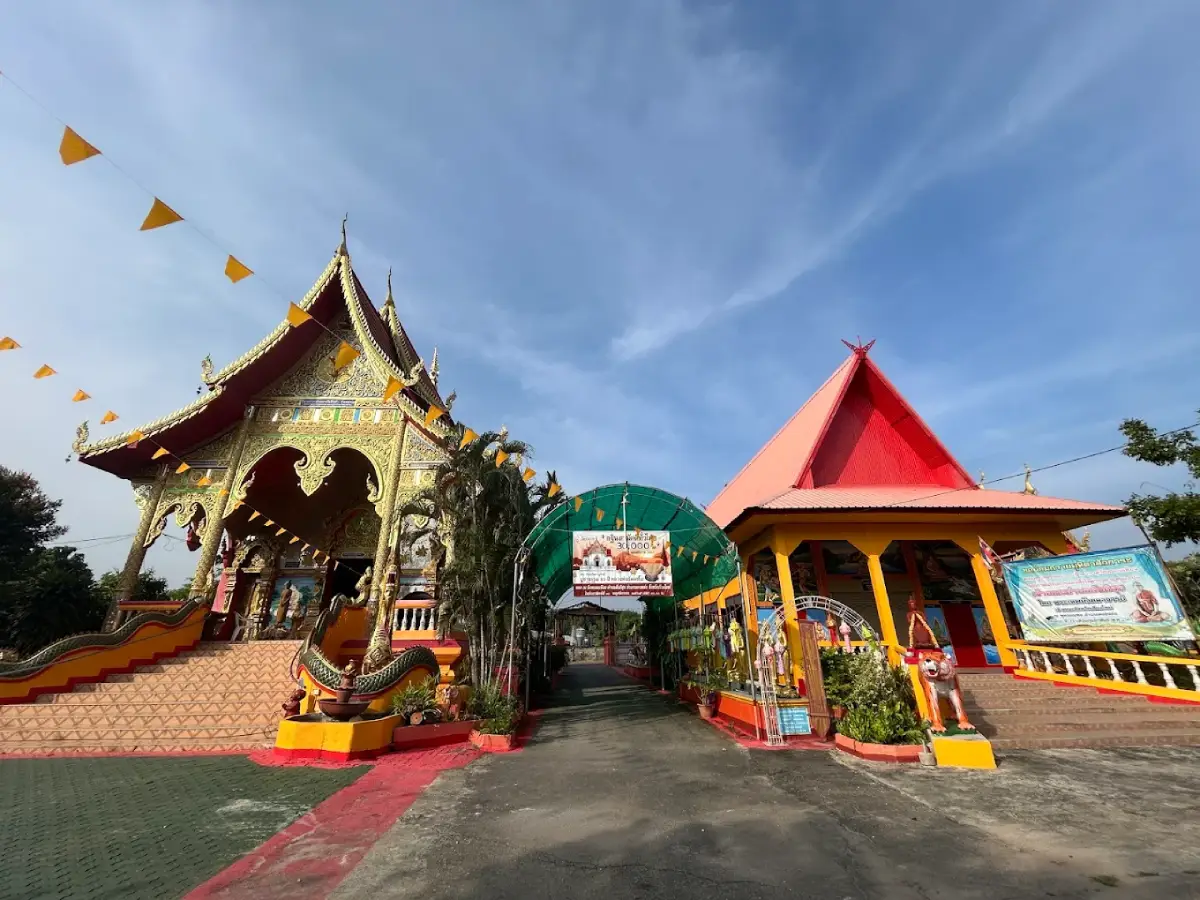
Wat Nong Hiang is a community Buddhist temple of the Maha Nikaya tradition in Ban Nong Hiang, Moo 2, Santi Suk Subdistrict, Doi Lo District, Chiang Mai Province. The temple was created through the direct support of local residents and has developed into an important religious and educational center for the surrounding community. Its most distinctive feature for cultural visitors is the main vihara, where mural paintings use scenes related to violations of the Five Precepts to communicate Buddhist ethics in a visual and accessible form.
Wat Nong Hiang remains listed in the current temple registry of Doi Lo District under temple code 350240403, with the location identified as Ban Nong Hiang, Moo 2, Santi Suk Subdistrict, Chiang Mai. Recent Buddhist activities and religious media also continue to identify Phra Khru Wora Thammanat as the abbot of Wat Nong Hiang, showing that the temple remains an active monastic institution with resident monks and ongoing religious activities.
The physical development of Wat Nong Hiang began on 19 March 1976. Local residents, including Pho Tao and Mae Ma Chaiphrom, Pho Mi and Mae Kawi Nantanu, together with other members of the Ban Nong Hiang Buddhist community, donated approximately 6 rai and 45 square wah of land for the establishment of the temple. The foundation of the monastery therefore grew directly out of community faith, collective land donation, and local participation.
This origin is important for understanding the character of Wat Nong Hiang. Many rural temples in northern Thailand developed because villagers wanted a religious center close to their homes. The community contributed land, labor, materials, and support for monks. Wat Nong Hiang followed this pattern, making the temple not simply a religious property but a shared cultural institution created by the people of Ban Nong Hiang themselves.
The legal establishment of the temple developed in stages. Permission to construct a temple was granted on 31 July 1989, with Luang Chai Kham recorded in the local history as the person who applied for authorization. The original temple account states that the Ministry of Education announced the establishment of the temple on 30 May 1990, while current temple registry sources list 23 May 1990 as the official establishment date. Both dates belong to the same administrative period in which the community monastery received formal legal recognition.
A further milestone came on 29 September 1998, when Wat Nong Hiang received a royal grant of Wisungkhamsima. The designated sacred boundary measures 20 meters wide by 40 meters long. In Thai Buddhism, a Wisungkhamsima is an officially granted monastic boundary used for formal Sangha ceremonies, particularly ordination. Receiving this boundary marked the development of Wat Nong Hiang from a community religious site into a monastery capable of supporting major formal acts of the Buddhist monastic order.
The sequence of development is therefore unusually clear. Community members donated the land and began building in 1976. Official permission to construct the temple was granted in 1989. The temple obtained formal status in 1990, and the Wisungkhamsima boundary was granted in 1998. This progression shows how a village monastery can develop gradually over decades through the combined efforts of local Buddhists and the Thai monastic administrative system.
Ban Nong Hiang is part of Santi Suk Subdistrict in Doi Lo District, a rural area south of Chiang Mai city. The surrounding landscape is characterized by local villages, agricultural land, regional roads, and small Buddhist communities. Temples in this part of Chiang Mai retain a particularly close relationship with everyday village life. Wat Nong Hiang is therefore different from the major tourist temples in the Old City: it remains primarily a working community monastery.
Santi Suk Subdistrict contains several Buddhist temples, including Wat Khanthawat, Wat Nong Hiang, Wat Sila Mongkhon, Wat Huai Din Chi, and Wat Mai Nong Hoi, together with other religious sites nearby. This network reflects a traditional northern Thai settlement pattern in which temples are closely associated with individual villages. Wat Nong Hiang should therefore be understood as part of the broader cultural landscape of Santi Suk rather than as an isolated attraction.
The original temple land of 6 rai and 45 square wah provided enough space for religious buildings and community activities, but the deeper significance of the property lies in the fact that it was given by the local community. A monastery established through village donations naturally becomes part of collective memory. Families who contributed to its development and subsequent generations who used the temple for merit-making have helped maintain the relationship between the monastery and Ban Nong Hiang.
One of the most important spaces for visitors is the main vihara. It is a central worship area where Buddhists pay respect, participate in religious activities, and gather during temple events. The vihara is also significant because its interior contains mural paintings that have been developed as a local educational resource.
The murals relating to the Five Precepts are the strongest distinctive feature of Wat Nong Hiang. The paintings depict themes associated with human behavior and violations of the Five Buddhist Precepts. In Theravada Buddhism, the Five Precepts encourage lay followers to abstain from killing, stealing, sexual misconduct, false speech, and intoxicants that lead to heedlessness. Presenting these teachings through visual narratives allows complex ethical ideas to become easier to understand for visitors of different ages.
The murals are therefore more than decoration. They act as a form of visual Buddhist education. Instead of explaining morality only through sermons or written texts, the temple communicates ethical lessons through scenes that illustrate choices, behavior, and consequences. This method is particularly effective for children and young people because it connects abstract religious principles with situations that can be recognized in everyday life.
The educational role of the murals has been formally recognized through local learning activities. Wat Nong Hiang has been included in educational field-study programs focusing on local mural paintings and community learning resources. Students have visited the temple together with other educational destinations such as a Ganesha museum and Pha Chor in Mae Wang National Park. This demonstrates that Wat Nong Hiang functions as a learning center in addition to being a place of worship.
For families traveling with children, the murals provide a useful opportunity to discuss Buddhist ethics, personal responsibility, and the consequences of actions. For adult travelers, the same paintings can be viewed as examples of how local Buddhist communities use art to communicate values. The temple is therefore suitable not only for merit-making but also for cultural travelers interested in religious education and community-based art.
The 20-by-40-meter Wisungkhamsima boundary confirms that the monastery has a formally designated area for Sangha ceremonies. Although current reliable sources do not provide enough detail to describe the architectural style or construction history of the ordination hall, the existence of the royal boundary remains an important part of the temple's institutional history and reflects its maturation as a fully recognized monastery.
The earliest abbot named in the local history is Phra Unruean Piyadhammo. In later years, Phra Khru Wora Thammanat was appointed abbot of Wat Nong Hiang on 29 July 2010. His name continues to appear in more recent records, including temple activity information from 2025 and Buddhist broadcasting in September 2026.
Phra Khru Wora Thammanat has a role extending beyond the management of the monastery. The Santi Suk Subdistrict Learning Center recognizes him as a local wisdom holder specializing in religion, rituals, and religious traditions. Religious media published in 2026 also identifies him as both abbot of Wat Nong Hiang and ecclesiastical head of Santi Suk Subdistrict. His activities demonstrate how senior monks in rural northern Thailand often serve simultaneously as religious leaders, educators, ritual specialists, and community advisers.
The publicly listed contact number associated with Phra Khru Wora Thammanat and Wat Nong Hiang is +66 87 177 4469. Travelers, schools, or organized groups planning a special visit can use this number to confirm access, religious events, learning activities, or arrangements related to the murals before traveling.
Wat Nong Hiang also remains involved in annual Buddhist merit-making traditions. In 2025, a kathin ceremony was recorded for 1 November at 09.30, when five monks were residing at the temple during the rains retreat period. Kathin is one of the most important post-rains-retreat traditions in Thai Buddhism and provides an opportunity for the community to gather, make merit, and present monastic robes and other necessities to the Sangha.
The exact kathin date changes each year, so visitors who want to attend a ceremony should contact the temple before making travel arrangements. The same principle applies to other Buddhist holy-day events, merit-making ceremonies, and local Lanna traditions. Wat Nong Hiang remains a working community monastery, and its calendar follows religious and village needs rather than a fixed tourist schedule.
The relationship between Wat Nong Hiang and local Lanna culture can be seen in the role of the monastery as a community gathering place. Northern Thai temples traditionally connect monks, elders, families, young people, and local organizations. At Wat Nong Hiang, this connection is particularly visible through educational programs, religious ceremonies, the teaching activities of the abbot, and the use of temple art as a learning resource.
The atmosphere is well suited to travelers who prefer local temples rather than heavily visited landmarks. Santi Suk and Doi Lo retain a rural character, and a visit to Wat Nong Hiang offers a very different experience from the famous temples of central Chiang Mai. Visitors can spend time quietly inside the vihara, study the murals, make merit, and observe how a village monastery continues to function as part of daily community life.
Respectful behavior is essential. Visitors should dress modestly, covering shoulders and knees, speak quietly inside religious buildings, and avoid entering monks' private residential areas. The murals should never be touched. Flash photography should be avoided if temple staff or signs prohibit it, and permission should be requested before photographing monks, local residents, or religious ceremonies.
Travelers interested in art should take time to study the murals rather than simply photograph them. The scenes relating to the Five Precepts can be interpreted as both religious teaching and community social commentary. They show how moral concepts are translated into visual narratives and how a rural Buddhist temple communicates ideas about responsibility, right conduct, and consequences to ordinary people.
The presence of these murals adds another dimension to tourism in Doi Lo District. Many travelers pass through the area on their way toward Chom Thong or Doi Inthanon, while others visit nearby natural attractions. Wat Nong Hiang shows that Doi Lo also contains meaningful cultural learning sites. It can easily be combined with temples in Santi Suk and natural attractions farther west.
Nearby temples suitable for a cultural route include Wat Fah Lang, Wat Sila Mongkhon, Wat Khanthawat or Wat Thung Pui, Wat Huai Din Chi, and Wat Pong Cho. These temples are located within Santi Suk or the surrounding Doi Lo area. Traveling by private car allows visitors to connect several monasteries without returning to central Chiang Mai.
For a natural attraction, Pha Chor in Mae Wang National Park is one of the most worthwhile additions to the route. Pha Chor consists of dramatic earth cliffs and pillars created by long-term erosion. Visitors follow a nature trail through the landscape, making it a strong contrast to the cultural and religious experience at Wat Nong Hiang.
Wat Nong Hiang has previously been combined with Pha Chor and a Ganesha museum in student field-study programs. This creates a useful thematic route: Buddhist ethics and mural art at the temple, cultural or artistic interpretation at the museum, and natural geology at Pha Chor. Families and educational groups can therefore use the temple as part of a broader learning journey through southern Chiang Mai.
Food options are available along Highway 108 and throughout Santi Suk and Doi Lo. Nearby choices include Auntie Tui's Northern Thai Sausage, TigerMother cafe, Fa Thani Noodle Shop, Tatonyon Eatery & Café, and Krua Doi Lo Restaurant. These provide a practical range of cafés, northern Thai food, noodles, and full meals for travelers planning a half-day or full-day route.
Accommodation is available both very close to the temple and in surrounding districts. Pimprajan Homestay is approximately 1.5 km away and can be contacted at +66 90 885 1545. Fortune Hotel Chiang Mai is about 3.6 km away, The Elephant House and Pool Villas about 4.1 km, Green Tree Resort about 4.6 km, Huen Tip Viman about 4.7 km, Kao Mai Lanna Resort about 7.6 km, and De Aerng Boutique about 9 km from Wat Nong Hiang.
Getting There is easiest by private car or rental car. From central Chiang Mai, travel south along the Chiang Mai-Hot route through Hang Dong and San Pa Tong toward Doi Lo District. Continue into Santi Suk Subdistrict and Ban Nong Hiang, Moo 2. Current mapping services identify the temple with the Plus Code GR9J+Q3P, Santi Suk, Doi Lo District, Chiang Mai 50160.
The approximate coordinates are 18.51907, 98.83213. Using the coordinates or Plus Code together with “Santi Suk, Doi Lo” is recommended because several temples elsewhere in Thailand share the name Wat Nong Hiang, including temples in Lampang and other provinces.
There is a small difference between older and newer address records. The historical temple account uses number 21, Moo 2, while the current local learning center address associated with Phra Khru Wora Thammanat uses number 22, Moo 2. For actual navigation, the temple name, Ban Nong Hiang, Moo 2, and the map coordinates are more reliable than using the building number alone.
Published visitor hours are 08.00 to 17.00 daily. No current official admission fee is publicly listed, so visitors should not assume or quote a fixed entrance charge. Merit donations may be made voluntarily. Organized groups or visitors specifically interested in studying the murals should contact the temple in advance to make sure the vihara is accessible without interfering with religious activities.
Morning is generally the best time for a quiet visit and cooler weather. Late afternoon can also work well as part of a wider Doi Lo itinerary. Anyone coming specifically to study the murals should visit during daylight hours and confirm access if necessary, as the opening of interior religious buildings may depend on temple activities on that particular day.
Wat Nong Hiang appeals to several types of traveler. Buddhist visitors can explore teachings related to the Five Precepts. Art enthusiasts can study how murals are used for moral education. Local-history travelers can follow the development of a community-built monastery from 1976 onward. Families and students can use the temple as a practical learning environment linking religion, art, ethics, and village life.
The value of Wat Nong Hiang does not depend on monumental architecture or extreme antiquity. Its importance comes from the community that created it, the gradual process by which it became an officially recognized monastery, the educational role of its murals, and the continuing work of Phra Khru Wora Thammanat in religious and community life.
From the donation of 6 rai and 45 square wah of land on 19 March 1976 to formal temple status in 1990 and the royal grant of Wisungkhamsima in 1998, Wat Nong Hiang has developed alongside Ban Nong Hiang and Santi Suk Subdistrict. Today it remains a place of worship, education, local wisdom, and community memory—an instructive example of how Buddhism, art, and village life continue to intersect in Doi Lo District.
| Name | Wat Nong Hiang |
| Type | Community Buddhist Temple, Maha Nikaya Tradition |
| Temple Code | 350240403 |
| Location | Ban Nong Hiang, Moo 2, Santi Suk Subdistrict, Doi Lo District, Chiang Mai 50160, Thailand |
| Recorded Street Number | Historical temple records use No. 21, while the current address associated with the abbot uses No. 22, Moo 2 |
| Approximate Coordinates | 18.51907, 98.83213 |
| Plus Code | GR9J+Q3P, Santi Suk, Doi Lo, Chiang Mai |
| Construction Began | 19 March 1976 |
| Original Land Donation | 6 rai and 45 square wah, donated by residents and Buddhist supporters of Ban Nong Hiang |
| Construction Authorization | 31 July 1989 |
| Official Temple Establishment | Current registry: 23 May 1990; original temple history records a Ministry of Education announcement dated 30 May 1990 |
| Wisungkhamsima | Granted 29 September 1998; boundary 20 x 40 meters |
| Main Highlight | Main vihara with Buddhist murals illustrating themes related to violations of the Five Precepts |
| Educational Role | Local learning center for mural art, Buddhist ethics, the Five Precepts, religion, and ritual traditions |
| Abbot | Phra Khru Wora Thammanat |
| Abbot's Community Role | Abbot of Wat Nong Hiang, ecclesiastical head of Santi Suk Subdistrict, and local knowledge specialist in religion and ritual traditions |
| Main Contact Number | +66 87 177 4469 |
| Open Days | Daily |
| Opening Hours | 08.00 - 17.00 |
| Admission Fee | No current official admission fee is publicly listed |
| Temple Activities | Buddhist ceremonies and annual kathin activities; dates vary by year |
| Current Status | Active registered Maha Nikaya temple with resident monks and ongoing Buddhist activities |
| Getting There | Drive south from Chiang Mai along the Chiang Mai-Hot route through Hang Dong and San Pa Tong toward Doi Lo, then continue to Santi Suk and Ban Nong Hiang, Moo 2. Private car or rental car is the most convenient option. |
| Nearby Tourist Attractions | 1. Wat Fah Lang, approximately 1 km 2. Wat Sila Mongkhon, approximately 2 km 3. Wat Khanthawat (Wat Thung Pui), approximately 3 km 4. Wat Pong Cho, approximately 7 km 5. Pha Chor Tourist Center, approximately 14 km |
| Nearby Restaurants And Cafés | 1. Auntie Tui's Northern Thai Sausage, approximately 2 km 2. TigerMother cafe, approximately 3 km, Tel. +66 96 685 1742 3. Fa Thani Noodle Shop, approximately 3 km 4. Tatonyon Eatery & Café, approximately 7 km, Tel. +66 52 000 566 5. Krua Doi Lo Restaurant, approximately 8 km, Tel. +66 81 026 4699 |
| Nearby Accommodations | 1. Pimprajan Homestay, approximately 1.5 km, Tel. +66 90 885 1545 2. Fortune Hotel Chiang Mai, approximately 3.6 km 3. The Elephant House and Pool Villas, approximately 4.1 km 4. Green Tree Resort, approximately 4.6 km 5. Huen Tip Viman, approximately 4.7 km 6. Kao Mai Lanna Resort, approximately 7.6 km 7. De Aerng Boutique, approximately 9 km, Tel. +66 61 316 0822 |
Frequently Asked Questions (FAQ)
Q: Where is Wat Nong Hiang located?
A: Wat Nong Hiang is in Ban Nong Hiang, Moo 2, Santi Suk Subdistrict, Doi Lo District, Chiang Mai Province 50160. Approximate coordinates are 18.51907, 98.83213, and the Plus Code is GR9J+Q3P.
Q: When was Wat Nong Hiang established?
A: Community members began building the temple on 19 March 1976 on 6 rai and 45 square wah of donated land. The temple received formal legal status in 1990.
Q: What is special about Wat Nong Hiang?
A: The main highlight is the vihara containing mural paintings related to the Five Buddhist Precepts and the consequences of violating them. The murals are also used as a local educational resource.
Q: Who is the abbot of Wat Nong Hiang?
A: Phra Khru Wora Thammanat is the abbot. He also serves as the ecclesiastical head of Santi Suk Subdistrict and is recognized locally for his knowledge of religion and ritual traditions.
Q: What are the opening hours of Wat Nong Hiang?
A: The temple is open daily from 08.00 to 17.00. Groups specifically visiting the murals can contact the temple at +66 87 177 4469 before traveling.
Q: Is there an admission fee at Wat Nong Hiang?
A: No current official admission fee is publicly listed. Visitors may make voluntary merit donations and should follow temple rules.
Q: Does Wat Nong Hiang hold a kathin ceremony?
A: Yes. Kathin activities are held at the temple, although the exact date changes each year. Visitors who want to attend should confirm the annual schedule directly with the temple.
Q: What can be visited after Wat Nong Hiang?
A: A cultural and nature route can include Wat Fah Lang, Wat Sila Mongkhon, Wat Khanthawat, Wat Pong Cho, and Pha Chor in Mae Wang National Park.
 Category: ●Places of Worship
 Group: ●Temple
Last Update : 3 WeekAgo
 Last Update : 3 WeekAgo
 Click to Access the Navigation Map GPS

 Muang Chiang Mai(121)Chom Thong(47)Mae Chaem(25)Chiang Dao(33)Doi Saket(68)Mae Taeng(85)Mae Rim(69)Samoeng(29)Fang(71)Mae Ai(59)Phrao(70)San Pa Tong(103)San Kamphaeng(66)San Sai(73)Hang Dong(73)Hot(32)Doi Tao(22)Omkoi(11)Saraphi(74)Wiang Haeng(15)Chai Prakan(28)Mae Wang(32)Mae On(22)Doi Lo(33)Galyani Vadhana(1)


