
lovethailand home >South Travel Attractions >Krabi Travel Attractions >Khlong Thom >Khlong Thom Nuea > Emerald Pool (Sa Morakot)
TL;DR: Emerald Pool (Sa Morakot) is located at Khao Pra–Bang Khram Wildlife Sanctuary, Khlong Thom Nuea, Khlong Thom District, Krabi Province, open Daily, hours 08:30 – 16:30.
Emerald Pool (Sa Morakot)
Open Days: Daily
Opening Hours: 08:30 – 16:30
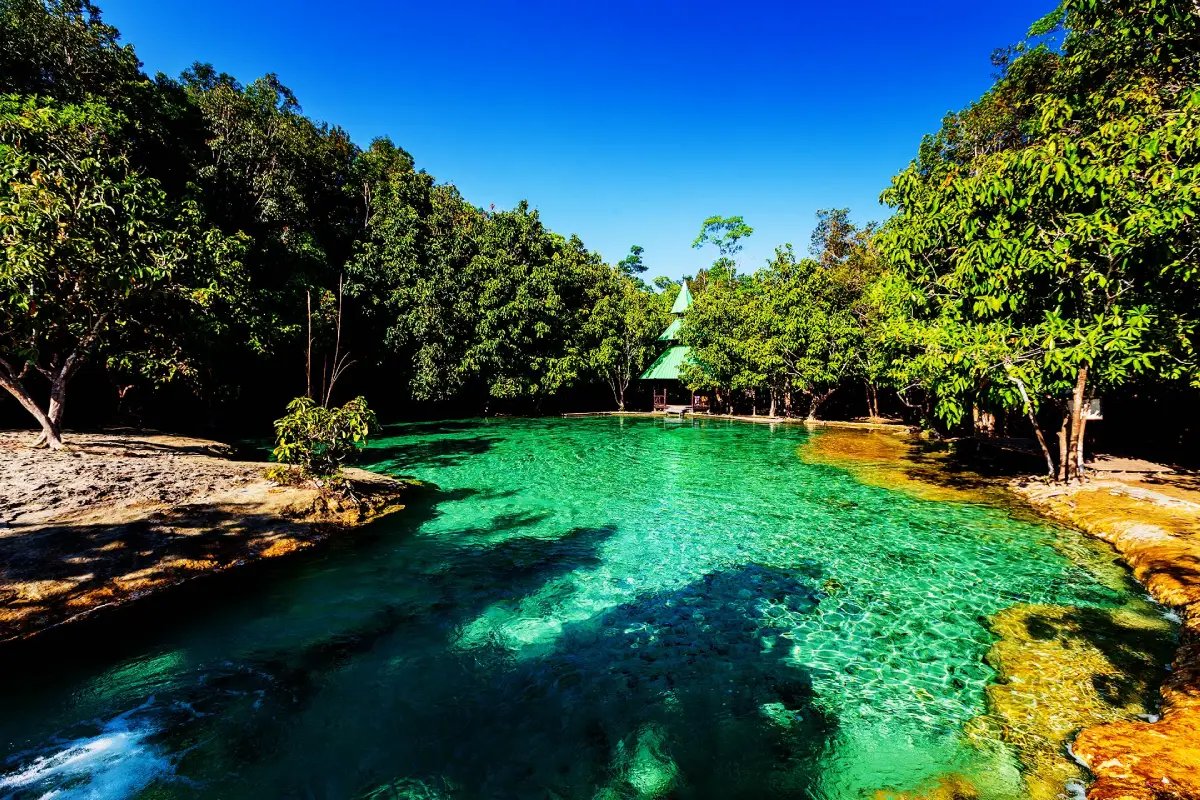
Emerald Pool (Sa Morakot), Krabi is a naturally formed green-blue pool hidden inside the lowland rainforest of Khao Pra–Bang Khram Wildlife Sanctuary in Khlong Thom District, Krabi Province. Its appeal goes far beyond the famous emerald-colored water. The site forms part of a connected thermal-water system surrounded by limestone terrain, rainforest streams, rare wildlife, and nature trails. Swimming is permitted in the main Emerald Pool, while the striking Blue Pool, also known as Sa Nam Phut, is a protected spring source where swimming is strictly prohibited. Emerald Pool remains open to visitors and is one of the most important inland nature attractions in Krabi.
Krabi is usually associated with limestone islands, beaches, clear Andaman Sea water, and coastal scenery. Emerald Pool reveals a very different landscape. Instead of a tropical beach, visitors enter a humid evergreen forest filled with streams, warm spring water, shaded paths, and wildlife. The contrast makes Khlong Thom particularly useful for travelers who want to experience more than Krabi's islands and beaches and who are interested in combining swimming with rainforest exploration and nature conservation.
Emerald Pool lies within Khao Pra–Bang Khram Wildlife Sanctuary, a major protected forest extending across parts of Krabi and Trang provinces. The sanctuary preserves an important section of southern Thailand's lowland rainforest, a forest type that has disappeared from many accessible areas of the region. The landscape includes streams, wetlands, warm groundwater, limestone formations, and forest habitats. Emerald Pool therefore functions as one visible part of a much larger ecological system rather than as an isolated swimming hole.
The changing color of the water is the feature that made Sa Morakot famous. Depending on sunlight, cloud cover, viewing angle, and time of day, the water can appear bright emerald green, turquoise, blue-green, or deeper green. On a clear morning the pool may look exceptionally transparent, with the pale limestone floor visible beneath the water. Under softer light, the pool takes on a darker forest-green tone. This natural variation explains why photographs taken on different days can look surprisingly different.
The color is entirely natural. The surrounding terrain is associated with limestone, and the water contains dissolved calcium carbonate. As the water flows and chemical conditions change, mineral deposits form naturally along the streambed and rock surfaces. Light interacting with the clear water, pale mineral deposits, vegetation, and microscopic life creates the distinctive colors seen around the pool. The green surfaces are not painted or artificially colored.
The water originates within a natural system of warm underground springs and streams. Water emerges from below ground and moves through several ponds before continuing through the forest. Temperatures across the wider spring system are commonly reported in the range of approximately 30–50°C, although the temperature is not uniform at every point. The main Emerald Pool is comfortable enough for recreational swimming and should not be confused with a small, intensely hot thermal bathing pool.
Understanding the different pools is important before visiting. The main natural-water system includes Sa Kaeo, Emerald Pool, and Sa Nam Phut or Blue Pool. Each has a different ecological role and different visitor rules. Emerald Pool is the designated swimming area. Sa Kaeo has a muddy bottom and is not open for swimming. Blue Pool is a sensitive spring source and may only be viewed from the designated area.
Sa Kaeo is an important receiving pool within the forest water system. It measures roughly 35 by 45 meters and reaches approximately 1–3 meters in depth. The bottom consists largely of soft mud, making it unsuitable and unsafe for swimming. Visitors should remain on the established path rather than approaching the water directly. Sa Kaeo helps demonstrate how water flows through several connected habitats before and after reaching the famous Emerald Pool.
The main Emerald Pool opens into a broad natural basin surrounded by dense vegetation. Its water is generally green-blue and can become remarkably clear under favorable light. Much of the swimming area is around 1.5 meters deep, although the natural floor is uneven and water depth varies. Children, older visitors, and anyone who is not a confident swimmer should remain in shallower sections and stay close to a companion.
Unlike a conventional swimming pool, Sa Morakot has a naturally formed limestone floor and continuously flowing water. The wet rock around the edge can be slippery. Running, pushing other swimmers, or jumping from rocks is unsafe. Visitors should treat the site as a protected natural spring where swimming happens to be permitted, rather than as a managed recreational pool where every section is designed for bathing.
From Emerald Pool, the forest path continues for approximately 600 meters to Blue Pool. Also known as Sa Nam Phut, this vivid blue spring is one of the most photogenic natural features in Khao Pra–Bang Khram Wildlife Sanctuary. The pool is roughly 10 meters across and approximately 4–5 meters deep. Warm water rises from underground here before flowing onward through the surrounding spring system.
Swimming in Blue Pool is prohibited. The restriction protects a sensitive spring source and surrounding ecosystem as well as keeping visitors away from the deep natural basin. Travelers should view the water from the designated edge or walkway, avoid stepping onto unstable ground, and never throw objects into the spring. Blue Pool is best appreciated as a conservation site and a geological feature rather than as a second swimming stop.
A major part of the Emerald Pool experience is the Tina Jolliffe Nature Trail, also known as the Thung Teao Nature Trail. The trail commemorates Tina Jolliffe, a British conservationist associated with early efforts to protect this lowland rainforest from destruction. Naming the trail after her reflects the long conservation history behind the attraction and reminds visitors that the forest survived because people recognized its ecological value before mass tourism arrived.
Krabi provincial tourism information describes the full Tina Jolliffe trail as approximately 2.7 kilometers long. Current visitor access also includes a more direct walk of about 800 meters from the entrance to Emerald Pool and a nature-oriented approach of roughly 1 kilometer through forest and streams. These distances refer to different parts or versions of the trail network rather than a single identical walking route. Travelers interested in the forest itself should allow more time than visitors using the shortest path directly to the pool.
Walking the Thung Teao route reveals the landscape that makes Emerald Pool possible. Shallow streams cross the forest floor, wetland plants occupy damp areas, and the vegetation displays features of southern lowland and swamp forest. The name Thung Teao is linked locally with the sa tiao tree, one of the characteristic plants associated with this environment. The trail therefore provides ecological context that cannot be understood by visiting the swimming pool alone.
Khao Pra–Bang Khram is also internationally significant for bird conservation. The forest is particularly associated with Gurney's pitta, one of the rarest birds historically recorded in southern Thailand. Hornbills, kingfishers, and numerous other forest birds also occur in the area. Bird sightings are never guaranteed, but quiet early-morning walking offers a very different experience from the busier midday swimming period.
The story of Gurney's pitta is closely connected with the conservation history of the sanctuary. Lowland forests are especially vulnerable because their relatively accessible terrain is often converted to agriculture. Large areas surrounding the protected forest have become rubber and oil-palm plantations over the decades, making the surviving natural habitat increasingly important. Protecting Emerald Pool therefore also means protecting forest species whose survival depends on the surrounding ecosystem.
The wider area has a history of forest exploitation followed by conservation. Local accounts describe former logging activity before community leaders, conservationists, and government agencies worked to protect remaining forest around the springs. The area later received stronger protected status and became part of Khao Pra–Bang Khram Wildlife Sanctuary. Today's tourism operates within that conservation framework rather than replacing it.
The sanctuary covers approximately 97,700 rai across the Krabi–Trang border area. The visitor zone around Emerald Pool represents only a small fraction of this protected landscape. For casual travelers, the main experience may last a few hours, but for birdwatchers, naturalists, and students of tropical ecology, the sanctuary is a valuable example of the relationship between lowland rainforest, groundwater, wetlands, limestone, and wildlife.
Early morning is generally the most comfortable time to visit. Arriving near opening time means fewer visitors on the paths, a quieter atmosphere around the pool, and more time to explore Blue Pool without rushing. Morning light can also make the water appear especially clear. Weekends and periods when several tour groups arrive at similar times can make the main pool considerably busier.
Photographers should not expect exactly the same emerald color throughout the day. Changing sunlight, reflections from the canopy, clouds, and viewing angle alter the appearance of the water. Moving between the permitted viewpoints usually provides enough variation without stepping onto slippery rocks or leaving marked areas. Softer morning light is particularly useful for balancing the bright water with the surrounding rainforest.
Travelers planning to swim should bring suitable swimwear, a towel, dry clothes, and a waterproof bag for electronics. Footwear with good grip is more useful than smooth-soled sandals because forest paths and wet limestone can become slippery. Anyone continuing to Blue Pool should wear shoes comfortable enough for additional walking rather than relying only on beach footwear.
Families can visit Emerald Pool with children, but adults should supervise them closely in and around the water. Depth changes naturally, the pool floor is uneven, and wet rock around the edge can be slippery. Children who are not strong swimmers should remain in shallow water. The visit can also be used to teach younger travelers why Emerald Pool allows swimming while the ecologically sensitive Blue Pool does not.
Visitors with limited mobility can choose the shorter main approach of approximately 800 meters instead of spending longer on the nature trail. Accessible parking is listed at the attraction, but the entire forest environment should not be assumed to be fully wheelchair accessible. The route farther toward Blue Pool is more natural and is not suitable for every visitor. Travelers can still experience the main pool without completing every trail section.
Most restaurants, food stalls, and visitor services are concentrated around the entrance and parking area. Once inside the protected forest, the experience becomes much more nature-oriented, with trails and waterways rather than continuous commercial facilities. Eating before entering or after returning to the entrance reduces the need to carry unnecessary packaging through the sanctuary.
Facilities at the entrance include parking, toilets, ticketing, and nearby food services. Parking is generally charged separately from the wildlife-sanctuary admission fee. Cash remains important for admission and local services, so visitors should carry enough Thai baht before leaving Krabi Town or the main highway.
Current admission prices are higher than the rates still shown on many older travel websites. Thai visitors pay 30 THB for adults and 20 THB for children. Foreign visitors pay 400 THB for adults and 200 THB for children. These rates replaced the older 20/10 THB Thai rates and 200/100 THB foreign rates in 2023 and continue to appear in updated 2026 travel information.
For trip planning, the most reliable current visiting window is 08:30–16:30 daily. Some travel pages still list 17:00 as the closing time, but current map and attraction listings consistently show 16:30 for the main site. Visitors should not arrive close to closing time because the pool is reached on foot and the walk to Blue Pool requires additional time.
A minimum of 2–3 hours is practical for the main Emerald Pool visit. Travelers who want to walk slowly through the forest, swim, rest by the pool, and continue to Blue Pool should reserve approximately half a day. Combining Emerald Pool with Khlong Thom Hot Spring Waterfall makes an excellent full-day inland Krabi itinerary.
Khlong Thom Hot Spring Waterfall is one of the easiest attractions to combine with Emerald Pool. The two sites are approximately 7 kilometers apart and offer very different experiences. Emerald Pool centers on lowland rainforest, walking, and a green natural swimming basin, while the hot waterfall consists of warm flowing water cascading over natural rock formations. Visiting both avoids a long return trip to Krabi Town between attractions.
Travelers interested in local history can also add Wat Khlong Thom Museum. The museum is associated with archaeological finds from the Khuan Luk Pat area, including beads and other evidence of ancient exchange networks. A morning in the forest followed by the museum gives the Khlong Thom route both environmental and cultural depth.
Khlong Thom Saline Hot Spring, approximately 18 kilometers from Emerald Pool, adds another type of geothermal landscape to the itinerary. The saline spring differs from both Emerald Pool and the hot waterfall, demonstrating the variety of underground-water features concentrated within the wider Khlong Thom area.
Birdwatchers should approach Emerald Pool differently from ordinary swimmers. Quiet early walking, patient observation, and minimal disturbance offer the best conditions for seeing forest birds. Loudspeakers and prolonged playback of bird calls are inappropriate in a wildlife sanctuary. Wildlife should be observed from a respectful distance without attempting to attract animals closer.
The Thung Teao forest is valuable precisely because lowland rainforest has been lost from many other areas of southern Thailand. Flat, accessible land is easier to convert to plantations and development than steep mountain forest. Protecting Khao Pra–Bang Khram therefore preserves not only attractive water but also a rare habitat, its groundwater system, and wildlife dependent on that habitat.
Soap, shampoo, body wash, and other chemicals should never be used in the natural pool. Visitors should not feed fish, remove stones, pick plants, or leave food waste. Water from Emerald Pool continues through a living natural system, so substances introduced by swimmers do not simply disappear when they leave the swimming area.
Wet limestone around the pool deserves particular caution. Mineral deposits, flowing water, and natural algae can make surfaces unexpectedly slippery. Walking rather than running and using footwear with good traction greatly reduces risk. Visitors should also follow staff instructions immediately if weather or site conditions require temporary restrictions.
Rain can make the forest exceptionally green and atmospheric, but it also increases the risk of slipping on paths, wooden walkways, and rock. A lightweight rain layer and waterproof protection for phones are more practical than rushing between locations. The rainforest should be enjoyed at a pace appropriate to the conditions rather than treated as a race to reach the pool.
Travelers who want to reach the pool as soon as it opens can stay in Khlong Thom Nuea, around the hot-spring area, or in Khlong Thom District. Staying locally reduces early-morning driving from Krabi Town or Ao Nang and works especially well for birdwatchers. Travelers based on the coast can still visit on a day trip, provided they leave early.
Food options closest to the attraction are concentrated around the entrance. Chann Roen Restaurant Krabi, Ruean Morakot Restaurant, and Rim Tarn Kitchen Restaurant are among the nearest established choices. Additional cafes and restaurants are available toward the hot springs and Khlong Thom town, making it easy to plan lunch outside the protected forest.
The site is managed by Khao Pra–Bang Khram Wildlife Sanctuary under Thailand's Department of National Parks, Wildlife and Plant Conservation. The latest 2026 appointment names Seree Nilsupan as head of Khao Pra–Bang Khram Wildlife Sanctuary for Krabi and Trang and also as head of the associated non-hunting area. Visitor management therefore operates within a wildlife-conservation mandate.
This management status explains why access rules can be stricter than at a conventional recreational attraction. Wildlife and ecological protection come first, while tourism is permitted under controlled conditions. Swimming is allowed in one pool but prohibited in other sensitive areas. If staff close a section or redirect visitors, the conservation requirement takes priority.
The complete Emerald Pool experience begins well before reaching the green water. The 800-meter walk, forest streams, Sa Kaeo, Thung Teao vegetation, the swimming pool, and the final walk toward Blue Pool form a sequence. Visitors who only take a quick photograph at Sa Morakot miss much of the ecological story that makes Khao Pra–Bang Khram distinctive.
Travelers with limited time can use the direct path, visit the main pool, and return. Those with half a day should include the nature trail and Blue Pool. Birdwatchers and plant enthusiasts benefit from moving much more slowly because the forest before and beyond the swimming area is as important as the pool itself.
Responsible tourism is central to the future of Emerald Pool. Visitor spending supports local restaurants, accommodation, transport, and communities, but high visitor numbers also put pressure on trails, water, and wildlife. Staying on the path, carrying out rubbish, respecting no-swimming zones, and keeping noise low are simple actions that directly reduce that pressure.
Getting There from Krabi Town involves a drive of roughly 60 kilometers and usually takes about 1–1.5 hours depending on traffic. Follow Phet Kasem Road, Highway 4, toward Khlong Thom, then turn toward Khlong Thom Nuea and follow signs for Emerald Pool or Khao Pra–Bang Khram Wildlife Sanctuary. After parking, visitors walk approximately 800 meters to the main pool.
A private car, rental car, hired driver, or organized tour is the most practical way to reach Emerald Pool. There is no regular direct public-transport service that delivers visitors to the forest entrance in the same way urban attractions are served. If using a taxi or hired vehicle, arrange waiting time or a return pickup in advance because a complete visit normally lasts several hours.
A well-paced full-day itinerary starts at Emerald Pool shortly after opening, continues through the nature trail and Blue Pool, stops for lunch near the entrance, and then visits Khlong Thom Hot Spring Waterfall. Travelers with an additional day can add Wat Khlong Thom Museum or the saline hot spring rather than trying to fit too many distant Krabi attractions into the same schedule.
Ultimately, Emerald Pool is not simply a beautiful green swimming hole. It is where limestone geology, warm groundwater, lowland rainforest, rare birds, community conservation history, and modern nature tourism meet. Protecting the green water alone would not be enough; the Thung Teao forest, Blue Pool, streams, plants, and wildlife all form part of the same system. Visiting with that understanding makes Sa Morakot one of the most meaningful inland nature experiences in Krabi.
| Name | Emerald Pool (Sa Morakot), Krabi |
| Location | Khao Pra–Bang Khram Wildlife Sanctuary, Khlong Thom Nuea, Khlong Thom District, Krabi Province |
| Address | W7G9+27, Khlong Thom Nuea, Khlong Thom District, Krabi 81120, Thailand |
| Coordinates | 7.92510, 99.26823 |
| Highlights | Natural emerald-green swimming pool in lowland rainforest, fed by a warm underground spring system, with Blue Pool and a nature trail nearby |
| Natural Features | Limestone basin with calcium-carbonate-rich water whose visible color changes with light and environmental conditions |
| Water-System Temperature | Approximately 30–50°C depending on location within the spring system |
| Main Pool Depth | Around 1.5 meters in many swimming sections; natural depth varies |
| Main Areas / Zones | 1. Sa Kaeo – muddy-bottom pool; no swimming 2. Emerald Pool – designated swimming area 3. Blue Pool / Sa Nam Phut – protected spring source; no swimming 4. Tina Jolliffe (Thung Teao) Nature Trail |
| Blue Pool | Approximately 600 m beyond Emerald Pool; about 10 m across and 4–5 m deep; viewing only |
| Nature Trail | Full Tina Jolliffe trail approximately 2.7 km; direct visitor walk to Emerald Pool about 800 m, with a nature-oriented route of roughly 1 km |
| Notable Wildlife | Gurney's pitta, kingfishers, hornbills, and numerous other forest birds |
| Conservation History | Formerly affected by forest exploitation before community, conservation, and government efforts led to stronger protection within Khao Pra–Bang Khram Wildlife Sanctuary |
| Current Caretaker | Seree Nilsupan, Head of Khao Pra–Bang Khram Wildlife Sanctuary, Krabi and Trang |
| Current Status | Open to visitors |
| Open Days | Daily |
| Opening Hours | 08:30 – 16:30 |
| Fees | Thai visitors: Adult 30 THB, Child 20 THB Foreign visitors: Adult 400 THB, Child 200 THB |
| Facilities | Paid parking, toilets, ticketing, restaurants and shops near the entrance |
| Visitor Rules | Swim only in designated areas; no swimming in Sa Kaeo or Blue Pool; do not use soap or chemicals in the water; do not litter, remove plants or rocks, or leave designated paths |
| Travel Information | Approximately 60 km from Krabi Town via Highway 4 toward Khlong Thom, then local roads toward Khlong Thom Nuea. Walk approximately 800 m from the parking area to the main pool. |
| Main Contact Number | +66 98 041 8171 |
| Managing Authority | Khao Pra–Bang Khram Wildlife Sanctuary, Department of National Parks, Wildlife and Plant Conservation |
| Nearby Tourist Attractions | 1. Blue Pool (Sa Nam Phut), about 0.6 km 2. Hermit Shrine, about 1.5 km 3. Khlong Thom Hot Spring Waterfall, about 7 km 4. Wat Khlong Thom Museum, about 12 km, Tel. +66 75 699 223 5. Khlong Thom Saline Hot Spring, about 18 km, Tel. +66 62 570 8175 |
| Nearby Restaurants | 1. Chann Roen Restaurant Krabi, about 0.4 km, Tel. +66 84 746 3686 2. Ruean Morakot Restaurant, about 0.9 km, Tel. +66 89 972 7194 3. Rim Tarn Kitchen Restaurant, about 0.9 km, Tel. +66 82 817 4577 4. Little Palm Homemade, about 8 km, Tel. +66 95 979 9166 5. Little Bit Restaurant, about 15 km, Tel. +66 98 071 9545 |
| Nearby Accommodations | 1. Morakot Resort, about 1 km, Tel. +66 81 415 1982 2. Saline Hot Water Springs Resort, about 7 km, Tel. +66 96 284 8669 3. Wareerak Hot Spring & Wellness, about 8 km, Tel. +66 62 457 6350 4. Vanilla Ville Resort, about 18 km, Tel. +66 81 802 9761 5. Nattha Waree Hot Spring Resort and Spa, about 20 km, Tel. +66 75 601 642 |
Frequently Asked Questions (FAQ)
Q: Where is Emerald Pool in Krabi?
A: Emerald Pool is inside Khao Pra–Bang Khram Wildlife Sanctuary in Khlong Thom Nuea, Khlong Thom District, approximately 60 km from Krabi Town.
Q: What are the current opening hours and entrance fees for Emerald Pool?
A: Emerald Pool is open daily from 08:30 to 16:30. Thai admission is 30 THB for adults and 20 THB for children. Foreign admission is 400 THB for adults and 200 THB for children.
Q: Can visitors swim in Emerald Pool?
A: Yes. Swimming is permitted in the designated main Emerald Pool. Visitors should be careful on slippery limestone and remember that natural water depth varies.
Q: Can visitors swim in Blue Pool?
A: No. Blue Pool is a protected spring source and swimming is prohibited. Visitors may view it only from the designated area.
Q: How far is the walk from the entrance to Emerald Pool?
A: The direct walk is approximately 800 meters. Choosing the nature-oriented route increases the walking distance and allows more time to explore the lowland forest.
Q: What is the best time of day to visit Emerald Pool?
A: Arriving close to opening time is best for lighter crowds, comfortable walking conditions, and enough time to visit both Emerald Pool and Blue Pool without rushing.
Q: How do travelers get from Krabi Town to Emerald Pool?
A: Drive south on Highway 4 toward Khlong Thom, then follow local roads toward Khlong Thom Nuea and signs for Emerald Pool. The journey is roughly 60 km. A rental car, private driver, taxi arrangement, or organized tour is the most practical option.
Q: What should travelers bring to Emerald Pool?
A: Bring shoes with good grip, swimwear, a towel, dry clothes, waterproof protection for valuables, light rain protection when needed, and Thai baht in cash for admission and local services.
 Category: ●Nature and Wildlife
 Group: ●Hot Springs
Last Update : 2 MonthAgo
 Last Update : 2 MonthAgo
 Click to Access the Navigation Map GPS
Emerald Pool (Sa Morakot) Map
Recommend

 Art, Culture and Heritage
 Historical Sites and Monuments(1)
 Landmarks and Memorials(7)
 Art, Craft Centres, Tradition(2)
 Museums(2)
 Educational Places
 Educational Gardens, Farm(1)
 Places of Worship
 Temple(3)
 Mosque(2)
 Other Sacred Sites(2)
 Research and Development
 Royal Project(1)
 Suburban Living
 Village, Community(6)
 National Parks and Marine Reserves(5)
 Mountain (Doi)(2)
 Dam, Reservoir, Lake(3)
 Waterfalls(12)
Hot Springs(3)
 Caves(20)
 River, Canal(2)
 Bays and Beaches(36)
 Islands(23)
 Other natural attractions(7)
 Entertainment and Agricultural
 Farms, Parks and Ecotourism(1)
 Outdoor and Adventure Activities(1)
 Travel Articles, Recipes
 Travel Review, Food Review(2)
 Southern Food Menu, Southern Food Recipes(1)


