
lovethailand home >Northeastern Travel Attractions >Nakhon Ratchasima Travel Attractions >Muang Nakhon Ratchasima >Nai Muang > Wat Phra Narai Maharat Worawihan
TL;DR: Wat Phra Narai Maharat Worawihan is located at Nai Mueang Subdistrict, Mueang Nakhon Ratchasima District, Nakhon Ratchasima Province, next to Korat City Pillar Shrine, open Daily, hours 08.00 – 17.00.
Wat Phra Narai Maharat Worawihan
Open Days: Daily
Opening Hours: 08.00 – 17.00
Wat Phra Narai Maharat Worawihan in Nakhon Ratchasima, widely known by local people as Wat Klang or Wat Klang Nakhon, is a third-class royal temple of the Worawihan type located in the heart of Korat’s old city. The temple stands in Nai Mueang Subdistrict, Mueang Nakhon Ratchasima District, Nakhon Ratchasima Province, right next to the Korat City Pillar Shrine. For travelers who want to understand the historical core of Nakhon Ratchasima, this temple is one of the most important places to visit. It is not only an active Buddhist temple, but also a center of old-city planning, royal memory, local faith, Ayutthaya-period heritage, and the civic identity of Korat.
The name Wat Klang means “central temple,” and the name comes directly from the temple’s location in the middle of the old city. Other temples within the old city wall were traditionally named according to their directions from this central temple. Wat Burapha refers to the eastern direction, Wat Isan to the northeast, and Wat Phayap to the northwest, while Wat Bueng and Wat Sa Kaeo also belong to the group of important old-city temples. This naming system allows visitors to read the old urban layout of Korat through temple locations. Wat Phra Narai Maharat therefore functions as a key to understanding how religion, city planning, and community life were organized in historic Nakhon Ratchasima.
The temple is believed to have been founded during the Ayutthaya period under King Narai the Great, when Nakhon Ratchasima was developed as a strategic city and an important gateway to the northeastern region. At that time, the city had military, administrative, and transportation significance. Establishing a major Buddhist temple at the center of the city was therefore not merely an act of religious construction. It created a spiritual anchor for the city, a place where officials, residents, monks, and local communities could gather around a shared symbol of faith.
Wat Phra Narai Maharat is closely connected with six important temples traditionally associated with the old city wall of Nakhon Ratchasima: Wat Phra Narai Maharat, Wat Burapha, Wat Isan, Wat Phayap, Wat Bueng, and Wat Sa Kaeo. Wat Phra Narai Maharat stands at the center of this group. For foreign travelers, this is an important concept. A visit to Wat Klang should not be understood as a visit to one isolated temple. It is better understood as the starting point for reading the sacred geography of old Korat.
The temple also played an important role in state ritual. In earlier times, Wat Phra Narai Maharat was used for the Oath of Allegiance ceremony, known in Thai as the Thue Nam Phiphat Sattaya ceremony. Government officials from different departments would swear loyalty and promise to perform their duties honestly. This ceremony reveals how Buddhist temples could serve not only religious purposes but also political and administrative functions. The choice of Wat Phra Narai Maharat as the site of such a ceremony confirms its status as a sacred civic center of Korat.
The temple was also used for the chanting and consecration of holy water for royal ceremonies. This further strengthened the temple’s connection with royal ritual and the spiritual welfare of the state. For visitors, this background is important because it shows that Wat Phra Narai Maharat was never simply a neighborhood temple. Its role extended into public ceremony, royal symbolism, and the moral structure of official life in the city.
Another major historical connection is with Thao Suranari, or Ya Mo, the revered heroine of Nakhon Ratchasima. The temple once contained a monument enshrining her ashes at the northwestern corner of the temple grounds. In 1934, the monument was moved to Chumphon Gate, where it remains today as one of Korat’s most famous landmarks. Even though the present main monument stands outside the temple, the earlier presence of Ya Mo’s ashes inside Wat Phra Narai Maharat confirms the temple’s importance as a sacred site of civic memory.
Inside Wat Phra Narai Maharat, visitors will find several important areas: the ordination hall in the middle of a lotus pond, the royal viharn, the main stupa, the King Narai the Great monument, the Narai shrine, the four-armed Vishnu image, the main Buddha image known as Phra Thotsaphon Yan Prathan Barami or Luang Pho Yai, boundary stones around the ordination hall, a Buddhist scripture school, temple halls, monastic areas, and shaded grounds. Each area has a different function and meaning. Together, they make the temple one of the richest cultural sites in central Korat.
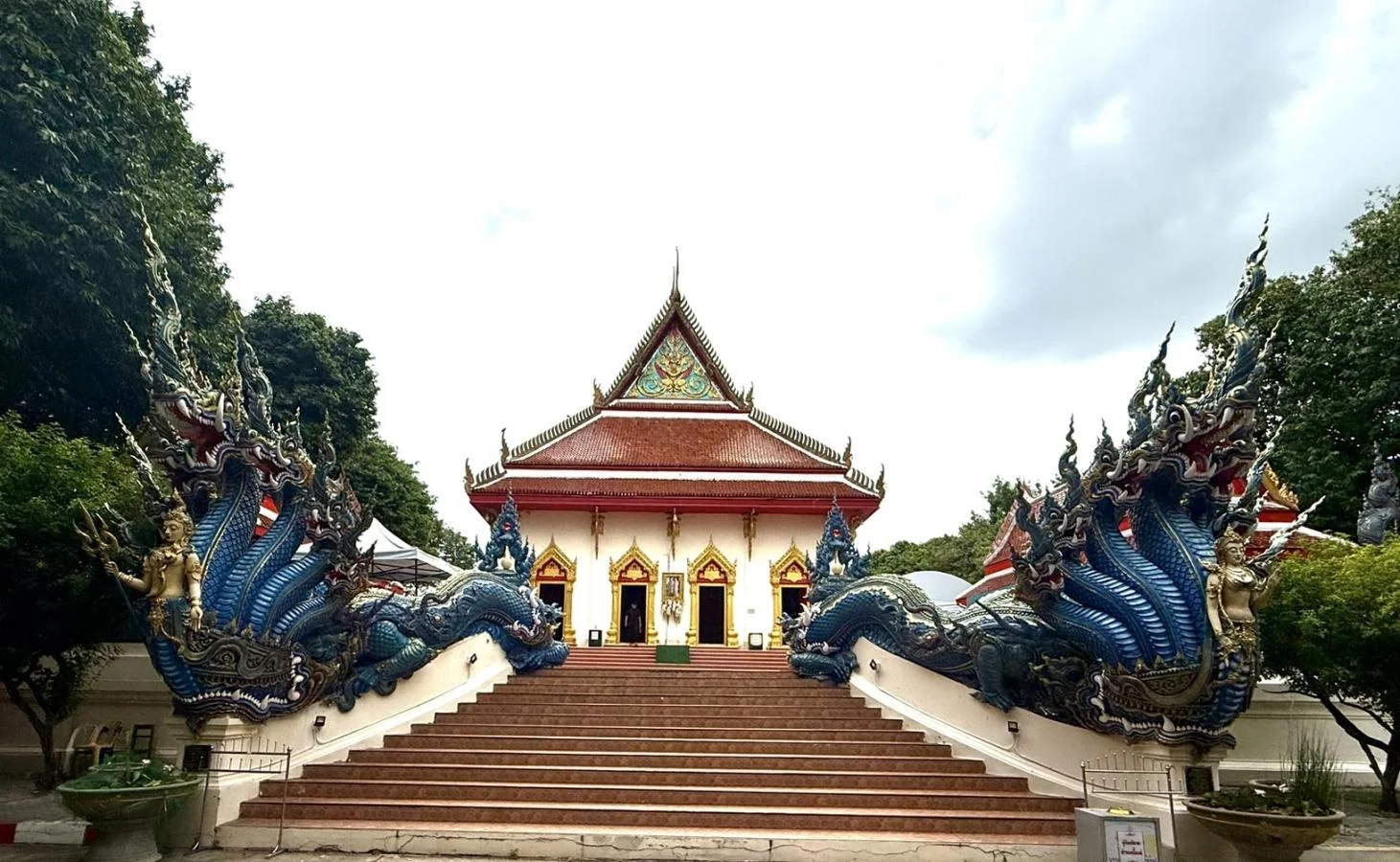
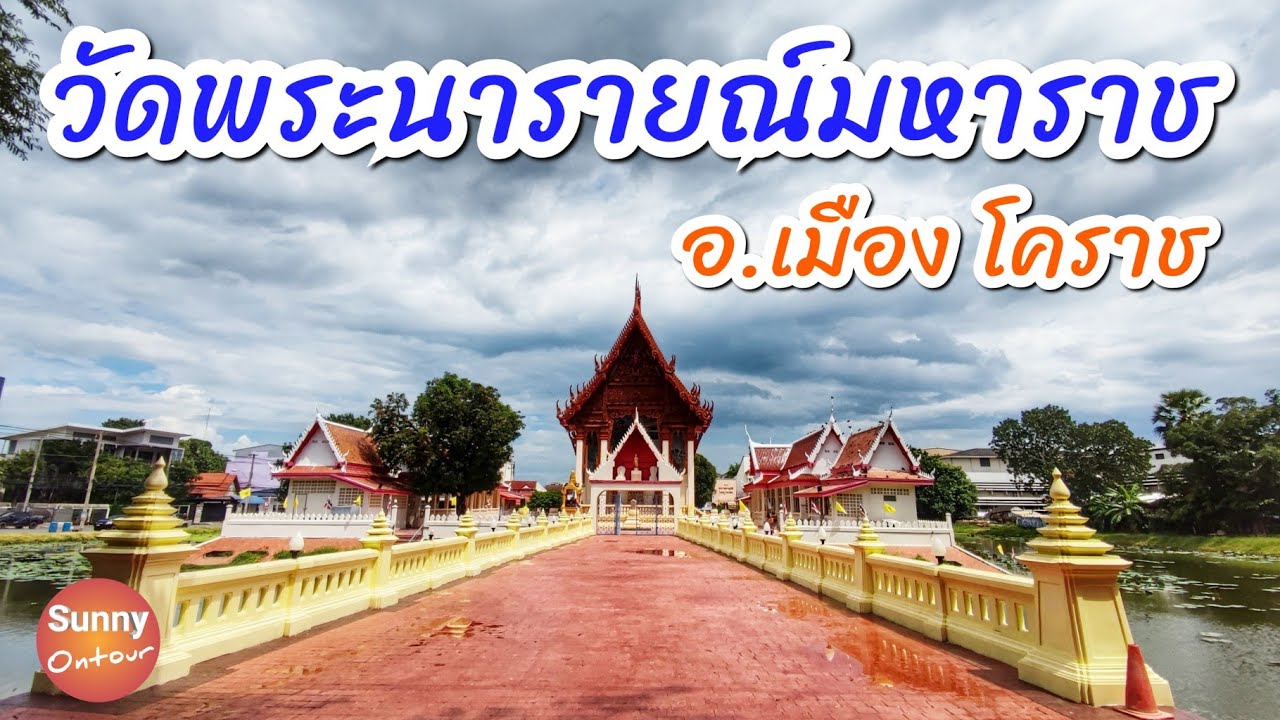
The ordination hall in the middle of the lotus pond is one of the temple’s most memorable features. It stands on an island-like platform in a pond on the eastern side of the temple. This setting gives the hall a distinctive visual identity and separates the sacred space from the surrounding urban environment. The original ordination hall was built together with the temple and is said to have had a boat-like form. The present structure was rebuilt over the original base while preserving some elements inspired by the old design. Crossing toward the hall gives visitors the feeling of moving from the busy old city into a calmer ritual space.
The present ordination hall has a three-tiered gable roof. On the eastern side, the gable shows Narai riding Garuda, while the wall includes an image of the Buddha practicing austerities. There are three doors on this side. On the western side, which is approached from the bridge, the gable shows Indra riding the three-headed elephant Erawan, while the wall shows Prince Siddhartha leaving worldly life to become a monk. There are two doors on this side. These details show a rich combination of Buddhist storytelling and Hindu-Brahmanic symbolism within Thai temple art.
Around the ordination hall are eight boundary stones, or sema stones. These mark the consecrated area of the ubosot where important monastic acts are performed. The current stones are replacements because the original boundary stones deteriorated over time. For travelers unfamiliar with Thai Buddhist architecture, sema stones are not merely decorative. They define the sacred ritual space of the ordination hall and are essential to the religious function of the building.
Inside the ordination hall is a Buddha image in the posture of subduing Mara. This posture represents the Buddha’s victory over temptation and delusion before enlightenment. It is a powerful symbol of mental steadiness, wisdom, and spiritual victory. Visitors entering the hall should remove their shoes, dress respectfully, keep their voices low, and avoid touching the Buddha image or sacred objects. The ubosot is not simply an architectural attraction. It remains an active sacred space.
The royal viharn is another major feature of the temple. It is one of the most important buildings on the grounds and is associated with the early development of Nakhon Ratchasima. Inside the viharn is Phra Thotsaphon Yan Prathan Barami, also known as Luang Pho Yai, a large Buddha image in the posture of subduing Mara. This image is highly respected by local Buddhists and is considered one of the temple’s spiritual centers. Visitors who come to Wat Phra Narai Maharat should pay respect to Luang Pho Yai as part of a complete visit.
The royal viharn has gone through several stages of damage and restoration. The old viharn was damaged in 1826 during a period of conflict. Later, during the administration of Phraya Maha Suphap, also known as Im Singhaseni, a new viharn was built. The building was later damaged by fire, and during a royal visit to Nakhon Ratchasima by Queen Saovabha Phongsri, funds were granted for restoration. This layered history shows how the temple has been preserved and renewed through the care of local and royal patrons across generations.
Luang Pho Yai, or Phra Thotsaphon Yan Prathan Barami, is one of the most important Buddha images in Korat. The image is associated with wisdom, merit, and auspicious protection. Local people come to pay respect, make merit, and seek peace of mind. For foreign visitors, the image helps explain how a Buddha image functions in Thai society: not merely as art, but as a living center of devotion and spiritual confidence.
The four-armed Vishnu image is one of the temple’s most distinctive sacred objects. Carved from sandstone in ancient Khmer style, the standing image is approximately 17 inches high. It is regarded as a symbol connected with the name of the temple and the memory of King Narai the Great. Its presence inside a Buddhist temple shows the long coexistence and blending of Buddhist, Hindu-Brahmanic, and Khmer artistic traditions in the region. This makes Wat Phra Narai Maharat especially meaningful for visitors interested in Southeast Asian religious art.
The Narai shrine inside the temple continues to serve as an important site of local devotion. Visitors will see flowers, incense, candles, and offerings brought by worshippers. The shrine connects the temple’s name, the Vishnu image, and the historical memory of King Narai in a very tangible way. It is one of the best areas of the temple for understanding how official history and local faith meet within a living religious space.
The temple stupa also carries an important history. Earlier records describe two stupas that once stood near the western side of the royal viharn. These were damaged along with the viharn in 1826. Later abbots and patrons made efforts to restore the stupa area. In recent years, the stupa was restored and completed, with Buddha relics, a Gandhara Buddha image, and a five-tiered umbrella structure enshrined and installed in 2022. The stupa therefore represents both memory and renewal: an old sacred idea restored for the present generation.
The King Narai the Great monument is another significant feature of the temple. The bronze figure stands approximately 3.60 meters high and is placed to the west of the stupa and royal viharn near Prachak Road. The monument reminds visitors that the temple is inseparable from the history of King Narai and the development of Nakhon Ratchasima as a planned city. For Thai visitors, it is a point of civic memory. For foreign visitors, it provides a clear historical anchor for understanding why the temple bears the name Phra Narai Maharat.
Wat Phra Narai Maharat has several entrances, including access from Atsadang Road, Chomphon Road, Prachak Road, and the side near the market that leads toward the Narai shrine. The temple is surrounded by commercial buildings, local shops, markets, and city traffic. This setting gives it a different character from rural temples or forest monasteries. Wat Klang is a temple embedded in the everyday life of the city. It has always existed with the movement of people around it.
The temple’s atmosphere is therefore unique. It is a royal temple with historic architecture and sacred objects, but it is also a central city temple next to markets and local life. Visitors who expect complete silence may find the surroundings lively, especially during market hours. However, this liveliness is part of the temple’s identity. Wat Phra Narai Maharat is not separated from the city; it is part of the city’s living heart.
The temple was historically connected with provincial monastic leadership and Buddhist education. A Buddhist scripture school within the temple has been used for religious instruction, including Sunday Buddhist education for children. This shows that Wat Phra Narai Maharat is not only a place to worship but also a place of learning. Temples in Thailand often function as educational and cultural centers for the community, and Wat Klang is a clear example of that role.
Behind the royal viharn is the monastic area, shaded by rows of trees. Visitors should understand the distinction between the worship zone and the monastic residential zone. The worship zone includes the ubosot, viharn, stupa, shrine, and public areas. The monastic zone is where monks live and carry out their daily duties. Visitors should not enter restricted areas without permission and should keep their voices low around monastic residences.
A meaningful visit to Wat Phra Narai Maharat should begin with an awareness of its central position in the old city. Visitors can then proceed to the ordination hall in the lotus pond, observe the sema stones and gable details, pay respect to the Buddha image inside, continue to the royal viharn to worship Luang Pho Yai, and then visit the stupa, the King Narai monument, and the Narai shrine. This route reveals the temple’s story through architecture, worship, and history.
For architecture enthusiasts, the temple offers many details worth observing: the ordination hall in water, the three-tiered gable roof, the Narai-on-Garuda gable, the Indra-on-Erawan gable, Buddhist scenes on the walls, boundary stones, the stupa form, and the royal viharn. These features make the temple an excellent place for studying Thai religious architecture in the context of an old provincial city.
For travelers interested in Korat history, Wat Phra Narai Maharat should be visited together with the City Pillar Shrine, Wat Isan, Wat Phayap, Wat Burapha, Wat Bueng, Wat Sa Kaeo, Chumphon Gate, and Thao Suranari Monument. These sites are interconnected. Starting at Wat Klang makes it easier to understand the directional temple names and the sacred geography of the old city. This approach turns a simple temple visit into a deeper historical walk through Korat.
For foreign travelers, Wat Phra Narai Maharat is one of the best places in Nakhon Ratchasima to understand the city’s historical identity. It brings together royal temple status, old-city planning, Ayutthaya heritage, Buddhist worship, Hindu-Brahmanic symbolism, Khmer sandstone sculpture, the city pillar context, and local devotion. A visitor who takes time to read the temple carefully will understand that Korat has a much deeper cultural foundation than its modern image as the gateway to Isan.
The temple is open daily from 08.00 to 17.00. Morning is the best time to visit because the weather is cooler and the light is suitable for respectful photography. Late afternoon is also pleasant for worship and a short old-city walk. On major Buddhist holy days, the temple may be busier with local worshippers, offerings, and religious activities, so visitors should allow extra time and behave with additional care.
There is no admission fee at Wat Phra Narai Maharat. Visitors may enter during opening hours to pay respect, walk around the temple, and see the main areas. Donations may be made voluntarily at designated points. This distinction is useful for foreign visitors: many Thai temples are living religious spaces rather than ticketed tourist attractions. A donation is an act of merit-making and support according to personal faith.
Getting There is very easy because the temple is in central Nakhon Ratchasima. Navigation apps can search for Wat Phra Narai Maharat Worawihan or Wat Klang Nakhon. The destination should be in Nai Mueang Subdistrict near Atsadang Road, Chomphon Road, and the Korat City Pillar Shrine. From Thao Suranari Monument or Chumphon Gate, visitors can travel by tuk-tuk, taxi, local transport, private car, or ride-hailing service. Those already exploring the old city can also walk between nearby landmarks, depending on the weather.
Visitors who enjoy walking can combine the temple with Thao Suranari Monument, Chumphon Gate, Korat City Pillar Shrine, and Maha Weerawong National Museum. The distances are short, but Korat can be hot. A hat, drinking water, and comfortable shoes are useful. Families with children or elderly travelers may prefer short local rides between sites.
Temple etiquette is important. Visitors should dress modestly, covering shoulders and knees. Shoes should be removed before entering the ordination hall or viharn. Voices should be kept low. Buddha images, the Vishnu image, relics, and sacred objects should not be touched. Photography should be respectful and should not disturb monks, worshippers, or ceremonies. The monastic residential area should be avoided unless permission is granted.
During major Buddhist observance days such as Makha Bucha, Visakha Bucha, Asalha Bucha, Buddhist Lent, the end of Buddhist Lent, and Kathin season, Wat Phra Narai Maharat becomes especially active. Local Buddhists may come to make merit, listen to sermons, join temple ceremonies, and pay respect to sacred objects. Visitors during these periods can experience the temple as a living religious center, but should always give priority to worshippers and ongoing ceremonies.
A recommended half-day route begins at Wat Phra Narai Maharat, continues to the City Pillar Shrine, Thao Suranari Monument, Chumphon Gate, and Maha Weerawong National Museum, and then extends to Wat Isan, Wat Phayap, Wat Sala Loi, or Wat Pa Salawan if time allows. This route is suitable for Thai visitors interested in merit-making and for foreign visitors interested in old-city history, Buddhist culture, and local identity.
What makes Wat Phra Narai Maharat different from many other temples is the way it connects many layers of meaning. It represents King Narai and the founding memory of Korat. It preserves a Khmer sandstone Vishnu image. It contains an ordination hall in the middle of a pond. It houses Luang Pho Yai in the royal viharn. It was used for the Oath of Allegiance ceremony. It once held the monument containing Thao Suranari’s ashes. It remains a royal temple and an active place of worship. Few temples in Korat contain so many layers of city history in one place.
As an educational site, the temple functions like an open-air classroom. Visitors can learn about Ayutthaya-period city development, directional temple naming, Buddhist and Brahmanic symbolism, Khmer art, royal ritual, monastic education, and the continuing role of temples in Thai urban life. Students, cultural travelers, and history enthusiasts can all benefit from observing the temple carefully rather than treating it as a quick photo stop.
For families, Wat Phra Narai Maharat is a useful place to teach children about Thai history and temple manners. Parents can explain why the temple is called Wat Klang, why other temples are named by direction, what the Vishnu image represents, why the ordination hall stands in water, and why the City Pillar Shrine is located nearby. Such explanations turn a temple visit into a cultural learning experience.
For photography, the temple offers strong visual angles: the ordination hall across the pond, the bridge to the ubosot, gable details, the royal viharn, the stupa, and the King Narai monument. Photographs should be taken respectfully. Avoid blocking worshippers, posing inappropriately with Buddha images, or using flash in sacred spaces. The best images are those that preserve the dignity of the place.
In summary, Wat Phra Narai Maharat Worawihan in Nakhon Ratchasima is one of Korat’s most important royal temples. It is an old central temple associated with King Narai the Great and the historical layout of the old city. It served as a sacred civic space for state ceremonies, was once connected with the ashes of Thao Suranari, and still preserves important features such as the ordination hall in the lotus pond, the royal viharn, Luang Pho Yai, the four-armed Vishnu image, the stupa, the Narai shrine, and the King Narai monument. The temple is easy to reach, has no admission fee, and is highly suitable for Thai and foreign visitors who want to understand Korat through Buddhism, old-city history, royal memory, and local devotion.
| Name | Wat Phra Narai Maharat Worawihan, Nakhon Ratchasima |
| Alternative Names | Wat Klang, Wat Klang Nakhon, Wat Klang Nakhon Worawihan |
| Location | Nai Mueang Subdistrict, Mueang Nakhon Ratchasima District, Nakhon Ratchasima Province, next to Korat City Pillar Shrine |
| Address | Atsadang Road / Chomphon Road / Prachak Road, Nai Mueang, Mueang Nakhon Ratchasima, Nakhon Ratchasima 30000, Thailand |
| Coordinates | 14.97558, 102.10692 |
| Temple Status | Third-Class Royal Temple, Worawihan Type, Maha Nikaya Order |
| Highlights | Ordination hall in a lotus pond, royal viharn, Phra Thotsaphon Yan Prathan Barami or Luang Pho Yai, four-armed Vishnu image, stupa, King Narai the Great monument, and Narai shrine |
| History | An old central temple of Korat founded during the Ayutthaya period under King Narai the Great. It served as the central temple for the old-city temple layout of Nakhon Ratchasima |
| Name Origin | Known as Wat Klang because it stands in the middle of the old city and served as the central reference point for directional temple names such as Wat Burapha, Wat Isan, and Wat Phayap |
| Distinctive Features | A central old-city royal temple combining Ayutthaya heritage, royal ritual history, Khmer sandstone art, Buddhist worship, city pillar context, and local Korat devotion |
| Historical Importance | Former site of the Oath of Allegiance ceremony, holy water consecration for royal ceremonies, and the earlier monument containing the ashes of Thao Suranari before it was moved to Chumphon Gate in 1934 |
| Travel Information | From Thao Suranari Monument or Chumphon Gate, follow old-city roads to Atsadang Road or Chomphon Road. Accessible by private car, tuk-tuk, local transport, taxi, or ride-hailing service |
| Current Status | Active royal Buddhist temple, important Korat city temple, and faith-based cultural attraction in central Nakhon Ratchasima |
| Open Days | Daily |
| Opening Hours | 08.00 – 17.00 |
| Fees | No admission fee; voluntary donations may be made according to personal faith |
| Facilities | Ordination hall, royal viharn, Narai shrine, temple halls, Buddhist scripture school, worship areas, merit-making areas, shaded grounds, and parking depending on old-city conditions |
| Main Areas / Zones | Ordination hall in the lotus pond Royal viharn Phra Thotsaphon Yan Prathan Barami or Luang Pho Yai Four-Armed Vishnu image Narai shrine Main stupa King Narai the Great monument Sema stones around the ordination hall Buddhist scripture school Monastic residential zone |
| Abbot / Caretaker | Phra Phrom Wachirayanok (Opas Niruttimedhi) |
| Main Contact Number | 094-524-5455 |
| Official Website / Official Page | Wat Phra Narai Maharat Worawihan / Wat Klang Nakhon KORAT |
| Nearby Tourist Attractions | 1. Korat City Pillar Shrine, about 0.1 km 2. Wat Isan, about 0.5 km, Tel. 044-244-044 3. Thao Suranari Monument, about 0.8 km 4. Chumphon Gate, about 0.9 km 5. Wat Phayap, about 1.0 km, Tel. 062-126-6146 6. Maha Weerawong National Museum, about 1.4 km, Tel. 044-242-958 7. Wat Sala Loi, about 1.7 km, Tel. 083-461-2999 |
| Nearby Restaurants | 1. Jojo Phet Yang Phimai, about 0.9 km, Tel. 044-267-347, 092-239-9246 2. Chonburi Noodles at Korat near Wat Sa Kaeo, about 1.1 km, Tel. 065-585-6636, 061-084-6452 3. Yim Cafe Wat Sala Loi, about 1.7 km, Tel. 065-198-2249 4. Oshinei Korat, about 2.5 km, Tel. 097-946-4445 5. Pa Noei Naem Nueang, about 2.7 km, Tel. 044-354-032, 082-376-8737 6. Krua Khru Pom, about 3.0 km, Tel. 044-285-304 |
| Nearby Accommodations | 1. Korat Hotel, about 0.4 km, Tel. 044-341-345 2. Thai Inter Korat Hotel, about 0.6 km, Tel. 044-247-700 3. Mayflower Grande Hotel Korat, about 1.1 km, Tel. 044-243-825 4. Centre Point Hotel Terminal21 Korat, about 1.5 km, Tel. 044-498-880 5. Fortune Hotel Korat, about 1.7 km, Tel. 044-079-900 6. Romyen Garden Place, about 2.5 km, Tel. 044-285-816-7, 098-105-7978 |
Frequently Asked Questions (FAQ)
Q: Where is Wat Phra Narai Maharat Worawihan located?
A: Wat Phra Narai Maharat Worawihan is located in central Nakhon Ratchasima, in Nai Mueang Subdistrict, Mueang Nakhon Ratchasima District, next to the Korat City Pillar Shrine and near Thao Suranari Monument.
Q: Why is Wat Phra Narai Maharat called Wat Klang?
A: It is called Wat Klang because it stands in the center of the old city and served as the reference point for directional temple names such as Wat Burapha, Wat Isan, Wat Phayap, Wat Bueng, and Wat Sa Kaeo.
Q: What are the opening days and hours of Wat Phra Narai Maharat?
A: The temple is open daily from 08.00 to 17.00. Morning is a suitable time for worship, photography, and a calm walk around the ordination hall in the lotus pond.
Q: Is there an admission fee at Wat Phra Narai Maharat?
A: There is no admission fee. Visitors may make voluntary donations or support temple activities according to personal faith.
Q: What are the main highlights of Wat Phra Narai Maharat?
A: The main highlights include the ordination hall in the lotus pond, royal viharn, Luang Pho Yai, four-armed Vishnu image, stupa, Narai shrine, and King Narai the Great monument.
Q: How is Wat Phra Narai Maharat connected with the Oath of Allegiance ceremony?
A: In the past, the temple was used for the Oath of Allegiance ceremony, in which government officials swore loyalty and promised to perform their duties honestly.
Q: How is Wat Phra Narai Maharat connected with Thao Suranari?
A: The temple once contained a monument enshrining the ashes of Thao Suranari at its northwestern corner before the monument was moved to Chumphon Gate in 1934.
Q: What should foreign visitors know before visiting Wat Phra Narai Maharat?
A: Visitors should dress modestly, remove shoes before entering the ordination hall or viharn, keep quiet, avoid touching Buddha images or sacred objects, and take time to understand the temple’s connection with King Narai, the old city, and Korat’s local devotion.
 Category: ●Places of Worship
 Group: ●Temple
Last Update : 3 MonthAgo
 Last Update : 3 MonthAgo
 Click to Access the Navigation Map GPS
Wat Phra Narai Maharat Worawihan Map
Recommend

 Art, Culture and Heritage
 Historical Sites and Monuments(20)
 Landmarks and Memorials(5)
 Art, Craft Centres, Tradition(7)
 Museums(6)
 Art Gallery(1)
 Educational Places
 Educational Gardens, Farm(4)
Temple(29)
 Mosque(1)
 Other Sacred Sites(6)
 Research and Development
 Royal Project(3)
 Suburban Living
 Village, Community(6)
 Local Market(4)
 Floating Market(1)
 Nature and Wildlife
 National Parks and Marine Reserves(3)
 Mountain (Doi)(5)
 Dam, Reservoir, Lake(8)
 Waterfalls(9)
 Hot Springs(1)
 Caves(2)
 Flower Field(1)
 River, Canal(8)
 Bays and Beaches(2)
 Other natural attractions(3)
 Entertainment and Agricultural
 Zoos and Aquariums(2)
 Animal camps and shows(1)
 Farms, Parks and Ecotourism(21)
 Waterpark(4)
 Outdoor and Adventure Activities(6)
 Shopping
 Shopping and Night Market(2)
 Travel Articles, Recipes
 Travel Review, Food Review(6)


