
lovethailand home >Northeastern Travel Attractions >Kalasin Travel Attractions >Muang Kalasin >Phu Po > Phutthasathan Phu Po
TL;DR: Phutthasathan Phu Po is located at Phu Po Subdistrict, Mueang Kalasin District, Kalasin Province, open Daily, hours 08.00 – 17.00.
Phutthasathan Phu Po
Open Days: Daily
Opening Hours: 08.00 – 17.00
Phutthasathan Phu Po in Kalasin Province is an important Buddhist sanctuary and historic site located within Wat Inthra Prathan Phon in Phu Po Subdistrict, Mueang Kalasin District. It lies about 28 kilometers north of Kalasin town. Travelers can follow Highway 213 to around kilometer marker 59, then turn left through the local route passing Ban Chot, Ban Na Chan, and Ban Na Khok Khwai for about 16 kilometers. The site is famous for two ancient reclining Buddha images carved directly into sandstone cliffs. These sacred cliff-carved Buddha images are deeply revered by people in Kalasin and nearby provinces, while the surrounding hill scenery makes Phu Po a peaceful destination for worship, cultural travel, light hill walking, and quiet reflection.
Phutthasathan Phu Po is not simply a temple on a hill. It is a rare place where Buddhist faith, ancient rock carving, local history, and natural landscape come together. The reclining Buddha images are not free-standing sculptures. They are high-relief carvings on natural sandstone cliffs beneath rock shelters, making the sacred images feel inseparable from the mountain itself. Visitors therefore experience more than Buddhist art. They encounter the relationship between stone, cliff, forest, stairways, pilgrimage, and long-lasting local devotion.
Phu Po is a sandstone hill extending along an east-west axis. The hill rises about 336 meters above sea level, or about 94 meters above the surrounding lowland. The northern side connects with the Sahatsakhan area, while the southern side belongs to Mueang Kalasin District. This location makes Phu Po a natural link between routes from Kalasin town, Somdet District, and Sahatsakhan District. Visitors can easily combine the site with other attractions in northern Kalasin, including dinosaur heritage sites, hill temples, and reservoir landscapes.
The first reclining Buddha image, often referred to as the lower image, is located near the lower slope on the approach to the hill. It is carved beneath a sandstone overhang about five meters above the ground. The image is attributed to the 12th to 14th Buddhist centuries and represents local Isan-style Dvaravati art. It measures about 3.30 meters long and 1.27 meters wide. The Buddha reclines on the right side in the lion posture, with the head turned toward the north and the face oriented toward the west. Its form is simple, powerful, and deeply rooted in early Buddhist art of northeastern Thailand.
The lower image has several important details. The face is rather square, the eyes are closed, the nose is prominent, the lips are full, the hair curls are large, and the ushnisha is rounded like a raised jewel. The left arm rests along the body, and the left foot slightly overlaps the right foot. The artisan also carved the stone surface into a bedding cloth, with supports under the head and feet. Around the body and head is a halo-like frame decorated with floral motifs. These details show that the image was not carved as an isolated figure, but as a carefully composed sacred scene on the living surface of the cliff.
The second reclining Buddha image, often called the upper image, is located higher on Phu Po, around 80 meters above the lower area. Visitors must walk up stairways and hill paths to reach it. The upper image is larger, measuring about 5.20 meters long and 1.50 meters wide. It is attributed to the 18th to 19th Buddhist centuries and shows Dvaravati tradition with later Sukhothai influence. Compared with the lower image, it has a softer and more elegant form, with more flowing lines and a more refined sense of proportion.
The upper reclining Buddha also lies on the right side. The head rests on a triangular pillow and turns toward the north. The face is oval, the eyebrows curve gracefully, the nose is prominent, the lips show a slight smile, and the ears are long. The hair curls are large, and the short flame-like radiance is carved with fine lines. The robe is shown with incised folds, and the overall composition is more fluid than the lower image. Seeing both images together allows visitors to compare different periods of Buddhist art and understand how local craftsmanship developed over time.
The importance of Phutthasathan Phu Po lies not only in age, but also in the way it preserves the tradition of rock-carved Buddhist imagery in Isan. Such cliff-carved reclining Buddha images are not common in northeastern Thailand. The presence of two reclining Buddha images at different levels of the same hill makes the site especially valuable for the study of Dvaravati art, Buddhist landscape, and sacred mountain culture. Travelers interested in art history should take time to observe the differences between the lower and upper images rather than treating the site as a quick photo stop.
For people in Kalasin, the Phu Po reclining Buddha images are sacred objects closely tied to local faith. Worshippers come to pay respect, make merit, ask for blessings, and participate in annual ceremonies. This continuing devotion keeps the site alive. Phutthasathan Phu Po is therefore both an archaeological place and a living sacred site. It is meaningful because people still come here to worship, to remember, and to maintain the relationship between community and sacred landscape.
Wat Inthra Prathan Phon serves as the temple connected with Phutthasathan Phu Po. The abbot is Phra Khru Intha Thammapathan, who is also associated with religious and community activities in Phu Po Subdistrict. Visitors should begin with a respectful mindset, make merit if they wish, and then continue to the lower and upper reclining Buddha areas. The temple is not only an entrance point to the historic site, but also a living Buddhist institution that supports local faith and community activities.
One of the most important traditions at Phutthasathan Phu Po is the annual worship and ceremonial water procession for the reclining Buddha images. This tradition is connected with sacred water, Buddha image bathing, merit-making, and community unity. In 2026, Kalasin Province scheduled the Festival of Sacred Water Procession and Worship of the Phu Po Reclining Buddha from 28 May to 1 June at Wat Inthra Prathan Phon, Phutthasathan Phu Po. Activities included the sacred water procession, cultural performances, exhibitions about the legend and cultural heritage of Phu Po, and local community activities.
This annual worship tradition shows how Buddhism, local culture, and sacred landscape are connected in Kalasin. Local people do not see the reclining Buddha images merely as ancient art. They see them as sacred presences that protect and unite the community. Carrying sacred water to honor the Buddha images is therefore both a religious act and a cultural expression of gratitude, continuity, and shared identity.
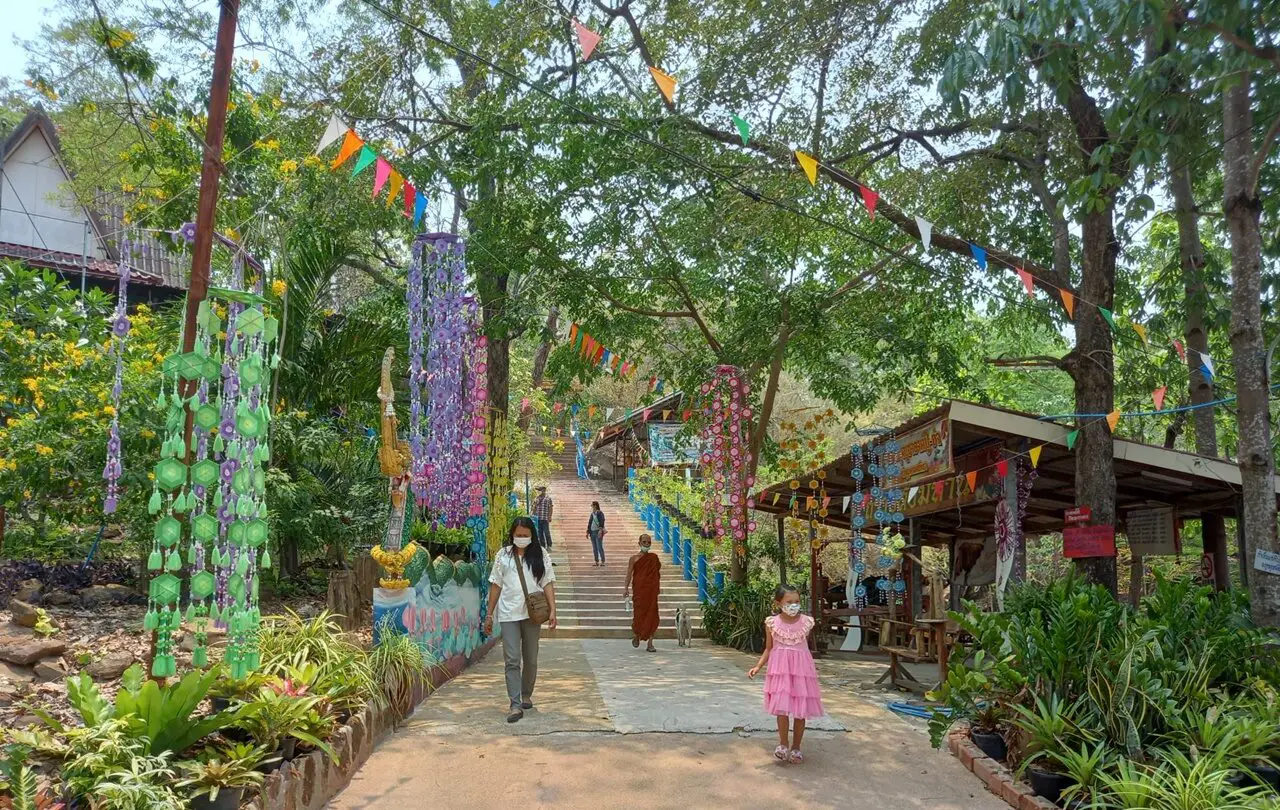
Besides the sacred Buddha images, Phu Po also offers beautiful natural scenery. The path to the upper image includes stairs and resting points. Along the way, visitors can experience sandstone formations, trees, quiet air, and views that gradually open as the path climbs. At the upper area, worship is combined with a natural viewpoint, making the visit both spiritual and scenic. This is one reason Phu Po appeals to merit-making travelers, cultural visitors, photographers, and people who enjoy gentle hill walks.
Visitors should allow at least 1 to 2 hours for the site if they want to worship both the lower and upper images, walk slowly, rest along the way, and appreciate the natural surroundings. A rushed visit may miss important details, including the texture of the sandstone, the halo motifs, the difference in artistic style between the two images, and the quiet atmosphere of the hill. Those who are interested in Buddhist art should read the information signs and observe the images carefully.
Conservation is essential at Phutthasathan Phu Po. The cliff-carved Buddha images are valuable cultural heritage. Visitors should not touch, rub, scratch, write on, climb near, or place objects on the carved images or rock surfaces. Even small actions can damage ancient stone surfaces over time. Visitors should stay on designated paths, avoid climbing on the cliff, and help keep the area clean. Respectful behavior protects the site for future generations.
Temple and heritage-site etiquette should both be observed. Visitors should dress modestly, speak quietly, avoid loud music, and avoid taking photos that disturb worshippers. Good walking shoes are recommended for those who plan to climb to the upper image. Visitors should bring drinking water and avoid climbing during heavy rain or slippery conditions. Those with mobility difficulties can still worship the lower reclining Buddha image, which is also historically and artistically important.
Getting There is most convenient by private car or rental car. From Kalasin town, drive north for about 28 kilometers along Highway 213. Around kilometer marker 59, turn left through the route passing Ban Chot, Ban Na Chan, and Ban Na Khok Khwai for about 16 kilometers. Travelers may also search for Wat Inthra Prathan Phon or Phutthasathan Phu Po on a navigation app and follow local signs in Phu Po Subdistrict.
The journey to Phu Po gives travelers a rural view of Kalasin, passing local communities, agricultural areas, and sandstone hill landscapes. Morning or early afternoon is the best time to visit, as there is enough daylight for the climb and for possible onward travel. During the annual festival period, visitors should allow extra time because local processions, worshippers, and community activities may make the area busier than usual.
Phutthasathan Phu Po works well as a half-day trip. Visitors can worship the lower image, climb to the upper image, enjoy the viewpoint, then continue to restaurants in Sahatsakhan or Somdet. With more time, the trip can be combined with Sirindhorn Museum, Wat Sakkawan, Phu Kum Khao Dinosaur Excavation Site, Dino Road, Wat Phutthawat Phu Sing, or Wat Phuttha Nimit (Phu Khao). These nearby places form a strong cultural and natural travel route in northern Kalasin.
A full-day itinerary can begin at Phu Po in the morning, continue to Sirindhorn Museum and Wat Sakkawan, stop for lunch in Sahatsakhan, and end at Wat Phutthawat Phu Sing, Wat Phuttha Nimit (Phu Khao), or Thepsuda Bridge. This route gives visitors a broad view of Kalasin: Buddhist art, Dvaravati heritage, dinosaur history, sandstone hills, community faith, and reservoir scenery.
For families, Phutthasathan Phu Po is a valuable learning site. Children can learn that Buddha images in Thailand are not only cast in bronze or built with plaster, but can also be carved directly into natural rock cliffs. Parents can explain Dvaravati art, local history, sacred mountains, and why ancient heritage must not be damaged. A visit here can become both a spiritual journey and an outdoor history lesson.
For foreign travelers, Phutthasathan Phu Po offers a different perspective on Thai Buddhism. It is not dominated by golden pagodas or grand urban architecture. Instead, it shows Buddhism integrated with a sandstone mountain, local pilgrimage, and ancient cliff carving. The climb to the upper image turns worship into a physical journey through landscape, helping visitors understand how faith and place are connected in Isan culture.
Photography is possible, especially in the morning or late afternoon when natural light highlights the stone surfaces. However, photographs should be taken respectfully. Visitors should avoid flash in sensitive areas, keep an appropriate distance from the Buddha images, and avoid posing in ways that are unsuitable for a sacred site. The purpose of photography should be to record the beauty and cultural value of the place, not to disturb worship.
There is no admission fee at Phutthasathan Phu Po. Visitors may make merit according to personal faith. Because access is free, visitors should be especially responsible in helping preserve the area: do not litter, do not damage the rock surfaces, do not disturb religious activities, and follow the paths prepared by the temple and local community. In this way, Phu Po can remain both a sacred site and a meaningful cultural attraction.
Overall, Phutthasathan Phu Po is one of Kalasin’s most important Buddhist and cultural destinations. It preserves two ancient reclining Buddha images carved into sandstone cliffs, reflects local Dvaravati art and later Sukhothai influence, offers peaceful hill scenery, and continues to support annual community worship traditions. For travelers who want to understand Kalasin beyond ordinary sightseeing, Phu Po is a place where faith, art, history, and nature meet in a powerful and memorable way.
| Name | Phutthasathan Phu Po / Wat Inthra Prathan Phon |
| Location | Phu Po Subdistrict, Mueang Kalasin District, Kalasin Province |
| Address | Wat Inthra Prathan Phon, 85 Moo 3, Phu Po Subdistrict, Mueang Kalasin District, Kalasin Province 46000, Thailand |
| Highlights | Two ancient reclining Buddha images carved into sandstone cliffs, local Isan-style Dvaravati art with later Sukhothai influence, sandstone hill scenery, and the annual sacred water procession worshipping the Phu Po reclining Buddha |
| History | The lower reclining Buddha is attributed to the 12th – 14th Buddhist centuries, while the upper image is attributed to the 18th – 19th Buddhist centuries, preserving an important tradition of rock-carved Buddhist images in northeastern Thailand. |
| Name Origin | Phutthasathan Phu Po refers to the sacred Buddhist site on Phu Po hill within Wat Inthra Prathan Phon in Phu Po Subdistrict. |
| Distinctive Features | The lower image is carved under a rock shelter about 5 meters above the ground and measures about 3.30 x 1.27 meters. The upper image is about 80 meters higher and measures about 5.20 x 1.50 meters, accessible by stairs and hill paths. |
| Main Areas / Zones | 1. Wat Inthra Prathan Phon and lower worship courtyard 2. Lower reclining Buddha / Ong Ya 3. Stairway and resting points up Phu Po 4. Bells along the route to the upper Buddha image 5. Upper reclining Buddha / Ong Pu 6. Buddha handprint area and natural viewpoint 7. Festival area for the sacred water procession and worship of the Phu Po reclining Buddha |
| Travel Information | From Kalasin town, travel north for about 28 km on Highway 213 to around kilometer marker 59, then turn left through Ban Chot, Ban Na Chan, and Ban Na Khok Khwai for about 16 km. Travelers can also search for Wat Inthra Prathan Phon / Phutthasathan Phu Po on a navigation app. |
| Current Status | An active Buddhist sanctuary and historic site open for worship, cultural visits, and local community ceremonies |
| Open Days | Daily |
| Opening Hours | 08.00 – 17.00 |
| Fees | No admission fee; visitors may make merit according to personal faith. |
| Abbot / Caretaker | Phra Khru Intha Thammapathan, abbot of Wat Inthra Prathan Phon and ecclesiastical chief of Phu Po Subdistrict |
| Important Tradition | The annual worship and sacred water procession for the Phu Po reclining Buddha is a major local tradition. In 2026, Kalasin Province scheduled the event from 28 May to 1 June at Wat Inthra Prathan Phon, Phutthasathan Phu Po. |
| Nearby Tourist Attractions | 1. Sirindhorn Museum, about 14 km 2. Wat Sakkawan / Phu Kum Khao Dinosaur Excavation Site, about 14 km 3. Dino Road, about 16 km 4. Wat Phutthawat Phu Sing, about 17 km 5. Wat Phuttha Nimit (Phu Khao), about 19 km 6. Lam Pao Dam, about 25 km |
| Nearby Restaurants | 1. Jamnian Restaurant, Phu Po Subdistrict, about 5 km, Tel. 093-078-8386 2. Sod Tiew Kai Mara Sahatsakhan, about 15 km, Tel. 081-779-9282 3. Krua Mae Kong, about 15 km, Tel. 084-717-5825 4. With Love Cafe Sahatsakhan, about 16 km, Tel. 093-092-7861 5. Huan Pha Khao, about 17 km, Tel. 088-561-6629, 097-305-0888 |
| Nearby Accommodations | 1. Idin Place, Somdet District, about 10 km, Tel. 043-010-411 2. Phupeng House Resort, about 13 km, Tel. 082-477-7702, 080-516-2985 3. Sukwan Boutique Home Resort, about 14 km, Tel. 094-540-2607 4. Baan Suan Khwam Huk Resort, about 15 km, Tel. 082-117-9083 5. Somdet Hotel, about 17 km, Tel. 043-010-194 |
Frequently Asked Questions (FAQ)
Q: Where is Phutthasathan Phu Po located?
A: Phutthasathan Phu Po is located within Wat Inthra Prathan Phon in Phu Po Subdistrict, Mueang Kalasin District, Kalasin Province, about 28 km north of Kalasin town.
Q: What is the main highlight of Phutthasathan Phu Po?
A: The main highlight is the pair of ancient reclining Buddha images carved into sandstone cliffs. The lower image is near the foot of the hill, while the upper image is located higher on Phu Po, with natural hill scenery around the site.
Q: Which art period are the Phu Po reclining Buddha images associated with?
A: The lower image is associated with local Isan-style Dvaravati art from the 12th – 14th Buddhist centuries, while the upper image dates to the 18th – 19th Buddhist centuries and shows later Sukhothai influence.
Q: Is there an admission fee?
A: No. There is no admission fee. Visitors may make merit according to their faith and should help keep the site clean and peaceful.
Q: How long should visitors spend at Phutthasathan Phu Po?
A: Visitors should allow at least 1 to 2 hours to worship the lower image, climb to the upper image, rest along the way, and enjoy the natural viewpoint without rushing.
Q: How can travelers get to Phutthasathan Phu Po?
A: From Kalasin town, travel north along Highway 213 for about 28 km to around kilometer marker 59, then turn left through Ban Chot, Ban Na Chan, and Ban Na Khok Khwai for about 16 km. Travelers can also search for Wat Inthra Prathan Phon / Phutthasathan Phu Po on a navigation app.
Q: When is the important annual tradition at Phutthasathan Phu Po?
A: The annual worship and sacred water procession for the Phu Po reclining Buddha is a major local tradition. In 2026, the event was scheduled from 28 May to 1 June.
Q: What nearby places can be visited on the same trip?
A: Nearby places include Sirindhorn Museum, Wat Sakkawan, Phu Kum Khao Dinosaur Excavation Site, Dino Road, Wat Phutthawat Phu Sing, Wat Phuttha Nimit (Phu Khao), and Lam Pao Dam.
 Category: ●Places of Worship
 Group: ●Other Sacred Sites
Last Update : 4 MonthAgo
 Last Update : 4 MonthAgo
 Click to Access the Navigation Map GPS

 Art, Culture and Heritage
 Historical Sites and Monuments(2)
 Landmarks and Memorials(3)
 Art, Craft Centres, Tradition(4)
 Museums(3)
 Art Gallery(1)
 Educational Places
 Educational Gardens, Farm(1)
 Temple(21)
Other Sacred Sites(7)
 Suburban Living
 Village, Community(3)
 Nature and Wildlife
 National Parks and Marine Reserves(3)
 Mountain (Doi)(2)
 Dam, Reservoir, Lake(5)
 Waterfalls(4)
 Caves(2)
 River, Canal(3)
 Bays and Beaches(1)
 Other natural attractions(2)
 Entertainment and Agricultural
 Animal camps and shows(1)
 Farms, Parks and Ecotourism(2)
 Travel Articles, Recipes
 Travel Review, Food Review(1)


