
lovethailand home >Northeastern Travel Attractions >Bueng Kan Travel Attractions >Si Wilai >Na Sabaeng > Phu Tok
TL;DR: Phu Tok is located at Ban Kham Khaen Phatthana, Na Saeng Subdistrict, Si Wilai District, Bueng Kan Province, Thailand, open Daily, except the Phu Tok climbing route is closed to visitors from 10 – 16, hours 08.30 – 17.00.

Phu Tok
Open Days: Daily, except the Phu Tok climbing route is closed to visitors from 10 – 16 April every year
Opening Hours: 08.30 – 17.00
Phu Tok in Bueng Kan Province is one of the most remarkable spiritual and natural landmarks in upper northeastern Thailand. Located at Ban Kham Khaen Phatthana, Na Saeng Subdistrict, Si Wilai District, Bueng Kan Province, Phu Tok is a large sandstone mountain that rises dramatically from the surrounding lowland. In the Isan language, the name “Phu Tok” means a lonely or isolated mountain, a meaning that perfectly describes its appearance. The area consists of Phu Tok Yai and Phu Tok Noi. Phu Tok Noi is home to Wat Jetiyakhiri Wihan, commonly known as Wat Phu Tok, while Phu Tok Yai stands nearby as a natural sandstone mountain and forested backdrop.
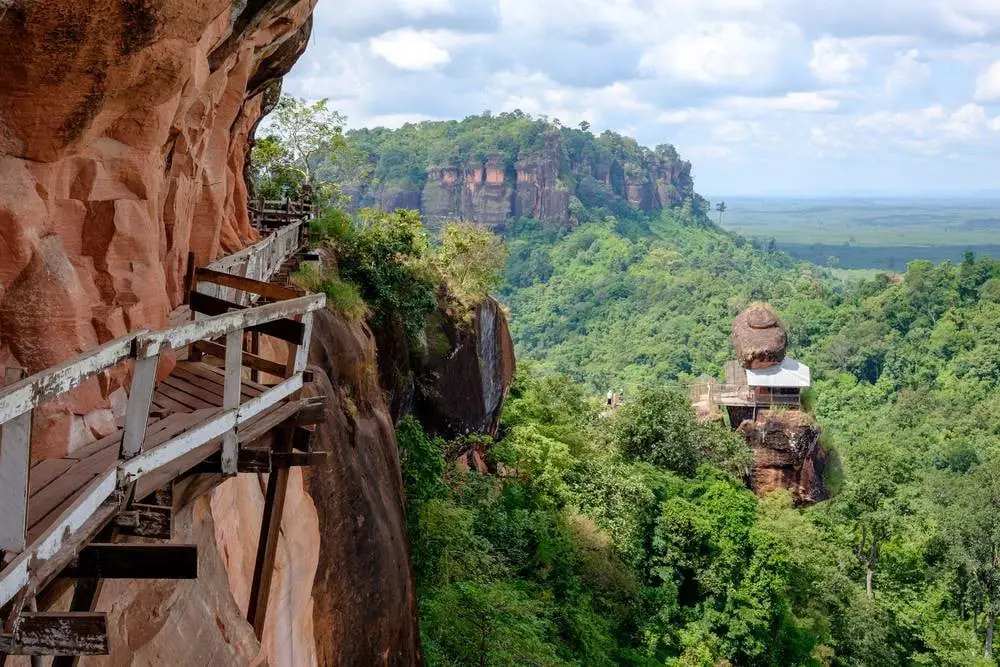
Phu Tok is not only a viewpoint or an unusual sandstone mountain. It is a place where nature, Buddhist practice, local faith, and the history of Thai forest meditation monks come together. Its most famous feature is the system of wooden stairways and cliffside walkways that spiral around the mountain in 7 symbolic levels. These wooden paths were built by monks, novices, and local villagers through deep faith and physical effort. Construction began in 1969 and took around 5 years to complete. Today, the route has become one of the most extraordinary pilgrimage paths in Thailand, combining scenic beauty, height, silence, and spiritual meaning.
Wat Jetiyakhiri Wihan, or Wat Phu Tok, is closely associated with Phra Ajarn Juan Kulachettho, a respected forest meditation monk in the lineage of Phra Ajarn Mun Bhuridatta. Phra Ajarn Juan came to this remote and quiet mountain area and developed it as a place for meditation and Buddhist practice. In the past, the area around Phu Tok was dense forest with many wild animals, making it suitable for solitude and intensive practice. The temple grew gradually from this spiritual foundation, with simple structures, meditation spaces, and the wooden mountain walkway built through the shared effort of the monastic community and local people.
The wooden walkway of Phu Tok is often understood as a Dhamma path. The climb from the base of the mountain to the upper levels is not only a physical journey, but also a symbolic movement from worldly distraction toward mindfulness, patience, and inner stillness. Some sections are steep, some follow the cliff face, some pass through caves and rock platforms, and some open into wide views of forest and countryside. Each change in the path reminds visitors to walk carefully, breathe steadily, and remain aware of both body and mind.
Levels 1 and 2 form the beginning of the climb from the base of the mountain toward level 3. These early sections are still surrounded by forest, rocks, vegetation, and shaded natural terrain. Visitors should use this first part of the walk to adjust their pace and prepare physically. Phu Tok is not a place to rush. Walking here requires care, mindfulness, and respect for the temple environment.
Level 3 is where the circular wooden walkway around the mountain becomes more noticeable. The surrounding environment includes forest, rock outcrops, and sandstone surfaces. At the end of level 3, the path separates into 2 choices. The left-hand route is a shortcut to level 5, but it is steep and passes through a dark tunnel. The right-hand route continues to level 4 and is more suitable for most visitors who want to follow the normal route and experience the mountain gradually and safely.
Level 4 is a raised wooden bridge that circles the mountain and begins to reveal wider views below. From this level, visitors can see small rolling hills known locally as Dong Chomphu, and the eastern view extends toward the Phu Langka area and Seka District. The walkway around this level is about 400 meters long and includes resting points along the way. Parts of this level are also connected with areas used by mae chi, or Buddhist nuns, so visitors should keep their voices low and behave respectfully.
Level 5 is one of the most important sections of Phu Tok. It includes a hall, monks’ dwellings, and several cave passages, including caves known as Tham Lek Lai, Tham Kaeo, and Tham Rue Si. This level functions as a place of rest, worship, meditation, and memory. It is also closely connected with the legacy of Phra Ajarn Juan Kulachettho. Visitors can feel here that Phu Tok is not simply an elevated walkway, but a living forest temple shaped by Buddhist discipline and spiritual effort.
On the northern side of level 5, a natural stone bridge leads toward a Buddhist hall that enshrines Buddha relics. This area is one of the most memorable parts of Phu Tok because the rock bridge and the hall appear to belong naturally to the sandstone mountain. Looking outward from this point, visitors can see Phu Tok Yai clearly. The view helps explain that Phu Tok is not only one climbable mountain, but part of a broader sandstone landscape of forest, cliffs, faith, and local memory.
Level 6 is the most famous and visually striking level. It includes a cliffside wooden walkway about 400 meters long, circling the mountain at a high elevation. From this level, visitors can see the wooden path attached to the sandstone cliff, with forest and open plains far below. For people afraid of heights, parts of the walkway can feel challenging. Yet for those who walk slowly and carefully, this level offers one of the most powerful experiences at Phu Tok: a combination of fear, silence, openness, and spiritual concentration. It is the level that best expresses the identity of the place.
Level 7 is the uppermost level of the mountain. It is a forested area on the summit and requires careful walking. Many visitors choose to stop at level 5 or level 6 because these levels already contain the main religious sites, cave areas, viewpoints, and cliffside walkways. Continuing to level 7 should depend on physical condition, weather, and temple guidance. Visitors should never force themselves to climb beyond their ability.
At the base area of the mountain, the Phra Ajarn Juan Kulachettho Chedi Museum is another important place to visit. It houses relics, a life-size image of Phra Ajarn Juan, monastic requisites, and exhibits connected with his life and practice. This museum gives deeper meaning to a visit to Phu Tok because it explains the spiritual foundation behind the mountain walkway. The site is not simply an architectural wonder; it is a Dhamma heritage shaped by the life of a forest meditation monk.
A complete visit to Phu Tok should take at least 2 hours, and more time is recommended for those who want to stop for worship, rest, photography, and careful observation. Visitors should bring drinking water, wear secure walking shoes, avoid flip-flops, and use both hands carefully on stairs where needed. Small children should be closely supervised at all times. Visitors with fear of heights, heart conditions, knee problems, or balance issues should consider their ability before climbing.
Phu Tok remains an active Buddhist temple and meditation site. It should not be treated only as an adventure attraction. Visitors should dress modestly, avoid loud behavior, stay on designated paths, avoid climbing outside the walkway, keep the area clean, and respect monastic spaces. The atmosphere of the temple is quiet and sacred, and respectful behavior is essential for both Thai and foreign visitors.
The best time to visit is in the morning. The weather is cooler, the light is good for photography, and visitors have enough time to climb up and down safely before the temple closes. The rainy season and early cool season can be especially beautiful because the forest is green and the surrounding landscape looks fresh. However, after rain, wooden steps and sandstone surfaces can be slippery. During the hot season, visitors should bring water, sun protection, and suitable clothing. The climbing route is closed to visitors from 10 to 16 April every year, so travel plans should avoid this period.
There is no admission fee to visit Phu Tok or Wat Jetiyakhiri Wihan. Visitors may make donations according to their faith to support the temple and the maintenance of its religious structures. The absence of an entrance fee makes Phu Tok accessible to pilgrims, Thai travelers, foreign visitors, and anyone interested in Buddhist culture, forest temples, and natural landscapes.
Getting There from Bueng Kan town is easiest by private car, rental car, or hired local transport. Take Highway 222 toward Si Wilai District, then continue through local villages such as Ban U Kham, Ban Na Sing, Ban San Sai Ngam, Ban Saeng Charoen, and toward Ban Na Kham Khaen or Ban Kham Khaen Phatthana, where Wat Jetiyakhiri Wihan is located. The distance from Bueng Kan town is about 45 to 50 kilometers, and the drive usually takes around 50 minutes to 1 hour depending on road and traffic conditions.
Travelers coming from Seka District, Bueng Khong Long District, or nearby areas can combine Phu Tok with other important attractions in Bueng Kan, such as Chet Si Waterfall, Tham Phra Waterfall, Phu Wua Wildlife Sanctuary, Hin Sam Wan, and Phu Sing. Visitors staying in Bueng Kan town can start early in the morning, climb Phu Tok before midday, and return to town for dinner or continue to nearby attractions.
Phu Tok is suitable for several types of travelers. Buddhist pilgrims can pay respect to Phra Ajarn Juan Kulachettho and visit the Chedi Museum. Nature lovers can enjoy the sandstone mountain, forest, and panoramic views. Travelers who enjoy meaningful physical challenges can experience the cliffside walkway, but the route should never be treated as a thrill ride. Every step should be taken carefully and respectfully.
For foreign travelers, Phu Tok is best understood as a sacred mountain temple with a 7-level wooden walkway built around sandstone cliffs. Its value is not only the dramatic height or unusual structure, but also the spiritual meaning of the climb. The route represents patience, mindfulness, and gradual movement toward inner calm. Visitors from other countries should dress respectfully, keep quiet, and remember that this is a meditation temple, not an amusement attraction.
One of the strongest impressions of Phu Tok is the harmony between human effort and natural landscape. The wooden walkway does not dominate the mountain; it follows the rock face and appears to become part of the cliff. Halls, caves, and meditation spaces are placed naturally among stone ledges and forest shade. This creates a sense that the temple is not trying to conquer nature, but to live humbly with it.
Walking along the cliffside paths, visitors hear the wind, the leaves, and the silence of the forest. Some sections reveal Phu Tok Yai, while others look out over endless forest, farmland, and communities below. These views show that Phu Tok stands between forest, temple, and local life. It is isolated in shape, but deeply connected with the people and landscape around it.
Safety is essential throughout the visit. Visitors should not run on the wooden bridges, stop in narrow sections for too long, lean heavily on railings, or climb outside the walkway. The route should be avoided during heavy rain, strong wind, or unsafe weather. Groups should walk with reasonable spacing and look after children and elderly companions. A safe visit allows travelers to experience both the beauty and the stillness of Phu Tok fully.
The surrounding area of Si Wilai and nearby districts also offers restaurants, cafés, accommodation, and attractions that can be combined with a Phu Tok trip. Options include Phu Tok Coffee, local food stalls near Wat Phu Tok, Khem Khon Cake in Si Wilai, Hin Sam Wan, Phu Sing, Chet Si Waterfall, and Tham Phra Waterfall. Travelers who want to stay overnight can choose accommodation in Si Wilai, Seka, or Bueng Kan town, depending on the next day’s route.
Historically, Phu Tok is a rare example of community faith made visible. The wooden walkways and stairs were not created as a commercial tourist project. They were built gradually through the labor and devotion of monks, novices, and villagers over about 5 years. This makes the structure more than a scenic walkway. It is a record of shared faith, endurance, and local cooperation.
Phu Tok also helps visitors understand the idea of a Dhamma path in physical form. Each level is both an actual walkway and a symbolic stage of inner development. A visitor may begin with excitement, tiredness, or fear, but walking carefully and mindfully can turn those feelings into calm attention. This is what makes Phu Tok different from an ordinary viewpoint.
In summary, Phu Tok or Wat Jetiyakhiri Wihan is an essential destination in Bueng Kan for travelers who want to experience nature, faith, forest meditation history, and sandstone mountain scenery in one place. Its 7-level wooden walkway, Phra Ajarn Juan Kulachettho Chedi Museum, Buddha relic hall, level 6 cliffside viewpoint, and quiet forest-temple atmosphere make it one of Thailand’s most meaningful spiritual landscapes. A visit to Phu Tok offers more than beautiful photographs; it gives travelers a direct experience of effort, mindfulness, humility, and respect for nature.
| Name | Phu Tok / Wat Jetiyakhiri Wihan (Wat Phu Tok) |
| Location | Ban Kham Khaen Phatthana, Na Saeng Subdistrict, Si Wilai District, Bueng Kan Province, Thailand |
| Address | Wat Jetiyakhiri Wihan, Moo 6, Ban Kham Khaen Phatthana, Na Saeng Subdistrict, Si Wilai District, Bueng Kan 43210 |
| Highlights | A lonely sandstone mountain with 7 levels of wooden stairways and cliffside walkways, the Phra Ajarn Juan Kulachettho Chedi Museum, a Buddha relic hall, and panoramic viewpoints |
| History / Importance | Phra Ajarn Juan Kulachettho developed Phu Tok as a meditation and practice site. The wooden mountain walkway began construction in 1969 and took around 5 years to complete through the faith of monks, novices, and villagers |
| Name Origin | In the Isan language, Phu Tok means a lonely or isolated mountain, matching the mountain’s distinctive form rising from the surrounding lowland |
| Distinctive Features | The area consists of Phu Tok Yai and Phu Tok Noi. Phu Tok Noi contains Wat Jetiyakhiri Wihan and the 7-level wooden walkway, while Phu Tok Yai forms part of the surrounding sandstone mountain landscape |
| Travel Information | From Bueng Kan town, take Highway 222 toward Si Wilai District, then continue through Ban U Kham, Ban Na Sing, Ban San Sai Ngam, Ban Saeng Charoen, and toward Ban Na Kham Khaen / Ban Kham Khaen Phatthana. The distance is about 45 – 50 km |
| Current Status | Open for worship and visits during temple hours, except the climbing route is closed to visitors from 10 – 16 April every year |
| Open Days | Daily, except the Phu Tok climbing route is closed from 10 – 16 April every year |
| Opening Hours | 08.30 – 17.00 |
| Fees | No admission fee; donations may be made according to personal faith |
| Facilities | Parking area, worship area, Chedi Museum, halls, rest points along the route, toilets in some areas, and local food or shops near the temple area |
| Main Areas / Zones | 1. Phra Ajarn Juan Kulachettho Chedi Museum 2. Base Area And Starting Point Of The Phu Tok Climb 3. Wooden Stairways And Walkways On Levels 1 – 3 4. Level 4 Elevated Walkway And Dong Chomphu View 5. Level 5 Halls, Monks’ Dwellings, Caves, And Buddha Relic Hall 6. Level 6 Cliffside Wooden Walkway And Panoramic Viewpoint 7. Level 7 Forested Summit Area |
| Abbot / Religious Caretaker | Phra Khru Sunthon Wihantham (Luang Ta Yaeng Sukhakamo), Wat Jetiyakhiri Wihan |
| Main Contact Number | 08-2055-4183, 08-1261-4907 |
| Official Website / Official Page | Wat Phu Tok Facebook Page and Museum Thailand Database |
| Nearby Tourist Attractions | 1. Phra Ajarn Juan Kulachettho Chedi Museum, about 0 km 2. Hin Sam Wan / Phu Sing, about 35 km 3. Chet Si Waterfall, about 45 km 4. Tham Phra Waterfall, about 50 km 5. Phu Wua Wildlife Sanctuary, about 50 km 6. Bueng Khong Long, about 55 km |
| Nearby Restaurants | 1. Local Made-To-Order Food Stalls In Front Of Wat Phu Tok, about 0 km 2. Phu Tok Coffee, about 9 km, Tel. 065-816-8814 3. Khem Khon Cake, Si Wilai District, about 22 km, Tel. 082-508-2131, 085-210-9293 4. Nakee Mee Mon Cafe Bueng Kan, about 35 km 5. Riverside Restaurant & Bar Bungkan, about 50 km, Tel. 087-222-9899 |
| Nearby Accommodations | 1. The Little Garden Resort, Si Wilai District, about 25 km, Tel. 098-296-5196 2. Seka Resort, Seka District, about 42 km, Tel. 064-535-7457 3. Wan Resort Hotel, Seka Town, about 45 km, Tel. 084-551-1934 4. Yoga Homestay Seka, about 46 km, Tel. 098-617-2875 5. BK Place Hotel Bueng Kan, about 50 km, Tel. 082-495-2125 |
Frequently Asked Questions (FAQ)
Q: Where is Phu Tok located?
A: Phu Tok is located at Ban Kham Khaen Phatthana, Na Saeng Subdistrict, Si Wilai District, Bueng Kan Province. It is home to Wat Jetiyakhiri Wihan, also known as Wat Phu Tok.
Q: Is Phu Tok open every day?
A: Phu Tok is open daily during temple hours, except from 10 to 16 April every year when the climbing route is closed to visitors.
Q: What are the opening hours of Phu Tok?
A: The practical visiting hours are 08.30 to 17.00. Morning is the best time to visit because visitors have enough time to climb up and down safely.
Q: Is there an entrance fee for Phu Tok?
A: No. There is no admission fee. Visitors may make donations according to their faith.
Q: How many levels does Phu Tok have?
A: The climbing route has 7 levels. The wooden circular walkway begins clearly from level 3, level 5 contains important religious areas, and level 6 is the most famous viewpoint with cliffside wooden paths.
Q: Who founded Wat Phu Tok?
A: Phra Ajarn Juan Kulachettho, a respected forest meditation monk, developed Phu Tok as a place for meditation and Buddhist practice.
Q: What should visitors prepare before climbing Phu Tok?
A: Visitors should wear secure walking shoes, bring drinking water, dress modestly, avoid climbing during rain or slippery conditions, and walk carefully throughout the route.
Q: How long should visitors spend at Phu Tok?
A: Visitors should allow at least 2 hours for the climb and main viewpoints. More time is recommended for worship, photography, rest, and a careful visit to each level.
Mobile : 0874930355
 Mobile : 0874930355
 Category: ●Nature and Wildlife
 Group: ●Mountain (Doi)
Last Update : 2 MonthAgo
 Last Update : 2 MonthAgo
 Click to Access the Navigation Map GPS

 Art, Culture and Heritage
 Landmarks and Memorials(1)
 Museums(1)
 Places of Worship
 Temple(12)
 Other Sacred Sites(4)
 Suburban Living
 Local Market(1)
 National Parks and Marine Reserves(1)
Mountain (Doi)(3)
 Waterfalls(5)
 Caves(1)
 River, Canal(4)
 Bays and Beaches(1)
 Islands(1)
 Entertainment and Agricultural
 Waterpark(1)
 Shopping
 Shopping and Night Market(1)
 Travel Articles, Recipes
 Travel Review, Food Review(1)


