
lovethailand home >South Travel Attractions >Nakhon Si Thammarat Travel Attractions >Mueang NaKhon Si Thammarat >Khlang > Nakhon Si Thammarat City Pillar Shrine
TL;DR: Nakhon Si Thammarat City Pillar Shrine is located at Northern Side Of Sanam Na Mueang, Khlang Subdistrict, Mueang Nakhon Si Thammarat District, Nakhon Si Thammarat Province, open Daily, hours 08.00 – 16.30.

Nakhon Si Thammarat City Pillar Shrine
Open Days: Daily
Opening Hours: 08.00 – 16.30
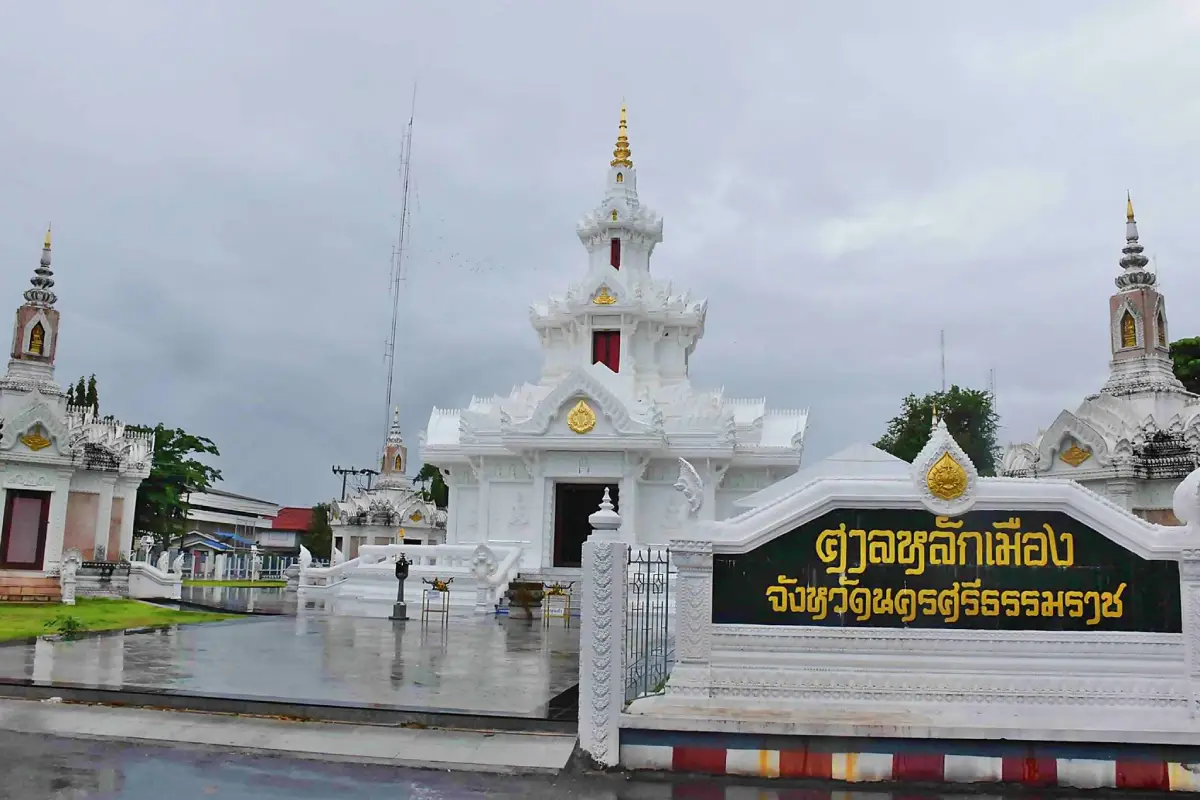
Nakhon Si Thammarat City Pillar Shrine is located on the northern side of Sanam Na Mueang in Khlang Subdistrict, Mueang Nakhon Si Thammarat District. It is one of the most important sacred landmarks in the city and serves as a spiritual center for local people and visitors. The shrine occupies an area of about 2 rai and consists of 5 buildings. The central building enshrines the city pillar, while the 4 smaller surrounding shrines represent guardian shrines in the four directions. For many visitors, this shrine is an ideal first stop before exploring the historic heart of Nakhon Si Thammarat.
The importance of the shrine is not limited to prayer and blessing. It also represents the idea of a city’s spiritual foundation. Nakhon Si Thammarat has long been one of the great historic cities of southern Thailand, with Wat Phra Mahathat Woramahawihan as its Buddhist heart. The city pillar shrine adds another layer of meaning as the symbolic pillar of civic protection, stability, and auspiciousness. It reflects the local belief that a city should have a sacred center that protects its people and supports the prosperity of the community.
The foundation stone of the main shrine was laid on 4 August 1989. The four surrounding guardian shrines were later founded on 7 May 1992, and the whole complex was completed in 1999. The central building was designed in a style inspired by Srivijaya art and is often described locally as Hemmarat Lila style. Its white structure, elegant rooflines, and balanced composition make it one of the most recognizable sacred buildings in central Nakhon Si Thammarat.
The shrine complex consists of the main central building and four smaller buildings known as Chatu Lok Thep shrines. These are associated with Phra Suea Mueang, Phra Song Mueang, Phra Phrom Mueang, and Phra Ban Dan Mueang. Together, they represent protective forces in the four directions. Visitors often begin by paying respect at the central city pillar before continuing to the surrounding shrines in a respectful sequence.
The city pillar itself is the spiritual core of the shrine. It is made from golden teakwood taken from Khao Yot Lueang in Ka Ror Subdistrict, Nopphitam District, Nakhon Si Thammarat Province. The pillar is about 2.94 meters high and about 0.95 meters in circumference. The upper section is carved as a four-faced Jatukam Ramathep, regarded as a guardian deity of the city, and the top flame-like form represents the victorious crown of the city pillar. This makes the pillar both a sacred object and a highly symbolic work of southern Thai craftsmanship.
Before the pillar was enshrined in Nakhon Si Thammarat, the top of the city pillar received royal consecration from King Bhumibol Adulyadej at Chitralada Palace on 3 August 1987. It was then brought to be enshrined in Nakhon Si Thammarat the following day. This royal connection gives the city pillar special meaning for the people of Nakhon Si Thammarat, linking the shrine with royal blessing, civic identity, and local devotion.
On 16 June 2000, King Vajiralongkorn, then Crown Prince, presided over the official opening ceremony on behalf of King Bhumibol Adulyadej. This event completed the shrine’s formal role as a sacred civic landmark. Since then, the City Pillar Shrine has continued to serve as a major place of worship and a source of pride for the people of Nakhon Si Thammarat.
The carvings on the city pillar carry layered symbolic meanings. The 9-tier circular base reflects ideas of impermanence, moral awareness, and the reign of King Rama IX. Other decorative motifs express ideas of purity, moral development, good and evil, and the importance of righteous conduct. The four-faced deity represents divine awareness in all directions, while the flame-shaped top symbolizes victory, protection, and the future prosperity of the city.
The architecture of the shrine is therefore more than decorative. It contains religious, artistic, and civic meanings. The central building resembles a sacred monument, with concrete forms, multi-directional rooflines, and refined stucco work by modern artisans of Nakhon Si Thammarat. The result is a sacred space that combines local craftsmanship, Srivijaya-inspired design, and contemporary devotion.
Most visitors begin by paying respect at the central shrine. People come to pray for safety, stability, success, good fortune, protection for travel, family wellbeing, and auspicious beginnings. After the central shrine, visitors may continue to the four surrounding guardian shrines. This sequence allows them to experience the site as a complete sacred complex rather than a single building.
The atmosphere of Nakhon Si Thammarat City Pillar Shrine is clean, bright, and dignified. Its white buildings stand prominently in a spacious courtyard near Sanam Na Mueang. The location places the shrine within the civic and historical core of the city. Morning visits offer a comfortable and peaceful atmosphere, while late afternoon light gives the white architecture a soft and elegant appearance.
The shrine also plays an important role in civic ceremonies. During the Songkran period, the city organizes a blessing and worship ceremony at the City Pillar Shrine, with participation from government agencies, private organizations, tourism groups, and local residents. This shows that the shrine remains a living ritual center of the city, not merely a historic structure or tourist attraction.
The shrine is also included in the old-town cultural route promoted by Nakhon Si Thammarat City Municipality. It appears as a key stop in the city-history route, together with other places such as Ho Phra Sung, local archival sites, and the handicraft area of Tha Chang Road. For travelers, the shrine is a strong starting point for understanding the old city before continuing to nearby historical and religious landmarks.
Compared with Buddhist temples in Nakhon Si Thammarat, the City Pillar Shrine has a distinct character. It is a civic shrine rather than a temple, combining ideas of the city pillar, guardian deities, Srivijaya art, Mahayana-influenced symbolism, and local ceremonies. Visitors should therefore approach it as a symbolic center of the city, where local faith and civic identity meet.
Art lovers should pay attention to the balance between the central shrine and the surrounding pavilions, the roof forms, white stucco ornamentation, and the details of the city pillar itself. The use of golden teakwood, the four-faced Jatukam Ramathep carving, and the symbolic layers of the base make the shrine different from many other city pillar shrines in Thailand.
For history-minded travelers, the shrine introduces several important themes: modern revival of city-pillar belief, the use of Srivijaya-inspired art, the importance of sacred wood from Nakhon Si Thammarat, and the desire to create a civic symbol of protection and prosperity. These themes make the shrine more than a quick photo stop. It is a compact but meaningful lesson in how a historic city expresses identity through art and sacred belief.
A typical visit takes around 30 minutes to one hour. A short visit is enough for worship and photography, but visitors interested in architecture and symbolism should allow more time. Families can use the shrine as a place to teach children about city history, sacred etiquette, and the meaning of civic landmarks. Photography should be done respectfully and should not disturb people who are praying.
Visitors should dress modestly, speak quietly, avoid touching sacred objects without permission, and keep the courtyard clean. During major ceremonies, visitors should follow the guidance of officials and avoid entering restricted ritual areas. Respectful behavior helps preserve the dignity of this sacred civic place.
Getting There is easy because the shrine is located in central Nakhon Si Thammarat near Sanam Na Mueang. Visitors can travel by private car, taxi, local transport, or the Hua Thanon–Stadium songthaew route. From Nakhon Si Thammarat Bus Terminal, the shrine is about 1.6 kilometers away, making it convenient to reach by local songthaew or hired transport.
Drivers can set their destination to Sanam Na Mueang, the Provincial Hall area, or Nakhon Si Thammarat City Pillar Shrine. Since the shrine is in a civic area, parking may depend on traffic and local events. During Songkran, ceremonial days, and long weekends, visitors should allow extra time for parking and walking.
The shrine fits naturally into a central Nakhon Si Thammarat heritage route. A good itinerary can begin with the City Pillar Shrine, continue to Phra Suea Mueang Shrine, the Old City Wall, Ho Phra Buddha Sihing, Wat Phra Mahathat Woramahawihan, Nakhon Si Thammarat National Museum, and Suchart Subsin Shadow Puppet Museum. This route gives visitors a broad view of the city through religion, history, art, and southern Thai folk culture.
The best time to visit is in the morning or late afternoon. Morning is suitable for worship and a quiet atmosphere, while late afternoon offers softer light for viewing the white architecture. During Songkran and major civic ceremonies, the shrine becomes livelier with ritual activity and local participation.
Nakhon Si Thammarat City Pillar Shrine is therefore one of the most meaningful places to visit in the city. It is a sacred civic landmark, a work of Srivijaya-inspired architecture, a guardian symbol of Nakhon Si Thammarat, and a living ritual center. Its value lies not in size alone, but in the way it brings together history, artistry, belief, and the pride of the people of Nakhon Si Thammarat.
| Name | Nakhon Si Thammarat City Pillar Shrine |
| Location | Northern Side Of Sanam Na Mueang, Khlang Subdistrict, Mueang Nakhon Si Thammarat District, Nakhon Si Thammarat Province |
| Address | Khlang Subdistrict, Mueang Nakhon Si Thammarat District, Nakhon Si Thammarat 80000, Thailand |
| Reference Coordinates | Plus Code: CXJ6+4VW, Khlang, Mueang Nakhon Si Thammarat |
| Highlights | Sacred city pillar shrine of Nakhon Si Thammarat, white Hemmarat Lila-style architecture inspired by Srivijaya art, golden teakwood city pillar, and four guardian shrines |
| History | The main shrine foundation stone was laid on 4 August 1989. The four surrounding shrines were founded on 7 May 1992. The complex was completed in 1999 and officially opened on 16 June 2000. |
| Area | About 2 rai |
| Architectural Features | The central shrine is inspired by Srivijaya art and known as Hemmarat Lila style. The complex has 5 buildings: the main city pillar hall and 4 surrounding guardian shrines. |
| City Pillar | Made from golden teakwood from Khao Yot Lueang in Ka Ror Subdistrict, Nopphitam District. The pillar is about 2.94 meters high and 0.95 meters in circumference, with a four-faced Jatukam Ramathep carving at the top. |
| Main Areas / Zones | Central city pillar hall, Phra Suea Mueang Shrine, Phra Song Mueang Shrine, Phra Phrom Mueang Shrine, Phra Ban Dan Mueang Shrine, circumambulatory courtyard, and worship areas |
| Important Ceremonies | City pillar blessing ceremony during Songkran and city pillar celebration ceremonies in early August in some years |
| Role Of The Place | Sacred civic shrine, spiritual center of Nakhon Si Thammarat, and learning site for city history, local belief, Srivijaya-inspired art, and city pillar traditions |
| Travel Information | Reachable by private car, local taxi, or the Hua Thanon–Stadium songthaew route. From Nakhon Si Thammarat Bus Terminal, the shrine is about 1.6 km away. |
| Current Status | Open for worship and visitation |
| Open Days | Daily |
| Opening Hours | 08.00 – 16.30 |
| Admission Fee | Free Admission |
| Facilities | Worship courtyard, walkways around the shrine, nearby parking depending on city traffic and local events, and nearby restroom facilities |
| Nearby Tourist Attractions | 1. Phra Suea Mueang Shrine, about 0.3 km 2. Old City Wall Of Nakhon Si Thammarat, about 0.7 km 3. Ho Phra Buddha Sihing, about 1 km 4. Wat Phra Mahathat Woramahawihan, about 2 km 5. Nakhon Si Thammarat National Museum, about 3 km 6. Suchart Subsin Shadow Puppet Museum, about 4 km |
| Nearby Restaurants | 1. Kopi Khang Sala Klang, about 0.5 km, Tel. 089-431-9999 2. Khanom Chin Mueang Khon Sen Sot, about 2 km, Tel. 086-475-7641, 088-764-8430, 084-293-2456 3. Roti Pa Nom Branch 9, about 2 km, Tel. 081-970-1573 4. Kopi QueQuton, about 3 km, Tel. 089-701-7777 5. Ko Bua Restaurant, about 7 km, Tel. 098-867-4911 6. Khanom Chin Mueang Khon Rim Khlong, about 9 km, Tel. 097-348-5995 |
| Nearby Accommodations | 1. B2 Nakhon Si Thammarat Premier Hotel, about 2 km, Tel. 075-804-288 2. Navakitel Design Hotel, about 2 km, Tel. 080-393-9339 3. Bunprasop Garden Hotel, about 3 km, Tel. 075-805-252 4. Grand Fortune Hotel Nakhon Si Thammarat, about 3 km, Tel. 075-841-888 5. The Twin Lotus Hotel Nakhon Si Thammarat, about 4 km, Tel. 075-323-777 6. HOP INN Nakhon Si Thammarat, about 4 km, Tel. 075-314-888 |
Frequently Asked Questions (FAQ)
Q: Where is Nakhon Si Thammarat City Pillar Shrine located?
A: It is located on the northern side of Sanam Na Mueang in Khlang Subdistrict, Mueang Nakhon Si Thammarat District, Nakhon Si Thammarat Province.
Q: What are the opening hours of Nakhon Si Thammarat City Pillar Shrine?
A: The shrine is open daily from 08.00 to 16.30.
Q: Is there an admission fee?
A: No. Admission is free.
Q: What is the main highlight of the shrine?
A: The main highlight is the white Srivijaya-inspired shrine complex, the golden teakwood city pillar, and the 4 surrounding guardian shrines known as Chatu Lok Thep shrines.
Q: What is the city pillar made from?
A: The city pillar is made from golden teakwood from Khao Yot Lueang in Nopphitam District. It is about 2.94 meters high and has a four-faced Jatukam Ramathep carving at the top.
Q: What important ceremonies are held at the shrine?
A: Important ceremonies include the city pillar blessing ceremony during Songkran and city pillar celebration ceremonies held in early August in some years.
Q: How can travelers get to the shrine?
A: Travelers can go by private car, local taxi, or the Hua Thanon–Stadium songthaew route. From Nakhon Si Thammarat Bus Terminal, the shrine is about 1.6 km away.
Q: What nearby places can be visited with the shrine?
A: Nearby places include Phra Suea Mueang Shrine, the Old City Wall, Ho Phra Buddha Sihing, Wat Phra Mahathat Woramahawihan, Nakhon Si Thammarat National Museum, and Suchart Subsin Shadow Puppet Museum.
 Category: ●Places of Worship
 Group: ●Other Sacred Sites
Last Update : 2 MonthAgo
 Last Update : 2 MonthAgo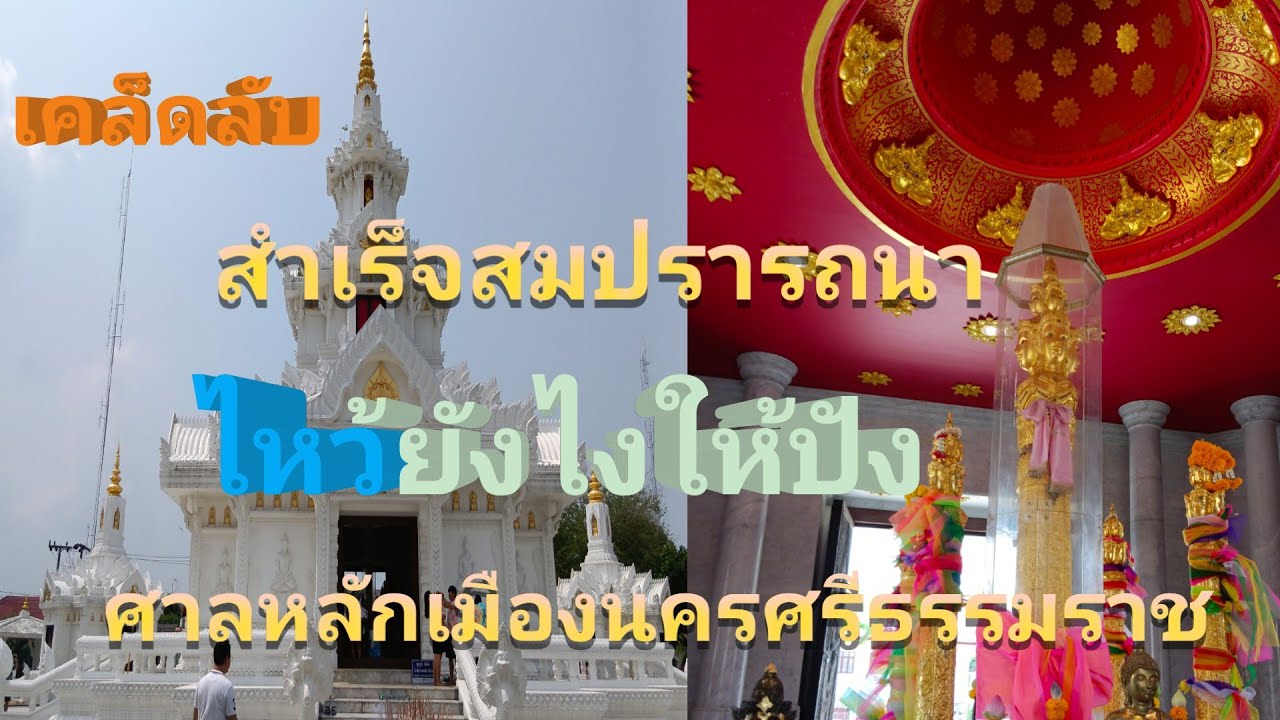
 Click to Access the Navigation Map GPS
Nakhon Si Thammarat City Pillar Shrine Map
Gellery
Recommend

 Art, Culture and Heritage
 Historical Sites and Monuments(9)
 Landmarks and Memorials(9)
 Royal Palace(1)
 Art, Craft Centres, Tradition(12)
 Museums(5)
 Educational Places
 Educational Gardens, Farm(2)
 Temple(44)
 Mosque(2)
Other Sacred Sites(17)
Mosque(2)
Other Sacred Sites(17)
 Research and Development
 Royal Project(2)
 Suburban Living
 Village, Community(8)
 Local Market(1)
 Floating Market(1)
 Nature and Wildlife
 National Parks and Marine Reserves(6)
 Mountain (Doi)(11)
 Dam, Reservoir, Lake(10)
 Waterfalls(43)
 Hot Springs(1)
 Caves(13)
 River, Canal(3)
 Bays and Beaches(29)
 Islands(2)
 Other natural attractions(3)
 Entertainment and Agricultural
 Farms, Parks and Ecotourism(3)
 Outdoor and Adventure Activities(4)
 Travel Articles, Recipes
 Travel Review, Food Review(5)
 Southern Food Menu, Southern Food Recipes(18)


