
lovethailand home >Northeastern Travel Attractions >Nakhon Ratchasima Travel Attractions >Pak Thong Chai >Nok Ok > Wat Khok Si Saket
TL;DR: Wat Khok Si Saket is located at Ban Sa Noi, Nok Ok Subdistrict, Pak Thong Chai District, Nakhon Ratchasima Province, open Daily, hours 08.00 – 17.00.
Wat Khok Si Saket
Open Days: Daily
Opening Hours: 08.00 – 17.00
Wat Khok Si Saket is located at 73 Mu 4, Ban Sa Noi, Nok Ok Subdistrict, Pak Thong Chai District, Nakhon Ratchasima Province. This historic rural temple is one of the most meaningful cultural sites in Pak Thong Chai. It is known for its old ordination hall, Khmer-style boundary stones with Khmer inscriptions, a wooden pavilion with natural-color ceiling paintings, a local museum preserving community objects, and a shaded forest garden with a rich collection of plants. For foreign travelers, Wat Khok Si Saket offers a rare opportunity to experience a Thai community temple that preserves not only Buddhist faith, but also local craftsmanship, rural memory, vernacular art, and the relationship between temple and village life.
The temple is not a large commercial attraction. Its value lies in the details. Visitors who walk slowly through the temple grounds can see how architecture, inscriptions, paintings, old objects, plants, and community traditions remain connected in one living place. A meaningful visit should begin at the old ubosot, continue around the Khmer-style boundary stones, move toward the wooden pavilion known locally as Ho Chaek or Rong Than, and then continue to the local museum and shaded forest garden. This route reveals the temple as both a sacred Buddhist site and a cultural learning space.
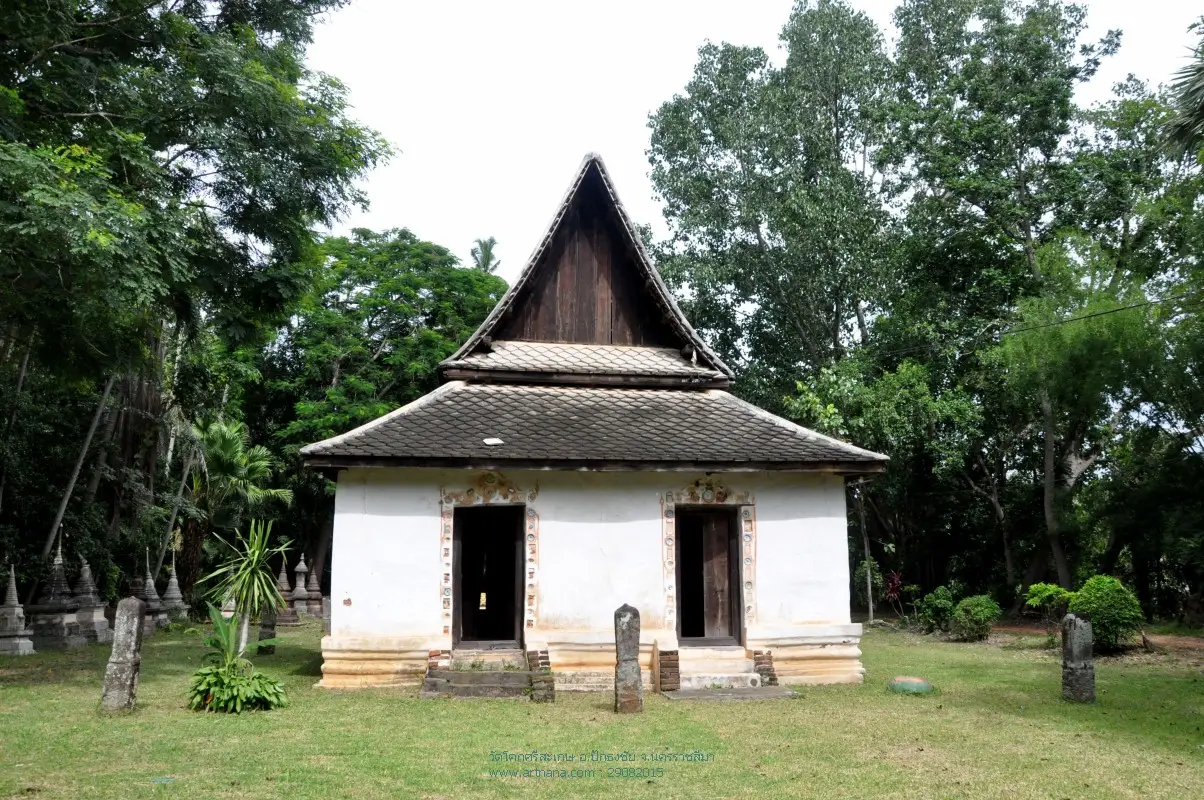
The most important historic structure is the old ubosot, or ordination hall, which is said to have been built around 1789. The building has stood for more than 200 years and remains a key piece of local heritage. Around the ubosot are boundary stones with Khmer inscriptions and Khmer artistic influence. These stones are especially important because they connect the temple with the deeper cultural history of lower northeastern Thailand, a region where Buddhist, local Isan, and ancient Khmer influences have long interacted. For travelers interested in historical layers, these boundary stones make Wat Khok Si Saket far more than an ordinary rural temple.
The old ubosot has the character of a traditional northeastern sim. It is built of brick and plaster, with a clay-tile roof, wooden doors and windows, and old structural timber. The entrance areas are decorated with Chinese ceramic bowls and stucco patterns, revealing the way local craftsmen combined available materials with religious architecture. Inside, wooden pillars support the roof, and traces of old ceiling decoration still show the care and devotion of earlier generations. Even where parts have aged, the building still communicates the quiet dignity of a community-made sacred space.
Visitors should not rush through the old ubosot. Its value is found in the small details: the remaining ceramic decorations, the old wooden doors, the side windows, the roof structure, the weathered surfaces, and the boundary stones outside. These details show how rural temples were built through collective faith and local craftsmanship. Unlike royal temples that were shaped by court artisans, Wat Khok Si Saket reflects the hands and imagination of community craftsmen. This gives the temple a deeply local identity.
Near the old ubosot stands an old wooden pavilion known locally as Ho Chaek or Rong Than. This pavilion is one of the temple’s most distinctive artistic treasures. Its ceiling contains paintings created by local artisans using natural colors. The images depict imaginative creatures from the Himavanta forest, a mythical landscape in Buddhist and Thai literary tradition. These ceiling paintings are lively, symbolic, and strongly rooted in folk imagination. They reveal how local painters interpreted sacred cosmology through their own artistic language.
The Himavanta creatures on the ceiling are not ordinary animals from the natural world. They belong to a sacred and mythical universe connected with Buddhist cosmology, storytelling, and Thai imagination. The local artisan who painted them used natural pigments and a personal visual style. At one corner of the roof, an inscription records the year of the painting as 1903, although the artist’s name is not recorded. This absence of a named artist makes the work even more representative of community art. The paintings were created not to promote an individual artist, but to serve the temple and the village.
The pavilion’s local names, Ho Chaek and Rong Than, suggest its social role in temple life. It was not simply a decorative structure. Such spaces were used in temple events, food sharing, merit-making, rest, and community gatherings. During religious festivals, villagers would gather, prepare offerings, share meals, and take part in temple activities. The ceiling paintings therefore belonged to a living communal space, not to a museum gallery from the beginning. This makes them especially valuable because they were part of everyday religious and social life.
Another major feature is the Wat Khok Si Saket Local Museum. The museum developed from the temple’s effort to preserve old objects, religious items, and everyday tools connected with the community. In the past, an old monks’ residence was used to store ancient Buddha images, village Buddha images, brassware, and valuable objects. Some older items were later lost in a fire, but the remaining objects and newly donated pieces still form an important collection. The museum allows visitors to understand the daily life, ritual culture, and material heritage of Ban Sa Noi.
The museum displays a wide range of objects, including Benjarong ceramics, food trays for offerings to monks, ritual water bowls, traditional water containers, rice baskets, Dan Kwian pottery, betel sets, oil lamps, bells, wooden document containers, funerary urns, silk textiles, and old and newer preaching pulpits used in Mahachat sermons. Each object may appear simple on its own, but together they form a detailed picture of rural life. They show how people cooked, made merit, listened to sermons, preserved documents, stored food, performed rituals, and remembered the dead.
The preaching pulpits are especially important because they are connected with the Mahachat sermon tradition. A Mahachat sermon is not only a religious lecture. It is a major community event involving the Vessantara Jataka, merit-making, food preparation, temple decoration, and collective participation. The pulpits therefore represent both Buddhist teaching and the social energy of a village festival. For foreign travelers, they provide a clear example of how objects in Thai temples often carry religious, artistic, and communal meaning at the same time.
Outside the museum is a forest garden with more than 500 plant species. This shaded garden turns the temple into an outdoor learning space. Visitors can walk through the greenery and observe local plants, herbs, and trees. One of the most notable plants is the large lan palm. In Thai Buddhist culture, palm leaves were historically used to make manuscripts for Buddhist texts and traditional knowledge. A temple with a large lan palm therefore carries associations with learning, scholarship, and manuscript culture. This connection makes the garden more than a pleasant green area; it is part of the temple’s educational identity.
The garden also reflects the role of the abbot, Phra Khru Phiphat Isarakun, who is associated with preserving and explaining the temple’s plant knowledge. The forest area functions like a community classroom where visitors can learn about plants, uses, and local wisdom. Wat Khok Si Saket therefore shows that a temple can be a place of worship, a museum, a botanical learning space, and a cultural memory center at the same time. This layered role is one of the reasons the temple deserves careful attention.
The temple grounds also include wooden houses and distinctive semi-circular pavilions. These buildings serve as welcoming spaces for visitors who travel from far away, stay overnight, or gather to exchange knowledge. Their design harmonizes with the forest setting rather than competing with it. Such buildings show how the temple has developed not only as a place of ritual, but also as a place for learning, hospitality, conversation, and community connection.
Wat Khok Si Saket also preserves local stories connected with San Pu Nen, a sacred shrine respected by villagers. The story tells of a novice monk who once lived on a fertile mound and planted fruit trees that he shared with the community. After a tragic event, villagers built a shrine to remember him, and the place became part of the community’s sacred memory. This story gives the temple an emotional and spiritual layer beyond its architecture. It shows how local belief, memory, and sacred geography can become part of a temple’s identity.
The temple remains an active center for local traditions. Important community events have included Khao Lam Day, Mahachat sermons, Salak Phat ceremonies, and activities connected with royal and Buddhist occasions. These events reveal the temple’s continuing role in village life. Wat Khok Si Saket is not only a place to preserve old buildings; it is still a living institution where villagers gather, make merit, support one another, and maintain local culture.
Travelers interested in history and art should allow at least 1 to 2 hours for a proper visit. The old ubosot and boundary stones require careful viewing. The pavilion ceiling paintings deserve slow observation because many details are overhead and easy to miss. The museum collection should be seen as a whole, not as isolated objects. The forest garden also rewards visitors who take time to walk quietly and notice the relationship between plants, learning, and temple life.
The temple is open daily from 08.00 to 17.00 and does not charge an admission fee. Visitors may make merit according to their faith. The site also provides free parking, making it practical for travelers arriving by private car. Morning to late afternoon is the best time to visit because natural light makes the old buildings, ceiling paintings, and museum surroundings easier to appreciate. Visitors who want to see the museum in detail should arrive during normal daytime hours and ask politely if guidance is needed.
Getting There is most convenient by private car. From Nakhon Ratchasima city, travel toward Pak Thong Chai District. Follow the Pak Thong Chai–Chok Chai route, pass the Lam Phra Phloeng intersection area, continue on Highway 24, and turn right near the Pak Thong Chai agricultural office area. Continue for about 4 km toward Ban Sa Noi in Nok Ok Subdistrict. The temple is located within the community and can be combined easily with other cultural stops in Pak Thong Chai.
Visitors should observe proper temple and museum etiquette. Dress modestly, speak quietly, avoid touching paintings, wooden ceilings, boundary stones, or museum objects, and do not climb on old structures. Photography should be done respectfully, especially inside sacred and museum areas. The site contains fragile cultural heritage, so careful behavior helps protect the temple for future generations.
Families can use the temple as an educational destination. Children can learn about the meaning of an ubosot, boundary stones, folk paintings, local museums, everyday objects, traditional sermons, plants, and community stories. Adults should guide children to walk calmly, avoid touching objects, and respect sacred areas. This kind of visit helps younger travelers understand Thai culture through direct experience rather than only through books.
Wat Khok Si Saket is suitable for several types of travelers. Temple lovers can appreciate the old ubosot and sacred boundary stones. Art lovers can study the ceiling paintings in the wooden pavilion. Cultural travelers can explore the local museum. Nature lovers can walk through the forest garden. Visitors exploring Pak Thong Chai can include the temple in a route with Wat Pathum Khongkha, Pak Thong Chai Silk Market, Nakhon Chai Burin Silk Center, Wat Na Phra That, and Chattong80 Gallery N Bistro.
In a broader sense, Wat Khok Si Saket is valuable because it connects past and present in one place. The old ubosot and boundary stones reveal historical depth. The wooden pavilion shows folk imagination and craftsmanship. The local museum preserves everyday life. The forest garden protects plant knowledge. Community traditions show that the temple still plays an active role in local society. For travelers who want to understand Pak Thong Chai beyond silk markets and highway routes, this temple offers a deeper and more grounded cultural experience.
Wat Khok Si Saket is therefore one of the important heritage temples of Pak Thong Chai District. It is a Buddhist temple, an art site, a local museum, a forest learning space, and a community memory center. Visitors who come with patience and respect will discover a place where sacred architecture, vernacular painting, local objects, plants, and village traditions continue to speak together. This makes the temple a meaningful destination for anyone interested in rural Thai Buddhism and the cultural heritage of Nakhon Ratchasima.
| Name | Wat Khok Si Saket |
| Location | Ban Sa Noi, Nok Ok Subdistrict, Pak Thong Chai District, Nakhon Ratchasima Province |
| Address | 73 Mu 4, Wat Khok Si Saket, Ban Sa Noi, Nok Ok Subdistrict, Pak Thong Chai District, Nakhon Ratchasima 30150, Thailand |
| Highlights | Old ubosot built around 1789, Khmer-inscribed boundary stones, wooden Ho Chaek or Rong Than pavilion, natural-color ceiling paintings, local museum, and a forest garden with more than 500 plant species |
| History | The old ubosot dates to around 1789. Cultural heritage records identify the temple’s formal establishment in 1889 and its consecrated boundary in 1890. The wooden pavilion ceiling paintings record the year 1903 |
| Name Origin | The temple name is connected with Ban Khok Sa Noi or Ban Sa Noi, the local community in Nok Ok Subdistrict, and with local stories surrounding San Pu Nen |
| Distinctive Features | A historic rural temple combining ancient architecture, folk painting, Khmer-style boundary stones, a local museum, forest learning areas, and community traditions |
| Travel Information | From Nakhon Ratchasima city, travel toward Pak Thong Chai. Follow the Pak Thong Chai–Chok Chai route, pass the Lam Phra Phloeng intersection area, continue on Highway 24, then turn right near the Pak Thong Chai agricultural office area and continue about 4 km toward Ban Sa Noi |
| Current Status | Open to visitors and still serves as a community temple, local museum, and folk art learning site in Pak Thong Chai District |
| Open Days | Daily |
| Opening Hours | 08.00 – 17.00 |
| Fees | No admission fee |
| Facilities | Local museum, pavilions, forest garden, walking route through plants, wooden reception buildings, and free parking |
| Main Areas / Zones | Old ubosot, Khmer-inscribed boundary stones, wooden Ho Chaek or Rong Than pavilion, Himavanta ceiling paintings, local museum building, forest garden, wooden reception buildings, semi-circular pavilion, and San Pu Nen shrine |
| Abbot / Caretaker | Phra Khru Phiphat Isarakun |
| Main Contact Number | 044-450-400 |
| Nearby Tourist Attractions | 1. Wat Pathum Khongkha (Wat Nok Ok), about 3 km 2. Pak Thong Chai Silk Market, about 8 km 3. Nakhon Chai Burin Silk Center, about 9 km 4. Wat Na Phra That (Wat Taku), about 10 km 5. Chattong80 Gallery N Bistro, about 10 km |
| Nearby Restaurants | 1. Bubble Tea & Fresh Coffee Pak Thong Chai, about 3 km, Tel. 080-196-9516 2. Sara Coffee And Eatery Pak Thong Chai, about 6 km, Tel. 080-362-3655 3. Wan Wang Cafe Pak Thong Chai, about 8 km, Tel. 086-309-1932 4. Mee Korat Ha Dao Pak Thong Chai, about 8 km, Tel. 084-887-7725 5. Krua Phi Ka Nong Pak Thong Chai, about 8 km, Tel. 082-536-9215, 090-918-6555 |
| Nearby Accommodations | 1. Mulberry House Korat, about 9 km, Tel. 081-890-2494 2. Bosswin Home Resort, about 10 km 3. iRETREAT Pak Thong Chai, about 13 km, Tel. 089-899-5347 4. Chao At Hotel, about 13 km, Tel. 085-015-1199 5. The Frog Cabana Resort, about 45 km, Tel. 088-146-3666 |
Frequently Asked Questions (FAQ)
Q: Where is Wat Khok Si Saket located?
A: Wat Khok Si Saket is located at 73 Mu 4, Ban Sa Noi, Nok Ok Subdistrict, Pak Thong Chai District, Nakhon Ratchasima Province.
Q: What are the opening hours of Wat Khok Si Saket?
A: The temple is open daily from 08.00 to 17.00.
Q: Is there an admission fee?
A: No. Wat Khok Si Saket does not charge an admission fee. Visitors may make merit according to their faith.
Q: What is the main highlight of Wat Khok Si Saket?
A: The main highlights are the old ubosot built around 1789, Khmer-inscribed boundary stones, a wooden pavilion with natural-color ceiling paintings, and the local museum.
Q: Why is the Ho Chaek or Rong Than pavilion important?
A: The pavilion contains ceiling paintings of mythical Himavanta creatures created with natural colors. An inscription records the painting year as 1903.
Q: What can visitors see inside the local museum?
A: The museum displays local household objects and religious items such as preaching pulpits, Benjarong ceramics, brassware, Dan Kwian pottery, betel sets, oil lamps, silk textiles, and ritual objects.
Q: How can travelers get to Wat Khok Si Saket?
A: From Nakhon Ratchasima city, travel toward Pak Thong Chai, follow the Pak Thong Chai–Chok Chai route, continue past the Lam Phra Phloeng intersection area, then turn near the Pak Thong Chai agricultural office area and drive about 4 km toward Ban Sa Noi.
Q: What nearby places can be visited on the same trip?
A: Nearby places include Wat Pathum Khongkha, Pak Thong Chai Silk Market, Nakhon Chai Burin Silk Center, Wat Na Phra That, and Chattong80 Gallery N Bistro.
 Category: ●Places of Worship
 Group: ●Temple
Last Update : 3 MonthAgo
 Last Update : 3 MonthAgo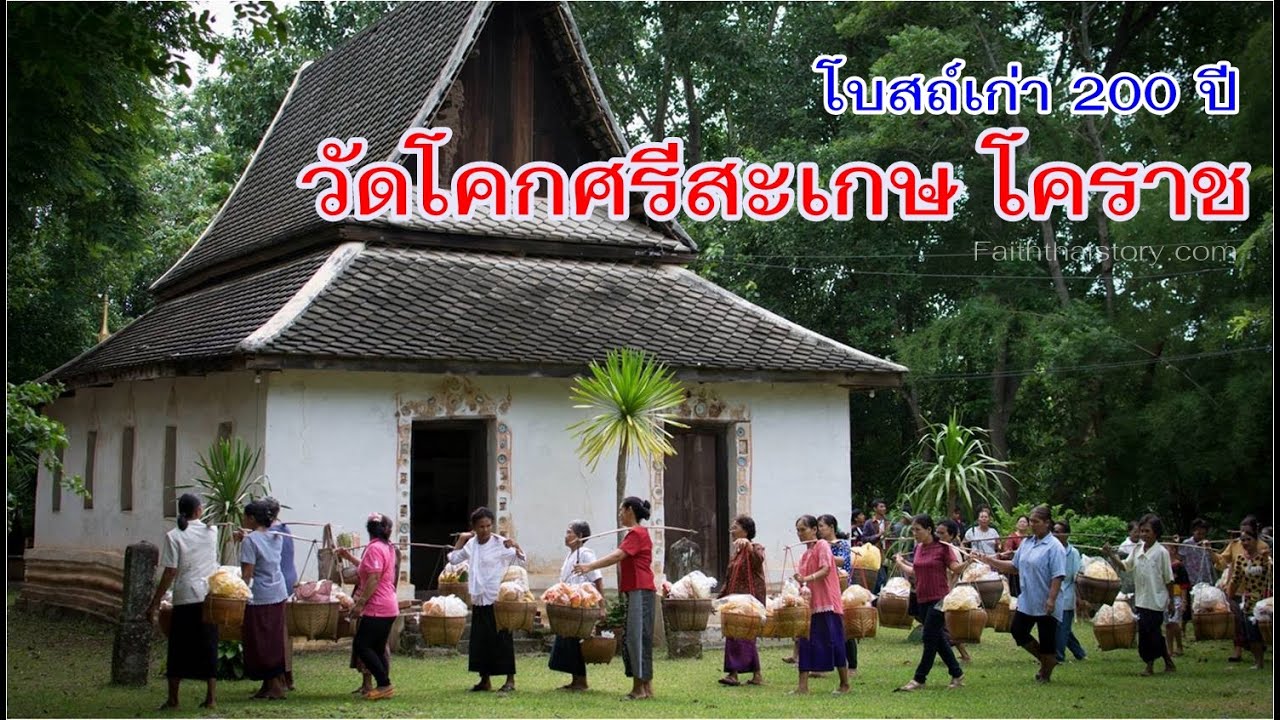
 Click to Access the Navigation Map GPS
Wat Khok Si Saket Map
Recommend

 Art, Culture and Heritage
 Historical Sites and Monuments(20)
 Landmarks and Memorials(5)
 Art, Craft Centres, Tradition(7)
 Museums(6)
 Art Gallery(1)
 Educational Places
 Educational Gardens, Farm(4)
Temple(29)
Educational Gardens, Farm(4)
Temple(29)
 Mosque(1)
 Other Sacred Sites(6)
 Research and Development
 Royal Project(3)
 Suburban Living
 Village, Community(6)
 Local Market(4)
 Floating Market(1)
 Nature and Wildlife
 National Parks and Marine Reserves(3)
 Mountain (Doi)(5)
 Dam, Reservoir, Lake(8)
 Waterfalls(9)
 Hot Springs(1)
 Caves(2)
 Flower Field(1)
 River, Canal(8)
 Bays and Beaches(2)
 Other natural attractions(3)
 Entertainment and Agricultural
 Zoos and Aquariums(2)
 Animal camps and shows(1)
 Farms, Parks and Ecotourism(21)
 Waterpark(4)
 Outdoor and Adventure Activities(6)
 Shopping
 Shopping and Night Market(2)
 Travel Articles, Recipes
 Travel Review, Food Review(6)


