
lovethailand home >Northeastern Travel Attractions >Nakhon Ratchasima Travel Attractions >Nong Bun Nak >Ban Mai > Prasat Ban Thanon Hak
TL;DR: Prasat Ban Thanon Hak is located at Inside Wat Ban Thanon Hak, Moo 4, Ban Thanon Hak, Ban Mai Subdistrict, Nong Bun Mak District, Nakhon Ratchasima 30410, Thailand, open Daily, hours 08:00 – 17:00.
Prasat Ban Thanon Hak
Open Days: Daily
Opening Hours: 08:00 – 17:00
Admission Fee: Free admission
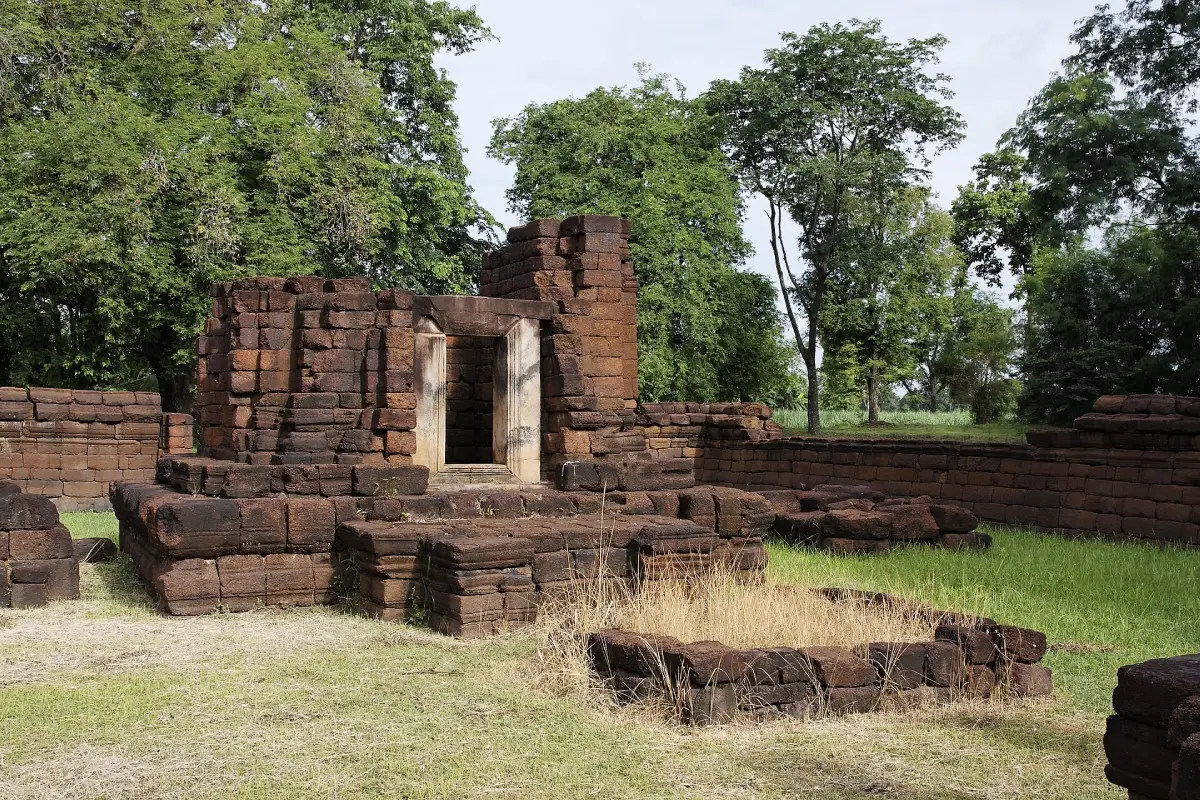
Prasat Ban Thanon Hak in Nakhon Ratchasima, also known as Prasat Thanon Hak, is an ancient Khmer sanctuary located within the grounds of Wat Ban Thanon Hak in Moo 4, Ban Thanon Hak, Ban Mai Subdistrict, Nong Bun Mak District, Nakhon Ratchasima Province. Although the monument now survives mainly as foundations, laterite walls, gateways, and other low architectural remains, it is an archaeological site of exceptional importance. It preserves evidence of Hindu religious practice, ancient construction technology, regional settlement, and the expansion of Khmer culture across the Khorat Plateau approximately 900 years ago. The sanctuary is also renowned for a remarkable hoard of finely crafted gold ornaments dating from the late 11th to early 12th centuries.
TL;DR: Prasat Ban Thanon Hak is a laterite Hindu sanctuary situated inside Wat Ban Thanon Hak in Nong Bun Mak District, approximately 60 kilometres from central Nakhon Ratchasima. Its principal features include the foundation of the central sanctuary, eastern and western gopuras, a laterite enclosure, a U-shaped water feature, and the location where an extraordinary collection of 900-year-old gold ornaments was discovered. The site is open daily from 08:00 to 17:00 with free admission. It is particularly rewarding for visitors interested in archaeology, ancient Khmer art, religious architecture, and lesser-known cultural destinations in northeastern Thailand.
The sanctuary stands in a rural community whose daily life is closely connected with agriculture, the Buddhist temple, and shared village spaces. Visiting the site therefore differs from exploring a large historical park. Travellers encounter not only the remains of an ancient monument but also a living cultural landscape in which several historical periods coexist. An ancient Hindu sanctuary occupies the same setting as a modern Buddhist temple and an active local community. This continuity demonstrates how archaeological heritage can remain part of everyday life rather than being isolated from the people who have inherited responsibility for its protection.
The monument is referred to by several closely related names, including Prasat Ban Thanon Hak, Prasat Thanon Hak, and the Thai name Prasat Hin Ban Thanon Hak. All refer to the same archaeological site within Wat Ban Thanon Hak. In this context, the word prasat does not describe a royal palace or defensive castle. It refers to a sacred building constructed to house an image of a deity and to serve as the focus of ritual activity. The name Thanon Hak, meaning “broken road,” is associated with an ancient raised route or earthwork in the surrounding landscape that was eroded and divided into sections by flowing water.
The sanctuary dates from the late 16th to early 17th Buddhist centuries, corresponding approximately to the 11th and early 12th centuries CE. This was a period when Khmer culture exercised extensive political, religious, artistic, and economic influence across the Khorat Plateau. Networks of settlements were connected through overland routes, water systems, agricultural zones, and centres of worship. Prasat Ban Thanon Hak formed part of this broader landscape of communities, administrators, craftspeople, priests, and ritual specialists rather than existing as an isolated rural building.
The Khorat Plateau contains one of the most important concentrations of ancient Khmer monuments within present-day Thailand. Nakhon Ratchasima Province includes sanctuaries of many different sizes, ranging from major architectural centres such as Phimai to smaller community sanctuaries such as Prasat Ban Thanon Hak. The modest scale of the latter does not reduce its historical value. Smaller monuments explain how religion and political organisation extended into rural areas and how local communities participated in networks of resources, labour, transportation, and ritual patronage.
Prasat Ban Thanon Hak was constructed according to Hindu religious concepts and is associated with Vaishnavism, the tradition that honours Vishnu as the supreme deity. The central sanctuary represented the sacred centre of the complex, while the enclosure and surrounding water feature separated the ritual area from the ordinary world. Passing through the gopura was therefore more than a physical movement through a gateway. It marked a transition from everyday space into a controlled sacred precinct governed by ritual order and restricted access.
Although the original cult image and the upper structures have disappeared, the surviving plan continues to explain the sanctuary's function. The central shrine occupies the core of the enclosed area and has a square plan with recessed or projecting corners. Its principal entrance faces east. This orientation is common in ancient Khmer religious architecture because the east is associated with sunrise, light, renewal, and auspicious power. Priests and ritual participants approached the sacred centre from the direction illuminated by the morning sun.
Laterite was the principal building material. This iron- and aluminium-rich material can be cut relatively easily when freshly extracted from the ground and becomes harder after prolonged exposure to air. Ancient builders shaped it into blocks for foundations, walls, and structural components required to bear considerable weight. Sandstone, which is finer and easier to carve, was used for door frames and details requiring smoother surfaces. The deliberate selection of different stones demonstrates a practical understanding of geology, construction, and the efficient use of available resources.
The foundation of the central sanctuary deserves careful observation because it reveals the original focus of the plan. Visitors can examine the courses of laterite, the arrangement of individual blocks, and the position of the eastern stairway. Although the tower and roof have collapsed, the foundation still identifies the limits of the garbhagriha, or innermost sacred chamber. This chamber was not designed to accommodate a large congregation. It housed the principal image and was entered by priests or designated ritual specialists, while other participants remained in the surrounding courtyard.
The Sanskrit term garbhagriha literally refers to a “womb chamber,” the innermost source of sacred presence within a Hindu temple. The space was generally dark and controlled, with access through a single principal doorway. Once the image of the deity had been installed, priests offered flowers, perfume, textiles, jewellery, and other valuable objects. The discovery of gold ornaments at Prasat Ban Thanon Hak is closely connected with this ritual system and confirms that the sanctuary was an important religious centre rather than simply a public or residential structure.
Smaller building foundations stand to the north and south of the central sanctuary. These structures supported the ritual organisation of the complex and created visual balance within the plan. They may have been associated with secondary images, ceremonial objects, or supporting religious functions. Visitors should therefore look beyond the central shrine and examine the relationship between all surviving foundations. The overall arrangement reveals how movement, hierarchy, and ritual activity were organised within the enclosure.
A rectangular laterite wall surrounded the sacred interior. Its purpose was not military defence but the definition of a ritual boundary. The enclosure separated the ordered sanctuary from the wider landscape and controlled the direction from which worshippers could approach. Walking along the wall makes it possible to understand that the central shrine was not positioned independently. Its location was carefully coordinated with the gateways, central axis, open courtyard, and surrounding water system.
Gopuras, or monumental gateways, were positioned at the centre of the eastern and western enclosure walls. These gateways controlled entry and established the principal east–west axis. From the eastern gopura, visitors entered the courtyard and looked directly towards the central sanctuary. The western gateway connected the interior with the opposite side of the complex. The alignment of the two gateways created a clear processional route and structured the ceremonial experience of approaching the sacred chamber.
The central room of the entrance gopura became one of the most significant archaeological locations at the site. During work to stabilise and conserve the foundation, archaeologists discovered a group of gold ornaments placed beneath the laterite floor. The objects had been gathered together rather than scattered randomly. Their deliberate position within an important architectural component indicates that the deposit was connected with the sacred use of the complex, the protection of religious property, or an act of ceremonial dedication.
The ornaments were produced from chased and repoussé gold and were set with gemstones using prong settings. Chasing and repoussé require the metalworker to apply carefully controlled pressure from the front and rear of a thin sheet of gold to create raised patterns. Prong setting uses small projections of metal to hold a gemstone securely while allowing light to enter the stone. These sophisticated techniques demonstrate the work of highly trained goldsmiths and access to valuable materials distributed through extensive trade and patronage networks.
Art-historical analysis places the gold ornaments in the late 11th to early 12th centuries, approximately 900 years ago. Their designs preserve elements inspired by the Baphuon style while introducing motifs that later became prominent in the Angkor Wat style. This transitional character is important because artistic styles rarely changed abruptly. Craftspeople retained established decorative traditions while gradually developing new forms that reflected changing religious preferences, courtly taste, and regional identity.
The gold pieces were not necessarily ordinary personal jewellery. They were created as precious offerings and ornaments for a sacred image formerly installed in the central sanctuary. Dressing divine images with gold, gemstones, textiles, flowers, and perfume expressed devotion and reinforced the elevated status of the deity. Such offerings also reflected the relationship between the sanctuary and its patrons, who may have included local leaders, administrators, or prosperous members of the community capable of providing rare and expensive materials.
A particularly notable object associated with the site is a complete gold ring set with translucent blue quartz. Its carefully formed setting illustrates the refinement of ancient jewellery production. Small objects such as rings are as important to archaeological study as larger ornaments because they reveal methods of casting, shaping, fastening, polishing, and gemstone selection. When examined together, the objects from the hoard provide evidence of a technically advanced and organised craft tradition.
Important objects from Prasat Ban Thanon Hak are preserved and studied by Phimai National Museum. Travellers who wish to understand the sanctuary more fully can continue to the museum to explore collections related to ancient Khmer culture on the Khorat Plateau. Visiting the archaeological site first provides an understanding of the original landscape and architectural context, while the museum allows close examination of materials, ornament, iconography, and craftsmanship that cannot be appreciated from the surviving foundations alone.
A water feature or moat surrounds much of the monument in a U-shaped arrangement. Water performed several functions, including boundary definition, drainage, storage, and cosmological symbolism. In Khmer religious architecture, water frequently represented the cosmic ocean surrounding Mount Meru, the sacred mountain at the centre of the Hindu universe. The central sanctuary could therefore be understood symbolically as the cosmic mountain rising within an ordered sacred landscape.
The water system also had practical value. Constructing a laterite sanctuary required water for workers, material preparation, and daily activities. After completion, the reservoir may have supported cleansing, ritual preparation, and the needs of caretakers living near the monument. Although the modern landscape has changed, the surviving water feature helps visitors visualise the original scale of the sacred precinct and its relationship with the surrounding terrain.
Today, the monument survives mainly at foundation level. Travellers accustomed to large Khmer temples with standing towers may initially feel that little remains. The value of Prasat Ban Thanon Hak, however, lies in learning to read archaeological traces. The surviving blocks reveal the position of buildings, the direction of the entrance, the limits of the sacred courtyard, the alignment of the gateways, and the construction methods used by ancient builders. The site rewards patient observation rather than a search for monumental height.
A useful way to explore the monument is to begin with a broad view before examining individual stones. Stand where the enclosure, gopura, and central foundation can be seen together. Follow the principal axis into the site and observe changes in ground level. Near the central shrine, study the size of the laterite blocks, their joints, and the courses that carried the original structure. Looking back towards the entrance reveals how the architecture directed the eye and made the central sanctuary the visual and ritual focus.
The Fine Arts Department registered Prasat Ban Thanon Hak as an ancient monument in 1936. Registration provides legal protection and requires excavation, construction, relocation, or alteration affecting the site to be supervised by the responsible authorities. Conservation does not mean reconstructing every missing part. Its primary purpose is to retain authentic evidence, stabilise vulnerable masonry, control vegetation and drainage, and prevent activities that could damage the archaeological context.
Laterite monuments require particularly careful conservation. The porous stone absorbs moisture and deteriorates when repeatedly exposed to cycles of rain, heat, and drying. Tree roots can penetrate joints between blocks, while moss and small plants retain moisture on the surface. Maintenance must therefore remove vegetation without striking the stone, preserve effective drainage, and guide visitors away from fragile architectural remains.
Fine Arts Office 10, Nakhon Ratchasima, is responsible for professional archaeological oversight, conservation, and coordination. Wat Ban Thanon Hak, its monks, local residents, and community organisations help maintain the surroundings and manage daily use of the area. The abbot of Wat Ban Thanon Hak is Phra At Siridhammo. Cooperation between the authorities and the community is essential because the ancient monument stands within an active Buddhist temple and cannot be protected independently from its immediate environment.
On 30–31 August 2025, the sanctuary hosted the cultural event “Phannarai Phattra Charat Fa Nong Bun Mak,” which used performance and interpretation to present the story of the gold hoard. The event demonstrated the continuing importance of the monument to the identity of Nong Bun Mak District. Such programmes are organised on specific dates and are not permanent daily attractions. Travellers interested in future cultural events should consult current announcements rather than relying on schedules from previous years.
The visitor area can be understood through 6 principal zones: the eastern gopura, the laterite enclosure, the central sanctuary, the smaller northern and southern foundations, the U-shaped water feature, and the grounds of Wat Ban Thanon Hak. This framework helps visitors identify the main elements even though the site does not have the extensive visitor routes and interpretive infrastructure found at a major historical park.
The first zone is the eastern gopura, the principal entrance on the sacred axis. This is the best place to begin interpreting the plan. Observe the central chamber, the alignment of the doorway, and the direct relationship with the central sanctuary. The gold hoard was discovered beneath the laterite floor of the gopura's central room, making this area important both architecturally and archaeologically.
The second zone is the enclosing wall. Visitors can follow the safe ground along its interior or exterior to understand the original limits of the monument. The wall reveals the size of the sacred precinct and clarifies the central placement of the principal shrine. Do not climb onto the wall or place bags, tripods, or other equipment on the laterite blocks, as accumulated pressure and abrasion can damage their edges.
The third zone is the central sanctuary foundation. Walk slowly around the perimeter and remain outside any restricted sections. Viewing the foundation from all 4 sides reveals its recessed corners and eastern approach. Morning light casts shadows across the courses of laterite, making construction details easier to see and photograph.
The fourth zone consists of the smaller building foundations to the north and south. Although they rise only slightly above ground level, their positions help reconstruct the original architectural composition. Comparing their scale with that of the central shrine demonstrates the hierarchy of buildings and their supporting role within the sacred precinct.
The fifth zone is the U-shaped water feature. Vegetation and water levels vary seasonally, so visitors should remain on firm ground and avoid soft banks or steep edges. A slightly elevated viewpoint provides a clearer understanding of the relationship between the moat, enclosure, and central sanctuary than standing immediately beside the water.
The sixth zone is Wat Ban Thanon Hak, an active Buddhist temple containing a sermon hall, multipurpose structures, monks' residences, and areas used for religious and community ceremonies. Visitors should dress respectfully, keep noise to a minimum, and avoid entering residential monastic areas without permission. When merit-making ceremonies, funerals, or local events are taking place, the needs of the temple community take priority.
A logical visiting sequence begins with the information area and a general view from outside the enclosure. Enter through the eastern gopura, follow the axis towards the central sanctuary, examine the enclosure and secondary foundations, and finish by viewing the surrounding water feature. This sequence reflects the original direction of movement and reduces unnecessary crossing of vulnerable archaeological surfaces.
The most comfortable visiting periods are 08:00–10:00 and 15:30–17:00. Temperatures are lower, and oblique light enhances the texture of laterite. Midday visits are possible, but exposed ground becomes hot and shade is unevenly distributed. Visitors should carry drinking water, a hat, and sun protection, particularly from March to May.
The cool season from November to February offers the most comfortable conditions. Mornings are generally pleasant and the ground is usually dry. During the rainy season, vegetation becomes greener and the water feature is more visible, but soil, grass, and laterite can become slippery. Avoid exploring during heavy rain or thunderstorms. During the hot season, arrive early and limit prolonged exposure to direct sunlight.
Clothing should be modest, lightweight, and suitable for a functioning temple. Avoid garments that are excessively short or expose the shoulders. Closed shoes or sports shoes with good grip are preferable to high heels or smooth-soled sandals, as the ground includes soil, grass, and uneven laterite blocks.
Visitors must not touch, scratch, mark, or attempt to move any stone. Do not apply chalk, water, paint, or other substances to architectural details for photography, and never collect stone fragments as souvenirs. Even a small fragment has archaeological value through its original position and relationship with other evidence. Removing it destroys context and may violate heritage protection laws.
General photography is permitted when it does not disturb monks, residents, or other visitors. Wide-angle lenses are useful for documenting the plan and water feature, while standard lenses or mobile phones can record laterite textures. Do not place tripods on archaeological foundations or obstruct access routes. Drone operation requires compliance with aviation regulations and advance permission from the site authorities.
For families, Prasat Ban Thanon Hak functions as an effective outdoor classroom. Children can compare laterite with sandstone, identify the eastern gateway, count the surviving foundations, and consider why the sanctuary was surrounded by water. Adults must ensure that children do not climb on the remains. Learning directly from the site makes subjects such as history, religion, geology, engineering, and conservation easier to understand than memorising dates from a textbook.
School groups and academic visitors should contact Fine Arts Office 10 in advance when requesting specialist information or arranging a large educational visit. Dividing participants into small groups reduces crowding around the foundations and allows guides to explain details clearly. The site supports interdisciplinary learning in history, art, geography, materials science, engineering, archaeology, and heritage management.
Older visitors who can walk independently can explore the site without covering a long distance, but uneven surfaces require care. Wheelchair users can reach parts of the temple grounds and obtain a general view, although the route around the archaeological foundations is not continuously accessible. Companions should select level viewing points and avoid the edges of foundations or water channels.
Facilities are basic and shared with the temple community. Vehicles may be parked in areas designated by the temple, and temple halls provide sheltered community space when available. The site does not operate a permanent visitor centre, souvenir shop, or regular guiding service. Travellers should carry water and use facilities in the nearby community, requesting permission before using temple amenities.
Allow approximately 45–90 minutes for a visit. A brief overview and photography session may take around 45 minutes, while visitors interested in architecture and archaeology should reserve at least 1 hour to examine the central axis, enclosure, subsidiary foundations, and water system. Additional time is appropriate for merit-making or respectful conversation with local residents, provided temple activities are not disrupted.
Getting There from central Nakhon Ratchasima is easiest by driving towards Chok Chai District and joining Highway 24, the Chok Chai–Det Udom route, towards Nong Bun Mak. Leave Highway 24 for local roads leading to Ban Mai Subdistrict and Ban Thanon Hak. The sanctuary lies approximately 4 kilometres from Highway 24 and about 60 kilometres from central Nakhon Ratchasima. Search for “Prasat Ban Thanon Hak” or “Wat Ban Thanon Hak” in a navigation application to reach the correct temple entrance.
From Bangkok, follow Phahonyothin Road towards Saraburi, continue on Mittraphap Road or Highway 2 towards Nakhon Ratchasima, and then take the route through Chok Chai to Highway 24. A private or rental car is the most practical option because the final section follows local roads and no scheduled public transport stops directly at the monument. Check fuel, tyres, and vehicle condition before leaving the main urban area.
Travellers using public transport can take a bus or minivan serving Chok Chai or Nong Bun Mak and arrange a local taxi or pre-booked vehicle for the final journey to Wat Ban Thanon Hak. Agree on the fare and return time in advance because there is no permanent taxi rank at the temple. Walking from Highway 24 is not recommended because the distance is several kilometres and some road sections lack protected pedestrian paths.
The reference coordinates are 14.748333, 102.418333. Using the coordinates helps distinguish the site from temples and villages with similar names elsewhere in Nakhon Ratchasima Province. Before departure, confirm that the map leads to Wat Ban Thanon Hak in Ban Mai Subdistrict, Nong Bun Mak District. Reduce speed on local roads and watch for community signs near the final junctions.
A convenient half-day itinerary begins with an early visit to the sanctuary, allowing approximately 1 hour for exploration. Continue to central Nong Bun Mak for lunch and a brief visit to the district area. This plan is suitable for families, older travellers, and visitors who prefer not to drive between numerous destinations in a single day.
A full-day route can combine Prasat Ban Thanon Hak with Ban Hua Thamnop Reservoir, Ban Nong Sano pottery community, or Dan Kwian pottery village, depending on the direction of travel. The itinerary brings together archaeology, rural landscapes, water management, and local craftsmanship. Limit the day to 3 or 4 principal stops so that each place can be explored without rushing.
Travellers with a strong interest in ancient Khmer culture can create a 2-day itinerary. Spend the first day at Prasat Ban Thanon Hak and surrounding destinations in Nong Bun Mak, staying locally or in Chok Chai. On the second day, continue to Phimai National Museum and Phimai Historical Park. Moving from a community-level sanctuary to a major regional centre clarifies differences in scale, architectural planning, religious function, and political importance.
Most nearby restaurants are located in central Nong Bun Mak, Nong Hua Raet Subdistrict, Laem Thong Subdistrict, and along Highway 24. Options include local made-to-order food, Thai cuisine, steak, coffee, and baked goods. Establishments with current contact information include Noi Pochana, Boonnam Restaurant, Ray's Cafe & Restaurant, MaMoCo Cafe, and Krua Plook Ngern. Call before travelling to confirm kitchen hours and weekly closing days.
Accommodation options include small resorts in Nong Bun Mak and properties along Highway 24. Richmond Resort is among the closest listed options, while Plook Ngern Resort and Greenway Resort are practical for travellers with private vehicles. Visitors seeking a rural waterside environment can enquire about community accommodation around Ban Hua Thamnop Reservoir. Room prices, check-in procedures, and availability change according to travel dates, so direct confirmation is recommended before payment.
Using local restaurants, accommodation, drivers, and community products helps distribute tourism income within Nong Bun Mak District. Responsible cultural tourism does not require large crowds. It should provide steady local benefits without damaging the archaeological site. Travellers can support the community by eating locally, purchasing regional products, respecting temple activities, and sharing accurate information about heritage etiquette.
Prasat Ban Thanon Hak does not offer permanent shows, a souvenir complex, or a towering reconstructed monument. Its appeal lies in authentic archaeological evidence and the opportunity to connect the surviving foundations with the lives of ancient builders, priests, patrons, and goldsmiths. Visitors who understand the site's history before arriving will see each laterite course as part of an organised sacred landscape rather than simply a collection of old stones.
The significance of the sanctuary extends beyond its age and gold objects. It demonstrates the relationship between religion, natural resources, technology, labour, and social organisation. Quarrying laterite, transporting stone, designing the enclosure, managing water, and producing precious jewellery required specialised knowledge and coordinated work. This small sanctuary therefore preserves evidence of a sophisticated system of skills and administration.
Protecting Prasat Ban Thanon Hak depends on cooperation among government authorities, the Buddhist temple, local residents, and visitors. The Fine Arts Department protects and conserves archaeological evidence, the temple manages the living environment, the community monitors and communicates local history, and travellers must avoid damaging behaviour or misleading claims. Shared responsibility allows the sanctuary to function as both an educational resource and an integral part of community life.
Prasat Ban Thanon Hak is an excellent destination for travellers seeking a deeper and less familiar perspective on the history of Nakhon Ratchasima. Standing among the laterite foundations and the surrounding water feature, visitors can imagine the period when this place served as the ritual centre of an ancient community. Knowledge of the gold hoard transforms the apparently modest ruins: beneath the quiet laterite floor once lay precious evidence of devotion, artistic mastery, and the cultural prosperity of people who lived on the Khorat Plateau approximately 900 years ago.
| Name | Prasat Ban Thanon Hak / Prasat Thanon Hak |
| Thai Name | ปราสาทบ้านถนนหัก หรือปราสาทหินบ้านถนนหัก |
| Location | Inside Wat Ban Thanon Hak, Moo 4, Ban Thanon Hak, Ban Mai Subdistrict, Nong Bun Mak District, Nakhon Ratchasima 30410, Thailand |
| Coordinates | 14.748333, 102.418333 |
| Site Type | Ancient Monument, Ancient Khmer Architecture, and Hindu Sanctuary |
| Historical Period | Late 11th to early 12th centuries CE, approximately 900 years ago |
| Religious Tradition | Hinduism, associated with Vaishnavism and the worship of Vishnu |
| Construction Materials | Laterite as the principal material, with sandstone used for door frames and finely finished architectural components |
| Highlights | Central sanctuary foundation, recessed square plan, eastern and western gopuras, laterite enclosure, U-shaped water feature, and a hoard of 900-year-old gold ornaments |
| Important Artefacts | Chased and repoussé gold ornaments set with gemstones using prong settings, including a gold ring set with translucent blue quartz |
| Artefact Collection | Phimai National Museum, Nakhon Ratchasima. Telephone: 044-471-167 |
| Heritage Registration | Registered as an ancient monument by the Fine Arts Department in 1936 |
| Current Status | Open to visitors within the temple grounds. Surviving elements include the central foundation, enclosure, gopuras, secondary foundations, and water feature |
| Open Days | Daily |
| Opening Hours | 08:00 – 17:00 |
| Admission Fee | Free admission |
| Recommended Visiting Time | 08:00–10:00 or 15:30–17:00. Allow approximately 45–90 minutes |
| Main Areas / Zones | 1. Eastern Gopura 2. Laterite Enclosure 3. Central Sanctuary and Garbhagriha Foundation 4. Northern and Southern Subsidiary Foundations 5. Western Gopura 6. U-Shaped Water Feature 7. Wat Ban Thanon Hak Grounds |
| Facilities | Parking in areas designated by the temple and basic shared temple facilities. There is no permanent visitor centre, souvenir shop, or regular guiding service |
| Accessibility | The temple grounds are accessible by car, but routes around the foundations include soil, grass, and uneven laterite and are not continuously wheelchair accessible |
| Archaeological Caretaker | Fine Arts Office 10, Nakhon Ratchasima, Fine Arts Department. Telephone: 044-471-518, working with Wat Ban Thanon Hak and the local community |
| Abbot of Wat Ban Thanon Hak | Phra At Siridhammo |
| Travel Information | From central Nakhon Ratchasima, travel through Chok Chai District and follow Highway 24 towards Nong Bun Mak. Turn onto local roads leading to Ban Mai and Wat Ban Thanon Hak. The site is approximately 60 km from the city and 4 km from Highway 24 |
| Visitor Guidelines | Dress respectfully, do not climb on the foundations, do not touch or move stones, do not mark any surface, and avoid disturbing monastic or community activities |
| Nearby Tourist Attractions and Continuing Routes | 1. Nong Bun Mak District Office, approximately 8 km. Telephone: 044-490-098 2. Ban Hua Thamnop Reservoir, approximately 24 km. Community service contact: 092-298-5891 3. Prasat Phakho, approximately 29 km 4. Ban Nong Sano Pottery Community, approximately 30 km 5. Dan Kwian Pottery Village, approximately 31 km 6. Phimai National Museum, approximately 75 km. Telephone: 044-471-167 |
| Nearby Restaurants | 1. Noi Pochana Nong Hua Raet, approximately 11 km. Telephone: 061-031-6064 2. Boonnam Restaurant, approximately 12 km. Telephone: 093-169-7768 3. Ray’s Cafe & Restaurant, approximately 12 km. Telephone: 096-583-7196 4. MaMoCo Cafe, approximately 14 km. Telephone: 094-386-8880 5. Krua Plook Ngern at Plook Ngern Resort, approximately 15 km. Telephone: 088-329-6547 |
| Nearby Accommodations | 1. Richmond Resort, approximately 7 km 2. Plook Ngern Resort, approximately 15 km. Telephone: 088-329-6547, 062-445-6974, 099-426-5005 3. Greenway Resort, approximately 20 km. Telephone: 044-938-886, 092-665-9988, 092-594-8889 4. Nong Takai Resort, approximately 22 km. Telephone: 095-646-6545 5. Accommodation and Homestays near Ban Hua Thamnop Reservoir, approximately 24 km. Telephone: 092-298-5891 |
Frequently Asked Questions (FAQ)
Q: Where is Prasat Ban Thanon Hak located?
A: The sanctuary is located inside Wat Ban Thanon Hak, Moo 4, Ban Thanon Hak, Ban Mai Subdistrict, Nong Bun Mak District, Nakhon Ratchasima Province. The coordinates are 14.748333, 102.418333.
Q: What are the opening hours and admission fee?
A: Prasat Ban Thanon Hak is open daily from 08:00 to 17:00. Admission is free.
Q: When was Prasat Ban Thanon Hak constructed?
A: The sanctuary dates from the late 11th to early 12th centuries CE, approximately 900 years ago, and was built as a Hindu religious site within the ancient Khmer cultural tradition.
Q: What are the main highlights of the sanctuary?
A: Highlights include the central sanctuary foundation, 2 gopuras, a laterite enclosure, a U-shaped water feature, and the discovery of finely decorated gold ornaments set with gemstones.
Q: Where are the gold objects from Prasat Ban Thanon Hak preserved?
A: Important artefacts are preserved and studied by Phimai National Museum in Nakhon Ratchasima. Visitors should confirm the current exhibition list with the museum before travelling.
Q: How long should visitors spend at the site?
A: Allow approximately 45–90 minutes. Visitors studying the architecture, enclosure, subsidiary foundations, and water system should reserve at least 1 hour.
Q: Can the sanctuary be reached by public transport?
A: Travellers can take a bus or minivan serving Chok Chai or Nong Bun Mak and arrange a local taxi or pre-booked vehicle for the final journey. A private or rental car remains the most convenient option.
Q: What precautions should visitors take?
A: Wear shoes with good grip, do not climb on the archaeological remains, do not touch or move stones, dress respectfully, and avoid disturbing temple and community activities.
 Category: ●Art, Culture and Heritage
 Group: ●Historical Sites and Monuments
Last Update : 3 MonthAgo
 Last Update : 3 MonthAgo
 Click to Access the Navigation Map GPS
Prasat Ban Thanon Hak Map
Recommend
 Historical Sites and Monuments(20)
 Landmarks and Memorials(5)
 Art, Craft Centres, Tradition(7)
 Museums(6)
 Art Gallery(1)
 Educational Places
 Educational Gardens, Farm(4)
 Places of Worship
 Temple(29)
 Mosque(1)
 Other Sacred Sites(6)
 Research and Development
 Royal Project(3)
 Suburban Living
 Village, Community(6)
 Local Market(4)
 Floating Market(1)
 Nature and Wildlife
 National Parks and Marine Reserves(3)
 Mountain (Doi)(5)
 Dam, Reservoir, Lake(8)
 Waterfalls(9)
 Hot Springs(1)
 Caves(2)
 Flower Field(1)
 River, Canal(8)
 Bays and Beaches(2)
 Other natural attractions(3)
 Entertainment and Agricultural
 Zoos and Aquariums(2)
 Animal camps and shows(1)
 Farms, Parks and Ecotourism(21)
 Waterpark(4)
 Outdoor and Adventure Activities(6)
 Shopping
 Shopping and Night Market(2)
 Travel Articles, Recipes
 Travel Review, Food Review(6)


