
lovethailand home >Northeastern Travel Attractions >Nakhon Ratchasima Travel Attractions >Non Thai >Non Thai > Wat Pa Lak Roi
TL;DR: Wat Pa Lak Roi is located at Ban Lak Roi, Moo 9, Non Thai Subdistrict, Non Thai District, Nakhon Ratchasima Province, open Daily, hours Morning – Evening.
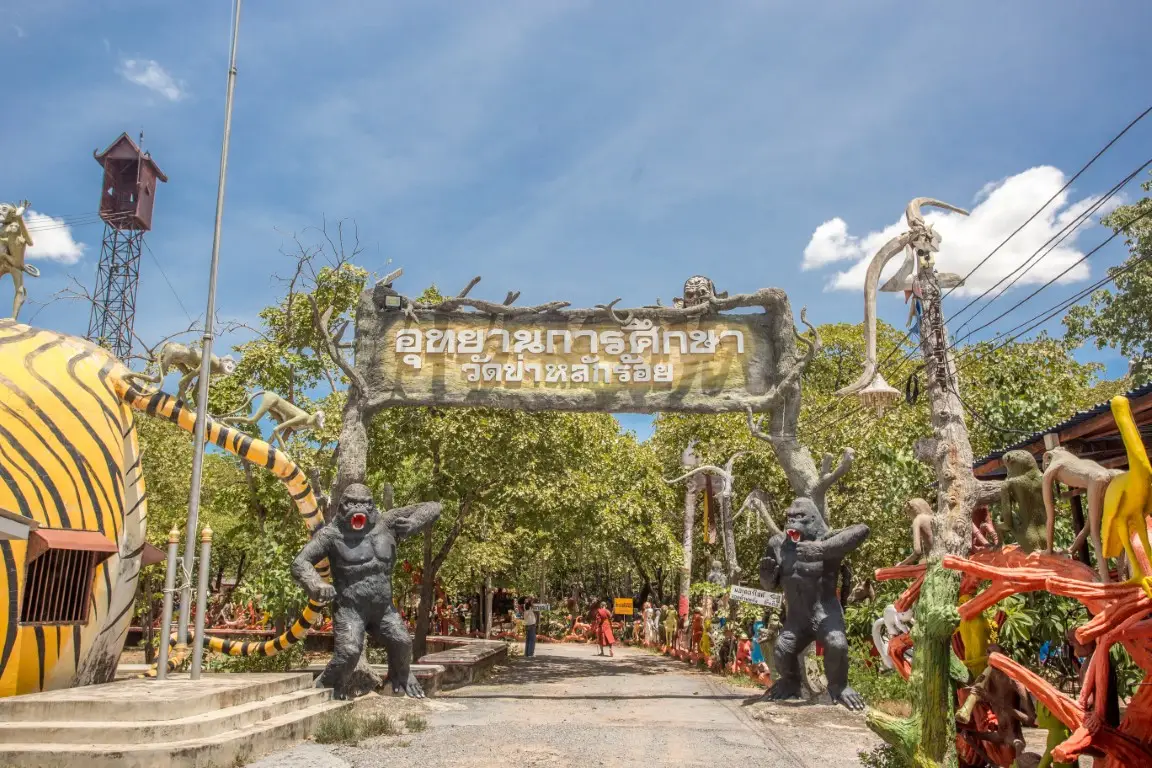
Wat Pa Lak Roi
Open Days: Daily
Opening Hours: Morning – Evening
Wat Pa Lak Roi in Nakhon Ratchasima is one of the most distinctive Buddhist educational temples in Non Thai District. Located at Ban Lak Roi, Moo 9, Non Thai Subdistrict, Non Thai District, Nakhon Ratchasima Province, the temple is approximately 20 kilometers from Korat city. It is widely known for its large Buddhist learning park, where scenes of hell, heaven, human life, deities, karmic consequences, and moral teachings are presented through numerous concrete sculptures. Unlike temples that are visited mainly for architecture, Wat Pa Lak Roi is designed as a visual moral classroom where visitors can learn Buddhist ethics by walking, observing, reading, and reflecting.
The most important character of Wat Pa Lak Roi is its ability to turn abstract Buddhist ideas into visible experience. Concepts such as merit, sin, karma, heaven, hell, human conduct, and moral responsibility are often difficult to explain through words alone. At this temple, those ideas are shown through sculptures, symbolic scenes, and narrative displays. Visitors see the consequences of harmful actions in the hell zone, the rewards of good actions in the heaven zone, the choices of ordinary life in the human zone, and divine imagery connected with Buddhist and local beliefs. This makes the temple especially suitable for families, teachers, students, and travelers interested in Thai Buddhist moral education.
Wat Pa Lak Roi began as a monastic residence around 1977 in an area of degraded forest. It was formally established as a Buddhist temple on 14 December 1995 under the Maha Nikaya order. The name of the temple comes from Ban Lak Roi, the village where it stands. From the beginning, the site attracted monks, lay practitioners, and local Buddhists who came for meditation and religious practice. Over time, the temple became known not only as a place of worship but also as a place where Buddhist teachings could be presented in a direct and memorable form.
The temple covers approximately 48 rai, giving it enough space for both religious buildings and a large outdoor educational park. The grounds include an ordination hall, meditation and merit-making areas, monks’ residences, a prayer hall, a bell tower, restrooms, parking areas, a community product zone, and large sections filled with moral sculptures. The temple is therefore not a small roadside shrine. It is a broad religious and educational complex that functions as a monastery, meditation site, learning park, community space, and local tourism destination at the same time.
The most famous area is the Buddhist educational park, filled with concrete sculptures that illustrate moral lessons. These sculptures are not meant to be viewed simply as strange or sensational displays. They are visual warnings and teachings. Scenes of wrongdoing, punishment, suffering, good deeds, heavenly rewards, and human choices are arranged to show the relationship between action and consequence. In Thai Buddhist culture, this method of teaching is familiar. Hell and heaven imagery has long been used to warn people against harmful conduct and encourage ethical living.
The hell zone is the area most visitors remember. It includes sculptures of hungry ghosts, figures of judgment, beings undergoing punishment, and scenes that explain the results of immoral actions. Some images may appear intense to foreign visitors, especially those unfamiliar with Thai temple teaching parks. However, the purpose is not entertainment or horror. The purpose is moral instruction. The scenes remind viewers that greed, violence, dishonesty, cruelty, and harmful conduct produce suffering for oneself and others.
It is important to understand that Wat Pa Lak Roi does not use hell imagery only to frighten people. The temple places hell, heaven, human life, and divine realms within the same moral landscape. This structure teaches that human beings live in the middle of moral possibility. They can choose harmful actions and move toward suffering, or they can choose generosity, honesty, compassion, and mindfulness and move toward a better state of life. This comparative design gives the temple its educational depth.
The heaven zone presents the opposite moral direction. Here, images of deities, heavenly beings, and peaceful scenes suggest the results of merit-making, ethical behavior, generosity, and religious devotion. This zone balances the stronger imagery of the hell zone. Together, both areas communicate a basic Buddhist teaching: actions have consequences, and the quality of one’s life is shaped by intention and conduct. For Thai visitors, this message is familiar. For foreign visitors, it is a useful introduction to popular Buddhist moral imagination in Thailand.
The human zone is equally important because it reminds visitors that karma begins in ordinary life. Speaking truthfully or dishonestly, helping others or harming them, respecting parents or neglecting them, earning a living honestly or exploiting others — these everyday actions form the ethical foundation of the temple’s message. The human zone links the dramatic scenes of hell and heaven back to normal behavior. It tells visitors that morality is not something remote. It begins with what people do every day.
Wat Pa Lak Roi also includes playful and folk-style displays, such as simulated stages for mor lam, ram wong, boxing, and village life. Some mechanical displays were designed to move or make sounds when coins are inserted. These features mix entertainment with moral education. They show that Buddhist teaching in local communities does not always appear in a solemn or academic form. Sometimes it is communicated through folk performance, humor, sound, movement, and familiar village scenes.
This approach makes Wat Pa Lak Roi feel like an open-air classroom. Visitors do not sit in a lecture hall. They walk through the lessons. They see sculptures, read explanations, hear sounds, and compare scenes. Children can learn through images before they fully understand abstract moral language. Parents and teachers can use each scene as a starting point for discussion about the Five Precepts, honesty, gratitude, respect, kindness, and responsibility. This is one of the reasons the temple is suitable for educational trips.
The ordination hall is another important feature. It is a reinforced concrete structure decorated with beautiful stucco floral motifs. The decorative work gives the building a bright and almost heavenly appearance. Visitors should take time to observe the entrance, window frames, gable details, ceiling, and ornamental surfaces. The ordination hall is not only an architectural feature but also a sacred ritual space. Visitors should remove shoes where required, dress respectfully, and keep their voices low when entering religious areas.
Wat Pa Lak Roi is also recognized as Nakhon Ratchasima Provincial Meditation Practice Center No. 3. This confirms that the temple is not only a tourism-oriented learning park. It remains a place for Buddhist practice, mindfulness, and spiritual cultivation. Visitors interested in meditation or religious practice should contact the temple directly, follow temple regulations, dress modestly, and maintain silence and discipline in the appropriate areas.
One of the temple’s important annual activities is the parivasa-kamma practice, held three days after the end of Buddhist Lent. Devotees come to practice, make merit, offer food, drinks, and monastic requisites to monks undergoing the formal disciplinary practice. This event highlights the living religious function of the temple. Wat Pa Lak Roi is not only a place of sculptures; it is also an active Buddhist temple with annual ceremonies and practice traditions.
The current abbot of Wat Pa Lak Roi is Phra Athikan Prasert Warasatto. He was appointed abbot on 10 July 2018, following the earlier leadership of Phra Khru Siriphattharaporn, also known as Luang Pho Niyom Suphattho, who played a major role in developing the temple and its permanent structures. This continuity of monastic leadership has helped preserve the temple’s educational mission, religious activities, and role as a local attraction.
Luang Pho Niyom, also known locally as Luang Pho Chan, remains significant in the temple’s history because he helped shape the idea of Wat Pa Lak Roi as a Buddhist moral learning park. The goal was not merely to create unusual sculptures but to use folk art and temple space as tools for teaching. This background helps visitors understand why the temple looks different from many other temples in Korat. Its visual intensity is part of a deliberate educational method.
The entrance gate is memorable. Visitors pass through a gate marked by two large elephants raising a Dhamma wheel. The image of elephants suggests strength and stability, while the Dhamma wheel represents the turning of Buddhist teaching. This symbolic entrance prepares visitors for the moral and religious learning space inside. Beside the entrance are parking areas and zones where local villagers may sell community products and handmade goods.
The community product area is an important part of the visitor experience. It connects the temple with local livelihood. Villagers may sell local snacks, handmade items, agricultural products, or souvenirs, depending on the day and season. Visitors who purchase these products support the surrounding community. In this way, a visit to Wat Pa Lak Roi can combine merit-making, learning, cultural travel, and local economic support.
A normal visit to Wat Pa Lak Roi should take at least one to two hours. Visitors who only want to see the main areas can walk through the entrance, ordination hall, hell zone, heaven zone, human zone, and community product area within that time. Those who want to read the captions, explain scenes to children, take respectful photographs, and understand the moral messages should allow a half-day visit. The temple rewards slow observation rather than quick sightseeing.
Parents bringing children should prepare age-appropriate explanations. Some sculptures in the hell zone may be visually strong. Children may be surprised or frightened if they are not guided properly. A good way to explain the temple is to say that the sculptures are teaching tools. They are not meant to terrify children but to show that harmful actions have consequences. Parents can use the scenes to discuss truthfulness, kindness, respect, self-control, and responsibility.
For schools, Wat Pa Lak Roi is suitable for field trips because it connects with several learning areas: Buddhism, civic education, local culture, visual communication, folk art, morality, and community economy. Students can learn how a temple functions as more than a place of worship. They can see how sculpture and public space can be used to teach values. For group visits, contacting the temple in advance is recommended so the visit can be organized smoothly.
For foreign visitors, Wat Pa Lak Roi should be understood as a Thai Buddhist moral education park. It is not a horror attraction, although some scenes may look shocking. It is not a theme park, although some displays are playful and mechanical. It is a religious learning environment based on popular Buddhist ideas of karma, merit, sin, heaven, hell, and moral responsibility. Visitors should approach the temple with cultural sensitivity and curiosity rather than mockery.
Temple etiquette is important. Visitors should dress modestly, cover shoulders and knees, avoid loud behavior, and respect worship areas. Do not climb on sculptures, touch religious objects, or pose in disrespectful ways with hell or deity figures. The sculptures may be outdoors, but they are still part of a religious teaching environment. Photography should be done respectfully, especially when monks, worshippers, or children are present.
Getting to Wat Pa Lak Roi is easiest by private car. From Nakhon Ratchasima city, take the Nakhon Ratchasima-Non Thai-Chaiyaphum route, Highway 205. From the Cho Ho intersection area, continue for approximately 17.5 kilometers. Before reaching the temple area, look for a sign on the left pointing to Wat Pa Lak Roi. Turn left and continue along the village road for about 2 kilometers. The entrance gate with two large elephants holding a Dhamma wheel will be clearly visible.
Getting There from central Korat or Thao Suranari Monument usually takes around 30 to 40 minutes by car, depending on traffic. Travelers should head toward Cho Ho and then follow Highway 205 toward Non Thai and Chaiyaphum. The final section passes through a local village road, so drivers should reduce speed and be careful. The temple has a spacious parking area that can accommodate cars, vans, and larger group vehicles.
There is no admission fee at Wat Pa Lak Roi. Visitors may enter, make merit, worship, walk through the educational park, and support local products according to personal interest. Donations may be made voluntarily at designated points. This distinction is important: Wat Pa Lak Roi remains a Buddhist temple and meditation site, not a ticketed commercial attraction. Donations are acts of merit-making, not compulsory entrance charges.
The best time to visit is from morning to late afternoon because most of the learning park is outdoors. Midday can be hot, especially around the open sculpture areas. Visitors should bring drinking water, a hat, an umbrella, and comfortable walking shoes. Those who want to take photographs and study the sculptures carefully should arrive early enough to allow time before evening.
Visitors should interpret the sculptures in their proper cultural context. Some images may appear graphic or unusual to those unfamiliar with Thai Buddhist teaching parks. However, these scenes are part of a long tradition of using visual reminders to teach morality. The images say that every action has a consequence. They encourage people to avoid harmful conduct and cultivate generosity, honesty, compassion, and mindfulness.
A half-day itinerary can begin in Nakhon Ratchasima city, travel to Wat Pa Lak Roi in the morning, walk through the educational park, make merit, and then stop for lunch in Non Thai District. Local options include noodle shops, Isan restaurants, cafés, and simple roadside restaurants. Visitors can then return to Korat city or continue to nearby sites such as Prasat Hin Phanom Wan, Wat Muen Wai, or Wat Sala Loi.
A full-day route can combine Wat Pa Lak Roi with old-city temples and historical sites. Start with Wat Pa Lak Roi in the morning, then return toward Korat to visit Prasat Hin Phanom Wan, Wat Sala Loi, or temples within the old city. This route allows travelers to see different dimensions of Nakhon Ratchasima: a moral education temple, ancient Khmer heritage, and urban Buddhist sites.
Restaurants near Wat Pa Lak Roi include noodle shops, Isan food restaurants, cafés, and local dining places in Non Thai District. Well-known nearby options include Pao Pak Noodles Non Thai, Thawatchai Tom Lueat Mu, Tam Saep Non Thai, Som Tam Pan Lan Non Thai, Café Amazon, and other roadside restaurants along Highway 205. Some restaurants operate mainly during the day, so groups should call in advance when phone numbers are available.
Accommodation close to the temple is limited compared with central Nakhon Ratchasima. Travelers who want to stay near the route may choose local accommodation in Non Thai or properties in the Cho Ho and Korat city areas. Options include Varinville Resort, Green Garden Resort, KoCo Hotel Korat, and Fah Proud Fon Hotel. Travelers should choose based on whether they plan to continue toward Non Thai and Chaiyaphum or return to Korat city after the visit.
Wat Pa Lak Roi is valuable because it shows a form of temple education that is deeply local and visually powerful. Children learn through images. Adults reflect on their own conduct. Teachers can use the place as an open classroom. Foreign travelers can observe how Buddhist ethics are communicated outside formal scripture study. The temple may look unusual, but its core message is simple: do good, avoid evil, understand consequences, and live with mindfulness.
In summary, Wat Pa Lak Roi in Nakhon Ratchasima is a distinctive Buddhist educational temple in Non Thai District. It is known for its 48-rai learning park, hell zone, heaven zone, human zone, deity displays, moral sculptures, ornate ordination hall, meditation role, parivasa-kamma tradition, community product area, and elephant entrance gate. It is suitable for merit-making, family visits, educational trips, photography with respect, and cultural learning. For Thai visitors, it is a reminder of karma and moral responsibility. For foreign visitors, it offers a vivid insight into Thai Buddhist visual teaching and local religious culture.
| Name | Wat Pa Lak Roi, Nakhon Ratchasima |
| Related Names | Wat Lak Roi, Wat Pa Lak Roi Non Thai, Wat Pa Lak Roi Temple |
| Location | Ban Lak Roi, Moo 9, Non Thai Subdistrict, Non Thai District, Nakhon Ratchasima Province |
| Address | Ban Lak Roi, Moo 9, Non Thai, Non Thai District, Nakhon Ratchasima 30220, Thailand |
| Coordinates | 15.17240, 102.07434 |
| Type | Buddhist temple, Buddhist educational park, moral learning attraction, faith-based cultural site |
| Highlights | Buddhist educational park, hell zone, heaven zone, human zone, deity zone, moral sculptures, ornate ordination hall, elephant gate with Dhamma wheel, folk performance displays, and community product area |
| History | Founded as a monastic residence around 1977 in a degraded forest area and formally established as a Buddhist temple on 14 December 1995 under the Maha Nikaya order |
| Name Origin | Named after Ban Lak Roi, the village where the temple is located |
| Area | Approximately 48 rai |
| Distinctive Features | A temple that uses concrete sculptures and visual scenes to teach Buddhist morality, karma, merit, sin, heaven, hell, human conduct, and the consequences of action |
| Travel Information | From Nakhon Ratchasima city, take Highway 205 on the Nakhon Ratchasima-Non Thai-Chaiyaphum route. From the Cho Ho intersection, continue about 17.5 km, turn left at the Wat Pa Lak Roi sign, and continue along the village road for about 2 km to the temple entrance |
| Current Status | Active Buddhist temple, tourist site, educational field-trip destination, merit-making place, and Nakhon Ratchasima Provincial Meditation Practice Center No. 3 |
| Open Days | Daily |
| Opening Hours | Morning – Evening |
| Fees | No admission fee; voluntary donations may be made according to personal faith |
| Facilities | Ordination hall, meditation hall, prayer hall, bell tower, monks’ residences, restrooms, spacious parking area, local product zone, and walking areas throughout the educational park |
| Main Areas / Zones | Elephant Gate With Dhamma Wheel Ornate Ordination Hall Buddhist Educational Park Hell Zone Heaven Zone Human Zone Deity Zone Mor Lam Stage Display Ram Wong Stage Display Boxing Stage Display Monkey And Gibbon Displays Moral Sculpture Area Local Product And Community Market Area Meditation Hall And Practice Area |
| Tradition / Important Activity | Parivasa-kamma practice held three days after the end of Buddhist Lent each year, with meditation practice, merit-making, and offerings of food, drinks, and monastic requisites to monks |
| Abbot / Caretaker | Phra Athikan Prasert Warasatto |
| Main Contact Number | 044-381-076, 062-356-2107, 085-308-0776 |
| Website / Contact Channel | Wat Pa Lak Roi, Non Thai District, Nakhon Ratchasima |
| Nearby Tourist Attractions | 1. Wat Niyommata, about 7 km 2. Non Thai District Center / Non Thai Town Area, about 8 km 3. Wat Muen Wai, about 16 km 4. Prasat Hin Phanom Wan, about 17 km 5. Wat Sala Loi, about 20 km, Tel. 083-461-2999 6. Thao Suranari Monument, about 22 km 7. Nakhon Ratchasima Zoo, about 38 km, Tel. 044-934-538, 083-372-0404, 098-867-7363 |
| Nearby Restaurants | 1. Thawatchai Tom Lueat Mu, about 1.3 km 2. Pao Pak Noodles Non Thai, about 1.4 km, Tel. 044-256-965, 044-256-966 3. Café Amazon PTT Kho Thian Yu Petroleum 2, about 1.4 km 4. Kamnan Prakop Kai Ka Ted, about 3.6 km 5. Tam Saep Non Thai, about 4.4 km 6. Som Tam Pan Lan Non Thai, about 8 km, Tel. 061-662-6566, 081-966-1497 |
| Nearby Accommodations | 1. Varinville Resort Non Thai, about 18 km, Tel. 093-535-3887 2. Green Garden Resort Korat, about 17 km, Tel. 044-952-185 3. KoCo Hotel Korat, about 18 km, Tel. 098-555-9558, 098-251-9388 4. Fah Proud Fon Hotel, about 18 km, Tel. 087-246-3838 5. Taya Resort, about 45 km, Tel. 081-966-7010, 084-475-2354 |
Frequently Asked Questions (FAQ)
Q: Where is Wat Pa Lak Roi located?
A: Wat Pa Lak Roi is located at Ban Lak Roi, Moo 9, Non Thai Subdistrict, Non Thai District, Nakhon Ratchasima Province, about 20 kilometers from Korat city.
Q: What are the opening days and hours of Wat Pa Lak Roi?
A: Wat Pa Lak Roi is open daily. The best visiting time is from morning to evening because most of the educational park is outdoors.
Q: Is there an admission fee at Wat Pa Lak Roi?
A: There is no admission fee. Visitors may make voluntary donations or support temple activities according to personal faith.
Q: What is Wat Pa Lak Roi famous for?
A: Wat Pa Lak Roi is famous for its Buddhist educational park with hell, heaven, human, and deity zones, moral sculptures, an ornate ordination hall, and folk-style teaching displays.
Q: Is Wat Pa Lak Roi suitable for children and students?
A: Yes. The temple is suitable for children and students because it uses sculptures and visual scenes to teach morality, karma, merit, sin, and the consequences of actions in an easy-to-understand way.
Q: When is the parivasa-kamma activity held at Wat Pa Lak Roi?
A: The parivasa-kamma activity is held three days after the end of Buddhist Lent each year, with meditation practice, merit-making, and offerings to monks.
Q: How can travelers get to Wat Pa Lak Roi?
A: From Nakhon Ratchasima city, take Highway 205 toward Non Thai and Chaiyaphum. From the Cho Ho intersection, continue about 17.5 km, then turn left at the Wat Pa Lak Roi sign and continue along the village road for about 2 km.
Q: What should foreign visitors know before visiting Wat Pa Lak Roi?
A: Foreign visitors should understand that Wat Pa Lak Roi is a Thai Buddhist moral education park. Its hell, heaven, human, and karmic scenes are religious teaching tools, so visitors should dress modestly, avoid mocking the sculptures, and respect the temple context.
 Category: ●Places of Worship
 Group: ●Temple
Last Update : 3 MonthAgo
 Last Update : 3 MonthAgo

 Click to Access the Navigation Map GPS
Wat Pa Lak Roi Map
Recommend

 Art, Culture and Heritage
 Historical Sites and Monuments(20)
 Landmarks and Memorials(5)
 Art, Craft Centres, Tradition(7)
 Museums(6)
 Art Gallery(1)
 Educational Places
 Educational Gardens, Farm(4)
Temple(29)
 Mosque(1)
 Other Sacred Sites(6)
 Research and Development
 Royal Project(3)
 Suburban Living
 Village, Community(6)
 Local Market(4)
 Floating Market(1)
 Nature and Wildlife
 National Parks and Marine Reserves(3)
 Mountain (Doi)(5)
 Dam, Reservoir, Lake(8)
 Waterfalls(9)
 Hot Springs(1)
 Caves(2)
 Flower Field(1)
 River, Canal(8)
 Bays and Beaches(2)
 Other natural attractions(3)
 Entertainment and Agricultural
 Zoos and Aquariums(2)
 Animal camps and shows(1)
 Farms, Parks and Ecotourism(21)
 Waterpark(4)
 Outdoor and Adventure Activities(6)
 Shopping
 Shopping and Night Market(2)
 Travel Articles, Recipes
 Travel Review, Food Review(6)


