
lovethailand home >Northeastern Travel Attractions >Nakhon Ratchasima Travel Attractions >Khon Buri >Khon Buri Tai > Prang Khon Buri
TL;DR: Prang Khon Buri is located at Inside Ban Khon Buri Nakhon Tham Khosit Witthayakhan School, Khon Buri Tai Subdistrict, Khon Buri District, Nakhon Ratchasima, open Daily, hours 08.00 – 17.00.
Prang Khon Buri
Open Days: Daily
Opening Hours: 08.00 – 17.00
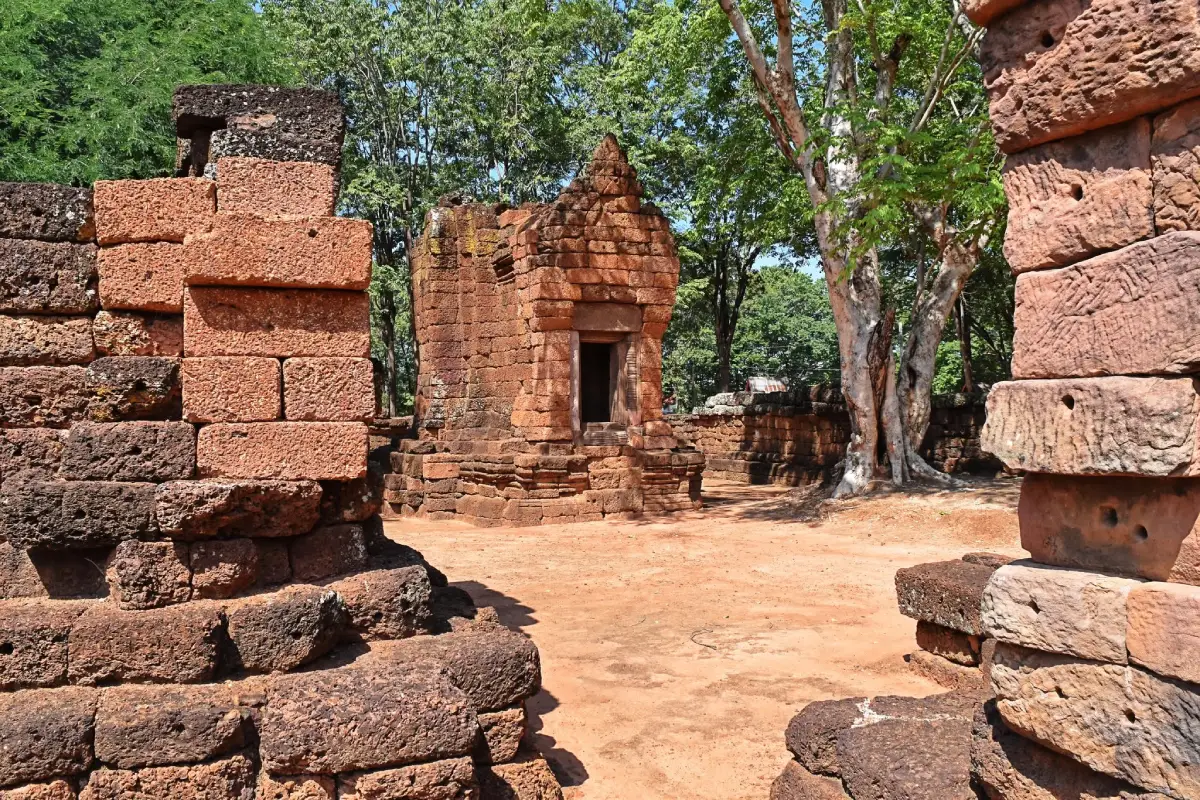
Prang Khon Buri in Nakhon Ratchasima Province is an approximately 800-year-old Khmer sanctuary built in the Bayon architectural tradition. It stands within the grounds of Ban Khon Buri Nakhon Tham Khosit Witthayakhan School in Khon Buri Tai Subdistrict, Khon Buri District. The monument was not simply an ancient place of worship. It formed the religious component of an arogyasala, a hospital system established across the Khmer Empire under King Jayavarman VII. The remaining complex includes a central sanctuary, a small auxiliary building commonly described as a library, a laterite enclosure wall, an eastern entrance pavilion or gopura, and a rectangular pond outside the wall. Admission is free, and most visitors should allow between 30 and 60 minutes to explore the site respectfully.
Prang Khon Buri is much smaller than the monumental Khmer complexes at Phimai or Phnom Rung, yet its historical significance lies in its distinctive social function. It was not designed primarily as an imperial state temple or a monumental demonstration of royal power. Instead, it belonged to a network combining religious practice, healthcare, public welfare, and regional administration. The surviving laterite structures reveal a side of Khmer civilization that is sometimes overshadowed by grand temples: the development of public infrastructure intended to serve communities, travelers, and people requiring medical care.
The sanctuary dates to the 18th Buddhist century, corresponding to the reign of King Jayavarman VII at Angkor, approximately 1181 to 1220 CE, or around 1724 to 1763 BE. Jayavarman VII was one of the most important rulers of the Khmer Empire and a major patron of Mahayana Buddhism. His reign was associated with the construction of temples, cities, roads, rest houses, bridges, and hospitals. The establishment of arogyasalas reflects an administrative philosophy in which religious compassion was translated into practical services for the population. Their chapels provided a sacred focus for patients, attendants, medical personnel, and nearby communities.
The Sanskrit term arogyasala refers to a house of health or a place associated with freedom from illness. The Ta Prohm inscription in Cambodia records that Jayavarman VII established 102 hospitals throughout his realm. These institutions received personnel, medical supplies, provisions, and support from settlements incorporated into the imperial administrative network. Many functional hospital buildings were constructed from perishable materials and have disappeared. The chapels built from laterite and sandstone survived in a more recognizable form, allowing archaeologists to identify the former locations of the hospital system. Prang Khon Buri is one such surviving religious structure.
The arogyasala program was closely connected with Mahayana Buddhist ideals of compassion, mercy, and the relief of suffering. Hospital chapels were associated with the worship of Bhaisajyaguru, the Medicine Buddha, as well as compassionate bodhisattvas. Although the original cult images and most carved decorative components are no longer present at Prang Khon Buri, the surviving plan, orientation, materials, and architectural composition correspond closely to other hospital chapels from the reign of Jayavarman VII.
The distribution of arogyasalas across present-day Cambodia, Thailand, and neighboring regions demonstrates the extensive reach of Khmer transportation and administrative networks. Nakhon Ratchasima occupied a strategically important zone connecting the Khorat Plateau, Phimai, mountain passes, agricultural communities, and routes leading toward Angkor. The presence of a hospital chapel at Khon Buri indicates that this area was integrated into a wider regional system. It may have served residents and travelers moving between settlements in what is now southern Nakhon Ratchasima Province.
The principal structures of Prang Khon Buri stand within a laterite enclosure. The overall plan is rectangular and faces east, following the orientation commonly used in Khmer architecture. Visitors enter through a single eastern gopura before reaching an enclosed courtyard containing the central sanctuary and the auxiliary building. Although the upper levels and several wall sections have collapsed, the surviving foundations, doorways, and wall alignments still allow visitors to understand how movement through the sacred compound was controlled and organized.
The central sanctuary is the most important surviving structure. Its base measures approximately 6 by 6 metres and is constructed principally from laterite. A projecting vestibule extends toward the east, leading into the inner chamber where a sacred image would once have been installed. The eastern doorway served as the functional entrance, while the remaining sides were enclosed or treated as false doors in accordance with Khmer architectural conventions. When viewed through the eastern entrance, the surviving door frames create a sequence of receding openings that gives the ruin considerable visual depth.
Laterite is the principal construction material at Prang Khon Buri. This iron-rich stone is common in tropical regions and can be cut into blocks while still relatively soft below the ground. It hardens after exposure to the air, making it useful for walls, foundations, and structural cores. Laterite became especially prominent in the later phases of Khmer architecture and was widely used during the reign of Jayavarman VII. Its porous texture and reddish-brown colour give Prang Khon Buri a powerful visual character that blends naturally with the surrounding landscape.
Sandstone was reserved for components requiring finer workmanship, including door frames, decorative columns, lintels, and architectural details. At Prang Khon Buri, several sandstone framing elements remain visible, although the original carved ornament has largely disappeared. The contrast between the coarse surface of laterite and the smoother sandstone helps visitors understand how Khmer builders selected materials for different structural and decorative purposes.
The smaller building positioned to one side of the principal sanctuary is usually identified as a bannalai, often translated as a library. In Khmer temple compounds, this type of structure may have been used to store manuscripts, ritual objects, or materials required for religious ceremonies. The building at Prang Khon Buri was constructed from laterite and placed in a position consistent with the standardized arrangement of other arogyasala chapels. Although its roof and upper walls no longer survive, the remaining foundations preserve its relationship to the main sanctuary.
The enclosure wall separated the sacred interior from the surrounding hospital and community environment. It was built from laterite and was entered through a single eastern gopura. This controlled access created a deliberate progression from the outside world into a ritual space. Visitors moved through the entrance pavilion, crossed the courtyard, passed the auxiliary structure, and approached the central shrine. Walking through the site in the same sequence provides a clearer understanding of the original architectural experience than viewing the monument from only one angle.
A rectangular pond lies outside the enclosure near the eastern side of the complex. Water was important for daily life, cleansing, ritual practice, and the symbolic landscape of Khmer religious architecture. Local residents sometimes refer to this pond as the Anodat Pond, connecting it with beliefs concerning sacred water and healing. Its archaeological importance, however, comes from its position within the standardized arogyasala plan. Visitors should remain outside the pond, avoid feeding animals or throwing objects into the water, and help protect its natural ecology.
At certain times, tiny aquatic plants known locally as pham or watermeal cover the surface and turn the pond bright green. The phenomenon has attracted local attention and has occasionally been interpreted as an auspicious sign during community ceremonies. The visual contrast between green water, reddish laterite, and surrounding trees is striking, but visitors should understand it as a natural feature of still water while respecting the community traditions associated with the pond.
Prang Khon Buri survives as a ruin. The tower roof, upper levels, and sections of several walls have collapsed, leaving foundations, laterite wall courses, sandstone door frames, the enclosure alignment, and scattered architectural blocks. This incomplete condition does not diminish its significance. The exposed masonry reveals how the laterite blocks were arranged, how thick the walls were, and how the internal spaces were formed. Visitors must not move stones, climb onto the foundations, lean against fragile door frames, or enter unstable areas.
The site was officially registered as a national ancient monument on 27 September 1936. The protected archaeological boundary was subsequently declared on 30 June 1981. Registration places the monument under Thai legislation governing ancient sites, antiquities, works of art, and national museums. Excavation, alteration, removal of materials, and activities capable of damaging the monument are subject to the authority of the Fine Arts Department. Responsible visitor behaviour is therefore both an ethical duty and an essential part of legal heritage protection.
The Fine Arts Department carried out archaeological clearance and excavation at Prang Khon Buri in 2008. This work revealed buried wall lines, clarified the arrangement of the buildings, and improved the ability of authorities to monitor the site. Conservation and landscape maintenance have continued in later periods, but the aim has not been to reconstruct every missing section. Modern conservation prioritizes authentic materials and reliable archaeological evidence. The monument therefore retains the appearance of a stabilized historic ruin rather than a newly rebuilt temple.
The Fine Arts Department identifies Khun Koon Kruykrathok as the monument maintenance officer associated with the site. Management also requires cooperation among the Fine Arts Department, the school, local government, and the surrounding community. Organized groups, academic researchers, commercial photographers, and visitors requesting a guided explanation should contact the school or the 10th Regional Office of Fine Arts in advance. Prior coordination is particularly important because the monument stands within an active educational institution.
The location within a school creates an unusual and valuable relationship between archaeological heritage and everyday education. Students can study an authentic ancient structure, local history, construction materials, architectural planning, and conservation practice within their own campus. Prang Khon Buri functions simultaneously as a tourist attraction, a protected archaeological site, and an outdoor community classroom. Visitors should dress appropriately, keep noise to a minimum, and avoid disrupting classes or school activities.
Prang Khon Buri also remains part of the cultural memory of local residents. Community organizations and local authorities have held worship ceremonies to honour the monument and present local traditions. A major ceremony was organized on 26 December 2024, demonstrating that the site continues to function as a cultural focus rather than an isolated ruin. These activities help younger generations connect with the history of Khon Buri and encourage shared responsibility for the monument.
Local stories concerning sacred trees, protective spirits, and the pond should be treated respectfully while being distinguished from archaeological conclusions. Oral traditions are valuable because they show how communities have understood and cared for the place over time. Archaeology provides a different form of evidence concerning the monument’s date, architectural style, religious affiliation, and role in the hospital network. Considering both forms of knowledge gives visitors a fuller understanding of the site.
A useful visit begins outside the eastern enclosure. From this position, observe the relationship between the entrance gopura, enclosure wall, central sanctuary, and pond. Continue through the eastern gateway and examine the laterite wall surfaces and sandstone door frames without touching them. Locate the bannalai beside the central shrine and walk around the perimeter to understand how the buildings were positioned. Finish by viewing the pond from a safe distance. This sequence makes the plan easier to understand while avoiding fragile areas.
The most comfortable visiting period is between 08.00 and 10.00, when temperatures are lower and eastern sunlight emphasizes the textures of the laterite. Late afternoon also produces attractive angled light and strong shadows around the sanctuary. November to February generally offers the most pleasant weather. Visitors arriving during the hot season should carry water, a hat, and sun protection. During the rainy season, the surrounding vegetation is greener, but the soil, stone blocks, and uneven paths may become slippery.
For photography, the eastern frontal view captures the sequence of surviving doorways, while an oblique side view shows the thickness and construction of the walls. A wider composition near the pond records the relationship between architecture and landscape. Visitors must not stand on ancient foundations or loose laterite blocks to obtain a better angle. Repeated pressure, vibration, and physical contact can accelerate deterioration even when the masonry appears strong. Drone use and professional commercial filming require prior authorization.
Useful items include drinking water, a hat or umbrella, comfortable shoes suitable for uneven ground, and a mobile device with an offline map. The monument is an open-air archaeological site rather than a fully developed historical park. There is no large visitor centre, permanent English-language guide service, or extensive tourist infrastructure. Older travelers can view much of the monument from level ground near the entrance, but wheelchair access is limited by soil surfaces, foundations, and scattered stonework.
Because the monument is located inside school grounds, vehicles must be parked only in designated areas. Do not drive close to the archaeological structures or block routes used by students and staff. Access arrangements may change during school holidays, official events, maintenance work, or special ceremonies. Large groups should telephone the school before traveling, even though published information lists the monument as open daily from 08.00 to 17.00.
Getting There from Nakhon Ratchasima city is most convenient by private car. Follow Highway 224 toward Chok Chai, continue toward Khon Buri via Highway 2071, and use local roads to reach Ban Prang Khon Buri in Khon Buri Tai Subdistrict. The monument is inside Ban Khon Buri Nakhon Tham Khosit Witthayakhan School. The total road distance is approximately 55 to 60 kilometres, and the journey normally takes between 1 hour 10 minutes and 1 hour 30 minutes. Enter either “Prang Khon Buri” or the full school name into a navigation application.
Travelers starting in central Khon Buri should allow approximately 10 to 12 kilometres for the drive to the school. The route passes through local communities and agricultural areas. A private or rental vehicle is the most practical option. Public buses and vans can be used to reach Khon Buri District, but onward local transportation to the school is limited. Travelers relying on a hired vehicle should negotiate the fare and return pickup time before leaving the district centre.
Prang Khon Buri works well as the first destination on a half-day cultural itinerary. Visit the archaeological site in the morning, continue to Wat Khon Buri or Wat Luang Pu Nil, and have lunch in the district centre. In the afternoon, travel to Lam Mun Bon Dam, Wat Khao Chom Thong, or Chom Thong Beach. This route combines Khmer history, Buddhist culture, rural communities, and reservoir landscapes without requiring an excessively rushed schedule.
A full-day route can include the century-old wooden bridge at Ban Khok Krachai or Lam Chae Dam. The wooden bridge is known for views across rice fields and attractive evening light, while Lam Chae Dam offers mountain scenery and water-based activities. Distances between attractions in Khon Buri are substantial, making a private vehicle highly useful. Fill the fuel tank before leaving the district centre and check weather conditions before entering reservoir or forest-edge areas during the rainy season.
Most restaurants and cafés are located in central Khon Buri or along the main roads, approximately 9 to 15 kilometres from the monument. Recognized local options include Sawan Banna Cafe Food & Drink, Rong Kafae Nai Chang, Ran Kafae Khon Buri, It Downtown, and Rim Khlong Cafe. Opening days and service hours can change, so groups should telephone the restaurant before traveling. Buying water or refreshments in town is advisable before continuing to more remote natural attractions.
Accommodation near Prang Khon Buri consists mainly of small hotels and resorts, including M Resort Khon Buri, Yoo Sabai Rooms and Resort, Ton Mai Yai Resort, Baan Hansa Resort, and Poj Saen Charoen Hotel. These properties are practical for travelers planning to visit Lam Mun Bon Dam, Lam Chae Dam, or forest attractions on the following day. Advance reservations are recommended during long weekends and the cool season because the number of rooms in Khon Buri is more limited than in Nakhon Ratchasima city.
Foreign visitors should understand that Prang Khon Buri is a local archaeological site rather than a major historical park. English interpretation panels, permanent guides, ticket offices, and tourist services may not be available. Reading about Jayavarman VII, Mahayana Buddhism, and the arogyasala network before arrival greatly improves the experience. Save the school name, coordinates, and contact numbers on a mobile device, and use a translation application when communicating with local residents.
A general visit takes around 45 minutes. Archaeology enthusiasts may spend 1 to 2 hours examining the plan, materials, masonry, and changing views of the buildings. Follow a systematic route from the gopura to the main sanctuary, bannalai, enclosure wall, and pond. Comparing the layout with other Jayavarman VII hospital chapels, such as Prang Ku or the Kuti Ruesi sites, helps reveal the standardized architectural principles behind the arogyasala network.
The importance of Prang Khon Buri extends beyond its age and physical appearance. It provides evidence for regional administration, transportation, religion, healthcare, and the relationship between the Khmer Empire and communities on the Khorat Plateau. The site demonstrates that healing in the ancient world could combine physical treatment, medicinal resources, ritual practice, and psychological reassurance. Its chapel provided a sacred centre supporting the broader work of the hospital establishment.
From a local historical perspective, the monument shows that modern Khon Buri was connected to a major Southeast Asian network centuries ago. Its standardized design reflects the movement of architectural knowledge, craftsmen, administrative models, and resources from the imperial centre into distant regions. At the same time, the use of locally available laterite and the placement of the complex near water demonstrate adaptation to the landscape of southern Nakhon Ratchasima.
Preserving Prang Khon Buri requires more than structural repair. Government agencies provide archaeological expertise and legal protection. The school monitors the site through daily use of the surrounding area. Local communities preserve memories, ceremonies, and cultural meaning. Visitors contribute by avoiding climbing, graffiti, littering, removal of objects, and unnecessary contact. These simple actions significantly reduce long-term damage.
Prang Khon Buri is particularly rewarding for travelers interested in Khmer history, Bayon architecture, Mahayana Buddhism, ancient healthcare, archaeology, and community-based cultural tourism. It lacks the monumental scale of Thailand’s famous Khmer temples, but its compact layout allows visitors to understand the principal elements of an arogyasala chapel within a relatively small area. Standing among laterite walls, layered doorways, old trees, and the ancient pond creates a direct and intimate connection with the past.
Travelers passing through Chok Chai, Khon Buri, or Soeng Sang, or heading toward Lam Mun Bon and Lam Chae reservoirs, should consider adding Prang Khon Buri to their route. The visit requires relatively little time, admission is free, and the monument can be combined with nearby temples, restaurants, accommodation, and natural attractions. Visiting respectfully ensures that this 800-year-old record of Khmer public welfare, religion, and architecture remains available to future generations.
| Name | Prang Khon Buri, also known as Prasat Khon Buri |
| Site Type | Khmer archaeological monument and arogyasala hospital chapel |
| Location | Inside Ban Khon Buri Nakhon Tham Khosit Witthayakhan School, Khon Buri Tai Subdistrict, Khon Buri District, Nakhon Ratchasima |
| Address | Moo 16, Ban Prang Khon Buri, Khon Buri Tai, Khon Buri District, Nakhon Ratchasima 30250, Thailand |
| Coordinates | 14.573243, 102.155045 |
| Historical Period | 18th Buddhist century, during the reign of King Jayavarman VII, approximately 1724 – 1763 BE |
| Religion and Style | Mahayana Buddhism and Khmer Bayon-style architecture |
| Founder | Constructed under the royal program of King Jayavarman VII of the Khmer Empire |
| Historical Importance | One of the chapels associated with the network of 102 arogyasala hospitals established across the Khmer Empire |
| Highlights | Laterite central sanctuary, sandstone door frames, bannalai, enclosure wall, eastern gopura, and rectangular pond |
| Distinctive Features | East-facing plan, central sanctuary with a base of approximately 6 x 6 metres, projecting vestibule, and layered doorway views |
| Construction Materials | Laterite for the main structures, with sandstone used for door frames, columns, lintels, and selected architectural elements |
| National Registration | Registered as a national ancient monument on 27 September 1936; protected boundary declared on 30 June 1981 |
| Archaeological Work | Archaeological clearance and excavation conducted by the Fine Arts Department in 2008, followed by continuing maintenance |
| Name Origin | Named after the local community and Khon Buri District where the monument is located |
| Main Areas and Zones | 1. Eastern gopura entrance 2. Central sanctuary and inner chamber 3. Bannalai auxiliary building 4. Enclosure wall and inner courtyard 5. Rectangular pond outside the enclosure |
| Site Caretaker | Khun Koon Kruykrathok, monument maintenance officer, with oversight by the Fine Arts Department and coordination with the school |
| Current Status | Open to visitors; protected national monument retaining substantial original archaeological fabric within active school grounds |
| Open Days | Daily |
| Opening Hours | 08.00 – 17.00; large groups should contact the school in advance |
| Admission Fee | Free admission |
| Recommended Visit Duration | 30 – 60 minutes, or 1 – 2 hours for visitors with a strong interest in archaeology and architecture |
| Best Time to Visit | 08.00 – 10.00 or late afternoon before closing; November to February offers the most comfortable weather |
| Facilities | Parking in areas designated by the school, open-air walking space, partial tree shade, and local information coordination through the school |
| Visitor Guidelines | Do not climb, move stones, write on surfaces, or touch fragile masonry. Keep noise low within the school and obtain permission before drone use or commercial filming. |
| Travel Information | From Nakhon Ratchasima, follow Highway 224 through Chok Chai and Highway 2071 toward Khon Buri, then take local roads to Ban Khon Buri Nakhon Tham Khosit Witthayakhan School. Road distance is approximately 55 – 60 km. |
| Main Contact Numbers | Ban Khon Buri Nakhon Tham Khosit Witthayakhan School: 081-360-1304 10th Regional Office of Fine Arts, Nakhon Ratchasima: 044-471-518 |
| Official Information | 10th Regional Office of Fine Arts website and the official Facebook page of Ban Khon Buri Nakhon Tham Khosit Witthayakhan School |
| Nearby Tourist Attractions | 1. Wat Khon Buri or Wat Luang Pu Nil, approximately 1 km 2. Lam Mun Bon Dam, approximately 14 km 3. Wat Khao Chom Thong, approximately 15 km 4. Chom Thong Beach, approximately 18 km 5. Ban Khok Krachai Century-Old Wooden Bridge, approximately 25 km 6. Lam Chae Dam, approximately 30 km |
| Nearby Restaurants | 1. It Downtown, approximately 9 km, Tel. 092-913-1464 2. Ran Kafae Khon Buri, approximately 10 km, Tel. 064-053-2252 3. Sawan Banna Cafe Food & Drink, approximately 12 km, Tel. 081-321-1030, 081-266-9362 4. Rim Khlong Cafe Khon Buri, approximately 13 km 5. Rong Kafae Nai Chang, approximately 14 km, Tel. 093-507-5835 |
| Nearby Accommodations | 1. M Resort Khon Buri, approximately 6 km, Tel. 098-140-6197 2. Yoo Sabai Rooms and Resort, approximately 7 km 3. Ton Mai Yai Resort, approximately 11 km, Tel. 063-634-5678 4. Baan Hansa Resort, approximately 12 km, Tel. 080-797-3527 5. Poj Saen Charoen Hotel, approximately 12 km, Tel. 064-165-9595, 088-925-6615, 091-860-7788 |
Frequently Asked Questions (FAQ)
Q: When was Prang Khon Buri built?
A: Prang Khon Buri was built during the 18th Buddhist century under King Jayavarman VII, approximately 1724 – 1763 BE. It is a Khmer Bayon-style monument associated with Mahayana Buddhism.
Q: Was Prang Khon Buri an ancient hospital?
A: It was the religious chapel of an arogyasala hospital complex. The surviving stone structure supported ritual and spiritual care, while most functional hospital buildings were made from materials that did not survive.
Q: Where is Prang Khon Buri located?
A: It is inside Ban Khon Buri Nakhon Tham Khosit Witthayakhan School, Moo 16, Khon Buri Tai Subdistrict, Khon Buri District, Nakhon Ratchasima. The coordinates are 14.573243, 102.155045.
Q: What are the opening hours and admission fee?
A: The monument is open daily from 08.00 to 17.00 and admission is free. Large groups and visitors arriving on school holidays should contact the school in advance.
Q: What can visitors see at Prang Khon Buri?
A: The principal features include the eastern gopura, central sanctuary, bannalai, enclosure wall, courtyard, sandstone door frames, and a rectangular pond outside the enclosure.
Q: How long should visitors spend at the site?
A: Most visitors need approximately 30 to 60 minutes. Archaeology enthusiasts and photographers may prefer 1 to 2 hours.
Q: Can visitors climb the sanctuary for photographs?
A: No. Visitors should not climb foundations, stand on laterite blocks, move stones, or touch fragile architectural components because these actions can damage the protected monument.
Q: Which attractions can be combined with Prang Khon Buri?
A: Suitable nearby destinations include Wat Khon Buri or Wat Luang Pu Nil, Lam Mun Bon Dam, Wat Khao Chom Thong, Chom Thong Beach, the century-old wooden bridge at Ban Khok Krachai, and Lam Chae Dam.
 Category: ●Art, Culture and Heritage
 Group: ●Historical Sites and Monuments
Last Update : 3 MonthAgo
 Last Update : 3 MonthAgo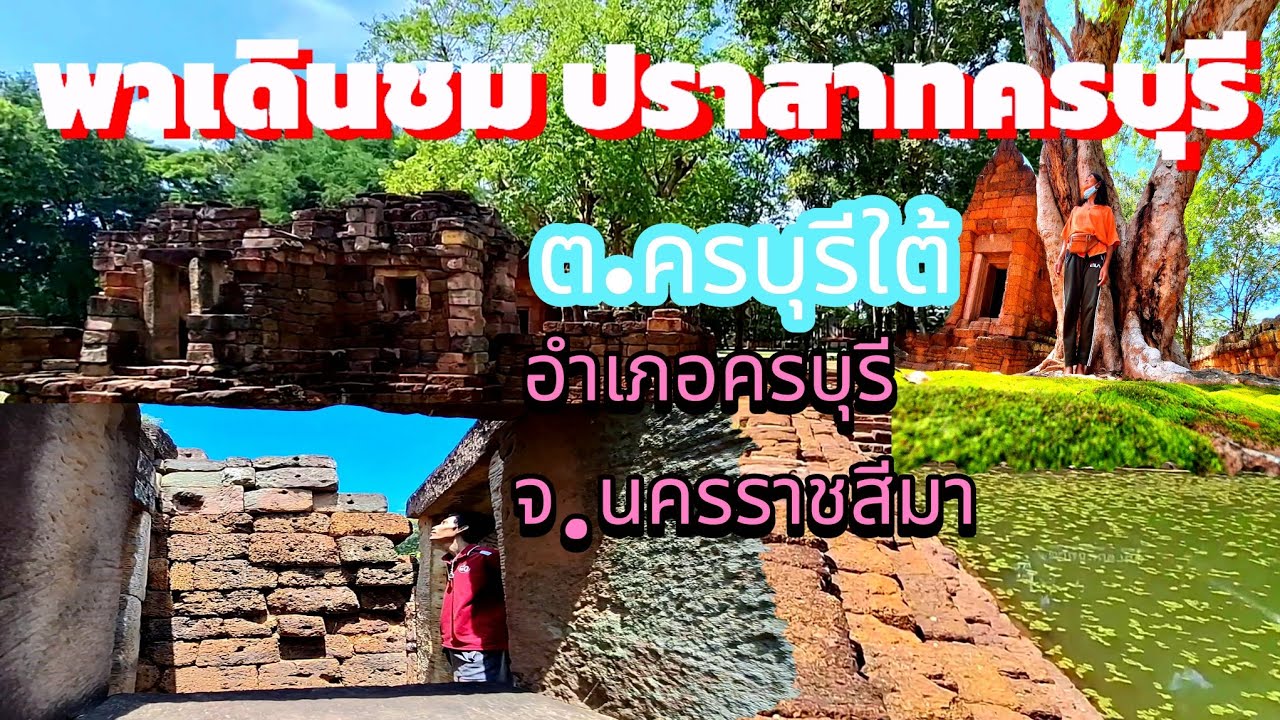
 Click to Access the Navigation Map GPS
Prang Khon Buri Map
Recommend
 Historical Sites and Monuments(20)
 Landmarks and Memorials(5)
 Art, Craft Centres, Tradition(7)
 Museums(6)
 Art Gallery(1)
 Educational Places
 Educational Gardens, Farm(4)
 Places of Worship
 Temple(29)
 Mosque(1)
 Other Sacred Sites(6)
 Research and Development
 Royal Project(3)
 Suburban Living
 Village, Community(6)
 Local Market(4)
 Floating Market(1)
 Nature and Wildlife
 National Parks and Marine Reserves(3)
 Mountain (Doi)(5)
 Dam, Reservoir, Lake(8)
 Waterfalls(9)
 Hot Springs(1)
 Caves(2)
 Flower Field(1)
 River, Canal(8)
 Bays and Beaches(2)
 Other natural attractions(3)
 Entertainment and Agricultural
 Zoos and Aquariums(2)
 Animal camps and shows(1)
 Farms, Parks and Ecotourism(21)
 Waterpark(4)
 Outdoor and Adventure Activities(6)
 Shopping
 Shopping and Night Market(2)
 Travel Articles, Recipes
 Travel Review, Food Review(6)


