
lovethailand home >Northeastern Travel Attractions >Nakhon Ratchasima Travel Attractions >Sung Noen >Kho Rat > Ancient Town at Korat Sub-District
TL;DR: Ancient Town at Korat Sub-District is located at Tambon Khorat, Sung Noen District, Nakhon Ratchasima Province, Thailand, open Daily, hours 07.30 – 17.30 at the main visitor service and ticket point at Prasat Mueang.
Ancient Town at Korat Sub-District
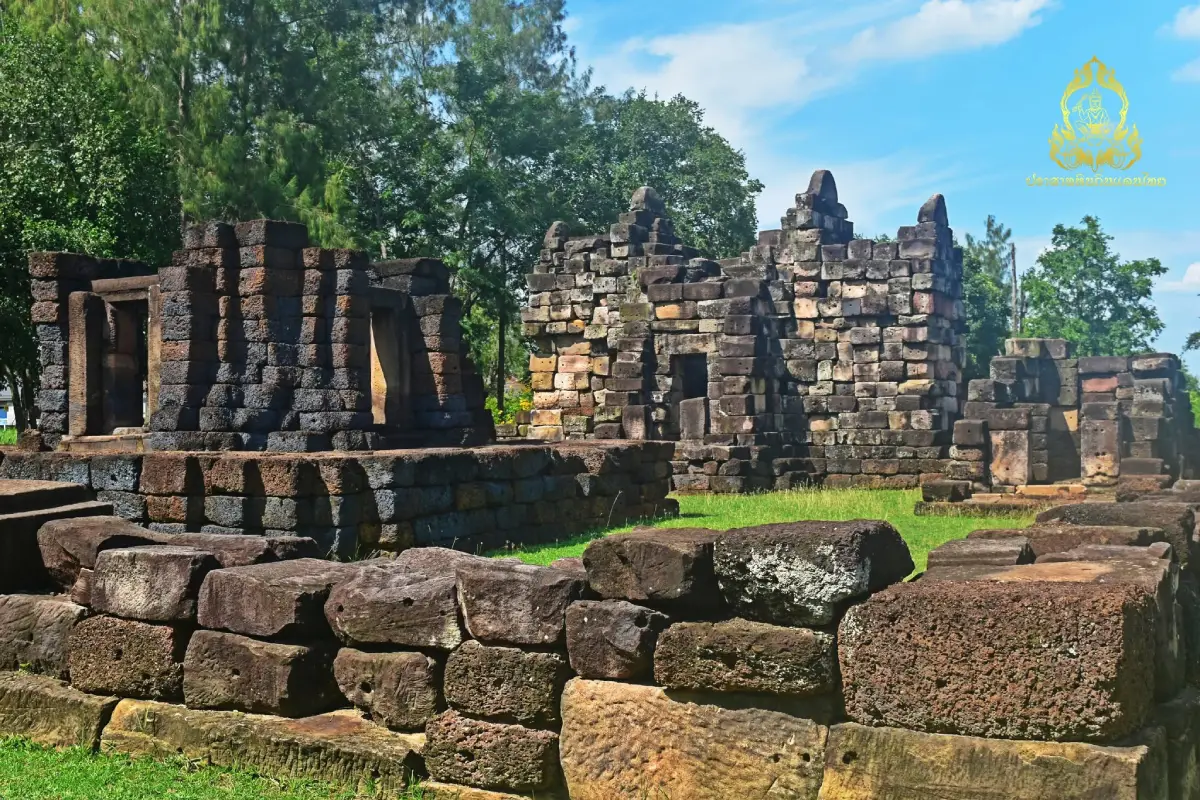
Open Days: Daily
Opening Hours: 07.30 – 17.30 at the main visitor service and ticket point at Prasat Mueang Khaek
The Ancient Town of Tambon Khorat, commonly known as Old Khorat Town, is one of the most important archaeological landscapes in Sung Noen District, Nakhon Ratchasima Province. The area contains three major Khmer-period monuments: Prasat Mueang Khaek, Prasat Non Ku, and Prasat Mueang Kao. Rather than belonging to a single construction phase, the three sites represent different historical periods, architectural traditions, religious beliefs, and administrative functions. Together, they reveal a long sequence of cultural development, beginning with Hindu sanctuaries built around the 9th and 10th centuries and continuing to a Mahayana Buddhist hospital sanctuary established during the reign of King Jayavarman VII in the late 12th or early 13th century.
A visit to Old Khorat Town is therefore far more than a quick stop to photograph ruined brick towers. The archaeological remains allow travelers to examine how sacred buildings were planned, how different materials were used, how ceremonial space was controlled, and how local settlements were connected to wider political and religious networks. Within a relatively compact area, visitors can compare Hindu temple architecture from the early Khmer cultural expansion with the standardized layout of an Arogayasala, or ancient hospital complex, from the later Angkorian period.
The ancient town lies in Tambon Khorat, Sung Noen District, west of central Nakhon Ratchasima along the Mittraphap Road corridor. The surrounding plain, located near waterways and long-established communication routes, offered favorable conditions for agriculture, settlement, and regional movement. Its position helped the community develop into a significant center capable of supporting monumental construction, skilled craftsmen, religious specialists, laborers, and the resources required to maintain important sanctuaries.
Old Khorat Town should not be confused with modern Nakhon Ratchasima city, nor is it identical to the nearby Sema Ancient Town. Sema is a separate moated settlement with a strong Dvaravati cultural foundation and evidence from several historical periods. The monuments of Prasat Mueang Khaek, Prasat Non Ku, and Prasat Mueang Kao, by contrast, provide particularly clear evidence of Khmer religious architecture. Visiting both areas on the same day is highly rewarding, but understanding them as separate archaeological entities gives travelers a more accurate view of Sung Noen's complex past.
The three monuments function as an open-air classroom. Visitors can compare construction materials, building orientation, sanctuary towers, mandapas, libraries, gateways, enclosure walls, moats, embankments, and water features. Prasat Mueang Khaek and Prasat Non Ku date broadly to the same early period and were associated with Hindu worship. Prasat Mueang Kao was constructed several centuries later as part of a Mahayana Buddhist Arogayasala. This chronological difference demonstrates that Old Khorat Town remained important across a long span of time rather than flourishing during only one brief historical episode.
Prasat Mueang Khaek is the largest and most complex monument in the group and serves as the principal visitor site. Located near Ban Kok Kok, the sanctuary was built mainly of brick and sandstone. Its central sanctuary is flanked by two subsidiary towers on the same platform, and the entire sacred complex faces north. This orientation is noteworthy because many Khmer sanctuaries face east. The north-facing plan may have reflected the local landscape, an earlier access route, or the relationship between the temple and other components of the ancient settlement.
A mandapa projects in front of the principal sanctuary, creating a transitional chamber before entry into the most sacred space. The two subsidiary towers have projecting porches, while buildings interpreted as libraries stand on either side and face toward the mandapa. Traces of enclosure walls and gateways define the inner ceremonial area. Beyond them are remains of a moat and earthen embankment, showing that the temple was originally part of a carefully planned sacred precinct rather than an isolated tower standing in an open field.
Although the upper structures have largely collapsed, the remaining platforms, brick walls, sandstone doorframes, columns, and architectural foundations still communicate the scale of the original monument. Visitors should examine the contrast between large sandstone blocks used in load-bearing sections and the brickwork of the walls. The junction between the mandapa and central sanctuary also reveals how different rooms were connected. These surviving details provide valuable evidence of ancient engineering, structural planning, weight distribution, and the controlled movement of worshippers through sacred space.
Archaeological discoveries identify Prasat Mueang Khaek as a Hindu sanctuary, particularly one associated with the worship of Shiva. Excavations uncovered a linga, a yoni pedestal, and a sculpture of Nandi, Shiva's sacred bull. Carved lintels and architectural fragments depict Hindu deities and mythological scenes, including Indra riding the elephant Airavata, divine figures above kala motifs, an avatar of Vishnu, and Durga defeating the buffalo demon Mahishasura. These images were not simply decorative. They communicated religious meaning, protected sacred entrances, and marked the transition from the human world into the divine realm.
The artistic style of Prasat Mueang Khaek is connected with the Koh Ker and Pre Rup traditions of ancient Khmer art. The monument is consequently dated to around the 9th or 10th century, corresponding broadly to the 15th Buddhist century in Thai historical chronology. During this period, Khmer cultural and political influence expanded into the interior of what is now northeastern Thailand. The construction of a large ceremonial complex at Sung Noen indicates that the surrounding community possessed considerable economic resources and occupied an important position within regional networks.
Many significant sculptures and carved architectural elements discovered during excavation have been transferred to museums for protection, research, and public display. Visitors to the archaeological site will primarily encounter the surviving architecture and foundations, while important movable objects can be studied at Phimai National Museum and other relevant collections. Combining a visit to Old Khorat Town with a museum visit provides the most complete understanding of how the preserved sculptures once belonged to the buildings seen in the field.
The Fine Arts Department conducted several archaeological investigations and conservation projects at Prasat Mueang Khaek, including major excavation campaigns in 1959 and 1990. These projects clarified the building plan, exposed buried walls and outer structures, and recovered religious artifacts. The monument was officially registered as a national ancient monument on 27 September 1936, with a protected archaeological boundary established later. It is now administered by the Fine Arts Department through the 10th Regional Office of Fine Arts, Nakhon Ratchasima.
Prasat Non Ku stands only about 500 to 600 meters from Prasat Mueang Khaek, making it easy to visit immediately afterward. The sanctuary occupies a raised area near the Lam Takhong basin. Its local name reflects the landscape: in northeastern Thai usage, non refers to a mound or raised ground, while ku commonly describes the remains of an ancient sanctuary or tower. The atmosphere differs from the larger Mueang Khaek complex. Non Ku is more compact, yet its high platform and heavy sandstone construction give the monument a strong visual presence.
Prasat Non Ku was a Hindu sanctuary built during the late 15th to early 16th Buddhist century, broadly corresponding to the late 9th or early 10th century. Its principal sanctuary stood alone on a high platform and was constructed with sandstone and brick. The building faces east and includes a projecting entrance porch. Two smaller structures stand in front of the main sanctuary, one on each side, facing inward. These buildings are interpreted as halls or libraries used in association with religious ceremonies.
The inner complex was once surrounded by enclosure walls and entered through gopuras, or monumental gateways. This arrangement created a sequence of movement from ordinary exterior space into a protected sacred area. Although much of the superstructure has collapsed, the elevated base, stairways, sandstone doorframes, and foundations of the auxiliary buildings still allow visitors to reconstruct the original ceremonial approach in their imagination.
Excavations at Prasat Non Ku uncovered sculptures of deities, guardian figures, a reclining Nandi bull, miniature architectural forms, and other ritual objects. These discoveries support the interpretation of the sanctuary as a Hindu religious site with strong connections to Shaivism. The sculptures display characteristics of the Koh Ker artistic tradition. Important movable artifacts are preserved in Phimai National Museum and Maha Viravong National Museum, where they can be studied under controlled conditions.
The close proximity and similar age of Prasat Non Ku and Prasat Mueang Khaek make them particularly valuable for comparative study. Mueang Khaek is larger and architecturally more elaborate, while Non Ku is centered on a single elevated sanctuary. The difference may reflect varying functions, levels of patronage, ritual communities, or administrative status within the same ancient settlement. The presence of more than one sanctuary also indicates a substantial population and active religious life during the early Khmer cultural period.
Prasat Non Ku was registered as a national ancient monument on 27 September 1936, and its protected boundary was formally defined later. Conservation work focuses on stabilizing the platform, sandstone components, surviving brickwork, and archaeological plan. Visitors must remain on designated paths, avoid climbing the platform or loose masonry, and never move bricks or stones. Even an apparently ordinary fragment may retain archaeological significance because of its original location and relationship to nearby structures.
Prasat Mueang Kao lies approximately 3 kilometers from Prasat Mueang Khaek, within the grounds associated with Wat Prang Mueang Kao. It belongs to a clearly later historical phase than the first two sanctuaries. The monument was constructed mainly of laterite and sandstone and consists of one principal sanctuary, a library, an enclosure wall, an eastern gateway, and a reservoir outside the enclosure. This arrangement follows the standardized plan of a religious building attached to an Arogayasala, an ancient hospital established during the reign of King Jayavarman VII.
The Sanskrit-derived term Arogayasala refers to a place associated with freedom from illness or medical care. During the reign of King Jayavarman VII, a network of 102 hospitals was founded across important towns and communication routes. Each institution included a religious sanctuary that served as a spiritual center for healing practices. Prasat Mueang Kao formed part of this network and therefore represents an administrative system concerned not only with political power and religion, but also with public welfare, resource distribution, and the care of communities throughout the kingdom.
The principal sanctuary has an indented square plan and faces east, the normal orientation for Arogayasala chapels. The library stands inside the enclosure beside the main shrine, while the reservoir lies outside the surrounding wall. The sanctuary would have been associated with Mahayana Buddhist healing beliefs, particularly devotion to Bhaisajyaguru, the Medicine Buddha. The architectural plan, ritual images, water feature, and enclosed sacred area worked together as part of an institution where physical treatment and religious practice were closely connected.
The laterite used at Prasat Mueang Kao differs visibly from the brick and sandstone construction of Mueang Khaek and Non Ku. Laterite can be cut while relatively soft and becomes harder after prolonged exposure to air. It was therefore suitable for walls, platforms, and strong structural masses. Comparing the color, surface, and block size of laterite with sandstone and brick provides a direct lesson in changing construction technology and material procurement between different historical periods.
King Jayavarman VII ruled from the late 12th into the early 13th century and was a prominent supporter of Mahayana Buddhism. His reign is associated with the construction of temples, roads, bridges, rest houses, and hospitals across the empire. The presence of Prasat Mueang Kao at Sung Noen indicates that Old Khorat Town continued to occupy an important place in regional communication and administration several centuries after the construction of Prasat Mueang Khaek and Prasat Non Ku.
Viewed together, the three monuments present a clear historical sequence. Prasat Mueang Khaek and Prasat Non Ku document the establishment of Hindu worship and early Khmer artistic traditions, while Prasat Mueang Kao illustrates the later integration of the area into a Mahayana Buddhist hospital network. Khmer influence did not arrive in Nakhon Ratchasima as a single event. It developed through repeated phases of construction, political reorganization, religious change, and renewed connections with wider regional systems.
The archaeological landscape also demonstrates the relationship between religion and settlement management. Large sanctuaries required labor, skilled craftsmen, ritual specialists, caretakers, agricultural production, and regular supplies from surrounding communities. Moats, embankments, access routes, gateways, and auxiliary buildings show deliberate planning beyond the construction of a ceremonial tower. A temple could function simultaneously as a place of worship, a marker of authority, a meeting point, and a center through which communities understood their connection to political power.
Building orientation is another detail worth examining. Prasat Mueang Khaek faces north, while Prasat Non Ku and Prasat Mueang Kao face east. Orientation influenced access, light, sightlines, ceremonial movement, and religious meaning. Standing at an entrance and looking along the central axis toward the principal sanctuary helps visitors understand how ancient architects controlled perspective and gradually directed worshippers toward the most sacred part of the complex.
Travelers interested in craftsmanship should inspect doorframes, attached columns, molded bases, brick courses, tool marks, and the joints between architectural components. Ancient Khmer builders did not rely on modern mortar and reinforced concrete. Sandstone blocks had to be cut precisely to bear weight and fit together, while brick walls were constructed with extremely narrow joints. These small technical details are often difficult to appreciate in wide photographs but become clear during close observation at the site.
The ruined condition of the monuments results from centuries of weathering, water erosion, temperature changes, soil movement, vegetation, and human activity. Archaeological conservation does not aim to rebuild every missing tower as if it were new. Excessive reconstruction without sufficient evidence could create a misleading historical image. Appropriate conservation stabilizes surviving structures, protects original materials, displays archaeological plans, and distinguishes modern interventions from ancient fabric.
The recommended route begins at Prasat Mueang Khaek, where the main visitor service and ticket point are located. After examining the central sanctuary, mandapa, subsidiary towers, libraries, enclosure, and surrounding earthworks, continue to nearby Prasat Non Ku to compare its smaller scale and elevated single-sanctuary plan. Finish at Prasat Mueang Kao, where the later Arogayasala layout provides a striking contrast. This sequence follows the historical development of the monuments and minimizes unnecessary backtracking.
The official admission fee collected at Prasat Mueang Khaek is 10 baht for Thai visitors and 80 baht for foreign visitors. The main service point is open daily from 07.30 to 17.30. Prasat Non Ku and Prasat Mueang Kao are outdoor archaeological monuments on the same heritage route, with no separately published ticket charge. Travelers should complete the full route during daylight and before the main visitor service closes.
The most comfortable visiting periods are early morning, between opening time and approximately 10.00, or late afternoon after about 15.30. Lower-angle sunlight reveals the texture of brick, sandstone, and laterite and generally produces better photographs. After the rainy season, green grass creates a vivid contrast with red brickwork. During the hot season, visitors should carry drinking water, a hat, an umbrella, and sun protection because much of the archaeological area is exposed and offers limited shade.
Comfortable footwear with good grip is recommended because surfaces include soil, grass, gravel, steps, and uneven ground. Visitors must not climb sanctuary platforms, sit on ancient masonry, cross protected brick alignments, or place photographic equipment on archaeological remains. Drone use requires permission. Maintaining a safe distance protects both the monuments and visitors, particularly where stone surfaces may be unstable or slippery.
Families traveling with children can turn the visit into an educational activity by comparing brick, sandstone, and laterite or by identifying entrances, platforms, libraries, gateways, and water features. Children can also look for differences in the scale and orientation of the three monuments. Close supervision is essential, as running across foundations or touching fragile architectural fragments can cause accidents and damage.
Older travelers and visitors with limited mobility can view much of the archaeological landscape from relatively level areas around the monuments. However, some sections have high steps, raised platforms, and uneven surfaces, so assistance may be required. A private vehicle is the most practical means of connecting all three sites because Prasat Mueang Kao is several kilometers from the first two monuments and local public transport is limited.
Sung Noen also hosts the cultural event known as Kin Khao Kham Khong Di Mueang Sung Noen, which uses the atmosphere of Prasat Mueang Khaek to present local food, traditional dress, performances, and community identity. Event dates vary each year. Travelers visiting during the festival can experience the monument as a living cultural setting rather than only as an archaeological reserve.
The local expression kin khao kham means eating the evening meal. The event emphasizes communal dining, hospitality, and the shared cultural roots of Sung Noen. Holding the celebration near the ancient sanctuary encourages local participation in heritage preservation and introduces younger generations to the history of their community. During the event, access routes and parking arrangements may be adjusted, so visitors should follow directions from local officers.
Old Khorat Town combines naturally with Sema Ancient Town and Wat Dhammachak Semaram. Sema preserves a large moated settlement with evidence of long-term occupation, while Wat Dhammachak Semaram is famous for its monumental Dvaravati sandstone reclining Buddha. Visiting these places together reveals how Sung Noen became a meeting point of Dvaravati traditions, early Khmer Hindu culture, Mahayana Buddhism, and later Thai communities.
Travelers with additional time can visit the historic Black Bridge of Sung Noen, associated with the development of railway transport, or continue to the Korat Iron Art Museum for a shift from ancient history to contemporary creative work. A full-day itinerary can begin with the three sanctuaries in the morning, include lunch in Sung Noen town, and continue to Sema Ancient Town and Wat Dhammachak Semaram in the afternoon.
For photography at Prasat Mueang Khaek, begin on the main approach axis to frame the gateway, mandapa, and principal sanctuary in a layered composition. Side angles reveal the shared platform and subsidiary towers more clearly. At Prasat Non Ku, a lower viewpoint emphasizes the height and mass of the platform. At Prasat Mueang Kao, include the contrast between the dark laterite blocks and green surroundings. Close-up photographs of doorframes, masonry joints, and weathered surfaces preserve details that wide views cannot show.
Visitors must avoid holding, pushing, leaning against, or climbing sandstone doorframes and columns. Some components have been stabilized to preserve their archaeological position and were not designed to support additional weight. Respectful behavior protects national heritage and allows other travelers to explore the area safely.
The name Khorat is deeply connected with the settlement history of Nakhon Ratchasima, and Old Khorat Town at Sung Noen is often described as an important early center of Khmer cultural evidence in the province. Its value does not depend on claiming that it was the only point of origin. Its true importance lies in the density of archaeological remains and the continuity of activity across several historical periods within the original landscape.
The nearby Lam Takhong basin was essential to community life. Water supported households, agriculture, travel, and ritual practice. River corridors also helped connect settlements. Moats and reservoirs around sanctuaries should therefore be understood as more than drainage facilities. They defined sacred boundaries, supported practical needs, and formed part of the religious landscape surrounding the monuments.
During the rainy season, grass and stone surfaces may become slippery, and visitors should stay outside areas closed by conservation officers. Heavy rain can make open sections uncomfortable until conditions improve. The cool season offers pleasant temperatures for visiting several sites in one day, although morning mist and moisture may still affect the ground. Suitable footwear remains important throughout the year.
Old Khorat Town is especially valuable for travelers wishing to explore Khmer history beyond the monumental scale of Phimai Historical Park. These smaller and medium-sized sanctuaries demonstrate that ancient political and religious systems were not based only on a few major centers. They depended upon interconnected towns, local communities, temples, roads, and public institutions distributed throughout the region.
Students and archaeology enthusiasts may benefit from studying basic plans before arrival and recording orientation, materials, approximate dimensions, and relationships between buildings at each site. Comparing field observations with museum collections develops a stronger understanding of archaeological interpretation. Visiting the monuments also reveals the limitations of preservation and the continuing transformation of the surrounding landscape, aspects that books and photographs alone cannot fully communicate.
No bricks, pottery fragments, stones, or other objects should ever be removed from the archaeological grounds. If an unusual object is discovered, it should be reported without being moved. The precise context in which an artifact is found is essential for dating and interpretation. Removing even a small fragment destroys scientific information and may violate Thai laws protecting ancient monuments and antiquities.
Getting There from central Nakhon Ratchasima, follow Highway 2, or Mittraphap Road, toward Saraburi. Near kilometer markers 221–222, turn onto Highway 2161 toward Sung Noen District. Continue for approximately 3 kilometers and look for the right-hand junction near Wat Yanasophit Wanaram, also known locally as Wat Pa Sung Noen. Use Prasat Mueang Khaek as the first navigation destination because it is the main visitor point and provides the most convenient starting position for the complete route.
Travelers driving from Bangkok should follow Phahonyothin Road to Saraburi and then take Mittraphap Road through Muak Lek, Pak Chong, Sikhio, and Sung Noen. Journey time varies according to traffic, especially on the mountain section between Muak Lek and Pak Chong and on portions of Mittraphap Road used by heavy trucks. After leaving the main highway, reduce speed through local communities and watch carefully for smaller junctions and local vehicles.
Rail travelers can disembark at Sung Noen Railway Station and hire local transport to Prasat Mueang Khaek, Prasat Non Ku, and Prasat Mueang Kao. The monuments are not immediately beside the station, and no regular local service continuously connects all three. Arrange a vehicle for the complete route and agree on a return pickup time. Bus passengers traveling along Mittraphap Road can similarly get off near Sung Noen and continue by local hired transport.
Allow at least 2 to 3 hours to explore the three monuments. Travelers who intend to read interpretive information, photograph architectural details, and examine the full plans should reserve half a day. Adding Sema Ancient Town and Wat Dhammachak Semaram requires most of a full day. Restaurants and accommodations are concentrated in Sung Noen town and along Mittraphap Road, so it is sensible to arrange fuel, meals, and essential supplies before entering smaller local roads.
The monuments are administered by the Fine Arts Department through the 10th Regional Office of Fine Arts, Nakhon Ratchasima. The office is responsible for conservation, archaeological study, site management, and visitor services at Prasat Mueang Khaek. Contact numbers are 044-471518 and 044-481024. Groups requiring special arrangements or information about temporary conservation work should contact the responsible office directly.
Old Khorat Town brings history, religion, architecture, and community life together within one cultural landscape. Prasat Mueang Khaek represents the scale and complexity of an early Hindu sanctuary. Prasat Non Ku preserves a more compact contemporary plan centered on a high platform. Prasat Mueang Kao records the later transition to the Mahayana Buddhist Arogayasala network of King Jayavarman VII. Following the route through all three monuments reveals that the history of Nakhon Ratchasima was shaped not by a single city or period, but by centuries of changing communities, beliefs, routes, and political connections.
| Name | Ancient Town of Tambon Khorat, or Old Khorat Town |
| Location | Tambon Khorat, Sung Noen District, Nakhon Ratchasima Province, Thailand |
| Main Site Address | Prasat Mueang Khaek, Ban Kok Kok, Tambon Khorat, Sung Noen District, Nakhon Ratchasima 30170 |
| Reference Coordinates | Prasat Mueang Khaek Plus Code: WR7M+FCQ Prasat Non Ku: 14.908094, 101.833723 |
| Highlights | Three Khmer-period monuments from different eras, demonstrating the development from Hindu sanctuaries to a Mahayana Buddhist Arogayasala |
| History and Period | Prasat Mueang Khaek and Prasat Non Ku were constructed around the 9th–10th centuries as Hindu sanctuaries influenced by the Koh Ker and Pre Rup styles. Prasat Mueang Kao was constructed around the late 12th or early 13th century as an Arogayasala sanctuary during the reign of King Jayavarman VII. |
| Distinctive Features | Visitors can compare architectural plans, materials, orientations, religious concepts, and construction technologies from different historical periods within one route. |
| Important Artifacts | Carved lintels, linga and yoni components, Nandi sculptures, guardian figures, deity fragments, and sandstone architectural elements. Important movable objects are preserved at Phimai National Museum and Maha Viravong National Museum. |
| Travel Information | From Nakhon Ratchasima, follow Highway 2 toward Saraburi. Near kilometer markers 221–222, turn onto Highway 2161 toward Sung Noen, continue about 3 km, and turn right near Wat Yanasophit Wanaram. Use Prasat Mueang Khaek as the first navigation point. |
| Current Status | Open to visitors and protected by the Fine Arts Department through the 10th Regional Office of Fine Arts, Nakhon Ratchasima |
| Open Days | Daily |
| Opening Hours | 07.30 – 17.30 at the Prasat Mueang Khaek visitor service and ticket point |
| Admission Fees | Prasat Mueang Khaek ticket point: Thai visitors 10 baht; foreign visitors 80 baht |
| Main Areas / Zones | 1. Prasat Mueang Khaek – a large Hindu complex with a principal sanctuary, subsidiary towers, mandapa, libraries, enclosure, moat, and embankment 2. Prasat Non Ku – a Hindu sanctuary on a high platform with auxiliary buildings, an enclosure, and gateways 3. Prasat Mueang Kao – an Arogayasala chapel with a principal sanctuary, library, enclosure, gateway, and external reservoir |
| Facilities | Visitor service and ticket point at Prasat Mueang Khaek, outdoor archaeological grounds, and road connections between the three monuments |
| Caretaker | Fine Arts Department, through the 10th Regional Office of Fine Arts, Nakhon Ratchasima |
| Main Contact Numbers | 044-471518, 044-481024 |
| Official Authority | 10th Regional Office of Fine Arts, Nakhon Ratchasima, Fine Arts Department, Ministry of Culture |
| Nearby Tourist Attractions | 1. Sung Noen Black Bridge, approximately 3 km 2. Sema Ancient Town, approximately 4 km 3. Wat Dhammachak Semaram, approximately 4 km 4. Wang Nern Waterfall, approximately 5 km 5. Korat Iron Art Museum, approximately 9 km |
| Nearby Restaurants | 1. Combo5, approximately 8 km, Tel. 094-287-9876 2. Jae Tu Lab Ped, approximately 8 km, Tel. 089-719-1690 3. LanLao, approximately 8 km, Tel. 080-004-0925 4. Chan Mit Han Paloe, approximately 9 km, Tel. 044-419-595 5. Ran Lab Ban Lao, approximately 10 km, Tel. 044-286-892 |
| Nearby Accommodations | 1. Rombaramee Villa and Resort, approximately 2 km, Tel. 081-822-7104 2. High Hill Fresh Resort, approximately 4 km, Tel. 081-777-1712 3. Phloi Namkhang Resort, approximately 5 km, Tel. 086-500-8099 4. The Lofts Eco Resort, approximately 7 km, Tel. 081-987-1518 5. Sema Nakhon Hotel, approximately 8 km, Tel. 086-262-7985 |
Frequently Asked Questions (FAQ)
Q: How many major monuments are located in Old Khorat Town?
A: The archaeological area contains three principal monuments: Prasat Mueang Khaek, Prasat Non Ku, and Prasat Mueang Kao. They belong to different periods and served different religious functions.
Q: Are Old Khorat Town and Sema Ancient Town the same place?
A: No. Old Khorat Town refers to the area containing the three Khmer-period monuments, while Sema is a separate moated ancient settlement with a strong Dvaravati cultural foundation.
Q: How much is the admission fee?
A: The ticket point at Prasat Mueang Khaek charges 10 baht for Thai visitors and 80 baht for foreign visitors.
Q: What are the opening hours?
A: The main visitor service at Prasat Mueang Khaek is open daily from 07.30 to 17.30. The complete three-site route should be visited during daylight.
Q: Which monument should travelers visit first?
A: Begin at Prasat Mueang Khaek, the main visitor and ticket point, continue to nearby Prasat Non Ku, and finish at Prasat Mueang Kao.
Q: Why is Prasat Mueang Kao historically important?
A: It was the religious sanctuary of an Arogayasala, or ancient hospital, belonging to the network of 102 medical institutions established during the reign of King Jayavarman VII.
Q: How long should visitors allow for all three monuments?
A: Allow at least 2 to 3 hours. A full day is recommended when combining the route with Sema Ancient Town and Wat Dhammachak Semaram.
Q: Can travelers reach the area by train?
A: Yes. Disembark at Sung Noen Railway Station and hire local transport for the three monuments. Arrange the complete route and return pickup in advance.
 Category: ●Art, Culture and Heritage
 Group: ●Historical Sites and Monuments
Last Update : 3 MonthAgo
 Last Update : 3 MonthAgo
 Click to Access the Navigation Map GPS
Ancient Town at Korat Sub-District Map
Recommend
 Historical Sites and Monuments(20)
 Landmarks and Memorials(5)
 Art, Craft Centres, Tradition(7)
 Museums(6)
 Art Gallery(1)
 Educational Places
 Educational Gardens, Farm(4)
 Places of Worship
 Temple(29)
 Mosque(1)
 Other Sacred Sites(6)
 Research and Development
 Royal Project(3)
 Suburban Living
 Village, Community(6)
 Local Market(4)
 Floating Market(1)
 Nature and Wildlife
 National Parks and Marine Reserves(3)
 Mountain (Doi)(5)
 Dam, Reservoir, Lake(8)
 Waterfalls(9)
 Hot Springs(1)
 Caves(2)
 Flower Field(1)
 River, Canal(8)
 Bays and Beaches(2)
 Other natural attractions(3)
 Entertainment and Agricultural
 Zoos and Aquariums(2)
 Animal camps and shows(1)
 Farms, Parks and Ecotourism(21)
 Waterpark(4)
 Outdoor and Adventure Activities(6)
 Shopping
 Shopping and Night Market(2)
 Travel Articles, Recipes
 Travel Review, Food Review(6)


