
lovethailand home >Northeastern Travel Attractions >Nakhon Ratchasima Travel Attractions >Muang Nakhon Ratchasima >Pru Yai > Wat Pa Salawan
TL;DR: Wat Pa Salawan is located at Behind Nakhon Ratchasima Railway Station, Suebsiri Road, Nai Mueang Subdistrict, Mueang Nakhon Ratchasima District, Nakhon Ratchasima, open Daily, hours 07.00 – 19.00.
Wat Pa Salawan
Open Days: Daily
Opening Hours: 07.00 – 19.00
Wat Pa Salawan in Nakhon Ratchasima is one of Korat’s most important forest meditation temples. Located in Nai Mueang Subdistrict, behind Nakhon Ratchasima Railway Station and near Suebsiri Road, the temple is a peaceful spiritual site within the city. It is especially meaningful for visitors who want to pay respect to the Buddha relics and the relics of revered Thai forest meditation masters, including Luang Pu Sao Kantasilo, Luang Pu Mun Bhuridatto, Luang Pu Singh Khantayagamo, Phra Ajarn Phon Sumano, Luang Pho Phut Thaniyo, and Phra Ajarn Tim, an early abbot who helped develop the temple. Wat Pa Salawan is not merely a city temple; it is a living center of faith, meditation, and Thai forest monk heritage.
The temple is best known for its unusually calm atmosphere. Although it stands within the urban area of Nakhon Ratchasima, close to the railway station, residential neighborhoods, and major roads, the mood inside the temple is quiet and contemplative. Visitors can feel a clear shift after entering the temple grounds. The sound and pace of the city begin to fade, replaced by shade, stillness, and a disciplined simplicity associated with Thai forest meditation practice. This contrast is one of the reasons Wat Pa Salawan is so valuable: it preserves the spirit of a forest monastery while remaining accessible to people in the city.
Wat Pa Salawan belongs to the Dhammayut tradition and is strongly connected with the Thai forest meditation lineage. The name “Salawan” reflects the original landscape of the temple area. The word “sala” is associated here with teng-rang or dipterocarp trees, while “wana” means forest. The name therefore preserves the memory of a forested area with many teng-rang trees. Even though the city has expanded around the temple, the name continues to remind visitors that Wat Pa Salawan began as a quiet natural place suitable for seclusion, meditation, and inner training.
The temple’s origin is closely associated with Phra Yan Wisit Samitthi Wirachan, better known as Luang Pu Singh Khantayagamo, an important disciple of Phra Ajarn Mun Bhuridatto. The site began as a monastic residence around 1931-1932 and gradually developed into a well-known meditation temple. Luang Pu Singh played an important role in spreading forest meditation practice in northeastern Thailand. His teaching emphasized morality, concentration, wisdom, and practical meditation. Through this foundation, Wat Pa Salawan became an important base for the Dhamma movement in Nakhon Ratchasima.
In the past, the temple area was quiet, remote, and forested. Local accounts describe old cart paths, former cremation areas, fields, and a pond known locally as Nong Kae Chang. These details reveal the landscape of Korat before modern urban expansion. Wat Pa Salawan did not emerge as a tourist site or commercial attraction. It grew from a place chosen for its suitability for meditation and monastic discipline. Understanding this background helps visitors appreciate why the temple still feels different from many other urban temples.
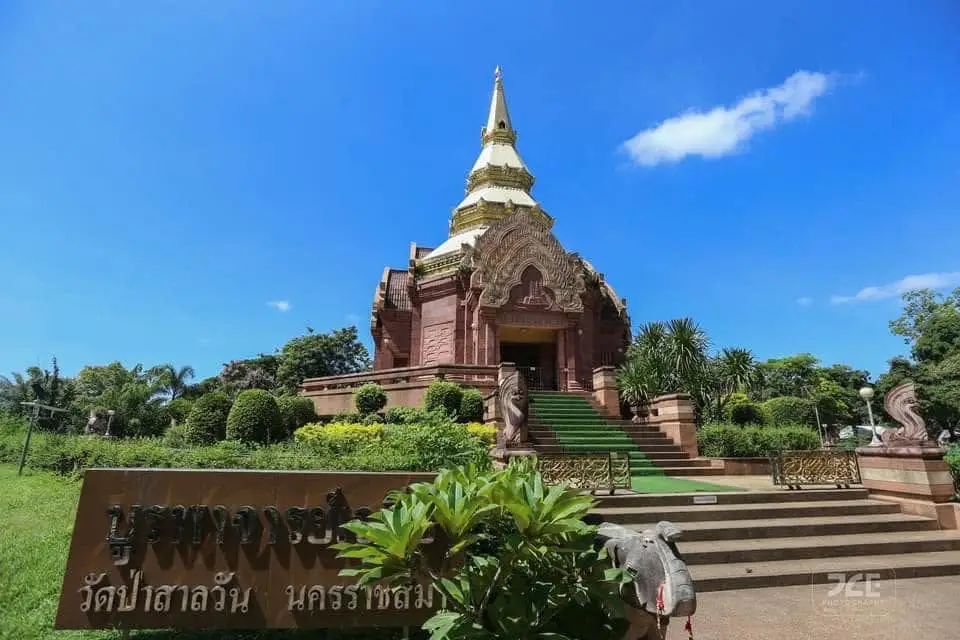
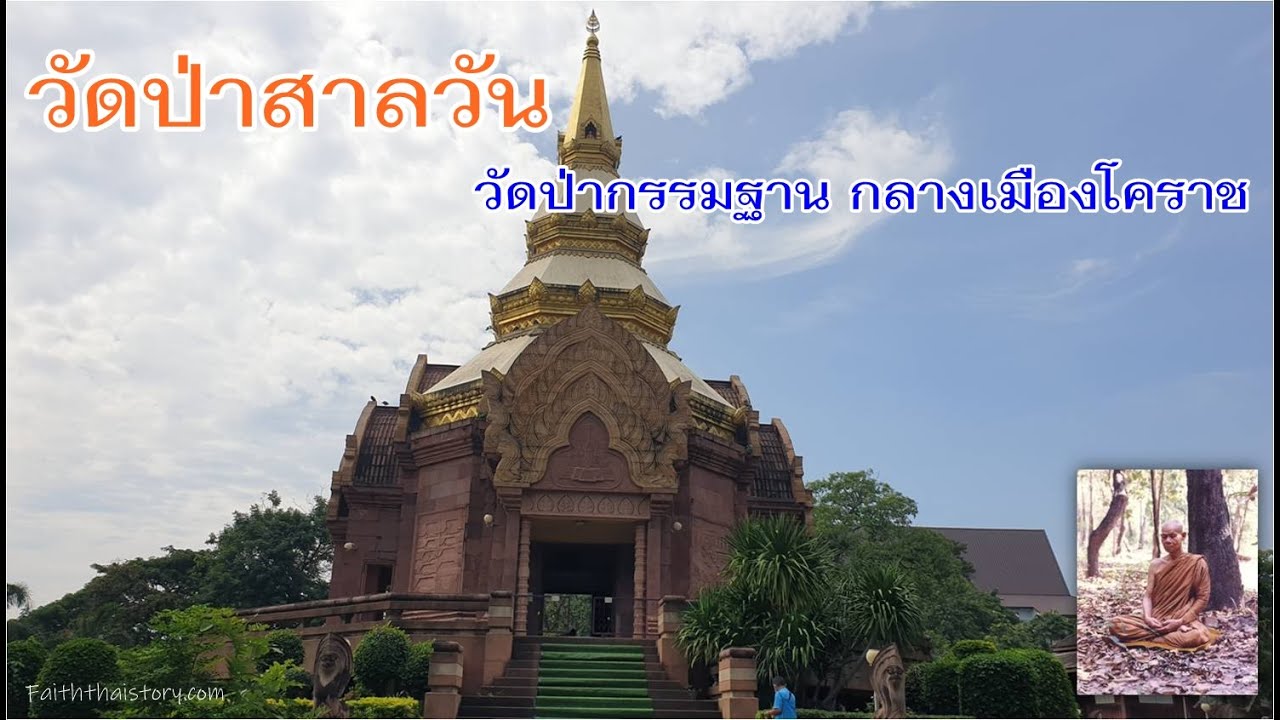
The most important structure inside Wat Pa Salawan is Buraphachan Chedi, a memorial stupa that enshrines Buddha relics and the relics of revered forest meditation masters. This is the spiritual heart of the temple. Devotees visit the stupa to pay respect, remember the discipline of the great teachers, and reflect on the path of Dhamma practice. The word “Buraphachan” refers to the great teachers of earlier generations, those who preserved and transmitted the path of practice. A visit to this stupa is therefore not only an architectural experience; it is a moment of remembrance and gratitude.
Buraphachan Chedi honors several major figures in the Thai forest tradition. These include Luang Pu Sao Kantasilo, Phra Ajarn Mun Bhuridatto, Luang Pu Singh Khantayagamo, Phra Ajarn Phon Sumano, and Luang Pho Phut Thaniyo. Each of these teachers contributed to the revival and continuity of serious meditation practice in Thailand. Their lives emphasized simplicity, discipline, mindfulness, and direct inner training. Foreign visitors unfamiliar with Thai Buddhism should understand that these teachers are respected not because of status or decoration, but because of their practice, restraint, and spiritual example.
Luang Pu Sao Kantasilo is remembered as one of the great early teachers of the forest meditation lineage. He influenced Phra Ajarn Mun and the generations that followed. His life represented restraint, simplicity, and steady meditation practice. Phra Ajarn Mun Bhuridatto later became the central figure of the modern Thai forest tradition. His teaching emphasized seeing the body and mind clearly, developing mindfulness, and training the heart through direct practice. The presence of their relics and memory at Wat Pa Salawan makes the temple especially meaningful for those interested in Thai meditation history.
Luang Pu Singh Khantayagamo is directly connected with the establishment of Wat Pa Salawan. As a key disciple of Phra Ajarn Mun, he helped spread the forest tradition across the northeast. His role in founding the temple shaped its identity as a practice-oriented monastery rather than a decorative temple. The spirit of Wat Pa Salawan is therefore rooted in discipline, humility, and meditation. This makes it very different from temples built mainly as tourist landmarks.
Luang Pho Phut Thaniyo, also known by his ecclesiastical title Phra Ratchasangwon Yan, made Wat Pa Salawan widely known throughout Thailand. He became abbot around 1970 and developed the temple as a center for meditation based on the Four Foundations of Mindfulness. Many laypeople came from different parts of the country to practice with him. His teachings were direct, practical, and accessible. He encouraged people to develop mindfulness in daily life, not only during formal meditation sessions. Because of him, Wat Pa Salawan became a bridge between the forest meditation tradition and modern urban practitioners.
Luang Pho Phut’s teaching style is one of the reasons Wat Pa Salawan continues to be respected. He showed that meditation is not limited to monks or to remote forests. Mindfulness can be practiced while walking, sitting, working, thinking, or facing emotions in ordinary life. This message remains relevant for visitors today. When travelers walk quietly through the temple, they are not only seeing a sacred site; they are entering a place shaped by teachings about awareness, simplicity, and mental clarity.
Phra Ajarn Tim, an early abbot and developer of the temple, also deserves attention. He contributed to the practical building and continuity of Wat Pa Salawan. Temples like this do not survive only because of famous names. They endure because generations of monks, teachers, and lay supporters maintain the land, buildings, discipline, and practice. Wat Pa Salawan is therefore a collective legacy built by many devoted people over time.
The temple grounds include several important areas: Buraphachan Chedi, the ordination hall, a viharn, a sermon hall, monks’ residences, the monastic office, meditation buildings, a kitchen, and quiet areas for contemplation. The temple covers more than 43 rai, giving it enough space to maintain a calmer atmosphere despite its urban setting. These zones show that the temple functions as a place of worship, monastic residence, meditation training, and lay practice.
Unlike temples designed mainly for visual spectacle, Wat Pa Salawan is quiet and restrained. Visitors should come with an appropriate attitude. The best reasons to visit are to pay respect, reflect on the forest teachers, make merit, learn about meditation, or simply sit quietly. Photography is acceptable in suitable areas, but it should be done respectfully. Avoid disturbing monks, meditators, or people who come for worship. Do not enter monastic areas without permission. The beauty of Wat Pa Salawan lies in stillness, not display.
For those interested in meditation, Wat Pa Salawan is one of the most meaningful temples in Korat. It is directly connected with the lineage of Luang Pu Sao and Phra Ajarn Mun. Visitors who wish to practice should prepare simply, dress modestly, observe silence, and follow temple rules. A forest meditation temple is not a place for hurried sightseeing. It is a place to slow down, watch the mind, and respect the discipline of those who live and practice there.
Wat Pa Salawan is also very convenient for cultural travelers. It is located behind Nakhon Ratchasima Railway Station, making it easier to reach than many forest temples. Travelers arriving by train can continue by taxi, local transport, or ride-hailing service. Those starting from Thao Suranari Monument can follow Mukmontri Road west for about 3 kilometers, turn near Wat Amphawan, cross the railway line, continue past the local education center, and turn toward the temple area. The temple stands on the right-hand side.
Getting There by private car is the most convenient option, especially for travelers planning to combine the temple with other attractions in Korat city. The route can be slightly confusing because of local lanes and railway crossings, so using a navigation app is recommended. Search for “Wat Pa Salawan Luang Pho Phut” or “วัดป่าสาลวัน หลวงพ่อพุธ” to avoid confusion with similarly named places. Local taxis and ride-hailing services are suitable for foreign visitors because the destination can be shown directly on a map.
Public transport is also possible. Local buses or shared vehicles from the city can take travelers near the area, and motorcycle taxis can continue into the temple. Older travel information also mentions the Nakhon Ratchasima-Dan Khun Thot route from the first bus terminal, with onward local transport to the temple. For first-time visitors, however, taxi or ride-hailing service remains the easiest and most reliable choice.
Visitors should allow enough time for a meaningful visit. A short visit may take 45 minutes to 1 hour if the purpose is to pay respect at Buraphachan Chedi and walk briefly around the grounds. Those who want to study the history of the teachers, observe the stupa, take respectful photographs, and sit quietly should allow around 2 hours. Morning is especially suitable because the weather is cooler and the atmosphere is more peaceful. Late afternoon is also pleasant for walking and reflection.
Inside Buraphachan Chedi, visitors should be especially respectful. This is a sacred area containing relics of the Buddha and revered teachers. Keep your voice low, move slowly, avoid unnecessary touching of sacred objects, and remember that the space is not a museum in the ordinary sense. It is a place of devotion and remembrance. The proper attitude is quiet gratitude toward the teachers whose practice shaped the temple.
The architecture of Buraphachan Chedi is dignified and meaningful. The stupa is both a reliquary and a memorial to Luang Pho Phut Thaniyo and the earlier masters. Its design creates a place for worship, reflection, and continuity of memory. Visitors may walk around the outside to observe the form and details before entering the inner area for worship. The stillness of the structure supports the temple’s identity as a meditation site rather than a decorative attraction.
In the broader history of Thai Buddhism, Wat Pa Salawan helps explain how the forest tradition entered an urban context. Many people imagine forest monasteries as remote mountain or jungle sites. Wat Pa Salawan shows that a forest temple can exist within a city if it preserves monastic discipline, simplicity, and mindfulness practice. This makes it a valuable example of how Thai Buddhism adapts to changing landscapes without losing its core purpose.
Devotees often visit Wat Pa Salawan to pay respect to the Buddha relics and the relics of forest masters because such acts help cultivate faith, mindfulness, and moral reflection. This should not be understood merely as a search for miracles. In Thai Buddhist culture, paying respect to the relics of noble practitioners is a way of honoring virtue, discipline, and the path of practice. The act reminds visitors that spiritual life is built through effort, humility, and awareness.
For foreign travelers, Wat Pa Salawan offers a rare opportunity to understand Thai Buddhism beyond temple architecture. It introduces the forest monk tradition, meditation practice, mindfulness, and the importance of teacher lineages. A traveler who has only visited grand royal temples may find Wat Pa Salawan more restrained, but its depth is considerable. The temple is best appreciated through quiet observation rather than hurried sightseeing.
Dress code matters. Visitors should wear modest clothing, with shoulders covered and trousers or skirts of appropriate length. Phones should be kept silent. Avoid eating in sacred areas, making loud noise, or taking intrusive photographs. If you see monks or laypeople practicing meditation, give them space. Respect for silence is one of the most important forms of etiquette in a forest meditation temple.
Wat Pa Salawan is also suitable for families who want to teach children about Thai culture and Buddhism. Parents can explain why the forest teachers are respected, what relics mean, and why meditation temples value silence and simplicity. A visit here can become more than a temple stop. It can become a lesson in mindfulness, gratitude, and respectful travel.
The temple can easily be included in a city route. Visitors may begin at Wat Pa Salawan in the morning, then continue to The Mall Korat, Art of Illusion 3D Museum, Thao Suranari Monument, Chumphon Gate, or Maha Weerawong National Museum. Those focused on temples may combine it with Wat Sala Loi, Wat Sala Thong, and Wat Phra Narai Maharat. Because these places are within the city area, the route is practical for a half-day or full-day Korat cultural trip.
Food options near the temple include local Isan restaurants, noodle shops, grilled chicken restaurants, roast duck shops, and Vietnamese-style food. Many are located around Suebsiri Road and the curve near the temple. Visitors should call ahead before going, especially on holidays or if traveling as a group. The temple’s location makes it easy to combine worship with lunch or dinner nearby.
Nearby accommodations range from city hotels near the railway station to business hotels and properties closer to The Mall Korat. Travelers who want to visit the temple early in the morning should stay in central Nakhon Ratchasima or near the railway station. This reduces travel time and makes it easier to continue to other city attractions.
There is no admission fee at Wat Pa Salawan. Visitors may enter during opening hours to pay respect and walk through the temple grounds. Voluntary donations may be made at designated points. This distinction is important: Wat Pa Salawan remains a religious and meditation site, not a commercial attraction. A donation is an act of merit-making and support according to personal faith.
The main zones inside the temple include Buraphachan Chedi, the Buddha relic and teacher relic worship area, the ordination hall, the viharn, the sermon hall, meditation buildings, monastic residences, and shaded areas for quiet walking. Understanding these zones helps visitors move respectfully and avoid disturbing restricted monastic spaces.
Today, Wat Pa Salawan continues to be recognized as an important meditation center in Nakhon Ratchasima. It is listed as a provincial meditation practice center in the Dhammayut tradition, with Phra Winai Molee named as the abbot or meditation center head in official registration data. This confirms that the temple is not only a historic site but also an active place of practice.
For anyone interested in Luang Pho Phut Thaniyo’s teachings, visiting Wat Pa Salawan provides a meaningful connection between place and Dhamma. His teachings emphasized mindfulness in daily life, awareness of the body and mind, and practical meditation. Walking quietly through the temple can help visitors sense why his teaching continues to matter. The atmosphere itself encourages slower movement, softer speech, and a clearer mind.
In summary, Wat Pa Salawan in Nakhon Ratchasima is a deeply valuable temple for faith, meditation, Thai Buddhist history, and cultural travel. It is associated with great forest meditation masters such as Luang Pu Sao, Phra Ajarn Mun, Luang Pu Singh, Phra Ajarn Phon, Luang Pho Phut, and Phra Ajarn Tim. It preserves Buddha relics and teacher relics at Buraphachan Chedi and remains a peaceful meditation temple within Korat city. For Thai visitors, it is a place of reverence. For foreign travelers, it is one of the best places in Korat to understand the living spirit of Thai forest Buddhism.
| Name | Wat Pa Salawan, Nakhon Ratchasima |
| Location | Behind Nakhon Ratchasima Railway Station, Suebsiri Road, Nai Mueang Subdistrict, Mueang Nakhon Ratchasima District, Nakhon Ratchasima Province |
| Address | 111 Moo 1, Ratchasima – Pak Thong Chai Road / Suebsiri Road, Nai Mueang, Mueang Nakhon Ratchasima, Nakhon Ratchasima 30000, Thailand |
| Coordinates | 14.96664, 102.07303 |
| Highlights | Buraphachan Chedi, Buddha relics, relics of Thai forest meditation masters, Luang Pu Sao, Phra Ajarn Mun, Luang Pu Singh, Phra Ajarn Phon, Luang Pho Phut Thaniyo, and the peaceful atmosphere of a forest meditation temple in Korat city |
| History | Founded as a monastic residence around 1931-1932 by Luang Pu Singh Khantayagamo, an important disciple of Phra Ajarn Mun Bhuridatto. It later developed into a major Thai forest meditation temple in Nakhon Ratchasima |
| Name Origin | The name comes from “sala,” associated with teng-rang trees, and “wana,” meaning forest, reflecting the original forested landscape of the temple area |
| Distinctive Features | An urban forest meditation temple with Buraphachan Chedi as its main memorial stupa, preserving Buddha relics and relics of revered forest meditation teachers |
| Travel Information | From Thao Suranari Monument, take Mukmontri Road west for about 3 km, turn near Wat Amphawan, cross the railway line, continue past the local education center, and turn toward the temple area. The temple can be reached by private car, taxi, ride-hailing service, or local transport from Nakhon Ratchasima Railway Station |
| Current Status | Active forest meditation temple and provincial meditation practice center in the Dhammayut tradition |
| Open Days | Daily |
| Opening Hours | 07.00 – 19.00 |
| Fees | No admission fee; voluntary donations may be made according to personal faith |
| Facilities | Buraphachan Chedi, ordination hall, viharn, sermon hall, monks’ residences, monastic office, meditation buildings, kitchen, quiet practice areas, and parking space within the temple grounds |
| Main Areas / Zones | Buraphachan Chedi Buddha relic and teacher relic worship area Ordination hall Viharn and sermon hall Meditation buildings Monks’ residences and monastic zone Quiet walking and meditation areas Shaded temple grounds |
| Abbot / Caretaker | Phra Winai Molee |
| Main Contact Number | 044-254-402, 044-256-173, 044-243-411 |
| Nearby Tourist Attractions | 1. Nakhon Ratchasima Railway Station, about 1.0 km 2. Art of Illusion 3D Museum Korat, about 1.2 km 3. The Mall Korat, about 1.8 km 4. Thao Suranari Monument, about 3.0 km 5. Chumphon Gate, about 3.1 km 6. Maha Weerawong National Museum, about 3.5 km |
| Nearby Restaurants | 1. Phor Samphao Boat Noodles Wat Pa Salawan, about 0.3 km, Tel. 081-997-6854 2. Kai Yang Khong Wat Pa Salawan, about 0.4 km, Tel. 044-259-592 3. Tam Saep Kaen Khon, about 0.5 km, Tel. 084-605-9120 4. Leng Roast Duck beside Wat Pa Salawan, about 0.6 km, Tel. 087-961-5559 5. Pa Noei Naem Nueang, about 1.0 km, Tel. 044-354-032 |
| Nearby Accommodations | 1. Leosor Hotel, about 1.6 km, Tel. 044-273-555 2. Punjadara Hotel, about 2.0 km, Tel. 044-257-567 3. Korat Hotel, about 2.5 km, Tel. 044-341-345 4. Siri Hotel, about 2.6 km, Tel. 086-469-5630, 044-341-822 5. Thai Inter Korat Hotel, about 2.8 km, Tel. 044-247-700 |
Frequently Asked Questions (FAQ)
Q: Where is Wat Pa Salawan located?
A: Wat Pa Salawan is located behind Nakhon Ratchasima Railway Station on Suebsiri Road in Nai Mueang Subdistrict, Mueang Nakhon Ratchasima District, Nakhon Ratchasima Province.
Q: What are the opening days and hours of Wat Pa Salawan?
A: Wat Pa Salawan is open daily from 07.00 to 19.00. Morning is the best time for worship, quiet walking, and visiting Buraphachan Chedi.
Q: Is there an admission fee at Wat Pa Salawan?
A: There is no admission fee. Visitors may make voluntary donations at designated points inside the temple.
Q: What is the most important place to visit inside Wat Pa Salawan?
A: The most important place is Buraphachan Chedi, which enshrines Buddha relics and relics of revered Thai forest meditation teachers such as Luang Pu Sao, Phra Ajarn Mun, Luang Pu Singh, Phra Ajarn Phon, Luang Pho Phut Thaniyo, and Phra Ajarn Tim.
Q: How is Wat Pa Salawan connected with Luang Pho Phut Thaniyo?
A: Luang Pho Phut Thaniyo was a former abbot of Wat Pa Salawan and played a major role in developing the temple as a meditation center based on the Four Foundations of Mindfulness.
Q: How can travelers get to Wat Pa Salawan?
A: Travelers can reach the temple by private car, taxi, ride-hailing service, or local transport. From Thao Suranari Monument, take Mukmontri Road west and continue toward the area behind Nakhon Ratchasima Railway Station.
Q: Is Wat Pa Salawan suitable for foreign visitors?
A: Yes. It is suitable for foreign travelers who want to understand Thai forest Buddhism, meditation practice, mindfulness, and the teacher lineage of Luang Pu Sao, Phra Ajarn Mun, and Luang Pho Phut.
Q: What should visitors wear to Wat Pa Salawan?
A: Visitors should dress modestly, cover shoulders and knees, keep their phones silent, avoid loud conversation, and respect monks, meditators, and sacred areas.
 Category: ●Places of Worship
 Group: ●Temple
Last Update : 3 MonthAgo
 Last Update : 3 MonthAgo
 Click to Access the Navigation Map GPS
Wat Pa Salawan Map
Recommend

 Art, Culture and Heritage
 Historical Sites and Monuments(20)
 Landmarks and Memorials(5)
 Art, Craft Centres, Tradition(7)
 Museums(6)
 Art Gallery(1)
 Educational Places
 Educational Gardens, Farm(4)
Temple(29)
 Mosque(1)
 Other Sacred Sites(6)
 Research and Development
 Royal Project(3)
 Suburban Living
 Village, Community(6)
 Local Market(4)
 Floating Market(1)
 Nature and Wildlife
 National Parks and Marine Reserves(3)
 Mountain (Doi)(5)
 Dam, Reservoir, Lake(8)
 Waterfalls(9)
 Hot Springs(1)
 Caves(2)
 Flower Field(1)
 River, Canal(8)
 Bays and Beaches(2)
 Other natural attractions(3)
 Entertainment and Agricultural
 Zoos and Aquariums(2)
 Animal camps and shows(1)
 Farms, Parks and Ecotourism(21)
 Waterpark(4)
 Outdoor and Adventure Activities(6)
 Shopping
 Shopping and Night Market(2)
 Travel Articles, Recipes
 Travel Review, Food Review(6)


