
lovethailand home >Northeastern Travel Attractions >Nakhon Ratchasima Travel Attractions >Sung Noen >Se Ma > Wat Dhammachak Semaram
TL;DR: Wat Dhammachak Semaram is located at Ban Khlong Khwang, Sema Subdistrict, Sung Noen District, Nakhon Ratchasima Province, open Daily, hours 07.00 – 17.00.
Wat Dhammachak Semaram
Open Days: Daily
Opening Hours: 07.00 – 17.00
Wat Dhammachak Semaram, also known locally as Wat Phra Non Khlong Khwang, is located in Ban Khlong Khwang, Sema Subdistrict, Sung Noen District, Nakhon Ratchasima Province. This temple is one of the most important Buddhist and archaeological sites in Sung Noen because it preserves a large Dvaravati-period sandstone reclining Buddha, widely known as the reclining Buddha of ancient Sema. The temple is about 6 km from the Sung Noen district office and stands within the historical landscape of ancient Sema, one of the key early settlements associated with the deeper origins of Nakhon Ratchasima. A visit to Wat Dhammachak Semaram is therefore not only a temple visit, but also a journey into Dvaravati art, Buddhist symbolism, sandstone sculpture, ancient inscriptions, local archaeology, and the long cultural memory of the Sema community.
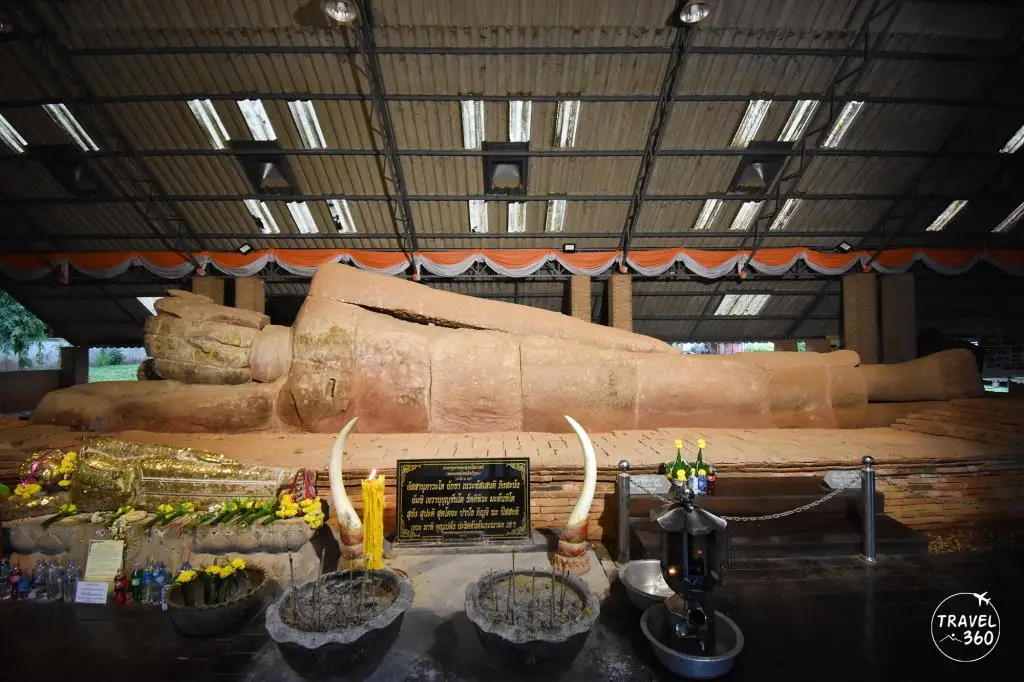
The main highlight of the temple is the reclining Buddha image, or Phra Phuttha Saiyat Sila, constructed from many large red sandstone blocks arranged along a north–south axis. The image is about 13.30 meters long and about 2.50 meters high. The head points south, while the face turns toward the east. The face is rather square in form and was assembled from 4 stacked sandstone slabs before being carved into facial features. The body is also composed of large sandstone sections placed together. This construction method makes the image highly distinctive. It reveals not only religious devotion, but also the technical ability of ancient craftsmen who created a monumental Buddhist image from heavy stone blocks more than a thousand years ago.
The temple area was originally a religious site during the Dvaravati period. Important objects found in and around this area include the reclining Buddha, a sandstone Dhammachak wheel, a Dhammachak pillar, bronze Buddha images, clay votive tablets, glass beads, clay spindle whorls, and stone inscriptions. These objects show that ancient Sema was not an isolated settlement, but a religious and cultural center connected with Buddhism, craftsmanship, ritual activity, and regional exchange. Wat Dhammachak Semaram allows visitors to see how Buddhism had already taken root in this part of northeastern Thailand long before the better-known later periods of Thai history.
The reclining Buddha is generally dated to around the 13th Buddhist century, or approximately 1,300 years ago. Its importance is not limited to age and size. The image is also remarkable because it was built from multiple sandstone blocks rather than cast in metal or formed entirely in plaster. This method makes the monument a rare example of early large-scale Buddhist stone construction in the region. Seeing the image in person helps visitors understand that the ancient community of Sema possessed not only faith, but also the organization, materials, and artistic ambition required to create a major religious monument.
The artistic features of the image are especially significant. The face is broad and square, the eyebrows are carved in raised curves, the eyes look downward, the nose is wide, and the mouth has a calm, slight smile. The hair curls show the conventional Buddhist visual language of the period, although some parts are damaged due to age. The overall style reflects Dvaravati influence combined with local artistic characteristics. For art and archaeology travelers, the Buddha image is a key example of how Buddhist iconography was adapted in the early cultural landscape of lower northeastern Thailand.
Another important object is the sandstone Dhammachak wheel, which was found near the face of the reclining Buddha. The wheel has Kala faces on both sides and a diameter of about 141 centimeters. Its lower section contains carved decoration associated with symbolic motifs such as Panaspati-like imagery, sacred trees, and the broader Buddhist cosmological imagination. In Buddhism, the Dhammachak represents the turning of the Wheel of Dhamma, or the teaching of the Buddha. The presence of a Dhammachak in the same setting as the reclining Buddha strongly confirms the religious importance of the site in the Dvaravati period.
The original Dhammachak wheel and its related pillar are preserved inside the museum building at Wat Dhammachak Semaram for safety and study. Visitors can see the original object in a glass display case and a replica used for educational presentation. Other ancient artifacts from the area, including bronze Buddha images, clay tablets, beads, spindle whorls, and inscriptions, are preserved and displayed at Phimai National Museum. This arrangement helps protect fragile and valuable objects while allowing visitors to study the Sema archaeological landscape in a wider historical context.
The Wat Dhammachak Semaram Museum is therefore an essential part of the visit. It helps explain the development of ancient Sema, the meaning of the Dhammachak, and the relationship between the reclining Buddha and the broader archaeological setting. Visitors should not treat the museum as a secondary stop. It provides the interpretive framework that makes the reclining Buddha more meaningful. After seeing the museum, the Buddha image is no longer just a large ancient sculpture; it becomes part of a larger network of religious monuments, objects, inscriptions, and local memory.
Today, the reclining Buddha has been excavated, conserved, and protected through archaeological work. A large protective structure covers the Buddha image and the foundations of the earlier ancient building. This shelter protects the sandstone from sunlight, rain, humidity, and environmental damage. The structure also allows visitors to walk around the monument safely while observing both the Buddha image and the archaeological remains around it. The conservation setting helps transform the temple into a historical learning site while preserving its sacred function.
In 2025, the Fine Arts Office No. 10, Nakhon Ratchasima, completed a conservation and development project for the reclining Buddha monument at Wat Dhammachak Semaram. The work was completed and handed over on 24 September 2025, improving the site as a historical tourism and learning center for the cultural heritage of the lower northeast. This recent conservation work is important because the site is not only a local temple, but a nationally significant archaeological place that helps explain the early history of Nakhon Ratchasima and Dvaravati Buddhism in the region.
The name Wat Dhammachak Semaram is meaningful. The word Dhammachak refers to the sandstone Wheel of Dhamma found at the temple, while Sema connects the temple with ancient Sema city and Sema Subdistrict. The name therefore combines Buddhist symbolism, archaeology, and local geography. It is not simply a temple name, but a condensed expression of the site’s identity. Understanding the name helps visitors understand why the temple is so closely connected with both the Buddha image and the ancient city nearby.
Ancient Sema city, located near the temple, was a major settlement with moats, earthen walls, and several archaeological monuments. The city developed from the Dvaravati period and later came under Khmer cultural influence. Important evidence includes multiple monument sites, the Dhammachak wheel, Sema inscriptions, Bo Ika inscriptions, and the Si Janasa inscription. These remains make the Sema area one of the most important archaeological landscapes in Nakhon Ratchasima. A visit to Wat Dhammachak Semaram should therefore be linked with a visit to ancient Sema city because the temple and the city belong to the same historical story.
The temple remains a place of living faith. Local people and visitors from other areas come to pay respect to the reclining Buddha, often known affectionately as Ong Pho Yai. Devotees pray for auspiciousness before work, travel, important decisions, or new beginnings. This living faith means that the reclining Buddha is not only an archaeological object. It continues to function as a sacred image and a spiritual anchor for the community. This combination of archaeology and devotion is one of the strongest qualities of Wat Dhammachak Semaram.
Visitors should approach the reclining Buddha with respect. It is both a sacred Buddhist image and a fragile ancient monument. Shoes should be removed where required. Visitors should not climb on the Buddha image or the ancient foundations, touch the sandstone unnecessarily, place objects on the stone, or apply gold leaf in unauthorized areas. Respecting the site is a form of conservation. It allows worship and tourism to coexist without damaging cultural heritage.
The temple grounds can be understood through several zones. The first and most important is the reclining sandstone Buddha zone. The second is the protective structure and ancient building foundation zone. The third is the Dhammachak display zone. The fourth is the Wat Dhammachak Semaram Museum. The fifth is the active temple and merit-making area. The sixth is the walking and rest area around the grounds. The final zone is the route connecting the temple with ancient Sema city. Visiting all of these zones gives a much fuller understanding than simply stopping for a quick photograph.
Travelers interested in history should allow at least 1 to 2 hours for the temple and museum. Begin by paying respect to the reclining Buddha, then observe the sandstone construction, protective building, and ancient foundations. Continue to the Dhammachak display and the museum. If time allows, continue to ancient Sema city, Monument No. 9, Wat Kaen Thao stupa, Prasat Mueang Khaek, and Prasat Non Ku. This itinerary helps visitors understand the transition from Dvaravati Buddhist culture to later Khmer influence in the Sung Noen region.
The site is open daily from 07.00 to 17.00 and does not charge an admission fee. Morning is suitable for worship and quieter viewing, while daytime hours are best for studying the museum and archaeological details. Visitors who want to photograph the reclining Buddha and its protective building should use natural light during normal visiting hours. Late afternoon can be pleasant, but visitors should make sure they have enough time to see the museum before closing.
Getting to Wat Dhammachak Semaram is easiest by private car or rental vehicle. From Nakhon Ratchasima city, take Mittraphap Road toward Sung Noen District. Around kilometer marker 237 or the entrance to Sung Noen, turn into the district area and continue through local roads toward Ban Khlong Khwang in Sema Subdistrict. The route is suitable for a half-day trip from Nakhon Ratchasima city or a full-day cultural route covering ancient Sema and nearby Khmer-period monuments.
Getting There from Sung Noen town is straightforward. Cross the railway, turn left, pass Ban Hin Tang and Ban Thale School, and continue toward Ban Khlong Khwang. When you see the blue entrance sign for the reclining Buddha at Wat Dhammachak Semaram, continue along the road for about 2 km to reach the temple. Because this is a local community route, drive carefully, respect local residents, and check a map before traveling if you are unfamiliar with rural roads in Sema Subdistrict.
Wat Dhammachak Semaram is suitable for many types of visitors. Buddhist devotees can pay respect to the ancient reclining Buddha. History lovers can explore the Dvaravati background of Sema. Museum visitors can study the sandstone Dhammachak and related artifacts. Families can use the temple as an outdoor history classroom. Foreign travelers can learn about early Buddhism in Thailand before the better-known Sukhothai and Ayutthaya periods. The temple therefore combines worship, education, archaeology, and cultural travel in one accessible location.
For children and students, the temple is an excellent learning site. It can be used to explain the meaning of a reclining Buddha, the symbolism of the Dhammachak, the use of sandstone in ancient sculpture, the role of museums, and the importance of conservation. Seeing the monument in person makes history easier to understand. Adults should guide children to walk calmly, avoid touching objects, and read the information signs with attention. This turns the visit into a meaningful cultural lesson rather than a simple sightseeing stop.
From a conservation perspective, the protective building is essential. Sandstone is vulnerable to water, humidity, sunlight, and physical contact. Because the Buddha image is more than a thousand years old, preservation must balance religious devotion with archaeological care. Visitors help protect the site by not touching the stone, not climbing on ancient remains, not placing offerings directly on protected surfaces, and following all on-site instructions. Responsible behavior is part of preserving national heritage.
The temple also helps visitors understand the importance of the Dhammachak symbol in Dvaravati Buddhism. Dhammachak wheels have been found in several ancient Buddhist centers in Thailand, but the Sema example is especially important for northeastern Thailand. The combination of a large reclining Buddha and a sandstone Dhammachak makes Wat Dhammachak Semaram a key case study in early Buddhist art and religious symbolism in the lower northeast. For travelers interested in Buddhist art, this temple is an essential site.
Another meaningful aspect is the continuity of faith. Although the reclining Buddha was created in the Dvaravati period, the site is still part of an active Buddhist temple today. Monks live here, local people make merit, and visitors continue to worship the image. The monument is not an abandoned ruin; it is a sacred object within a living temple community. This gives the site emotional depth and helps visitors understand how archaeology and devotion coexist in Thailand.
If planning a cultural route in Sung Noen, Wat Dhammachak Semaram should be the central stop. After visiting the reclining Buddha and museum, continue to ancient Sema city, Monument No. 9, Wat Kaen Thao stupa, Prasat Mueang Khaek, and Prasat Non Ku. This route reveals the historical layers of the area and shows why Sung Noen is one of the most important cultural districts in Nakhon Ratchasima.
Visitors should dress modestly, wear comfortable shoes, bring drinking water, and behave quietly around the Buddha image and museum. Photography should be respectful, and flash should be avoided in display areas where it may disturb others or affect sensitive objects. The best visit is one that combines worship, learning, and care for the monument.
For foreign travelers, Wat Dhammachak Semaram offers a deeper view of Thai Buddhist history. It shows that Buddhism in Thailand has roots far earlier than many well-known kingdoms. The reclining sandstone Buddha, the Dhammachak wheel, the museum, and ancient Sema city together explain a major chapter of early Buddhist culture in northeastern Thailand. This makes the temple valuable not only as a place of worship, but also as one of the most important cultural learning sites in Nakhon Ratchasima.
Overall, Wat Dhammachak Semaram is a destination that deserves careful and respectful time. Its importance lies in the Dvaravati reclining sandstone Buddha, the Dhammachak wheel, the temple museum, the connection with Phimai National Museum, ancient Sema city, and recent conservation work that protects the monument for future generations. For travelers who want to understand Sung Noen beyond Mittraphap Road and ordinary transit routes, this temple is one of the clearest gateways into the early history of Korat.
| Name | Wat Dhammachak Semaram, also known as Wat Phra Non Khlong Khwang |
| Location | Ban Khlong Khwang, Sema Subdistrict, Sung Noen District, Nakhon Ratchasima Province |
| Address | Sema Subdistrict, Sung Noen District, Nakhon Ratchasima 30170, Thailand |
| Coordinates | 14.9160559765, 101.79339098 |
| Highlights | Dvaravati-period reclining sandstone Buddha, sandstone Dhammachak wheel, Dhammachak pillar, Wat Dhammachak Semaram Museum, ancient Sema city, and early Buddhist archaeological heritage |
| History | The site was originally a Dvaravati-period religious place. The reclining Buddha is generally dated to around the 13th Buddhist century, or about 1,300 years ago, within the historical landscape of ancient Sema |
| Name Origin | The name refers to the sandstone Dhammachak wheel found at the temple and to ancient Sema, the historic city landscape of Sung Noen District |
| Distinctive Features | A temple and archaeological site combining a large red sandstone reclining Buddha, a Dhammachak wheel, a local museum, and a learning route connected with ancient Sema city |
| Reclining Buddha Details | A red sandstone reclining Buddha about 13.30 meters long and about 2.50 meters high, constructed from multiple sandstone blocks along a north–south axis, with the head to the south and the face turned east |
| Dhammachak Details | A sandstone Dhammachak wheel with Kala faces on both sides, about 141 centimeters in diameter, with lower carved motifs associated with Panaspati-like imagery, now preserved inside the temple museum/display building |
| Travel Information | From Nakhon Ratchasima city, take Mittraphap Road toward Sung Noen. Around kilometer marker 237, turn into Sung Noen town, cross the railway, and continue through the Ban Hin Tang–Ban Thale route toward Ban Khlong Khwang in Sema Subdistrict |
| Current Status | Open for worship, museum visits, Dhammachak viewing, and archaeological learning connected with ancient Sema |
| Open Days | Daily |
| Opening Hours | 07.00 – 17.00 |
| Fees | No admission fee |
| Facilities | Protective structure over the reclining Buddha, Wat Dhammachak Semaram Museum, Dhammachak display hall, worship area, temple courtyard, information signs, and parking within the temple area |
| Main Areas / Zones | Reclining sandstone Buddha zone, protective structure and ancient foundation zone, sandstone Dhammachak zone, Wat Dhammachak Semaram Museum zone, active temple and merit-making zone, walking and rest area, and route to ancient Sema city |
| Abbot / Caretaker | Phra Khru Dhammachak Semarak Chinavaro |
| Archaeological Information Contact | Fine Arts Office No. 10, Nakhon Ratchasima, Tel. 044-471-518, 044-481-024 |
| Nearby Tourist Attractions | 1. Ancient Sema City, about 1 km 2. Ancient Monument No. 9, Sema City, about 2 km 3. Wat Kaen Thao Stupa, about 3 km 4. Prasat Mueang Khaek, about 6 km 5. Prasat Non Ku, about 7 km 6. Lan Bun Mahawihan Somdet Phra Phutthachan (To Phromrangsi), about 8 km |
| Nearby Restaurants | 1. Judtem Sung Noen, about 7 km, Tel. 083-272-4879 2. Laab Ban Lao, about 8 km, Tel. 044-286-892 3. Kang Plu Eatery, about 10 km, Tel. 088-050-9093 4. Isaan Country Roadhouse, about 10 km, Tel. 093-530-7009 5. BN Korean BBQ Sung Noen, behind Seagate, about 11 km, Tel. 099-070-4545 |
| Nearby Accommodations | 1. Chawalee Place, about 7 km, Tel. 065-394-2453 2. Sema Nakhon Hotel, about 7 km, Tel. 086-262-7985 3. Sweet Mango Resort Sung Noen, about 9 km, Tel. 086-089-2131 4. High Hill Fresh Resort, about 12 km, Tel. 081-777-1712 5. Green Ville Laguna, about 18 km |
Frequently Asked Questions (FAQ)
Q: Where is Wat Dhammachak Semaram located?
A: Wat Dhammachak Semaram is located in Ban Khlong Khwang, Sema Subdistrict, Sung Noen District, Nakhon Ratchasima Province, about 6 km from Sung Noen District Office.
Q: What are the opening hours of Wat Dhammachak Semaram?
A: The temple and museum area are open daily from 07.00 to 17.00.
Q: Is there an admission fee?
A: No. Wat Dhammachak Semaram does not charge an admission fee. Visitors may make merit according to their faith.
Q: What is the main highlight of Wat Dhammachak Semaram?
A: The main highlight is the Dvaravati-period reclining sandstone Buddha, together with the sandstone Dhammachak wheel, the temple museum, and the connection with ancient Sema city.
Q: How large is the reclining Buddha of ancient Sema?
A: The reclining Buddha is about 13.30 meters long and about 2.50 meters high. It was constructed from multiple red sandstone blocks arranged along a north–south axis.
Q: Why is the sandstone Dhammachak important?
A: The Dhammachak is a key Buddhist symbol of the turning of the Wheel of Dhamma. Its presence at the temple confirms the importance of ancient Sema as a Dvaravati Buddhist center.
Q: How can travelers get to Wat Dhammachak Semaram?
A: From Nakhon Ratchasima city, take Mittraphap Road toward Sung Noen. Around kilometer marker 237, turn into Sung Noen town, cross the railway, and continue through the Ban Hin Tang–Ban Thale route toward Ban Khlong Khwang.
Q: What nearby places can be visited on the same trip?
A: Nearby places include Ancient Sema City, Ancient Monument No. 9, Wat Kaen Thao Stupa, Prasat Mueang Khaek, Prasat Non Ku, and Lan Bun Mahawihan Somdet Phra Phutthachan.
 Category: ●Places of Worship
 Group: ●Temple
Last Update : 3 MonthAgo
 Last Update : 3 MonthAgo
 Click to Access the Navigation Map GPS
Wat Dhammachak Semaram Map
Recommend

 Art, Culture and Heritage
 Historical Sites and Monuments(20)
 Landmarks and Memorials(5)
 Art, Craft Centres, Tradition(7)
 Museums(6)
 Art Gallery(1)
 Educational Places
 Educational Gardens, Farm(4)
Temple(29)
 Mosque(1)
 Other Sacred Sites(6)
 Research and Development
 Royal Project(3)
 Suburban Living
 Village, Community(6)
 Local Market(4)
 Floating Market(1)
 Nature and Wildlife
 National Parks and Marine Reserves(3)
 Mountain (Doi)(5)
 Dam, Reservoir, Lake(8)
 Waterfalls(9)
 Hot Springs(1)
 Caves(2)
 Flower Field(1)
 River, Canal(8)
 Bays and Beaches(2)
 Other natural attractions(3)
 Entertainment and Agricultural
 Zoos and Aquariums(2)
 Animal camps and shows(1)
 Farms, Parks and Ecotourism(21)
 Waterpark(4)
 Outdoor and Adventure Activities(6)
 Shopping
 Shopping and Night Market(2)
 Travel Articles, Recipes
 Travel Review, Food Review(6)


