
lovethailand home >Northeastern Travel Attractions >Khon Kaen Travel Attractions >Phu Wiang >Nai Muang > Phu Wiang National Park
TL;DR: Phu Wiang National Park is located at Nai Mueang Subdistrict, Wiang Kao District, Khon Kaen Province, Thailand, open Daily, hours 08.30 – 16.30.
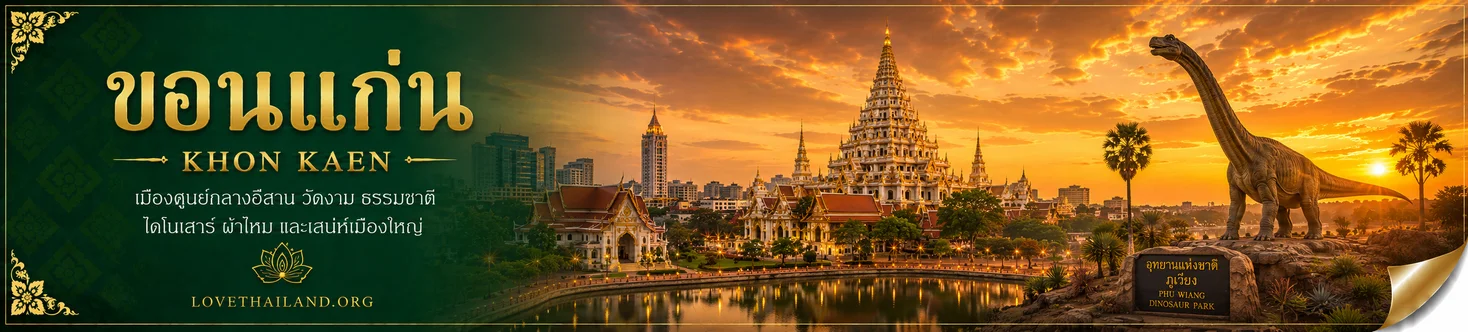
Phu Wiang National Park

Open Days: Daily
Opening Hours: 08.30 – 16.30
Phu Wiang National Park in Khon Kaen Province is one of Thailand’s most important destinations for dinosaur fossils, prehistoric landscapes, sandstone mountains, waterfalls, ancient rock art, and outdoor learning. For many travelers, the name Phu Wiang immediately brings dinosaurs to mind. Before the major discoveries in this area, few people imagined that the Khorat Plateau in northeastern Thailand had once been home to dinosaurs. That perception changed dramatically after fossil evidence was found in Phu Wiang in 1976.
The story began during a uranium survey in the Phu Wiang area. A geologist discovered a fossilized bone, which was later sent to a French specialist for examination. The result showed that the specimen was the left knee bone of a dinosaur. This discovery became a turning point for Thai paleontology and led to systematic excavations in the area. Since then, Phu Wiang has become one of the most significant dinosaur fossil sites in Thailand and one of the best places in the country to understand the prehistoric world through real landscapes.
Phu Wiang National Park covers approximately 325 square kilometers, or about 203,125 rai, in Khon Kaen Province. The park extends across areas of Wiang Kao, Phu Wiang, Si Chomphu, and Chum Phae districts. It was officially declared Thailand’s 71st national park on 8 December 1991. Its landscape consists of sandstone mountains, dry dipterocarp forest, mixed deciduous forest, dry evergreen forest, rock platforms, waterfalls, cliffs, caves, and fossil excavation sites. This combination makes the park both a natural attraction and an open-air museum of geological history.
The most famous fossil discovery area is Excavation Site 1 on Phu Pratu Ti Ma. This site revealed fossils of a large plant-eating sauropod dinosaur with a long neck, long tail, and a body length of about 15 meters. Because it was a new dinosaur species found in Thailand, it was named Phuwiangosaurus sirindhornae in honor of Her Royal Highness Princess Maha Chakri Sirindhorn. Today, this dinosaur is one of the best-known Thai dinosaur names and a key symbol of Phu Wiang.
At the same excavation site, researchers also found more than ten teeth belonging to carnivorous dinosaurs. This led to the interpretation that the large sauropod found in the area may have been connected to predatory dinosaur activity. Among the teeth, one specimen had a distinctive shape unlike the others. Further study showed that it belonged to a new carnivorous dinosaur species, which was named Siamosaurus suteethorni in honor of Thai paleontologist Warawudh Suteethorn, an important figure in Thailand’s dinosaur research.
Another major fossil from Phu Wiang is Siamotyrannus isanensis, an early tyrannosaur from the Early Cretaceous period, around 120–130 million years ago. This fossil is significant because it supports the idea that tyrannosaur-type dinosaurs may have had early evolutionary roots in Asia. Although the important specimen is displayed outside the park in Bangkok, its story remains closely linked to Phu Wiang and the scientific importance of the area.
Hin Lat Pa Chat, also known as Excavation Site 8, is another important point within the wider Phu Wiang fossil landscape. The site contains 68 dinosaur footprints estimated to be around 140 million years old. Most of the tracks belong to small two-legged carnivorous dinosaurs, while one larger footprint is believed to have belonged to a larger carnivorous dinosaur such as a carnosaur. The site is about 19 km from the park headquarters and is best reached with a suitable vehicle, especially during seasons when the road condition is more challenging.
Other fossils found in the Phu Wiang area include baby dinosaur remains, small crocodile fossils, and ancient shell fossils dating back around 150 million years. These discoveries help paint a broader picture of the ancient ecosystem that once existed here. Phu Wiang was not just a place where one dinosaur died; it was part of a complex prehistoric environment with water sources, plant-eating dinosaurs, carnivorous dinosaurs, reptiles, and other ancient life forms.
Travelers who want to understand the full story of the area should combine the national park with the nearby Phu Wiang Dinosaur Museum. The museum provides background knowledge about Thai dinosaur discoveries, fossil interpretation, geology, and the prehistoric environment of the Khorat Plateau. A practical route is to start with the museum, then continue into the national park to see the actual excavation sites. This allows visitors to connect scientific explanation with real terrain.
Phu Wiang is also important for cultural history. On a cliff in the mountain area, a high-relief reclining Buddha image was carved into the rock around the 14th Buddhist century. The reclining posture shows Indian artistic influence, with the head resting against the right arm and the left arm extending along the body. This sculpture shows that Phu Wiang was not only a prehistoric fossil landscape but also a place of religious and cultural importance in later historical periods.
Another culturally significant site is Tham Fa Mue Daeng near Ban Hin Rong. This cave contains ancient red handprints created by placing the hand against the cave wall and spraying red pigment around it. The resulting hand shapes are powerful evidence of prehistoric human expression. Visitors should never touch, trace, or write on the cave wall, as the artwork is an irreplaceable cultural resource.
Phu Wiang National Park also offers natural attractions. Thap Phaya Suea Waterfall is a small waterfall located near Tham Fa Mue Daeng. Tat Fa Waterfall is a larger waterfall about 15 meters high and can be reached by vehicle. It is located about 18 km from Phu Wiang District, followed by a mountain route of about 6 km. Continuing about 5 km beyond Tat Fa Waterfall leads to Tat Klang Waterfall. These waterfall routes are best visited during or after the rainy season when water flow is stronger and the forest is greener.
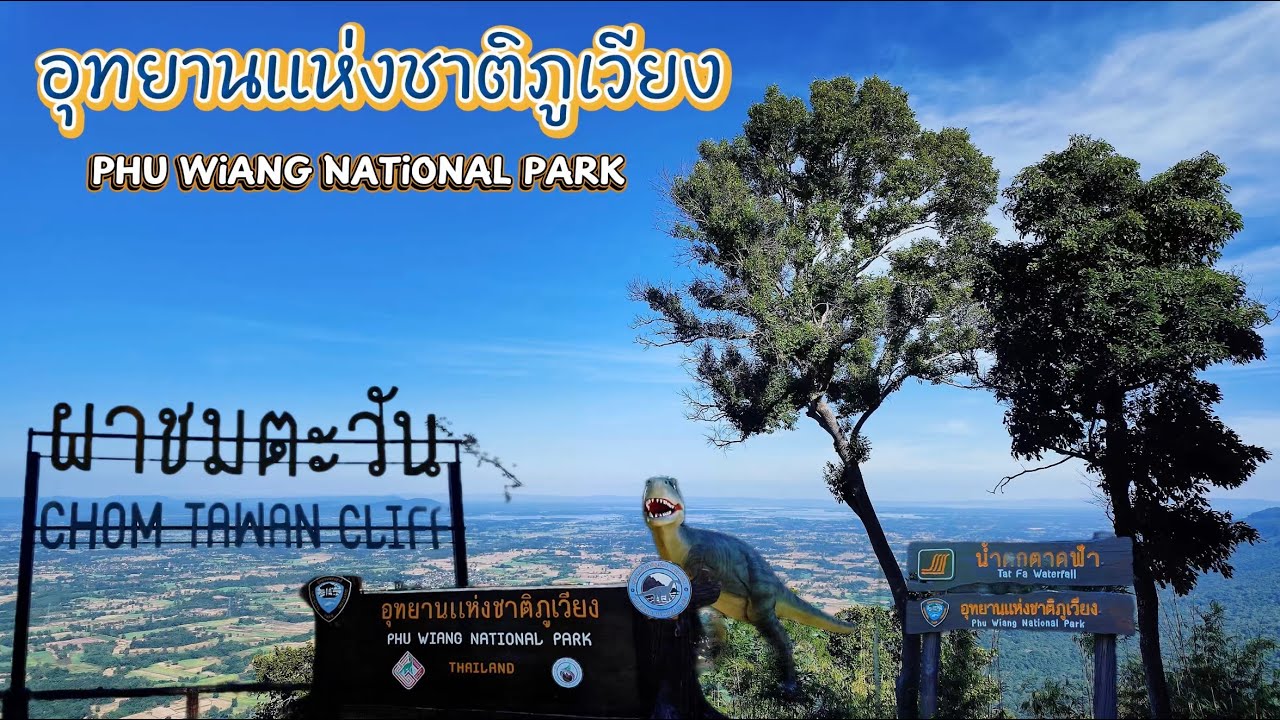
The Tat Fa and Pha Chom Tawan area is especially suitable for nature travelers and campers. Pha Chom Tawan is a viewpoint where visitors can enjoy mountain scenery and early morning light. The Tat Fa camping area allows travelers to spend more time in the park and experience its quieter natural atmosphere. Visitors who plan to stay overnight should contact the park directly in advance to confirm camping conditions, accommodation availability, road access, and safety rules.
Beyond waterfalls, Phu Wiang has open grasslands and rock platforms where wildflowers bloom after the rainy season. Areas such as Thung Yai Sao Aram, Hin Lat Wua Tham Kwang, and Hin Lat Ang Kop show the seasonal beauty of the park. During the late rainy season and early cool season, small wildflowers appear across the rock and grassland areas, creating a different kind of attraction from the fossil sites. These landscapes are ideal for photography and slow nature walks.
The forest ecosystem of Phu Wiang National Park includes dry dipterocarp forest, mixed deciduous forest, and some dry evergreen forest. Dry dipterocarp forest is common on drier slopes and rockier areas, while mixed deciduous forest appears in areas with better moisture and deeper soil. These forests provide habitat for birds, insects, reptiles, small mammals, and many native plants. The changing seasons strongly affect the park’s appearance: the dry season opens the forest canopy, while the rainy season brings fresh greenery and increased water flow.
Phu Wiang is best explored by choosing the right route for the available time. For a half-day visit, focus on Excavation Sites 1, 2, and 3 near the park headquarters. For a one-day trip, combine the fossil trail with Phu Wiang Dinosaur Museum and Si Wiang Dinosaur Park. For a deeper two-day trip, add Tat Fa Waterfall, Pha Chom Tawan, the camping area, Hin Lat Pa Chat dinosaur footprints, Tham Fa Mue Daeng, and the wildflower rock platforms. This approach allows visitors to experience the park as a complete destination rather than a single fossil stop.
The park provides visitor services, including a visitor center, restaurant, accommodation, camping area, restrooms, parking, interpretation signs, and nature trails. Facilities are concentrated around the headquarters and main visitor zones, while more remote sites require more preparation. Travelers should carry drinking water, comfortable walking shoes, sun protection, insect repellent, and enough time for travel between sites. Some areas may require a suitable vehicle, especially in the rainy season or on routes to remote fossil and waterfall sites.
Entrance fees follow national park rates. Thai adults pay 40 THB and Thai children pay 20 THB. Foreign adults pay 200 THB and foreign children pay 100 THB. Vehicle fees apply separately depending on vehicle type. Visitors should carry cash because some areas inside the park may not have reliable digital payment options or mobile signal.
Getting There from Khon Kaen city, take Highway 12 on the Khon Kaen-Chum Phae route, passing Ban Fang and Nong Ruea districts. After about 48 km, turn toward Phu Wiang District, then continue on Highway 2038 for about 38 km. The route passes Phu Wiang town and National Park Protection Unit No. 1 at Pak Chong Phu Wiang before reaching the park headquarters at Phu Pratu Ti Ma. The total distance from Khon Kaen city is about 86 km.
Traveling by private car, rental car, or chartered vehicle is the most convenient option because the attractions inside the park are spread across different zones. Travelers without a car can use local transport to Phu Wiang town and then arrange a local vehicle to the park, but this requires careful planning. If the goal is to visit the museum, dinosaur park, excavation sites, waterfalls, and viewpoints in one trip, having a private vehicle is strongly recommended.
The best time to visit is during the cool season and the transition from the rainy season to winter. The weather is more comfortable, the waterfalls may still have water, the forest is greener, and walking around the excavation sites is easier. The hot season is still possible for fossil-focused travel, but visitors should bring enough water, hats, and sun protection. During the rainy season, waterfalls and forests are beautiful, but some roads and rock surfaces can become slippery.
Visitors should follow conservation rules carefully. Do not touch fossils, move rocks, remove natural materials, write on cave walls, damage ancient rock art, leave trash, or walk outside designated routes. Fossil sites and prehistoric artworks in Phu Wiang are part of Thailand’s shared natural and cultural heritage. Responsible travel helps preserve these places for future generations.
In summary, Phu Wiang National Park is one of the most meaningful destinations in Khon Kaen Province. It brings together dinosaur discoveries, Thai paleontology, prehistoric human art, ancient Buddhist sculpture, waterfalls, viewpoints, rock platforms, wildflowers, and protected forest. For international travelers, it is an excellent place to understand that northeastern Thailand is not only a region of culture and food, but also a landscape of deep natural history stretching back more than 100 million years.
| Name | Phu Wiang National Park |
| Location | Nai Mueang Subdistrict, Wiang Kao District, Khon Kaen Province, Thailand |
| Address | P.O. Box 1, Nai Mueang Subdistrict, Wiang Kao District, Khon Kaen 40150, Thailand |
| Coordinates | Approximately 16.6000, 102.1832 |
| Area | Approximately 325 sq km or 203,125 rai |
| Highlights | Dinosaur excavation sites, Phuwiangosaurus sirindhornae, Siamosaurus suteethorni, Siamotyrannus isanensis, Hin Lat Pa Chat dinosaur footprints, Tham Fa Mue Daeng, reclining Buddha rock sculpture, Tat Fa Waterfall, and Pha Chom Tawan |
| History | A dinosaur bone was discovered during a uranium survey in 1976. The park was officially declared on 8 December 1991 as Thailand’s 71st national park. |
| Name Origin | Named after the Phu Wiang mountain area, the key landscape where major dinosaur fossils in Thailand were discovered |
| Distinctive Features | Sandstone mountains, fossil excavation sites, dinosaur footprints, caves, ancient rock art, waterfalls, rock platforms, grasslands, dry dipterocarp forest, and mixed deciduous forest |
| Travel Information | From Khon Kaen city, take Highway 12 toward Chum Phae, then turn onto Highway 2038 toward Phu Wiang and Wiang Kao. The route passes Phu Wiang town and National Park Protection Unit No. 1 before reaching the park headquarters at Phu Pratu Ti Ma. Total distance is about 86 km. |
| Current Status | Open for visitors |
| Open Days | Daily |
| Opening Hours | 08.30 – 16.30 |
| Fees | Thai adults 40 THB, Thai children 20 THB / foreign adults 200 THB, foreign children 100 THB / vehicle fees apply by vehicle type |
| Facilities | Visitor center, restaurant, accommodation, camping area, restrooms, parking, interpretation signs, and nature trails |
| Main Areas / Zones | 1. Park Headquarters at Phu Pratu Ti Ma 2. Dinosaur Excavation Nature Trail 3. Excavation Sites 1, 2, 3, and 9 4. Hin Lat Pa Chat / Excavation Site 8 Dinosaur Footprints 5. Tham Fa Mue Daeng and Thap Phaya Suea Waterfall 6. Tat Fa Waterfall and Tat Klang Waterfall 7. Pha Chom Tawan and Tat Fa Camping Area 8. Thung Yai Sao Aram, Hin Lat Wua Tham Kwang, and Hin Lat Ang Kop |
| Caretaker | Phu Wiang National Park, Department of National Parks, Wildlife and Plant Conservation |
| Main Contact Number | 043-358073 / 043-438333 |
| Official Website / Official Page | Phu Wiang National Park Official Facebook Page |
| Nearby Tourist Attractions | 1. Dinosaur Excavation Site 1, about 1 km 2. Dinosaur Excavation Sites 2 and 3, about 2 km 3. Pha Kan Wela, about 3 km 4. Phu Wiang Dinosaur Museum, about 17 km 5. Si Wiang Dinosaur Park, about 20 km 6. Hin Lat Pa Chat Dinosaur Footprints, about 19 km 7. Tat Fa Waterfall, about 24 km 8. Pha Chom Tawan, about 25 km |
| Nearby Restaurants | 1. Mae Boon Luan Beef Noodles & Coffee, about 15 km 2. Nong Da Som Tam, about 16 km 3. Noi Kai Yang Branch 2 Phu Wiang, about 18 km 4. OMG - OMEGA Cafe, about 18 km 5. A. Kung Phao Restaurant, Chai So Branch 1, about 20 km 6. Hi Cup, about 20 km |
| Nearby Accommodations | 1. Chuanchom Resort Phuwiang, about 3 km 2. Phu Wiang National Park Accommodation, inside the park, Tel. 043-358073 3. Pruksa Garden Hotel, about 15 km 4. Phuwiang Grand Hotel, about 15 km 5. The Pool Resort Phu Wiang Hotel, about 16 km 6. Pitchaya Ville Resort, about 18 km, Tel. 080-831-7399 |
Frequently Asked Questions (FAQ)
Q: Where is Phu Wiang National Park located?
A: Phu Wiang National Park is located in Khon Kaen Province, covering areas of Wiang Kao, Phu Wiang, Si Chomphu, and Chum Phae districts. The headquarters is at Phu Pratu Ti Ma.
Q: Why is Phu Wiang National Park famous for dinosaurs?
A: The park became famous after dinosaur fossils were discovered during a uranium survey in 1976. It later revealed several important Thai dinosaur species, including Phuwiangosaurus sirindhornae, Siamosaurus suteethorni, and Siamotyrannus isanensis.
Q: What is important about Excavation Site 1?
A: Excavation Site 1 revealed fossils of the large plant-eating dinosaur Phuwiangosaurus sirindhornae and carnivorous dinosaur teeth that contributed to the study of new Thai dinosaur species.
Q: Is there an entrance fee for Phu Wiang National Park?
A: Yes. Thai adults pay 40 THB and Thai children pay 20 THB. Foreign adults pay 200 THB and foreign children pay 100 THB. Vehicle fees apply separately.
Q: What are the opening hours of Phu Wiang National Park?
A: The park is open daily from 08.30 to 16.30. Visitors heading to waterfalls or remote areas should start early in the day.
Q: How do I get to Phu Wiang National Park from Khon Kaen city?
A: Take Highway 12 from Khon Kaen toward Chum Phae, then turn onto Highway 2038 toward Phu Wiang and Wiang Kao. The total distance is about 86 km.
Q: How many days should I spend at Phu Wiang National Park?
A: One day is enough for the main excavation sites, the museum, and nearby dinosaur attractions. Two days are recommended if you want to include Tat Fa Waterfall, Pha Chom Tawan, dinosaur footprints, and camping.
Q: Is Phu Wiang National Park suitable for children and families?
A: Yes. It is very suitable for families because children can learn about dinosaurs, fossils, geology, nature, and prehistoric life through real excavation sites and nearby museum displays.
Tel : 025620760
 Tel : 025620760
 Category: ●Nature and Wildlife
 Group: ●National Parks and Marine Reserves
Last Update : 3 MonthAgo
 Last Update : 3 MonthAgo
 Click to Access the Navigation Map GPS
Phu Wiang National Park Map
Recommend

 Art, Culture and Heritage
 Historical Sites and Monuments(7)
 Landmarks and Memorials(3)
 Art, Craft Centres, Tradition(2)
 Museums(4)
 Educational Places
 Museum for Study(2)
 Places of Worship
 Temple(27)
 Other Sacred Sites(5)
 Suburban Living
 Village, Community(3)
 Local Market(1)
National Parks and Marine Reserves(5)
 Mountain (Doi)(1)
 Dam, Reservoir, Lake(4)
 Waterfalls(8)
 Caves(9)
 River, Canal(10)
 Bays and Beaches(3)
 Islands(1)
 Other natural attractions(5)
 Entertainment and Agricultural
 Zoos and Aquariums(2)
 Animal camps and shows(2)
 Farms, Parks and Ecotourism(7)
 Waterpark(3)
 Travel Articles, Recipes
 Travel Review, Food Review(1)


