
lovethailand home >Northeastern Travel Attractions >Khon Kaen Travel Attractions >Muang Khon Kaen >Nai Muang > Phra Mahathat Kaen Nakhon
TL;DR: Phra Mahathat Kaen Nakhon is located at Klang Mueang Road, beside Bueng Kaen Nakhon, Nai Mueang Subdistrict, Mueang Khon Kaen District, Khon Kaen Province, open Daily, hours 08.00 – 18.00.
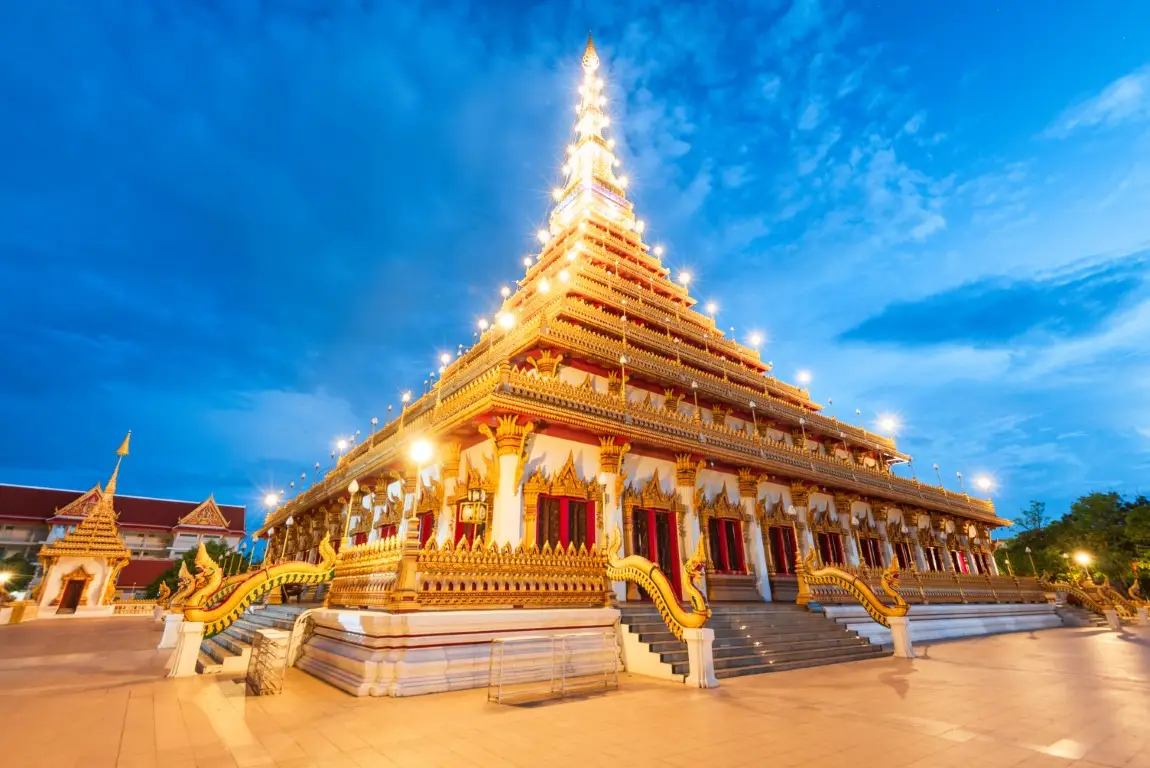
Phra Mahathat Kaen Nakhon
Open Days: Daily
Opening Hours: 08.00 – 18.00
Wat Nong Waeng Royal Temple, also known as Wat Nong Waeng Mueang Kao, is one of the most important Buddhist temples in Khon Kaen Province. Located on Klang Mueang Road beside Bueng Kaen Nakhon in Nai Mueang Subdistrict, Mueang Khon Kaen District, the temple is best known for Phra Mahathat Kaen Nakhon, a magnificent 9-storey stupa that has become one of the most recognizable landmarks of Khon Kaen. For foreign travelers, this temple is one of the best places to understand the spiritual, artistic, and cultural identity of northeastern Thailand.
Phra Mahathat Kaen Nakhon, often called the 9-storey stupa, rises about 80 meters high and stands prominently near Bueng Kaen Nakhon. The structure is made of reinforced concrete, brick, and plaster, with a stupa-shaped upper section inspired by Phra That Kham Kaen, one of the most sacred stupas associated with Khon Kaen Province. Around the main stupa are four smaller stupas at the four corners, together with a glass wall decorated with seven-headed Naga serpents. The entire composition reflects Buddhist faith, Isan artistic identity, and local beliefs connected with the Naga.
Wat Nong Waeng is a third-class royal temple under the Mahanikaya order of Thai Buddhism. Its location beside Bueng Kaen Nakhon gives it a special atmosphere. Visitors can pay respect to sacred relics, admire the temple’s architecture, study Isan mural art and carved stories, and enjoy views of Khon Kaen city from the upper floor of the stupa. The temple is therefore suitable for Buddhist pilgrims, cultural travelers, photographers, families, and foreign visitors who want to experience a major religious landmark within the city.
Phra Mahathat Kaen Nakhon was built to commemorate the 50th anniversary of His Majesty the King’s accession to the throne and the 200th anniversary of Khon Kaen city. The stupa is therefore more than a religious building. It is a commemorative monument that connects the monarchy, Buddhism, the history of Khon Kaen, and the devotion of the local community. Its 9 floors contain different religious, cultural, historical, and artistic functions, making the interior as meaningful as the exterior.
The artistic style of Phra Mahathat Kaen Nakhon combines Dvaravati influence, Indochinese elements, and local Isan craftsmanship. The beauty of the building is not limited to its tall stupa form. It appears in carved doors and windows, Benjarong-style decorative patterns, murals, Jataka stories, folk literature, Brahma images, directional deities, and Naga motifs. Walking through the stupa is like reading Isan culture through Buddhist art.
The first floor is the main assembly hall and the most important worship space. A relic of the Buddha is enshrined on a central busabok, and three principal Buddha images are placed in the middle of the hall. The doors and windows are carved with scenes from the Champa Si Ton folk tale, including impressive three-dimensional carvings. The walls contain murals related to the history of Khon Kaen. This floor brings together devotion, local history, and sacred architecture in one space.
The second floor functions as a resting hall. Its doors and windows are decorated with Benjarong-style patterns and carvings from the Sang Sin Chai story, one of the most important folk literary works in northeastern Thailand. The story reflects moral values such as courage, gratitude, loyalty, and social responsibility. Its presence inside the stupa shows how local literature is preserved within religious architecture.
The third floor is a Pariyatti hall, related to Buddhist learning. The doors and windows feature Benjarong-style patterns and carved scenes from the Nang Phom Hom story. This floor shows the close relationship between Buddhist education and local storytelling. The decorative art teaches moral values through images, making the stupa a place of both worship and cultural transmission.
The fourth floor is a Buddhist study hall and a small museum of old objects. Its doors and windows depict Buddha images for each day of birth, guardian deities of the directions, and local symbolic figures. This floor reflects the combination of Buddhism, local astrology, and traditional belief systems. Visitors can see how religious practice in Isan is connected with time, direction, protection, and daily life.
The fifth floor is a museum hall. It displays personal religious objects associated with Luang Pu Phra Khru Palad Bussaba Sumano, the sixth former abbot of Wat Nong Waeng. The doors and windows are carved with Buddhist Jataka scenes. This floor is especially important for understanding the history of the temple and the role of past abbots in developing the religious life of the local community.
The sixth floor is the hall of preceptors and teachers. Its doors and windows are carved with scenes from Vessantara Jataka, one of the most important Buddhist stories in Thai and Isan culture. The story emphasizes generosity, self-sacrifice, and the perfection of giving. This floor connects architecture with moral teaching, allowing visitors to encounter Buddhist values through carved art.
The seventh floor is the hall of the Buddha’s arahant disciples. The carved doors and windows present the story of Prince Temiya, one of the Ten Great Birth Tales of the Buddha. This story is associated with renunciation and spiritual determination. The floor encourages reflection on silence, detachment, and the path of spiritual discipline.
The eighth floor is the Dhamma hall, where important Buddhist scriptures, including the Tipitaka, are collected. The carved doors feature images of the sixteen levels of Brahma. This floor emphasizes the importance of Buddhist teaching as the heart of the religion. It also shows that Phra Mahathat Kaen Nakhon is not only a place for worship but also a place for preserving sacred knowledge.
The ninth floor is the Buddha hall and the highest level of the stupa. A central busabok enshrines the Buddha’s relics, and the doors are carved with three-dimensional images and Brahma figures. This floor also offers panoramic views of Khon Kaen city in all four directions. The eastern side gives a particularly beautiful view of Bueng Kaen Nakhon. For many visitors, this upper level is one of the most memorable parts of the temple.
The special experience of Phra Mahathat Kaen Nakhon comes from the gradual ascent through its 9 floors. Visitors move from the main worship hall to spaces of local literature, Buddhist learning, temple history, Jataka stories, scriptures, and sacred relics. Each floor has its own artistic language and meaning. The stupa is therefore not merely a tall viewpoint but a vertical cultural journey through faith, art, literature, and local memory.
Wat Nong Waeng also remains an active religious center for local people. Residents of Khon Kaen come to make merit, pay respect to the Buddha’s relics, listen to Dhamma teachings, and participate in Buddhist ceremonies. The temple is especially important during Buddhist holy days and local religious events. This living role gives the temple a different atmosphere from a monument that is visited only by tourists.
The area around the temple is closely connected with Bueng Kaen Nakhon, one of the main public recreation areas in Khon Kaen city. Visitors can combine the temple with a lakeside walk, local food, cafés, or evening photography. A practical half-day visit may begin with paying respect at the stupa, exploring all 9 floors, photographing the Naga wall and stupa exterior, and then continuing to the lake area for food or relaxation.
For travelers interested in local history, Wat Nong Waeng is an excellent starting point for understanding Khon Kaen. The murals and carved narratives inside the stupa connect Buddhism with city history, Isan literature, and local beliefs. This makes the temple more than a beautiful religious landmark. It is a cultural archive that helps explain the identity of Khon Kaen as both a modern regional city and a place with deep religious and cultural roots.
For photographers and architecture lovers, Phra Mahathat Kaen Nakhon offers many attractive angles. The exterior can be photographed from the temple courtyard, the Naga wall, and the lakeside area. From the upper floor, visitors can photograph Bueng Kaen Nakhon and the city skyline. In the late afternoon, the warm light makes the stupa especially beautiful, and in the evening the illuminated stupa creates a memorable view across the lake.
For foreign visitors, Wat Nong Waeng is one of the best places to understand Isan Buddhist culture. Inside one building, visitors can see Buddhist relic worship, folk literature, Jataka stories, murals, Naga symbolism, local craftsmanship, and panoramic city views. The temple demonstrates that Buddhist architecture in northeastern Thailand can function as a religious space, cultural museum, local art gallery, and viewpoint at the same time.
Visitors should dress respectfully because Wat Nong Waeng is a royal temple and a sacred Buddhist site. Shorts, sleeveless tops, and overly revealing clothing should be avoided. Shoes should be removed in designated areas. Visitors should keep quiet inside the stupa, avoid touching carvings or religious objects unnecessarily, and follow temple signs. Those climbing to the upper floors should take care, especially elderly visitors and families with young children.
The best time to visit is in the morning or late afternoon. Morning is ideal for merit-making and quiet worship, while late afternoon is suitable for city views and photography. Visitors who want to explore all 9 floors should allow at least 1 to 2 hours. The visit is most rewarding when done slowly, with time to observe the carvings, murals, and different functions of each floor.
Getting There is easy because Wat Nong Waeng is located in central Khon Kaen beside Bueng Kaen Nakhon. Visitors can travel by private car, rental car, taxi, local transport, or ride-hailing service. From Khon Kaen railway station, bus terminal, central shopping areas, or hotels in the city, the temple can be reached conveniently via Klang Mueang Road or the roads around Bueng Kaen Nakhon. The tall stupa is visible from a distance and serves as a clear landmark.
Visitors driving to the temple should set the destination as Phra Mahathat Kaen Nakhon or Wat Nong Waeng Royal Temple on Klang Mueang Road. During weekends, Buddhist holy days, and major religious events, parking may take more time because many local people come to worship. The temple’s location allows travelers to connect easily with nearby attractions, restaurants, and accommodations around the lake and city center.
A good one-day route in Khon Kaen can include Wat Nong Waeng, Bueng Kaen Nakhon, Hong Mun Mang Khon Kaen City Museum, Khon Kaen City Pillar Shrine, Wat That Royal Temple, Khon Kaen Walking Street, Central Khon Kaen, and Ton Tann Market. This route gives visitors a balanced experience of Buddhism, local history, city recreation, food, shopping, and everyday life in Khon Kaen.
Wat Nong Waeng and Phra Mahathat Kaen Nakhon offer a complete experience of faith, art, culture, and city scenery. Visitors can pay respect to the Buddha’s relics, study Isan folk narratives, admire intricate carvings and murals, and look across Bueng Kaen Nakhon from the upper floor. For anyone who wants to understand Khon Kaen through its spiritual and cultural heart, this temple should be included in the travel plan.
| Name | Wat Nong Waeng Royal Temple / Phra Mahathat Kaen Nakhon |
| Thai Name | วัดหนองแวง พระอารามหลวง / พระมหาธาตุแก่นนคร |
| Location | Klang Mueang Road, beside Bueng Kaen Nakhon, Nai Mueang Subdistrict, Mueang Khon Kaen District, Khon Kaen Province |
| Address | 593 Klang Mueang Road, Nai Mueang Subdistrict, Mueang Khon Kaen District, Khon Kaen 40000, Thailand |
| Coordinates | 16.4096, 102.8344 |
| Highlights | The 9-storey Phra Mahathat Kaen Nakhon, about 80 meters high, enshrining Buddha relics and featuring Isan art, carved doors, murals, folk literature, Naga motifs, and panoramic views of Bueng Kaen Nakhon |
| History | Phra Mahathat Kaen Nakhon was built to commemorate the 50th anniversary of His Majesty the King’s accession to the throne and the 200th anniversary of Khon Kaen city. |
| Name Origin | The temple name is connected with the old local community name Nong Waeng, while Phra Mahathat Kaen Nakhon refers to a major sacred stupa of Khon Kaen city. |
| Distinctive Features | A reinforced concrete, brick, and plaster stupa-shaped building inspired by Phra That Kham Kaen, with four smaller corner stupas and a seven-headed Naga glass wall surrounding the main structure |
| Art Style | A combination of Dvaravati influence, Indochinese elements, and local Isan craftsmanship, including folk-story carvings, Jataka scenes, Benjarong patterns, murals, and Naga symbolism |
| Main Areas / Zones | 1. First Floor: Assembly hall with Buddha relics, three principal Buddha images, Champa Si Ton carvings, and murals on Khon Kaen history 2. Second Floor: Resting hall with Benjarong patterns and Sang Sin Chai carvings 3. Third Floor: Pariyatti hall with Benjarong patterns and Nang Phom Hom carvings 4. Fourth Floor: Buddhist study hall and old-object museum with birth-day Buddha images, directional deities, and local symbolic figures 5. Fifth Floor: Museum hall displaying objects of Luang Pu Phra Khru Palad Bussaba Sumano and Jataka carvings 6. Sixth Floor: Hall of preceptors with Vessantara Jataka carvings 7. Seventh Floor: Hall of arahant disciples with Prince Temiya carvings 8. Eighth Floor: Dhamma hall with Buddhist scriptures, Tipitaka, and Brahma carvings 9. Ninth Floor: Buddha hall with Buddha relics and panoramic city views |
| Travel Information | Accessible by private car, rental car, taxi, local transport, or ride-hailing service. From central Khon Kaen, use Klang Mueang Road or the roads around Bueng Kaen Nakhon. The stupa is clearly visible from the lakeside area. |
| Current Status | Open for merit-making, worship, and sightseeing according to the temple’s visiting hours |
| Open Days | Daily |
| Opening Hours | 08.00 – 18.00 |
| Fees | Free Admission |
| Facilities | Parking area, restrooms, worship areas, merit-making areas, viewpoint areas inside the stupa, and nearby shops and restaurants around Bueng Kaen Nakhon |
| Caretaker | Wat Nong Waeng Royal Temple, Mahanikaya Buddhist Order |
| Abbot | Phra Dhammavachirasaramethi (Thanom Chinnavamso, Pali Grade 6), Abbot of Wat Nong Waeng Royal Temple and Ecclesiastical Provincial Governor of Khon Kaen |
| Related Contact Number | 043-224-427 |
| Official Website / Official Page | Facebook: Wat Nong Waeng Royal Temple - Phra Mahathat 9 Floors |
| Nearby Tourist Attractions | 1. Bueng Kaen Nakhon, about 0.2 km 2. Wat That Royal Temple, about 0.8 km 3. Hong Mun Mang Khon Kaen City Museum, about 1 km 4. Khon Kaen City Pillar Shrine, about 3 km 5. Khon Kaen Walking Street, about 3 km 6. Central Khon Kaen, about 4 km 7. Ton Tann Market, about 4 km |
| Nearby Restaurants | 1. Pa Auan Restaurant, about 0.1 km 2. Pa Auan 2 Restaurant, about 0.1 km 3. Steak Ban Hao Bueng Kaen Nakhon Branch, about 0.3 km 4. TEMPRIS COFFEE Khon Kaen, about 0.4 km 5. Food by Fire, about 4 km 6. DN Daeng Nong Nham Nueang, about 4 km |
| Nearby Accommodations | 1. Ingtara Hotel, about 1 km, Tel. 043-228-123, 081-873-2878 2. Weerawan Place, about 1 km, Tel. 089-709-7097 3. Gallery Lake View Hotel, about 2 km, Tel. 091-770-6555 4. L Hotel Khon Kaen, about 2 km, Tel. 043-224-017, 098-903-0344 5. Mantra Varee Hotel, about 2 km 6. Kosa Hotel Khon Kaen, about 3 km |
Frequently Asked Questions (FAQ)
Q: Where is Wat Nong Waeng and Phra Mahathat Kaen Nakhon located?
A: Wat Nong Waeng is located on Klang Mueang Road beside Bueng Kaen Nakhon in Nai Mueang Subdistrict, Mueang Khon Kaen District, Khon Kaen Province.
Q: What are the opening hours of Wat Nong Waeng?
A: The temple is open daily from 08.00 to 18.00 for merit-making, worship, and sightseeing.
Q: Is there an admission fee?
A: No. Admission is free for visitors who want to pay respect, explore Phra Mahathat Kaen Nakhon, and enjoy the city view.
Q: How many floors does Phra Mahathat Kaen Nakhon have?
A: Phra Mahathat Kaen Nakhon has 9 floors, each with a different religious, cultural, artistic, or educational function.
Q: What is the main highlight of Phra Mahathat Kaen Nakhon?
A: The main highlight is the 80-meter-high 9-storey stupa inspired by Phra That Kham Kaen, with Buddha relics, Isan carvings, murals, folk literature, and panoramic views of Bueng Kaen Nakhon.
Q: How long should visitors spend at Wat Nong Waeng?
A: Visitors should allow about 1 to 2 hours to pay respect, explore all 9 floors, take photos, and enjoy the view from the upper level.
Q: What should visitors wear when visiting the temple?
A: Visitors should dress respectfully, avoid overly revealing clothing, remove shoes in designated areas, and keep quiet inside the sacred spaces.
Q: What nearby attractions can be visited after Wat Nong Waeng?
A: Nearby attractions include Bueng Kaen Nakhon, Wat That Royal Temple, Hong Mun Mang Khon Kaen City Museum, Khon Kaen City Pillar Shrine, Khon Kaen Walking Street, Central Khon Kaen, and Ton Tann Market.
 Category: ●Places of Worship
 Group: ●Temple
Last Update : 3 MonthAgo
 Last Update : 3 MonthAgo
 Click to Access the Navigation Map GPS
Phra Mahathat Kaen Nakhon Map
Recommend

 Art, Culture and Heritage
 Historical Sites and Monuments(7)
 Landmarks and Memorials(3)
 Art, Craft Centres, Tradition(2)
 Museums(4)
 Educational Places
 Museum for Study(2)
Temple(27)
Museum for Study(2)
Temple(27)
 Other Sacred Sites(5)
 Suburban Living
 Village, Community(3)
 Local Market(1)
 Nature and Wildlife
 National Parks and Marine Reserves(5)
 Mountain (Doi)(1)
 Dam, Reservoir, Lake(4)
 Waterfalls(8)
 Caves(9)
 River, Canal(10)
 Bays and Beaches(3)
 Islands(1)
 Other natural attractions(5)
 Entertainment and Agricultural
 Zoos and Aquariums(2)
 Animal camps and shows(2)
 Farms, Parks and Ecotourism(7)
 Waterpark(3)
 Travel Articles, Recipes
 Travel Review, Food Review(1)


