
lovethailand home >Northeastern Travel Attractions >Khon Kaen Travel Attractions >Khao Suan Kwang >Kham Muang > Khon Kaen Zoo
TL;DR: Khon Kaen Zoo is located at 88 Moo 8, Kham Muang Subdistrict, Khao Suan Kwang District, Khon Kaen Province 40280, Thailand, open Daily, including public holidays, hours 08:30 – 16:30.
Khon Kaen Zoo
Open Days: Daily, including public holidays
Opening Hours: 08:30 – 16:30
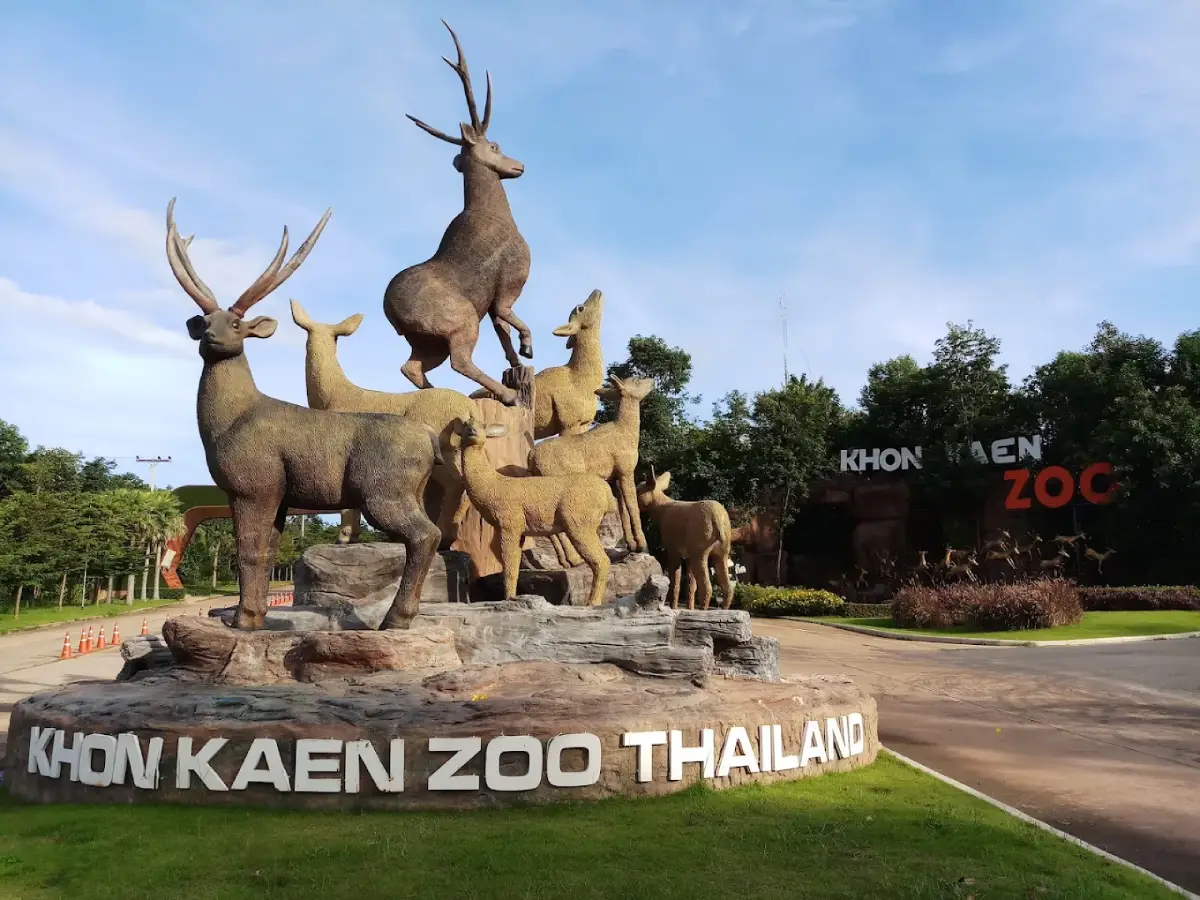
Khon Kaen Zoo, also known locally as Khao Suan Kwang Zoo, is a major wildlife attraction and environmental education destination in northeastern Thailand. Located at 88 Moo 8, Kham Muang Subdistrict, Khao Suan Kwang District, Khon Kaen Province, the zoo occupies a forested hillside landscape known for its natural scenery and expansive wildlife exhibits. Its development combines wildlife conservation with public education, recreation, and opportunities to observe animals in environments designed around the natural terrain. Major attractions include the expansive deer exhibition known as Thung Saen Kwang, elevated animal-viewing walkways, African wildlife exhibits, large predators, scenic viewpoints, animal activities, and recreational facilities for families.
The zoo is frequently called Khao Suan Kwang Zoo because of its location in Khao Suan Kwang District, an area recognized for its natural landscape and distinctive local cuisine. In particular, Khao Suan Kwang grilled chicken has become an established culinary identity of the district. The zoo also occupies a convenient location along the travel corridor connecting Khon Kaen and Udon Thani provinces, making it suitable for visitors traveling between the two cities and families looking for a full-day excursion.
What distinguishes Khon Kaen Zoo from many conventional zoological parks is its hillside setting. Forested slopes, open areas, viewing points, and animal exhibits are distributed across the landscape rather than concentrated within a compact urban site. Visitors experience changes in elevation and scenery as they travel through the zoo. This physical environment creates opportunities to combine wildlife observation with an appreciation of the forests and natural topography of upper northeastern Thailand.
For families with young children, Khon Kaen Zoo offers opportunities to learn outside the classroom. Children can encounter animals previously familiar only through books, films, or educational media and observe their actual size, appearance, movement, and behavior. These experiences help transform abstract descriptions into concrete knowledge and can encourage early curiosity about zoology, ecosystems, and environmental conservation.
The zoo also appeals to adults, students, photographers, and people interested in wildlife. Its diverse animal exhibits provide opportunities for extended observation, while the surrounding hills and vegetation create attractive natural backgrounds. Visitors can concentrate on learning about specific animal groups or enjoy the wider setting as an outdoor destination that differs substantially from attractions located in the center of Khon Kaen city.
The history of Khon Kaen Zoo began with a government initiative to develop part of the forest reserve landscape around Khao Suan Kwang into a center for wildlife conservation and environmental education. The project originally operated under the name Upper Northeastern Wildlife Park, Khon Kaen–Udon Thani. Its objectives included conserving natural resources, conducting wildlife research, supporting the breeding of rare species, encouraging environmental learning, and promoting tourism that could benefit surrounding communities.
April 27, 2009, marked an important stage in the project's establishment when four organizations entered into an academic cooperation agreement. These were the Royal Forest Department, the Department of National Parks, Wildlife and Plant Conservation, Khon Kaen Province, and the Zoological Park Organization. Their cooperation was designed to integrate wildlife conservation, research, education, and tourism development within the Khao Suan Kwang landscape.
A central principle of the project was to encourage people and forests to coexist sustainably. The forest was regarded not merely as undeveloped land but as an ecological system with intrinsic environmental value and opportunities for appropriate community participation. Establishing the wildlife park therefore represented an effort to connect conservation with local education, employment, tourism, and responsible use of natural resources.
The wildlife park opened informally on January 9, 2010, under its original name. On June 26, 2013, the Zoological Park Organization's board approved renaming it Khon Kaen Zoo. Official admission ticket sales began on June 28, 2013, a date subsequently recognized as a major anniversary in the zoo's development. The transition established the site as a public wildlife attraction with an increasingly organized system of animal exhibits and visitor services.
The official opening expanded access to wildlife education for communities throughout northeastern Thailand. Residents of Khon Kaen, Udon Thani, and neighboring provinces gained a major regional destination where children and adults could observe wildlife, participate in educational activities, and spend time outdoors without having to travel to zoological parks in other parts of the country.
The zoo's development is closely associated with the Khao Suan Kwang forest reserve and adjacent natural areas extending toward Udon Thani Province. Hills, forest vegetation, and changing ground elevations contribute to the character of the site. These geographical features influence the arrangement of animal exhibits, visitor facilities, and transportation routes, helping create an environment distinct from zoological parks established on relatively flat urban land.
The natural landscape is an important part of the visitor experience. Forest vegetation, wooded slopes, and changing views accompany journeys between the animal exhibits. Rather than functioning only as decorative scenery, the forest setting provides a practical example of the environmental context in which wildlife conservation takes place. It encourages visitors to consider the relationships between animal species, plant communities, and the landscapes they inhabit.
The original development concept emphasized the importance of achieving a balance between people and forests. Forests support wildlife, vegetation, water systems, and numerous ecological processes. Maintaining healthy forest ecosystems is therefore closely connected with protecting animal populations. The zoo's conservation-oriented educational role provides opportunities to explain why habitat preservation must accompany efforts to protect individual species.
One of Khon Kaen Zoo's best-known attractions is Thung Saen Kwang, an extensive exhibition area featuring deer and other hoofed mammals. The area is designed to allow visitors to observe groups of animals across an open landscape. Elevated viewing facilities provide broad perspectives over the exhibit, making it possible to appreciate both the animals and the spatial arrangement of their surroundings.
The appeal of Thung Saen Kwang lies in observing herbivores behaving within a relatively expansive environment. Some animals walk and forage, while others rest or gather in groups. These everyday activities reveal aspects of feeding behavior, movement, social relationships, and awareness of surrounding conditions. Watching animals over time can provide a more meaningful learning experience than simply identifying each species by name.
Deer and related hoofed mammals differ considerably in body size, coat coloration, antler structure, and natural habitats. Some deer possess large antlers, while smaller animals such as barking deer have different physical characteristics. Eld's deer, another species associated with wildlife conservation in Thailand, provides an opportunity to discuss threatened species and the importance of maintaining viable animal populations.
Hoofed mammals also perform important ecological functions in forests and grasslands. Through their feeding behavior and movement, they interact with vegetation and may contribute to seed dispersal. They are also part of natural food webs, serving as prey for predators in ecosystems where those animals occur. Studying this group helps visitors understand how herbivores, vegetation, and predators contribute to ecological balance.
The extensive deer exhibit is particularly suitable for educational observation because visitors can compare different activities and interactions within the same general area. Teachers and parents can explain the significance of group behavior, feeding patterns, and adaptations while children observe living examples. Such experiences provide a practical starting point for understanding wildlife ecology.
Elevated animal-viewing walkways are another distinctive feature of Khon Kaen Zoo. These facilities allow visitors to observe parts of the exhibits from above, providing a broader perspective on animal movement and the layout of the grounds. Viewing animals from different elevations also highlights the relationship between the exhibits and the surrounding hillside landscape.
In addition to deer and other native or regional hoofed mammals, Khon Kaen Zoo has exhibits associated with African wildlife. Animals such as zebras, giraffes, and other African herbivores are particularly attractive to visitors who want to discover species whose natural habitats differ from those found in Thailand. Their physical appearance, feeding methods, and movement patterns provide clear examples of wildlife diversity.
Zebras are members of the horse family and are immediately recognizable by their distinctive black-and-white stripes. The exact stripe pattern differs between individuals, and zebras typically live in social groups in the wild. Observing them offers opportunities to learn about herd behavior, animal communication, and the characteristics that support survival in grassland environments.
Giraffes are the world's tallest living land mammals. Their exceptionally long necks and legs allow them to reach leaves high in trees, illustrating the relationship between anatomy and feeding behavior. Their movement, body proportions, and specialized physiology provide further opportunities to examine the diversity of mammalian forms.
African wildlife exhibits also contribute to broader environmental education by introducing ecosystems that are geographically distant from Thailand. Comparing African grassland species with Asian forest animals helps visitors appreciate how climate, vegetation, and habitat conditions influence body structure, movement, diet, and social organization. Such comparisons demonstrate the global scale of biodiversity.
The predator exhibits are another major area of interest. Khon Kaen Zoo has a history of exhibiting tigers, lions, and white lions. These animals represent large carnivores whose physical structures and behavior are adapted to hunting and survival. Learning about predators also helps explain their ecological role in influencing the populations and behavior of other animals.
Tigers are powerful members of the cat family with characteristic striped coats that help them blend into certain natural environments. They are generally solitary in the wild and maintain their own territories. Lions differ in their social behavior, commonly living in groups. Comparing these species shows that large carnivores can possess distinctly different social structures even when they belong to the same biological family.
Lions are prominent predators of African ecosystems, particularly known for their group-based social organization. White lions are lions with pale coloration resulting from inherited genetic characteristics, rather than members of a separate species. Their appearance provides an accessible example of genetic variation and the diversity that can exist within a single animal species.
Khon Kaen Zoo publicizes supervised tiger and lion feeding activities, allowing visitors to observe aspects of carnivore feeding behavior while zoo staff manage the animals. These activities must follow strict safety procedures. Visitors must remain in designated areas and must never attempt to feed or approach large predators independently.
Predator exhibits also provide opportunities to discuss animal welfare and the differences between wildlife and domesticated animals. Large carnivores have specialized needs relating to food, space, sensory stimulation, and behavior. Visitors should never strike viewing barriers, make unnecessary noise, reach into exhibits, or disregard instructions from zoo staff. Respecting the animals' environment is essential to responsible wildlife observation.
Another notable species associated with the zoo's educational activities is the white rhinoceros. Native to Africa, this large herbivorous mammal is distinguished by its powerful body, thick skin, and prominent horns. White rhinoceroses are adapted for grazing, and their broad mouths are especially suited to feeding on grasses. Their anatomy provides an excellent example of the relationship between physical structure and diet.
Rhinoceroses are also important subjects in global wildlife conservation. Several rhinoceros species have faced severe population pressures because of poaching and habitat loss. Learning about these animals helps explain why international conservation efforts, habitat protection, and public awareness are essential to the survival of threatened large mammals.
Smaller animals and supervised interactive activities provide additional learning opportunities. Khon Kaen Zoo has publicized experiences involving goats and parrots, with animal feeding conducted under staff supervision. These activities can help children develop confidence around animals while learning to follow appropriate instructions concerning animal handling and feeding.
Goats are herbivorous mammals that display social behavior and characteristic feeding patterns. Observing them allows children to learn about plant-eating animals and how their bodies are adapted to such diets. Interactions should always be gentle and controlled. Visitors should never pull, chase, or force an animal to participate in an activity.
Supervised parrot feeding activities introduce visitors to the anatomy and behavior of birds. Parrots have strong beaks and feet adapted for grasping and manipulating objects. Many species also display sophisticated social behavior and communication. Observing parrots provides an accessible way to compare birds with mammals and to understand how beak structure relates to feeding requirements.
Khon Kaen Zoo is also known for its seal performances, which have been popular among families and children. Seals are marine mammals adapted to life in aquatic environments. Their streamlined bodies and flippers facilitate swimming, while their sensory capabilities and learning behavior make them fascinating subjects for educational interpretation.
The zoo publishes scheduled seal shows at 11:00 and 13:30 on weekdays, with an additional 15:00 show on weekends. The performances have a separate admission charge from the main zoo ticket. Visitors interested in attending these sessions can organize their animal-viewing itinerary around the published show schedule.
The zoo also advertises scheduled tiger and lion feeding demonstrations at 11:00 and 14:30, with no demonstrations on Wednesdays. These activities provide opportunities to observe carnivore feeding and to learn about the nutritional requirements of large predators. All feeding activities are managed by trained zoo personnel.
Khon Kaen Zoo provides educational opportunities for visitors of different ages. Students can investigate the differences between herbivores and carnivores, mammals and reptiles, birds and terrestrial animals, as well as adaptations to particular habitats. Observing wildlife directly helps connect biological concepts with living examples and strengthens understanding of ecological relationships.
From an ecosystem perspective, the zoo introduces several types of animals adapted to different environments. Certain species are associated with grasslands, while others occupy forests or habitats near water. These differences demonstrate that biodiversity depends on varied environments and that conservation strategies must reflect the needs of individual species and the ecological systems that support them.
Outdoor learning encourages students to practice observation, questioning, and reasoning. A child may wonder why giraffes have long necks, why zebras have stripes, or why certain animals live in groups. Such questions provide natural starting points for explanations about adaptation, evolution, behavior, and ecological relationships, making scientific learning more engaging.
Khon Kaen Zoo also contributes to wildlife conservation and research through the broader responsibilities of the Zoological Park Organization of Thailand. Professional animal care requires knowledge of zoology, veterinary medicine, nutrition, behavioral science, and environmental management. These disciplines support the welfare of different animal species and contribute to the professional management of zoological institutions.
Wildlife conservation extends beyond caring for individual animals in managed environments. It also involves maintaining natural habitats, protecting genetic diversity, and educating the public about threats such as deforestation and illegal wildlife trade. Zoological institutions with strong educational programs can help visitors understand these wider conservation challenges and their relevance to everyday environmental responsibility.
One of the zoo's distinctive recreational developments is the water park known as Thale Bon Phu, meaning a sea on the mountain. The facility was first opened on February 28, 2014, as an additional family recreation attraction. Developed on an area of approximately 15 rai, the original concept was to provide aquatic recreation in a hillside setting, creating a different experience from conventional coastal or urban water attractions.
The water park project has historically featured swimming pools for adults and children, waterslides, and other water-based recreational facilities. Its concept combines leisure activities with the surroundings of Khao Suan Kwang's elevated landscape. Access to individual facilities and attractions is governed by the current operational arrangements and safety requirements of the water park.
Families interested in water activities should bring suitable swimwear and personal equipment, supervise children closely, and follow staff instructions. Time should be allocated separately for wildlife observation and recreational activities, since exploring the extensive zoo grounds can occupy several hours. Safe and comfortable participation depends on appropriate planning and allowing adequate rest.
Scenic viewpoints are another attractive feature of Khon Kaen Zoo. The elevated terrain offers opportunities to appreciate the surrounding landscape, wooded hills, and broader views of the area. These viewpoints distinguish the zoo from zoological facilities established on flat urban land and provide additional interest for landscape photographers and nature enthusiasts.
Viewing areas and walkways also illustrate the relationship between terrain and the design of a nature-based tourist attraction. Developing visitor access on sloping land requires consideration of safety, drainage, and environmental impact. Guests should remain on designated routes and observe all restrictions concerning barriers and areas not open to the public.
Because Khon Kaen Zoo occupies a large and varied landscape, its internal sightseeing vehicles are particularly useful. The zoo operates as a closed-vehicle exhibition area, meaning that visitors are not permitted to drive their private cars through the animal-viewing sections. Instead, designated visitor transportation is provided to help manage movement and improve safety within the park.
Sightseeing vehicles make it easier for older travelers, families with small children, and visitors who prefer not to walk long distances to explore several exhibits. Such transportation can also reduce fatigue during hot weather and allow more time to be spent observing animals rather than walking between different sections.
Golf cart services provide another transport option for visitors seeking greater flexibility within permitted routes. The most appropriate choice depends on the number of travelers, available time, physical ability, and zoo operating conditions. Planning which exhibits to visit first is especially useful during busy periods or when several activities are scheduled on the same day.
Morning is generally a convenient time to begin exploring Khon Kaen Zoo because temperatures are often more comfortable and there is ample time to visit several exhibits. Arriving near opening time makes it easier to organize a schedule that includes wildlife exhibits, seal shows, and other available activities while leaving sufficient time for meals and rest.
Weather conditions should be considered because most of the zoo experience takes place outdoors on elevated terrain. Hot-season temperatures can be high during the day, making drinking water, hats, and sun protection important. The rainy season brings greener surroundings but may also produce slippery surfaces and wet pathways. During the cooler season, some days are particularly pleasant for walking and outdoor wildlife observation.
Comfortable walking shoes, light clothing, drinking water, and weather protection are useful for visitors planning to spend several hours at the zoo. Families with young children should bring appropriate personal supplies and allow regular breaks. Older visitors may find the internal transport services especially helpful because of the distances and slopes between certain exhibit areas.
Wildlife photography is another enjoyable activity at the zoo, where diverse animals are presented against a backdrop of forested hills and natural vegetation. Visitors should photograph animals from designated viewing locations, avoid extending equipment through barriers, refrain from calling or provoking animals for photographs, and avoid flash photography when it may disturb wildlife.
Animal behavior changes throughout the day. Some species are more active in the morning or evening, while others spend substantial periods resting during daylight hours. Visitors should allow animals to behave naturally rather than expecting continuous movement or interaction. Resting, feeding, and the use of different parts of an enclosure can all provide valuable information about a species' behavior.
Responsible conduct is essential during any visit. Guests should not bring unauthorized food for animals, make excessive noise, strike barriers, or enter restricted areas. Animals have different nutritional needs, and foods suitable for people may be harmful to them. Feeding should occur only through officially permitted activities managed by zoo staff.
Khon Kaen Zoo also plays a role in the local economy of Khao Suan Kwang District. As a major regional attraction, it supports demand for restaurants, accommodation, transportation, and other visitor services. Travelers can combine their zoo experience with local dining and shopping, extending the economic benefits of tourism to businesses and communities beyond the zoo grounds.
The district is particularly famous for Khao Suan Kwang grilled chicken, an established northeastern Thai specialty. Chicken is seasoned with herbs and spices before being grilled, producing a flavorful dish commonly enjoyed with sticky rice, papaya salad, and other regional foods. A zoo visit can therefore be combined with an opportunity to experience one of the district's most recognizable culinary traditions.
Numerous restaurants and roadside services are located along Mittraphap Road, the main highway connecting Khon Kaen and Udon Thani. Stopping for grilled chicken has become a familiar part of journeys through the district. Visitors can choose restaurants in Kham Muang or central Khao Suan Kwang before or after exploring the zoo, depending on their travel direction and schedule.
Beyond food and wildlife, Khao Suan Kwang offers other natural and cultural attractions. These include Wat Pa Khao Suan Kwang Tat Fa, Tat Fa Waterfall, Kinnaree Cave, and surrounding forested hills. Together, these destinations create opportunities to experience the area's religious traditions, natural landscape, and local way of life in addition to its well-known zoo.
Wat Pa Khao Suan Kwang Tat Fa is a forest monastery surrounded by a quiet natural landscape. Its setting reflects the atmosphere of northeastern Thailand's forest-monastery tradition, which emphasizes simplicity, restraint, meditation, and living in harmony with nature. Visitors interested in Buddhist culture can combine a peaceful temple visit with wildlife sightseeing in the same district.
Tat Fa Waterfall and Kinnaree Cave are natural features associated with the forest-monastery area. They add geological and ecological interest to a trip around Khao Suan Kwang, with rocky terrain, forest vegetation, and seasonal water features. Visitors should respect the monastery environment, observe local access rules, and consider weather and terrain conditions before exploring natural areas.
For travelers using rail transport, Khao Suan Kwang Railway Station provides a connection to the district. Visitors can continue from the station to the zoo using local hired transportation. Rail travel offers an alternative for people who do not wish to drive and provides a connection between regional public transport and the area's natural attractions.
Traveling from Khon Kaen city to the zoo is straightforward by private vehicle using Highway 2, also known as Mittraphap Road, in the direction of Udon Thani. Visitors then follow the roads and signs toward Khao Suan Kwang Zoo. Depending on the starting point and chosen route, the journey from Khon Kaen city covers approximately 50–65 kilometers, making the destination suitable for a day trip.
Travelers coming from Udon Thani can follow Mittraphap Road south toward Khon Kaen and turn toward Khao Suan Kwang District before continuing to the zoo. Its position between the two provincial cities makes it an accessible destination for visitors from both directions and allows the attraction to be included in a broader northeastern Thailand itinerary.
Private car users can park at the zoo's designated parking areas and use the available visitor transportation within the grounds. The animal-viewing areas are managed without private cars, which helps organize internal traffic and protect the experience of visitors and the animals. Sightseeing vehicles and golf carts form an important part of the zoo's transport arrangements.
Public transport travelers can use intercity services operating along the Khon Kaen–Udon Thani corridor and continue from Khao Suan Kwang using local transport. Train passengers can also use Khao Suan Kwang Station as a connection point. Organizing onward transport is particularly important for families and visitors traveling with young children.
Accommodation options in Khao Suan Kwang and nearby areas include small hotels, resorts, and roadside lodging establishments serving travelers on the Mittraphap Road corridor. Staying in the district is convenient for visitors who want to begin their zoo excursion early. Those planning additional sightseeing in Khon Kaen city may instead choose accommodation in the provincial capital and visit the zoo on a day trip.
A one-day visit can begin with an early arrival, followed by wildlife viewing across several exhibition zones. After lunch, visitors can attend scheduled animal activities or explore exhibits they have not yet seen before returning to Khao Suan Kwang for local food. This approach offers a balance of wildlife education, recreation, and regional cuisine without requiring an excessively rushed itinerary.
Travelers interested in both nature and culture can extend their outing to Wat Pa Khao Suan Kwang Tat Fa and nearby natural features. Separating sufficient time for animal exhibits and monastery visits allows each destination to be enjoyed at an appropriate pace. Such an itinerary introduces different aspects of the district, including wildlife, forests, religious heritage, and everyday community life.
Khon Kaen Zoo has continued developing as a regional center for tourism and wildlife education. Its services include electronic admission arrangements and visitor activities designed for different age groups. The zoo has also received several Thailand Tourism Awards, reflecting its established position among the country's recognized visitor attractions.
The institution's significance is also linked to environmentally responsible tourism. Using shared transportation within the zoo, keeping the grounds clean, respecting natural areas, and following wildlife protection rules are practical ways to reduce the impact of visitors. Public transport and organized group journeys provide additional options for travelers interested in reducing the environmental effects of their trips.
Overall, Khon Kaen Zoo brings together wildlife tourism, conservation, and environmental education in a distinctive hillside setting. Its evolution from the Upper Northeastern Wildlife Park into an established zoological destination, together with attractions such as Thung Saen Kwang, African wildlife exhibits, predator exhibits, scenic viewpoints, and educational activities, makes it a significant destination for families and nature enthusiasts. It offers visitors a chance to enjoy northeastern Thailand's landscapes while developing a deeper appreciation of wildlife, forest ecosystems, and the relationship between people and nature.
Getting There Khon Kaen Zoo is located at 88 Moo 8, Kham Muang Subdistrict, Khao Suan Kwang District, Khon Kaen Province 40280, Thailand. From Khon Kaen city, follow Highway 2 (Mittraphap Road) toward Udon Thani and continue along the signed route to the zoo. Travelers from Udon Thani can follow the same highway south toward Khon Kaen. Those arriving by train can alight at Khao Suan Kwang Station and continue by local hired transport. For information about admission and visitor services, contact +66 86 455 6341 or +66 86 459 4192.
| Name | Khon Kaen Zoo (Khao Suan Kwang Zoo) |
| Category | Zoological Park, Nature Attraction, Wildlife Conservation and Education Center |
| Address | 88 Moo 8, Kham Muang Subdistrict, Khao Suan Kwang District, Khon Kaen Province 40280, Thailand |
| Landscape | Forested hills within the Khao Suan Kwang landscape and adjoining protected forest areas in upper northeastern Thailand |
| Managing Organization | Zoological Park Organization of Thailand, Under the Royal Patronage of H.M. the King |
| History | April 27, 2009: Cooperation agreement establishing the Upper Northeastern Wildlife Park project January 9, 2010: Informal opening June 26, 2013: Renamed Khon Kaen Zoo June 28, 2013: Official admission operations began |
| Highlights | Thung Saen Kwang Deer Exhibit, Elevated Animal-Viewing Walkways, African Wildlife, Predators, Seal Shows, Scenic Viewpoints, and Family Recreation Facilities |
| Main Areas and Zones | Thung Saen Kwang, African Wildlife Exhibits, Tiger and Lion Exhibits, White Rhinoceros Exhibits, Small Animal Activities, Seal Show Area, Scenic Viewpoints, and Thale Bon Phu Water Park Area, Subject to Operational Availability |
| Notable Animals | Deer, Barking Deer, Eld's Deer, Zebras, Giraffes, Tigers, Lions, White Lions, White Rhinoceroses, Seals, Goats, and Parrots. Individual animal viewing depends on exhibit operations and animal care. |
| Activities | Wildlife Viewing, Sightseeing Vehicle Tours, Seal Shows, Tiger and Lion Feeding Demonstrations, Supervised Animal Feeding, Nature Education, and Recreational Activities |
| Open Days | Daily, Including Public Holidays |
| Opening Hours | 08:30 – 16:30 |
| Thai Visitor Admission | Adults: THB 130; Children Aged 3–12: THB 40 |
| Foreign Visitor Admission | Adults: THB 350; Children: THB 120 |
| Free Admission | Children Under 3, Buddhist Monks and Novices, War Veterans, Visitors With Disabilities, and Seniors Aged 60 and Above, Subject to Admission Policies |
| Parking Fees | Motorcycles: THB 10; Cars: THB 50; Buses With Six or More Wheels: THB 60 |
| Seal Show | Monday–Friday: 11:00 and 13:30 Saturday–Sunday: 11:00, 13:30, and 15:00 Show Tickets: Adults THB 20, Children THB 10 |
| Tiger and Lion Feeding Demonstrations | 11:00 and 14:30; No Demonstrations on Wednesdays; No Additional Admission Charge |
| Facilities | Parking, Restrooms, Visitor Service Areas, Sightseeing Vehicles, Golf Carts, Animal-Viewing Walkways, and Family Activity Areas |
| Getting There | Take Highway 2 (Mittraphap Road) between Khon Kaen and Udon Thani, then follow the signs to Khao Suan Kwang Zoo. Train passengers can continue by local transport from Khao Suan Kwang Railway Station. |
| Contact Numbers | General Administration: +66 86 455 6341 Business Development and Public Relations: +66 86 459 4192 Education Department: +66 86 455 6340 |
| Official Website | https://khonkaen.zoothailand.org/ |
| Current Status | Open to Visitors |
| Nearby Tourist Attractions | 1. Million-Year-Old Rock Viewpoint, Within the Zoo Grounds 2. Thung Saen Kwang, Within the Zoo Grounds 3. Thale Bon Phu Water Park Area, Within the Zoo Grounds 4. Khao Suan Kwang Arboretum, Kham Muang Subdistrict 5. Wat Pa Khao Suan Kwang Tat Fa, Khao Suan Kwang District 6. Tat Fa Waterfall, Wat Pa Khao Suan Kwang Tat Fa Area 7. Kinnaree Cave, Wat Pa Khao Suan Kwang Tat Fa Area |
| Nearby Restaurants and Route Dining | 1. Kai Yang Wanna, Mittraphap Road, Kham Muang, Tel. +66 43 449 024, +66 81 965 5484 2. Kai Yang Rabiap, Khao Suan Kwang, Mittraphap Road, Tel. +66 43 449 055 3. Wan Kai Yang Khao Suan Kwang, Kham Muang, Tel. +66 83 355 3535 4. Um Im Traditional Grilled Chicken, Khao Suan Kwang, Tel. +66 84 403 9503 5. Khao Suan Kwang Grilled Chicken Food Center, Kham Muang, Tel. +66 81 871 1940 |
| Nearby Accommodations | 1. Suan Kwang Resort & Spa, Khao Suan Kwang, Tel. +66 89 416 8717 2. Well House Khao Suan Kwang, Tel. +66 90 341 3801 3. Amp Inn Resort, Khao Suan Kwang, Tel. +66 61 282 4891 4. Baan Suan Phuang Phet Resort, Khao Suan Kwang, Tel. +66 97 923 6461 5. Tan Diao Resort, Mittraphap Road, Khao Suan Kwang |
Frequently Asked Questions (FAQ)
Q: Where is Khon Kaen Zoo located?
A: Khon Kaen Zoo is located at 88 Moo 8, Kham Muang Subdistrict, Khao Suan Kwang District, Khon Kaen Province, along the travel corridor between Khon Kaen and Udon Thani.
Q: Is Khon Kaen Zoo open every day?
A: Yes. The zoo is open daily, including public holidays, from 08:30 to 16:30.
Q: How much does admission to Khon Kaen Zoo cost?
A: Admission for Thai visitors is THB 130 for adults and THB 40 for children aged 3–12. Foreign visitors pay THB 350 for adults and THB 120 for children. Children under 3 and other eligible visitors receive free admission under the zoo's policies.
Q: What animals can visitors see at Khon Kaen Zoo?
A: The main attractions include deer and other hoofed mammals at Thung Saen Kwang, zebras, giraffes, tigers, lions, white rhinoceroses, seals, and additional animals according to exhibit availability.
Q: What is Thung Saen Kwang?
A: Thung Saen Kwang is a large deer and hoofed animal exhibit featuring elevated viewing facilities that allow visitors to observe animals and their surroundings from a broad perspective.
Q: Does Khon Kaen Zoo have seal shows?
A: Yes. Published seal show times are 11:00 and 13:30 on weekdays, with an additional 15:00 show on Saturdays and Sundays. A separate admission fee applies.
Q: Can visitors drive their own cars through the animal exhibits?
A: No. Private vehicles are not permitted inside the animal-viewing sections. The zoo provides sightseeing transportation and golf cart services for visitors.
Q: What other attractions can travelers visit near Khon Kaen Zoo?
A: Nearby destinations include Wat Pa Khao Suan Kwang Tat Fa, Tat Fa Waterfall, Kinnaree Cave, and Khao Suan Kwang Arboretum. Travelers can also enjoy Khao Suan Kwang grilled chicken, one of the district's best-known local specialties.
 Category: ●Entertainment and Agricultural
 Group: ●Zoos and Aquariums
Last Update : 1 WeekAgo
 Last Update : 1 WeekAgo
 Click to Access the Navigation Map GPS
Khon Kaen Zoo Map
Recommend

 Art, Culture and Heritage
 Historical Sites and Monuments(7)
 Landmarks and Memorials(3)
 Art, Craft Centres, Tradition(2)
 Museums(4)
 Educational Places
 Museum for Study(2)
 Places of Worship
 Temple(27)
 Other Sacred Sites(5)
 Suburban Living
 Village, Community(3)
 Local Market(1)
 Nature and Wildlife
 National Parks and Marine Reserves(5)
 Mountain (Doi)(1)
 Dam, Reservoir, Lake(4)
 Waterfalls(8)
 Caves(9)
 River, Canal(10)
 Bays and Beaches(3)
 Islands(1)
 Other natural attractions(5)
Zoos and Aquariums(2)
 Animal camps and shows(2)
 Farms, Parks and Ecotourism(7)
 Waterpark(3)
 Travel Articles, Recipes
 Travel Review, Food Review(1)


