
lovethailand home >Northeastern Travel Attractions >Kalasin Travel Attractions >Kamalasai >Nong Paen > Phra That Ya Khu
TL;DR: Phra That Ya Khu is located at Fa Daet Song Yang Ancient City, Ban Sema, Nong Paen Subdistrict, Kamalasai District, Kalasin Province, open Daily, hours 08.30 – 16.30.
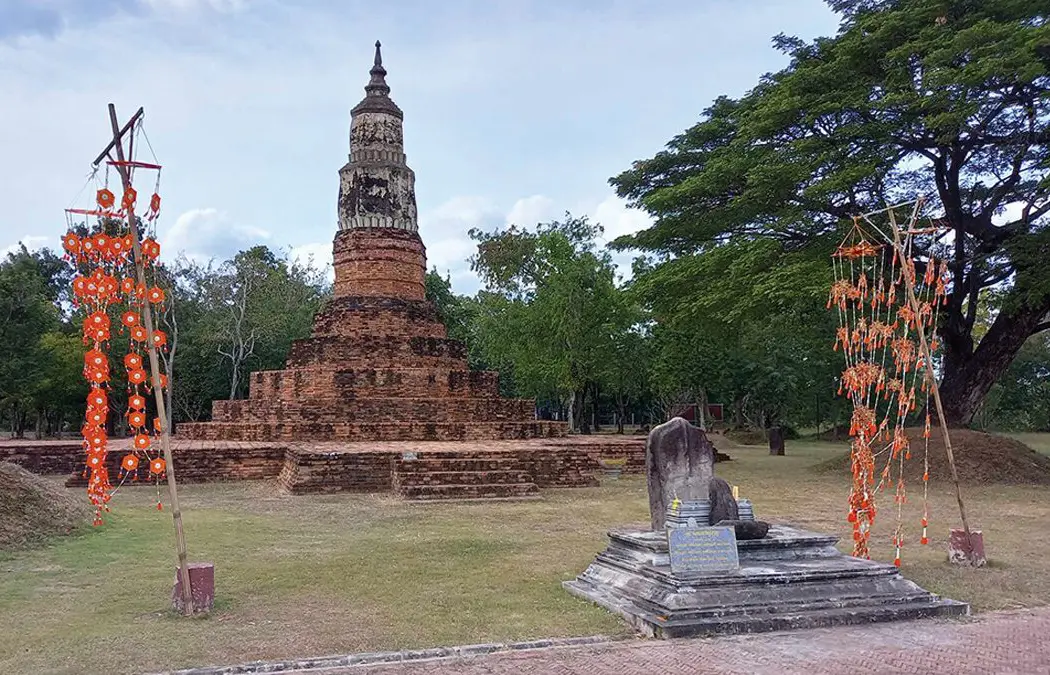
Phra That Ya Khu
Open Days: Daily
Opening Hours: 08.30 – 16.30
Phra That Ya Khu, also known as Phra That Yai in Kalasin Province, is one of the most important ancient monuments within the historic city of Fa Daet Song Yang. It is the largest chedi in the ancient city and is widely recognized for its distinctive octagonal brick structure, which preserves evidence of construction and restoration across 3 major periods: Dvaravati, Ayutthaya, and Rattanakosin. Around the chedi, sandstone boundary markers carved with low-relief Buddhist narratives were found, making this site a valuable destination for archaeology, Buddhist art, local belief, and cultural travel in northeastern Thailand.
Phra That Ya Khu is located in Ban Sema, Nong Paen Subdistrict, Kamalasai District, Kalasin Province, within the archaeological landscape of Fa Daet Song Yang. The site stands in an open plain, creating a calm and spacious atmosphere where visitors can clearly see the ancient brick chedi rising above the surrounding ground. For travelers, this is not only a place to pay respect to a sacred monument, but also a meaningful site for learning about Dvaravati-period Buddhism, the ancient settlement patterns of the Chi, Pao, and Phan river basins, and the living cultural identity of the local community.
Fa Daet Song Yang was an important ancient city in northeastern Thailand. Its oval-shaped layout, surrounded by moats and earthen embankments, reflects an organized settlement with clear urban planning and sacred zones. Archaeological remains found in the area include ancient brick foundations, religious structures, pottery fragments, sandstone boundary markers, and Buddhist-related artifacts. Phra That Ya Khu should therefore be understood not as an isolated chedi, but as a central sacred landmark within a wider ancient city that once played an important role in religious and cultural life.
The name “Ya Khu” or “Yaku” comes from a local Isan term referring to a senior monk or respected elder monk. Local belief holds that the chedi enshrines the remains of a revered Buddhist elder who was respected by the people of the ancient city. This meaning gives Phra That Ya Khu a deep emotional and spiritual significance. It represents reverence for Buddhism, respect for teachers and monks, and the long relationship between the people of Ban Sema and this sacred landscape.
The architectural value of Phra That Ya Khu is especially important because the monument shows different layers of construction. The lower base is square with indented corners, stairways on 4 sides, and traces of stucco decoration associated with the Dvaravati period. Above it is an octagonal base added over the original structure during the Ayutthaya period. The bell-shaped section and the upper spire were later restored or completed during the Rattanakosin period. Looking at the chedi is therefore like reading history through brickwork, layers of form, and successive phases of religious devotion.
The octagonal form gives Phra That Ya Khu a distinctive identity among ancient monuments in the region. From a distance, the chedi appears solid, balanced, and solemn. Up close, visitors can observe the texture of old bricks, the rhythm of the stepped base, and the projections that extend from the structure. These features reveal the skill of ancient builders and also show that the monument continued to be important to later generations, who restored and strengthened it instead of abandoning it.
Phra That Ya Khu is also significant as a site for studying Dvaravati art in northeastern Thailand. Sandstone sema stones, or Buddhist boundary markers, were found around the monument. Many of them are carved with low-relief images related to the life of the Buddha and Buddhist narratives. These sema stones served not only as artistic objects but also as markers of sacred space and as visual tools for communicating Buddhist teachings to people in the past.
The sema stones of Fa Daet Song Yang are among the most important pieces of evidence for understanding early Buddhism in the Isan region. Their carved images demonstrate craftsmanship, religious knowledge, and the presence of organized Buddhist communities. When considered together with the location of Phra That Ya Khu inside the ancient city, these finds indicate that the area once functioned as a major sacred and ceremonial zone.
One of the most memorable stories associated with Phra That Ya Khu concerns the survival of the chedi during a period of conflict. Local tradition says that when Chiang Som defeated Fa Daet Song Yang and destroyed many parts of the city, Phra That Ya Khu was not destroyed. This belief strengthens the sacred status of the monument in the eyes of local people. It is seen as a protected and powerful place, and as one of the clearest surviving symbols of the ancient city.
From an archaeological perspective, Phra That Ya Khu is a nationally registered historic site and is under the care of the Fine Arts Department. Excavation, conservation, and restoration work have helped preserve the form of the chedi and the surrounding archaeological features. Thanks to these efforts, visitors today can still appreciate the scale, form, and historical depth of the monument while walking through a cultural landscape that retains much of its original significance.
When visitors approach Phra That Ya Khu, the first impression is often the quiet dignity of the red-brown brick chedi standing in an open field. The color of the old bricks changes subtly with the light. In the morning, the monument feels soft and peaceful; in the late afternoon, the shadows emphasize the texture of the brickwork and the stepped base. For photography, walking around the chedi allows visitors to capture different angles of the octagonal form, the wide base, and the upper spire.
A meaningful visit to Phra That Ya Khu should take at least 30 minutes to 1 hour. Rather than stopping only for a quick photograph, visitors should walk around the 4 sides of the monument, observe the lower base, look at the brick patterns, and consider how the chedi relates to the larger ancient city. The site becomes much more interesting when it is seen as part of Fa Daet Song Yang rather than as a single monument standing alone.
The important areas around Phra That Ya Khu include the main chedi, archaeological structure number 10, subsidiary chedis, sema stone areas, open ground around the monument, and the wider ancient city landscape. Nearby Wat Pho Chai Semaram, also known as Wat Ban Kom, is another important stop. This old temple preserves many sema stones and artifacts found in the area, making it a useful companion site for travelers who want to understand the cultural and religious context of Phra That Ya Khu.
Beyond its historical value, Phra That Ya Khu remains closely connected with local rituals and community traditions. Every year around the full moon of the 6th lunar month, usually in May, local people hold the Phra That Ya Khu bathing ceremony and the Bun Bang Fai rocket festival. These traditions include merit-making, sacred bathing rites, prayers for rain, and communal ceremonies for fertility and prosperity. They show the deep relationship between Buddhism, agricultural life, and Isan beliefs.
The Bun Bang Fai festival at Phra That Ya Khu is not only a festive event. It is a ritual expression of the community’s hope for rain, agricultural abundance, and peace in the village. In farming communities, rainfall is central to life, rice cultivation, and seasonal rhythm. Holding the rocket festival in connection with the sacred chedi strengthens the role of Phra That Ya Khu as both a spiritual center and a symbol of collective well-being.
Another major event associated with Phra That Ya Khu is the Magha Purnami Bucha Festival, known for the spectacular “Sea of Isan Tung.” During this festival, thousands of colorful Isan ceremonial flags are displayed around the ancient monument, creating one of Kalasin’s most striking cultural scenes. Tung flags are traditional offerings in Isan Buddhist culture, and their presence around the chedi transforms the ancient site into a vivid landscape of devotion, art, and community identity.
The Magha Purnami Bucha Festival often includes ceremonies to honor Phra That Ya Khu, traditional dances, processions, candlelight activities, and cultural performances that tell the story of Fa Daet Song Yang. These activities show that the ancient monument is not merely a ruin. It is a living cultural place where local people continue to gather, worship, perform, remember, and pass on their heritage.
During festival periods, visitors may see local people dressed in traditional clothing, women wearing Phrae Wa textiles, dancers performing in honor of the chedi, and colorful flags moving in the wind. These scenes expand the meaning of Phra That Ya Khu beyond architecture. They reveal a living cultural system in which archaeology, faith, craft, and community participation come together.
For travelers interested in history, Phra That Ya Khu offers a valuable window into early Buddhism in the central Isan region. The Chi, Pao, and Phan river basins supported ancient settlement and cultural exchange. The presence of sema stones, ancient structures, and Buddhist imagery at Fa Daet Song Yang indicates that this city was once a significant religious center. Phra That Ya Khu remains one of the strongest pieces of evidence connecting that past with the present.
For general visitors, the site is accessible and easy to appreciate. The chedi stands clearly in an open area, making it simple to walk around and observe. Even travelers without archaeological background can immediately sense the age and dignity of the place. Those who want a deeper visit can study the base, the octagonal structure, the brickwork, and the relationship between the chedi and the sema stones to understand how sacred space was organized in the past.
The best times to visit Phra That Ya Khu are in the morning or late afternoon, when the weather is more comfortable and the light is suitable for photography. During the Sea of Isan Tung festival or the annual bathing ceremony in May, visitors should allow more time because there are more people, more cultural activities, and many additional photo opportunities. A festival visit gives a very different experience from an ordinary day because it reveals the active relationship between the monument and the local community.
Visitors should dress respectfully, avoid climbing on restricted parts of the monument, refrain from touching or moving ancient objects, and help keep the area clean. Phra That Ya Khu is both a national historic site and a sacred place for local people. Responsible behavior helps protect the monument and ensures that future generations can continue to learn from and pay respect to this important cultural heritage.
Getting There from Kalasin town is most convenient by private car. Take Highway 214 toward Kamalasai District, then continue onto Highway 2367 toward Ban Sema in Nong Paen Subdistrict. The distance from Kalasin town is about 19 km. Travelers using public transport should first reach Kalasin town and then arrange local transport or a hired vehicle to Ban Sema. A private car or hired driver is recommended for visitors who want to combine Phra That Ya Khu with Wat Pho Chai Semaram, Kalasin old town attractions, and other sites in the province.
A half-day itinerary can include Phra That Ya Khu, Fa Daet Song Yang ancient city, and Wat Pho Chai Semaram, since these places are close to each other. A full-day itinerary can add Rong Si Market in Kalasin town, Luang Pho Ong Dam at Wat Klang, and local restaurants in Kamalasai or Kalasin town. Travelers with a strong interest in history and museums may continue to Sirindhorn Museum and other attractions in Sahatsakhan District.
Phra That Ya Khu suits many types of travelers. History lovers can study Dvaravati and later-period architecture. Buddhist travelers can pay respect to a sacred chedi deeply revered by the community. Cultural travelers can learn about the bathing ceremony, rocket festival, and Sea of Isan Tung. Photographers can capture the ancient brick chedi, festival colors, and the rural Isan landscape that gives the site its distinctive atmosphere.
What makes Phra That Ya Khu especially valuable is that it remains connected to the living community. Some ancient sites are visited only as ruins, but Phra That Ya Khu continues to be used in rituals, festivals, dances, processions, and local storytelling. It is a place where the past is not silent. The monument, the flags, the ceremonies, and the people of Ban Sema together create a living cultural heritage.
A visit to Phra That Ya Khu should therefore be more than a search for impressive architecture. Visitors should pay attention to the meaning embedded in the layers of brick, the form of the base, the sema stones, and the seasonal rituals. This chedi preserves the story of Buddhism, artistic skill, respect for senior monks, agricultural beliefs, and the collective identity of the local community.
Today, Phra That Ya Khu remains one of Kalasin’s essential cultural destinations. Standing before the octagonal brick chedi within the ancient city of Fa Daet Song Yang allows travelers to experience one of the most meaningful links between ancient Isan civilization and the faith of present-day local people. It is a place where history, spirituality, and community life can be understood in a single visit.
| Name | Phra That Ya Khu, also known as Phra That Yai |
| Location | Fa Daet Song Yang Ancient City, Ban Sema, Nong Paen Subdistrict, Kamalasai District, Kalasin Province |
| Address | Moo 7, Ban Sema, Nong Paen Subdistrict, Kamalasai District, Kalasin Province 46130, Thailand |
| Coordinates | Latitude 16.3191762, Longitude 103.5180786 |
| Highlights | The largest chedi in Fa Daet Song Yang Ancient City, an octagonal brick monument with construction evidence from the Dvaravati, Ayutthaya, and Rattanakosin periods, and a major center for local ceremonies and the Sea of Isan Tung festival |
| History | The lower base belongs to the Dvaravati period, the octagonal base was added in the Ayutthaya period, and the bell-shaped section and spire were restored or completed in the Rattanakosin period |
| Name Origin | The word “Ya Khu” or “Yaku” refers to a senior monk; local belief holds that the chedi enshrines the remains of a respected Buddhist elder |
| Distinctive Features | Octagonal brick chedi with indented base, stairways on 4 sides, Dvaravati stucco traces, and sandstone sema stones carved with Buddhist narratives found around the monument |
| Key Evidence | Dvaravati-period base, Ayutthaya-period octagonal structure, Rattanakosin-period upper section, sandstone sema stones, subsidiary ancient structures, and the moats and embankments of Fa Daet Song Yang |
| Traditions / Rituals | Phra That Ya Khu bathing ceremony, Bun Bang Fai rocket festival in May, and the Magha Purnami Bucha Festival with the Sea of Isan Tung |
| Main Areas / Zones | Main Phra That Ya Khu chedi, archaeological structure number 10, subsidiary chedis, sema stone area, Fa Daet Song Yang ancient city landscape, moats and embankments, and festival grounds for the bathing ceremony and Sea of Isan Tung |
| Travel Information | From Kalasin town, take Highway 214 toward Kamalasai District, then continue on Highway 2367 to Ban Sema. The distance is about 19 km from Kalasin town |
| Current Status | Open to visitors and worshippers; registered as a national historic site under the care of the Fine Arts Department |
| Open Days | Daily |
| Opening Hours | 08.30 – 16.30 |
| Fees | No admission fee |
| Caretaker | Fine Arts Department |
| Nearby Tourist Attractions | 1. Wat Pho Chai Semaram, or Wat Ban Kom, about 0.4 km 2. Fa Daet Song Yang Ancient City, about 1 km 3. Ban Sema Community and Tung-making learning area, about 1 km 4. Rong Si Market in Kalasin town, about 19 km 5. Luang Pho Ong Dam at Wat Klang, about 20 km |
| Nearby Restaurants | 1. Na Mae Yai, about 4 km, Tel. 065-737-5195 2. Chuleerat Jaew Hon, about 6 km, Tel. 093-835-9154 3. hung huang Kalasin, about 6 km, Tel. 086-356-4496 4. Khun Ya Cafe & Coffee, about 9 km 5. Kuai Tiao Nai Bai Yorn Yuk, about 9 km |
| Nearby Accommodations | 1. Cha-Long Boutiques, about 10 km, Tel. 043-811-789 2. The Grace Kalasin, about 11 km, Tel. 085-117-1790 3. TK Residence, about 12 km, Tel. 095-338-0515 4. Farisa Garden Hotel, about 12 km, Tel. 088-563-2044, 081-380-9590, 080-763-5150 5. Rimpao Hotel, about 12 km, Tel. 043-813-631 |
Frequently Asked Questions (FAQ)
Q: Where is Phra That Ya Khu located?
A: Phra That Ya Khu is located in Fa Daet Song Yang Ancient City, Ban Sema, Nong Paen Subdistrict, Kamalasai District, Kalasin Province, about 19 km from Kalasin town.
Q: Why is Phra That Ya Khu important?
A: It is the largest chedi in Fa Daet Song Yang Ancient City and preserves architectural evidence from the Dvaravati, Ayutthaya, and Rattanakosin periods. It is also a sacred center for the local Ban Sema community.
Q: What does the name Phra That Ya Khu mean?
A: “Ya Khu” or “Yaku” refers to a senior monk. Local people believe that the chedi enshrines the remains of a respected Buddhist elder.
Q: Is there an admission fee for Phra That Ya Khu?
A: No. Visitors can enter and pay respect to the monument without an admission fee during visiting hours.
Q: When is the best time to visit Phra That Ya Khu?
A: Morning and late afternoon are the best times for comfortable weather and photography. The Sea of Isan Tung festival and the annual bathing ceremony in May offer a richer cultural experience.
Q: How is Phra That Ya Khu connected to the Bun Bang Fai rocket festival?
A: Local people hold the rocket festival and the Phra That Ya Khu bathing ceremony around May to pray for rain, fertility, and peace for the community.
Q: What attractions can travelers visit near Phra That Ya Khu?
A: Nearby places include Wat Pho Chai Semaram, Fa Daet Song Yang Ancient City, Ban Sema Community, Rong Si Market, and Luang Pho Ong Dam at Wat Klang.
Q: How can visitors travel to Phra That Ya Khu?
A: From Kalasin town, take Highway 214 toward Kamalasai District, then continue on Highway 2367 to Ban Sema. A private car is the most convenient option.
 Category: ●Places of Worship
 Group: ●Other Sacred Sites
Last Update : 4 MonthAgo
 Last Update : 4 MonthAgo
 Click to Access the Navigation Map GPS

 Art, Culture and Heritage
 Historical Sites and Monuments(2)
 Landmarks and Memorials(3)
 Art, Craft Centres, Tradition(4)
 Museums(3)
 Art Gallery(1)
 Educational Places
 Educational Gardens, Farm(1)
 Temple(21)
Other Sacred Sites(7)
 Suburban Living
 Village, Community(3)
 Nature and Wildlife
 National Parks and Marine Reserves(3)
 Mountain (Doi)(2)
 Dam, Reservoir, Lake(5)
 Waterfalls(4)
 Caves(2)
 River, Canal(3)
 Bays and Beaches(1)
 Other natural attractions(2)
 Entertainment and Agricultural
 Animal camps and shows(1)
 Farms, Parks and Ecotourism(2)
 Travel Articles, Recipes
 Travel Review, Food Review(1)


