
lovethailand home >North Travel Attractions >Chiang Mai Travel Attractions >Saraphi >Chom Phu > Wat Tha Ton Kwao
TL;DR: Wat Tha Ton Kwao is located at No. 87, Moo 4, Ban Tha Ton Kwao, Chomphu Subdistrict, Saraphi District, Chiang Mai Province 50140, open Daily, hours 08.00 – 17.00.

Wat Tha Ton Kwao
Open Days: Daily
Opening Hours: 08.00 – 17.00
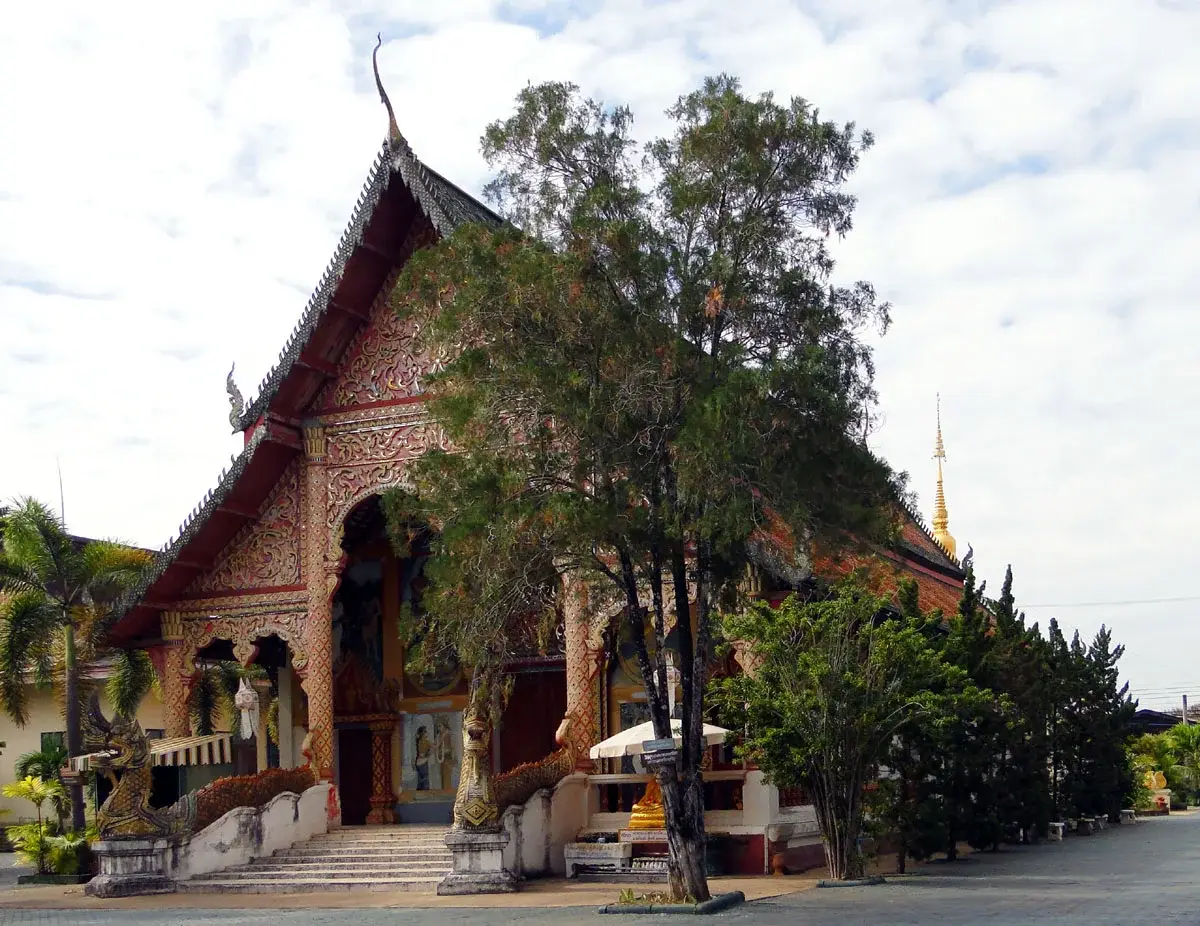
Wat Tha Ton Kwao is located at No. 87, Moo 4, Ban Tha Ton Kwao, Chomphu Subdistrict, Saraphi District, Chiang Mai Province 50140. It is a local Buddhist temple under the Mahanikaya sect. The temple was officially established in 1849 and received its royal consecrated boundary, or Wisungkhamsima, in 1975. The current abbot is Phra Maha Dr. Worawat Kittiwatthano. Wat Tha Ton Kwao is an old temple beside the Kuang River, closely connected with the history of Ban Tha Ton Kwao, Tai Yong and Tai Lue community roots, local agriculture, and Lanna Buddhist culture in Saraphi.
Wat Tha Ton Kwao is suitable for visitors who want to understand Saraphi through a living community temple rather than a major tourist site. Chomphu Subdistrict is an old community area shaped by villages, temples, irrigation routes, the Kuang River, and agricultural life. Ban Tha Ton Kwao developed along the river, and the temple serves as a spiritual center for the village. It is a place for merit-making, Dhamma listening, Buddhist ceremonies, annual traditions, and community memory.
The history of Wat Tha Ton Kwao is closely linked with the settlement history of the local community. Community history connects Ban Tha Ton Kwao with people from Sipsong Panna in southern China and with groups associated with Kengtung, Yon, and Lue communities during the period of Chiang Mai restoration under King Kawila. This historical background reflects the cultural roots of Tai Yong and Tai Lue families who settled along the Kuang River and carried their Buddhist traditions, agricultural skills, and community customs into the area.
The Kuang River is central to the identity of Ban Tha Ton Kwao. Local residents relied on the river for daily life, farming, rice cultivation, gardening, and cultural continuity. The village landscape was associated with blooming ton kwao, or golden shower-like flame trees, along the riverbank. The name “Tha Ton Kwao” therefore reflects both geography and memory: “tha” suggests a river landing or riverside area, while “ton kwao” refers to the trees that once marked the landscape. The name of the temple preserves this local identity.
Although the temple was officially established in 1849, local history places its beginning around 1786. This gives Wat Tha Ton Kwao a historical depth of more than two centuries. It has witnessed the transformation of Saraphi from a riverine agricultural community into a district closely connected with Chiang Mai city. Through these changes, the temple has continued to serve as a center of faith for villagers and nearby communities.
The granting of Wisungkhamsima in 1975 was an important milestone. A Wisungkhamsima is a consecrated monastic boundary used for important Buddhist ceremonies. Receiving this boundary confirmed the temple’s formal religious status and strengthened its ability to support monastic rites and community Buddhist activities.
The temple land covers 3 rai and 88 square wah under land title deed No. 12520. Its boundaries show a close connection with the village and river landscape: the north adjoins a public road, the south adjoins a public way, the east adjoins the Kuang River, and the west adjoins a public way. The temple also has one monastic land plot covering 2 ngan and 25 square wah under land title deed No. 12521. This location makes Wat Tha Ton Kwao both a village temple and a riverside religious landmark.
Important structures at Wat Tha Ton Kwao include the ubosot, sermon hall, monks’ residences, scripture hall, alms pavilion, and kitchen. The ubosot is especially important because its interior contains mural paintings of the Mahachat Jataka, one of the most meaningful Buddhist narrative traditions in northern Thai temple art. These murals make the ubosot not only a ritual space but also a place for visual Dhamma learning.
The sermon hall supports Dhamma listening, community gatherings, and merit-making events. The monks’ residences support monastic life. The scripture hall reflects the preservation of Buddhist teachings, while the alms pavilion and kitchen support food offerings and larger annual ceremonies. Together, these structures show that Wat Tha Ton Kwao functions as a complete Lanna community temple.
The temple’s sacred objects include a white-plaster Buddha image in Chiang Saen style, a brass Buddha image in the forbidding-the-relatives posture, a brass Buddha image in the contemplation posture, an alms-bowl Buddha image, a bronze Buddha image in meditation posture, Phra Singh Nueng, Phra Upakhut, Phra Maha Kaccayana, and a silver Buddha image in meditation posture. This collection gives the temple significant devotional and cultural value.
The white-plaster Buddha image in Chiang Saen style connects the temple with northern Thai Buddhist art. Phra Singh Nueng reflects a revered Lanna Buddha-image tradition. Phra Upakhut and Phra Maha Kaccayana are associated with protection, abundance, and auspicious belief in local Buddhist culture. Visitors should take time to pay respect calmly and observe the variety of devotional objects preserved at the temple.
Phra Maha Dr. Worawat Kittiwatthano, the abbot of Wat Tha Ton Kwao, plays an important role in caring for the temple, guiding ceremonies, teaching Dhamma, coordinating with villagers, and keeping the temple as a peaceful center of faith. In a community temple, the abbot’s role is closely connected with daily village life, not only with formal religious duties.
Wat Tha Ton Kwao serves Ban Tha Ton Kwao and nearby communities through Buddhist holy day merit-making, food offerings, Dhamma listening, Buddhist Lent, the end of Buddhist Lent, Kathin, robe-offering ceremonies, Songkran, water-pouring ceremonies for elders, and Yi Peng. These traditions keep Lanna Buddhist culture alive and help maintain strong social relationships within the village.
Chomphu Subdistrict Municipality has included Wat Tha Ton Kwao among the temples participating in local Buddhist Lent candle-offering activities. This reflects the temple’s continuing role within the religious and cultural network of the subdistrict. The temple remains meaningful not only to Ban Tha Ton Kwao but also to the wider Chomphu community.
The main appeal of Wat Tha Ton Kwao is its layered identity. It has a long community history, a riverside setting along the Kuang River, Tai Yong and Tai Lue cultural roots, a name connected with ton kwao trees, an ubosot with Mahachat Jataka murals, and many important Buddha images and sacred figures. It is suitable for travelers interested in old temples, Lanna culture, community history, Buddhist art, and cultural routes near Chiang Mai city.
Getting There is convenient because the temple is located in Saraphi District, not far from Chiang Mai city. Visitors can travel from Chiang Mai city toward Saraphi and Chomphu Subdistrict, then continue to Ban Tha Ton Kwao, Moo 4. Private car, motorcycle, or local transport can be used. The route is suitable for a half-day or full-day cultural trip combining temples and community attractions in Chomphu.
Wat Tha Ton Kwao can be combined with nearby attractions such as Wat Phaya Chomphu and Wang Matcha Phaya Chomphu, Wat Thung Khi Suea, Lan Sai Fai Hin at Ban Thung Khi Suea, Wat Buppharam, Wat Si Don Mun, Wat Mae Salap, and Wiang Kum Kam. A meaningful route can begin at Wat Tha Ton Kwao to understand the Kuang River community, continue to Wat Phaya Chomphu for a cultural and fish-sanctuary experience, and then visit Wat Thung Khi Suea to learn about a revived old temple site.
Wat Phaya Chomphu and Wang Matcha Phaya Chomphu add another cultural dimension to the route, with a temple, a freshwater fish sanctuary, and a local devotional site. Wat Thung Khi Suea is known for its ancient stupa remains and stupa tunnel. Combining these places with Wat Tha Ton Kwao gives travelers a broader understanding of Chomphu Subdistrict, including old temples, riverside communities, folk belief, and local Buddhist traditions.
Restaurants around Wat Tha Ton Kwao include local eateries in Chomphu, northern Thai food restaurants, cafés, and restaurants in Saraphi. Accommodations can be found in Saraphi and nearby Chiang Mai areas, making the temple easy to include in a cultural route that also covers Wiang Kum Kam, Chiang Mai city, or Lamphun.
Visitors should dress modestly, speak quietly, avoid disturbing monks or local residents, and respect the temple’s religious areas, especially the ubosot, viharn, sermon hall, scripture hall, and sacred images. If photographing murals or Buddha images, visitors should observe temple rules and avoid flash where inappropriate. Wat Tha Ton Kwao is an active community temple, and a calm visit is the best way to appreciate its history and living role.
In summary, Wat Tha Ton Kwao is a Mahanikaya community temple in Ban Tha Ton Kwao, Moo 4, Chomphu Subdistrict, Saraphi District, Chiang Mai Province. It is open daily from 08.00 to 17.00. The temple began around 1786, was officially established in 1849, and received its Wisungkhamsima in 1975. Its importance lies in its Kuang River setting, Tai Yong and Tai Lue community roots, the ton kwao name origin, its ubosot with Mahachat Jataka murals, and its collection of important Buddha images and sacred objects.
| Name | Wat Tha Ton Kwao |
| Type | Local Buddhist temple under the Mahanikaya sect |
| Location | No. 87, Moo 4, Ban Tha Ton Kwao, Chomphu Subdistrict, Saraphi District, Chiang Mai Province 50140 |
| Address | Ban Tha Ton Kwao, Moo 4, Chomphu Subdistrict, Saraphi District, Chiang Mai 50140, Thailand |
| Highlights | Old riverside temple connected with the Kuang River, Tai Yong and Tai Lue community roots, ton kwao trees, Mahachat Jataka murals, and many important sacred objects |
| History | Began around 1786 and was officially established in 1849, giving the temple more than two centuries of community history |
| Wisungkhamsima | Granted in 1975 |
| Temple Land | 3 rai and 88 square wah under land title deed No. 12520, with one monastic land plot of 2 ngan and 25 square wah under land title deed No. 12521 |
| Boundaries | North: public road South: public way East: Kuang River West: public way |
| Name Origin | The name is connected with the Kuang River landing area and ton kwao trees blooming along the riverbank of the village |
| Important Structures | Ubosot with Mahachat Jataka murals, concrete sermon hall, monks’ residences, scripture hall, alms pavilion, and kitchen |
| Sacred Objects | White-plaster Buddha image in Chiang Saen style, brass Buddha images, alms-bowl Buddha image, bronze meditation Buddha image, Phra Singh Nueng, Phra Upakhut, Phra Maha Kaccayana, and a silver meditation Buddha image |
| Abbot / Caretaker | Phra Maha Dr. Worawat Kittiwatthano |
| Open Days | Daily |
| Opening Hours | 08.00 – 17.00 |
| Temple Contact | 053-422-711 |
| Local Contact | Chomphu Subdistrict Municipality, Tel. 053-420-779 |
| Community Role | Spiritual center of Ban Tha Ton Kwao and nearby villages, place for merit-making, Dhamma listening, Buddhist Lent activities, and Chomphu cultural traditions |
| Merit Events / Traditions | Buddhist holy day merit-making, Buddhist Lent, end of Buddhist Lent, Kathin, robe offerings, Songkran, water-pouring ceremonies, Yi Peng, and Chomphu candle-offering activities |
| Travel Information | Travel from Chiang Mai city toward Saraphi and Chomphu Subdistrict, then continue to Ban Tha Ton Kwao, Moo 4. Private car, motorcycle, or local transport is suitable. |
| Nearby Tourist Attractions | 1. Wat Phaya Chomphu and Wang Matcha Phaya Chomphu, about 3–5 km 2. Wat Thung Khi Suea, about 3–5 km 3. Lan Sai Fai Hin, Ban Thung Khi Suea, about 4–6 km 4. Wat Buppharam, Chomphu Subdistrict, about 5–7 km 5. Wat Si Don Mun, about 5–8 km 6. Wat Mae Salap, about 6–9 km 7. Wiang Kum Kam, about 10–15 km |
| Nearby Restaurants / Chomphu and Saraphi Route | 1. Aromdee Cafe Saraphi Chiang Mai, about 2–4 km, Tel. 090-326-2926 2. Larb Lung Phueak Saraphi Chiang Mai, about 3–5 km, Tel. 083-321-4073 3. De’Chill Saraphi, about 3–5 km, Tel. 093-696-5883, 081-525-2441 4. Sanae Chai Nam Chiang Mai Restaurant, about 4–6 km 5. Khrua Khun Ton Khon Sukhothai Mae Salap Chomphu Saraphi, about 6–9 km, Tel. 099-961-3489 6. Suki Saraphi, about 8–12 km, Tel. 081-033-1248 |
| Nearby / Saraphi and Chiang Mai Area Accommodations | 1. 9Roomz Hotel, about 10–15 km, Tel. 053-963-829, 095-446-0758 2. Baan Hom Samunphrai, about 10–15 km, Tel. 081-885-1429 3. Baan Saraphi, about 10–15 km, Tel. 053-321-942 4. Zen Retreat Chiang Mai Villa, about 12–18 km 5. Chiang Mai city accommodations, about 15–20 km |
Frequently Asked Questions (FAQ)
Q: Where is Wat Tha Ton Kwao located?
A: Wat Tha Ton Kwao is located at No. 87, Moo 4, Ban Tha Ton Kwao, Chomphu Subdistrict, Saraphi District, Chiang Mai Province 50140.
Q: What are Wat Tha Ton Kwao’s opening days and hours?
A: The temple is open daily from 08.00 to 17.00.
Q: When was Wat Tha Ton Kwao established?
A: Wat Tha Ton Kwao was officially established in 1849, while local history places its beginning around 1786.
Q: When did Wat Tha Ton Kwao receive its Wisungkhamsima?
A: Wat Tha Ton Kwao received its Wisungkhamsima in 1975.
Q: Why is the temple called Wat Tha Ton Kwao?
A: The name is connected with Ban Tha Ton Kwao, a riverside village along the Kuang River where ton kwao trees bloomed along the riverbank.
Q: What important structures are found at Wat Tha Ton Kwao?
A: Important structures include the ubosot with Mahachat Jataka murals, sermon hall, monks’ residences, scripture hall, alms pavilion, and kitchen.
Q: Who is the abbot of Wat Tha Ton Kwao?
A: The abbot is Phra Maha Dr. Worawat Kittiwatthano.
Q: What nearby places can be combined with this visit?
A: Nearby route options include Wat Phaya Chomphu and Wang Matcha Phaya Chomphu, Wat Thung Khi Suea, Lan Sai Fai Hin, Wat Buppharam, Wat Si Don Mun, Wat Mae Salap, and Wiang Kum Kam.
 Category: ●Places of Worship
 Group: ●Temple
Last Update : 3 WeekAgo
 Last Update : 3 WeekAgo
 Click to Access the Navigation Map GPS

 Muang Chiang Mai(121)Chom Thong(47)Mae Chaem(25)Chiang Dao(33)Doi Saket(68)Mae Taeng(85)Mae Rim(69)Samoeng(29)Fang(71)Mae Ai(59)Phrao(70)San Pa Tong(103)San Kamphaeng(66)San Sai(73)Hang Dong(73)Hot(32)Doi Tao(22)Omkoi(11)Saraphi(74)Wiang Haeng(15)Chai Prakan(28)Mae Wang(32)Mae On(22)Doi Lo(33)Galyani Vadhana(1)


