
lovethailand home >North Travel Attractions >Chiang Mai Travel Attractions >Doi Saket >Mae Pong > Wat Doi Ploi Nok
TL;DR: Wat Doi Ploi Nok is located at Moo 4, Mae Pong Subdistrict, Doi Saket District, Chiang Mai Province, open Daily, hours 08.00 – 17.00.

Wat Doi Ploi Nok
Open Days: Daily
Opening Hours: 08.00 – 17.00
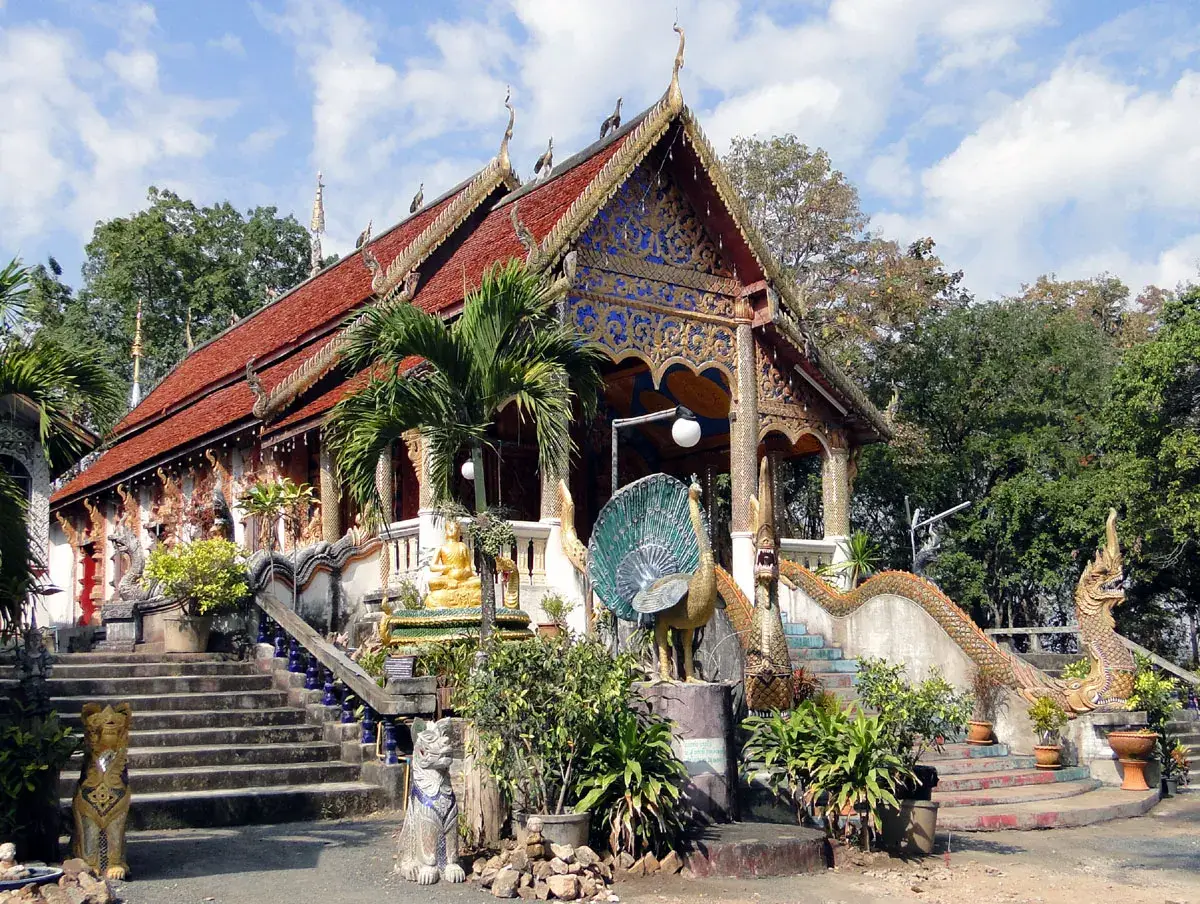
Wat Doi Ploi Nok is a local Buddhist temple in Moo 4, Mae Pong Subdistrict, Doi Saket District, Chiang Mai Province. It is a community temple under the Maha Nikaya tradition, officially permitted to be established in 1917 and granted Wisung Kham Sima in 1968. The temple is currently associated with Phra Athikan Suphap Suttadhammo as its abbot. Wat Doi Ploi Nok is one of the community temples of Mae Pong and is suitable for visitors who want to make merit, pay respect to the Buddha, and experience a quieter side of Doi Saket.
Wat Doi Ploi Nok is located in Moo 4 of Mae Pong Subdistrict, east of Chiang Mai city. Mae Pong is a long-established local community area with villages, agricultural land, water sources, temples, schools, and rural travel routes connected with Doi Saket, Mae On, and San Kamphaeng. The temple is therefore not an isolated religious site, but part of a wider village landscape shaped by local Buddhist practice and community life.
The historical importance of Wat Doi Ploi Nok begins with its official establishment in 1917. With more than a century of background, the temple has served the Mae Pong community for generations. A village temple with this kind of history normally functions as more than a place of worship. It is a centre for merit-making, Buddhist ceremonies, community gatherings, moral learning, and relationships between monks and local residents.
The granting of Wisung Kham Sima in 1968 is another important religious detail. Wisung Kham Sima refers to a consecrated boundary granted for formal monastic acts according to Buddhist discipline. This confirms Wat Doi Ploi Nok’s status as a recognized Buddhist temple with an established religious function for the Sangha and the local community.
The name “Wat Doi Ploi Nok” is distinctive. The word “doi” suggests a hill or elevated local landscape, while “ploi nok” evokes the Buddhist idea of releasing life and making merit. Although a confirmed origin story of the name is not publicly documented, the name gives the temple a memorable identity and reflects the atmosphere of a rural Buddhist site in Doi Saket.
Mae Pong Subdistrict has an important community identity within Doi Saket. The Ban Mae Pong area has long been associated with water sources, fields, village settlement, and local Buddhist life. Wat Doi Ploi Nok is part of this cultural setting. It represents the role of temples as spiritual centres where people gather for merit-making, ceremonies, and community traditions.
Several temples are located around Mae Pong, including Wat Kanjanitayaram, Wat Doi Chom Chaeng, Wat Mae Pong, Wat Mae Hong Khrai, and Wat Mai Mongkhon Chai. This group of temples makes Mae Pong a suitable area for a quiet temple route. Visitors can include Wat Doi Ploi Nok as a starting point or one stop in a route that explores the religious and community landscape of Doi Saket.
The atmosphere at Wat Doi Ploi Nok is calm and modest. It is suitable for paying respect to the Buddha, making merit, offering alms, and spending quiet time in a local temple setting. Community temples of this kind are valuable because they remain part of everyday religious life rather than being designed mainly for mass tourism.
Phra Athikan Suphap Suttadhammo is the abbot of Wat Doi Ploi Nok. Visitors who wish to make offerings, donate, or participate in temple activities should visit during daytime opening hours. If a ceremony or community event is taking place, visitors should behave respectfully, keep their voices low, and give space to monks and local worshippers.
Wat Doi Ploi Nok is valuable for travellers who want to understand Chiang Mai at the community level. Instead of focusing only on famous temples in the old city, visitors can see how Buddhism continues in village life. The temple shows how faith, local traditions, family merit-making, and community identity remain connected in Doi Saket.
Throughout the year, community temples such as Wat Doi Ploi Nok support Buddhist activities such as Buddhist holy days, Buddhist Lent, the end of Buddhist Lent, Kathin offerings, forest robe offerings, merit-making for ancestors, and ceremonies connected with important life events. These traditions keep the relationship between monks and laypeople active and help preserve Buddhist values across generations.
Wat Doi Ploi Nok can be included in a half-day temple route in Mae Pong. Visitors can begin at Wat Doi Ploi Nok, then continue to Wat Mae Pong, Wat Kanjanitayaram, Wat Doi Chom Chaeng, and Wat Mae Hong Khrai. This route is suitable for travellers who want to visit several local temples in one area without rushing.
With a full day, visitors can connect Wat Doi Ploi Nok with major attractions in Doi Saket and nearby districts, including Wat Phra That Doi Saket, Huai Hong Khrai Royal Development Study Centre, San Kamphaeng Hot Springs, Bo Sang Village, and natural areas around Mae Pong. This creates a balanced route that includes merit-making, community learning, nature, and local culture.
Wat Phra That Doi Saket is one of the district’s important temples and a popular viewpoint. Huai Hong Khrai Royal Development Study Centre is suitable for visitors interested in nature and development studies. San Kamphaeng Hot Springs and Bo Sang Village can add relaxation, handicrafts, and community travel to the same itinerary.
Accommodation and food options are available around Mae Pong and Doi Saket. Nearby places include small resorts, cafés, restaurants, and homestay-style accommodation. Visitors who prefer slow travel can stay near Mae Pong, visit Wat Doi Ploi Nok in the morning, then continue to local restaurants, nature sites, and nearby temples during the day.
Visitors should dress respectfully when entering Wat Doi Ploi Nok. Clothing should be appropriate for a sacred place. Shoes should be removed before entering religious buildings, voices should be kept low, and private monastic areas should not be entered without permission. If ceremonies or community activities are taking place, visitors should give space to monks and local worshippers.
Getting There is easiest by private car, rental car, or local hired transport. From Chiang Mai city, travel toward Doi Saket District and continue into Mae Pong Subdistrict, or use the San Kamphaeng–Mae On–Mae Pong connection. Visitors should search for “Wat Doi Ploi Nok” on a navigation map to reach the temple accurately.
Public map sources list Wat Doi Ploi Nok with Plus Code 7MCXR59G+M5 in Mae Pong, Doi Saket, Chiang Mai. Visitors unfamiliar with the area should keep navigation open while travelling because Mae Pong has several local roads, village routes, and small community lanes.
The best time to visit Wat Doi Ploi Nok is from morning to early afternoon. Morning is suitable for merit-making and better aligned with the daily rhythm of monks. Travellers who want to photograph the temple atmosphere or continue to other places in Mae Pong should allow enough time for a relaxed route.
Wat Doi Ploi Nok is ideal for travellers who want to experience Chiang Mai beyond the main tourist route. Its value lies in its status as a Maha Nikaya community temple with a clear history, an active abbot, and a continuing religious role for Mae Pong residents.
In summary, Wat Doi Ploi Nok is a Maha Nikaya community temple in Moo 4, Mae Pong Subdistrict, Doi Saket District, Chiang Mai Province. It was officially established in 1917 and granted Wisung Kham Sima in 1968. With Phra Athikan Suphap Suttadhammo as its abbot, the temple remains a meaningful place for merit-making, Buddhist practice, and cultural travel in the Mae Pong–Doi Saket area.
| Name | Wat Doi Ploi Nok |
| Location | Moo 4, Mae Pong Subdistrict, Doi Saket District, Chiang Mai Province |
| Navigation Code | Plus Code: 7MCXR59G+M5, Mae Pong, Doi Saket, Chiang Mai |
| Temple Type | Local Buddhist temple under the Maha Nikaya tradition |
| History | Officially permitted to be established in 1917 and granted Wisung Kham Sima in 1968 |
| Abbot / Caretaker | Phra Athikan Suphap Suttadhammo |
| Highlights | Old community temple in Mae Pong with more than 100 years of history, suitable for merit-making and a quiet Mae Pong–Doi Saket temple route |
| Distinctive Features | A Maha Nikaya village temple reflecting local Buddhist life in Mae Pong and Doi Saket |
| Travel Information | Travel from Chiang Mai city toward Doi Saket District and continue into Mae Pong Subdistrict, or use the San Kamphaeng–Mae On–Mae Pong connection. Private car, rental car, or local hired transport is recommended. |
| Current Status | Open as a community temple and listed in public temple, map, and travel sources |
| Open Days | Daily |
| Opening Hours | 08.00 – 17.00 |
| Nearby Tourist Attractions | 1. Wat Mae Pong, about 2 km 2. Wat Kanjanitayaram, about 3 km 3. Wat Doi Chom Chaeng, about 4 km 4. Ban Mae Pong Community Area, about 4 km 5. San Kamphaeng Hot Springs, about 9 km 6. Huai Hong Khrai Royal Development Study Centre, about 10 km 7. Wat Phra That Doi Saket, about 12 km |
| Nearby Restaurants | 1. Tara Restaurant at Papai Country Lodge, about 2 km, Tel. 081-882-7100 2. Lap Pa Ut, about 2 km 3. Village Green Cafe & Retreat, about 5 km, Tel. 087-656-9213 4. Peppercorns Restaurant, about 6 km, Tel. 087-460-0451 5. Ing Tarn Cafe, about 7 km 6. Huen Nom Ka Fae, about 8 km |
| Nearby Accommodations | 1. Papai Country Lodge, about 2 km, Tel. 081-882-7100 2. Capybara Zen Resort And Spa, about 3 km 3. North Pine Forest Homestay, about 4 km 4. Village Green Cafe & Retreat, about 5 km, Tel. 087-656-9213 5. Secret Garden Chiang Mai, about 9 km, Tel. 053-339-502 6. Ban Tung Residence, about 10 km |
Frequently Asked Questions (FAQ)
Q: Where is Wat Doi Ploi Nok located?
A: Wat Doi Ploi Nok is located in Moo 4, Mae Pong Subdistrict, Doi Saket District, Chiang Mai Province.
Q: What are the opening hours of Wat Doi Ploi Nok?
A: Wat Doi Ploi Nok is open daily from 08.00 to 17.00.
Q: What type of temple is Wat Doi Ploi Nok?
A: It is a local Buddhist temple under the Maha Nikaya tradition.
Q: When was Wat Doi Ploi Nok officially established?
A: Wat Doi Ploi Nok was officially permitted to be established in 1917.
Q: When did Wat Doi Ploi Nok receive Wisung Kham Sima?
A: Wat Doi Ploi Nok was granted Wisung Kham Sima in 1968.
Q: Who is the abbot of Wat Doi Ploi Nok?
A: The abbot of Wat Doi Ploi Nok is Phra Athikan Suphap Suttadhammo.
Q: How can travellers get to Wat Doi Ploi Nok?
A: Travel from Chiang Mai city toward Doi Saket District and continue into Mae Pong Subdistrict, or use the San Kamphaeng–Mae On–Mae Pong connection. Private car, rental car, or local hired transport is recommended.
Q: What nearby attractions can be combined with Wat Doi Ploi Nok?
A: Nearby places include Wat Mae Pong, Wat Kanjanitayaram, Wat Doi Chom Chaeng, Ban Mae Pong Community Area, San Kamphaeng Hot Springs, Huai Hong Khrai Royal Development Study Centre, and Wat Phra That Doi Saket.
 Category: ●Places of Worship
 Group: ●Temple
Last Update : 1 MonthAgo
 Last Update : 1 MonthAgo
 Click to Access the Navigation Map GPS

 Muang Chiang Mai(121)Chom Thong(47)Mae Chaem(25)Chiang Dao(33)Doi Saket(68)Mae Taeng(85)Mae Rim(69)Samoeng(29)Fang(71)Mae Ai(59)Phrao(70)San Pa Tong(103)San Kamphaeng(66)San Sai(73)Hang Dong(73)Hot(32)Doi Tao(22)Omkoi(11)Saraphi(74)Wiang Haeng(15)Chai Prakan(28)Mae Wang(32)Mae On(22)Doi Lo(33)Galyani Vadhana(1)


