
lovethailand home >Northeastern Travel Attractions >Surin Travel Attractions >Chom Phra >Kra Hat > Nong Samet Community Forest
TL;DR: Nong Samet Community Forest is located at Ban Nong Yao, Moo 7, Krahad Subdistrict, Chom Phra District, Surin Province 32180, open Daily, hours 08.00 – 17.00.

Nong Samet Community Forest
Open Days: Daily
Opening Hours: 08.00 – 17.00
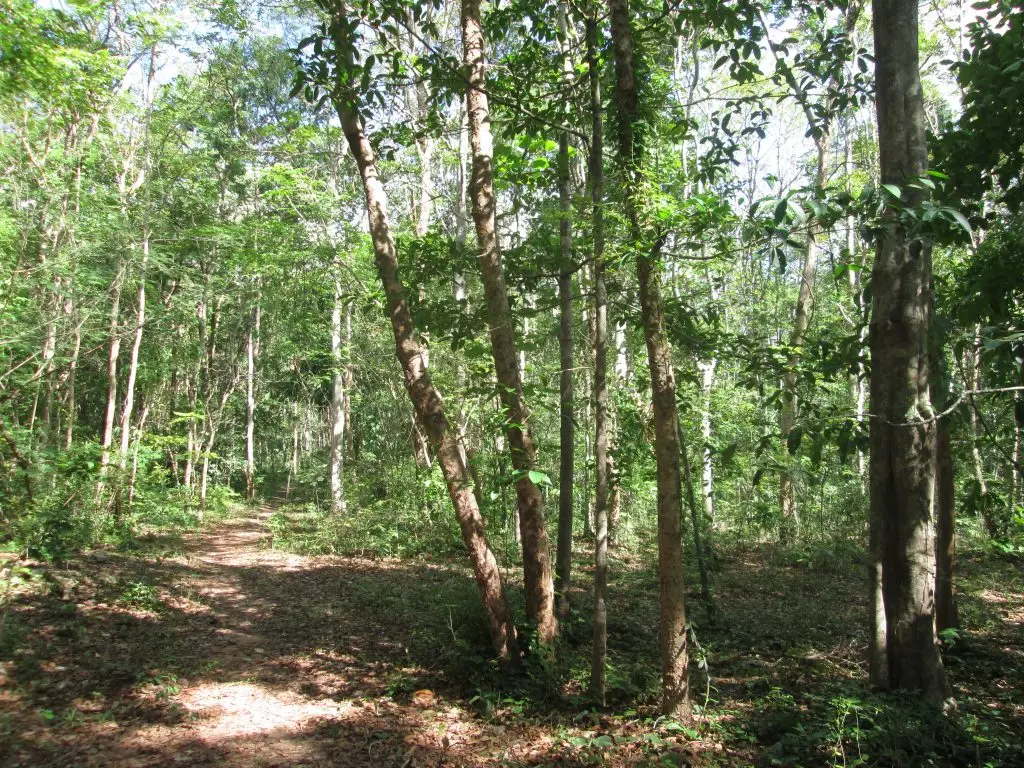
Nong Samet Community Forest Surin is an important community-managed forest in Ban Nong Yao, Moo 7, Krahad Subdistrict, Chom Phra District, Surin Province. Covering about 665 rai, the forest is a living ecological and cultural landscape with local tree species, medicinal plants, seasonal forest foods, community-use areas, conservation zones, and 3 important ponds: Nong Samet, Nong Krachai, and Nong Somphot. These ponds help retain moisture, support wildlife, provide ecological learning value, and connect the forest directly with the daily life of nearby communities.
Nong Samet Community Forest is more than a green area. It is a strong example of how local people can protect, restore, and use natural resources together under community rules. Villagers around the forest do not regard the forest as empty land. They see it as a source of food, medicine, shade, water, ritual meaning, and shared responsibility. The forest therefore represents a living relationship among people, soil, water, trees, wildlife, and community culture.
The main character of the forest lies in its old local woodland atmosphere and its mixed ecosystem of forest and water. Local trees, bamboo, herbs, wild vegetables, mushrooms, and seasonal fruits appear according to natural cycles. In the rainy season, the forest becomes lush and productive. In the dry and cool seasons, it still provides shade, shelter, and ecological stability. The 3 ponds inside the area create a landscape that is richer than ordinary dry woodland because water, forest edge, and community-use areas exist together.
The name Nong Samet reflects the relationship between water and local vegetation. “Nong” means pond or natural water body, while “Samet” is associated with a local tree name known in many parts of Thailand. The name therefore suggests a landscape where trees and water belong together. It helps visitors understand that this community forest is not only a dry woodland, but a forest landscape with important wetland elements.
Nong Samet, Nong Krachai, and Nong Somphot are the ecological heart of the area. They help support birds, small animals, insects, plants, and seasonal community activities. Water bodies inside a community forest make the area more diverse and more meaningful to local people. They also function as natural learning sites where visitors can observe how water supports forest recovery, plant growth, and wildlife habitat.
In the past, Nong Samet Community Forest was used by local people for grazing, food gathering, medicinal plants, and necessary forest products. As land-use pressure increased, parts of the forest faced degradation. The community responded by organizing forest protection, creating rules, separating use areas from conservation areas, and working with related agencies. This shift from scattered use to organized community management allowed the forest to recover and remain important to Krahad Subdistrict today.
The community established forest committees and developed a system of patrols, monitoring, firebreaks, and shared rules. These rules help reduce illegal logging, wildlife hunting, and uncontrolled extraction of forest products. The strength of the system is that local people themselves take part in forest care. When people feel that the forest belongs to the community, protection becomes a shared duty rather than the work of a single agency.
Important activities include forest patrols, firebreak maintenance, tree ordination, replanting, bamboo planting, herb garden restoration, youth forest surveys, and community merit-making for the forest. These activities make the forest an active community space. It is not an abandoned patch of woodland, but a place where people learn, work, worship, and protect nature together.
Tree ordination is one of the clearest cultural tools used to protect the forest. By connecting Buddhist and local belief with conservation, trees gain spiritual status in the minds of villagers. The ceremony helps create moral boundaries around the forest and strengthens community awareness. In this way, culture becomes a practical method of environmental protection.
Firebreaks are especially important during the dry season. Forest fire can destroy young plants, herbs, nests, insects, small animals, and soil moisture in a short time. Community firebreak work requires clearing fuel, checking risk areas, and raising awareness. It is also a learning activity for younger generations, showing that forest conservation must be practiced every year through real labor and local cooperation.
The herb and local plant areas in the forest preserve valuable community knowledge. Older residents know many plants used for food and traditional medicine. This knowledge is passed on through forest walks, plant identification, practical use, and family teaching. Responsible harvesting is part of the wisdom: people take only what is needed, avoid damaging mother plants, and protect the ecological cycle of the forest.
The forest is also important for local food security. In suitable seasons, villagers can gather mushrooms, wild vegetables, herbs, and forest fruits for household consumption. These resources reduce household expenses and remind people of the direct value of forest protection. A healthy forest gives seasonal food naturally, making conservation meaningful in everyday life.
Birds and small wildlife are indicators of ecological recovery. Morning bird calls, squirrels, tree shrews, junglefowl, and seasonal small animals show that the forest is functioning as habitat. Visitors should therefore walk quietly, avoid disturbing animals, avoid collecting plants without permission, and never leave waste behind. Every action in a community forest affects the living system around it.
Nong Samet Community Forest is suitable for nature-based travel, ecological learning, and community forest study. Visitors can learn how a community forest is organized, who manages it, what rules are used, how villagers benefit from forest products, and how conservation activities help the forest recover. A visit here is different from walking in a general public park because it shows a real model of community-based forest management.
The forest is suitable for students, researchers, nature lovers, local wisdom learners, and travelers who want to understand rural lower-Isan ecology. A simple visit may take 1 to 2 hours. A group study visit with local explanation may take 2 to 3 hours, allowing time to learn about the forest history, community rules, firebreaks, herb areas, water bodies, and the 3 ponds inside the forest.
Visitors should prepare for a natural environment. Wear comfortable shoes, breathable clothing, and sun protection. Bring drinking water, mosquito repellent, and a small bag for personal waste. During the rainy season, paths may be slippery and insects may be more active. During the dry season, visitors must avoid any use of fire. Proper preparation helps keep the visit safe and protects the forest environment.
Important rules include no tree cutting, no unauthorized plant collecting, no hunting, no animal disturbance, no littering, no loud noise, no entering deep forest areas alone, no driving into restricted areas, and following community instructions. Group visitors should contact Krahad Subdistrict Municipality or the community forest coordinator in advance so that routes and learning activities can be properly arranged.
There is no admission fee for ordinary visits to Nong Samet Community Forest. Costs may apply only for arranged group learning activities, guided visits, or community-supported programs. Visitors can support the local community by using local services, buying community products, eating at nearby restaurants, staying in nearby accommodation, and respecting the forest rules throughout the visit.
The forest is also connected with community fruit-tree planting and local planting activities around water areas. Fruit trees, herbs, bamboo, and local tree species make the forest beneficial at many levels. They provide shade, protect soil, retain water, support wildlife, and offer useful products for local people. A forest that benefits daily life is more likely to be loved and protected by the community.
Getting There to Nong Samet Community Forest is most convenient by private car, rental car, or chartered van. From Surin city, take Highway 214 toward Chom Phra District, then continue into Krahad Subdistrict and Ban Nong Yao. The distance from Surin city is about 34 to 40 km depending on the starting point and route. From Chom Phra District, travel west toward Krahad Subdistrict and continue to Ban Nong Yao, Moo 7.
Visitors using navigation should search for “Nong Samet Community Forest, Ban Nong Yao, Krahad Subdistrict, Chom Phra District, Surin Province.” Because the name Nong Samet is used in several provinces, including Ban Nong Yao, Krahad Subdistrict, and Chom Phra District helps avoid confusion. Group visitors should contact the forest coordinator or Krahad Subdistrict Municipality before traveling.
A suitable travel route can make Nong Samet Community Forest the main nature-learning stop, then continue to nearby community sites such as Ban Nong Yao Silk Weaving Group, Ban Kanjrong Community Rice Seed Center, Chom Phra town, Khwao Sinarin Handicraft Village, and Ban Tha Sawang Gold Brocade Silk Weaving Village. From Surin city, visitors can make this a full-day route by visiting the forest in the morning, eating in Chom Phra, and returning to Surin city for the city shrine, Wat Burapharam, or Surin National Museum in the afternoon.
Restaurants near the forest are mostly located in Chom Phra District and along the Chom Phra – Krahad route. Visitors should plan meals before entering the forest area because Ban Nong Yao and the community forest are rural areas rather than dense food-service zones. Groups should prepare drinking water and snacks carefully, and all waste must be taken out of the forest.
Accommodation near the forest is available mainly in Chom Phra District, while visitors who prefer hotels, restaurants, markets, and transport options should stay in Surin city. Staying in the city is convenient for international travelers and those arriving by train or bus. Staying in Chom Phra is suitable for visitors who want more time in the Krahad community or have a study visit in the area.
For international visitors, Nong Samet Community Forest is a clear example of what a “community forest” means in Thailand. It is not a large remote national park. It is a forest close to villages, cared for by local people, and used under shared rules. It functions as a food source, medicinal plant area, learning space, ecological reserve, water landscape, and cultural site. Visiting this forest helps explain how conservation can begin at community level through rules, cooperation, and local attachment to the land.
International visitors should understand the forest as a rural lower-Isan learning site rather than a fully serviced tourist attraction. Its simplicity is its value. The visit reveals a forest that villagers use and protect in real life, water bodies that support the ecosystem, and community rules that make conservation possible. Even a relatively small forest can be vital for food, water, health, culture, and local identity.
In summary, Nong Samet Community Forest Surin is an important community forest in Ban Nong Yao, Krahad Subdistrict, Chom Phra District. Covering about 665 rai, it contains 3 ponds: Nong Samet, Nong Krachai, and Nong Somphot. The forest includes local trees, herbs, seasonal forest foods, wildlife, and community conservation activities. It is open daily from 08.00 to 17.00 with no general admission fee. It is suitable for quiet nature walks, community forest study, ecological learning, and understanding the relationship between local people and forest in Surin Province.
| Name | Nong Samet Community Forest Surin / Nong Samet Community Forest, Ban Nong Yao |
| Location | Ban Nong Yao, Moo 7, Krahad Subdistrict, Chom Phra District, Surin Province 32180 |
| Address | Nong Samet Community Forest, Ban Nong Yao, Moo 7, Krahad Subdistrict, Chom Phra District, Surin Province 32180 |
| Highlights | Old community forest of Krahad Subdistrict, about 665 rai, 3 ponds, local tree species, medicinal plants, seasonal forest foods, tree ordination, firebreak activities, and community-based forest management |
| History | The forest has long been used by Ban Nong Yao and nearby communities. Local people later organized community forest committees, patrols, firebreaks, herb restoration, replanting, and rules for sustainable forest use |
| Name Origin | The name Nong Samet reflects a landscape of ponds and local vegetation, showing that water and forest are the main elements of this community forest |
| Distinctive Features | A community forest where woodland and ponds exist together. Nong Samet, Nong Krachai, and Nong Somphot support moisture, wildlife, plants, and community learning |
| Travel Information | From Surin city, take Highway 214 toward Chom Phra District, then continue into Krahad Subdistrict and Ban Nong Yao. The distance is about 34 – 40 km by road, depending on the starting point and route |
| Current Status | Open for nature visits, ecological learning, and community forest study. Visitors should use the area quietly and follow community forest rules |
| Open Days | Daily |
| Opening Hours | 08.00 – 17.00 |
| Fees | No Admission Fee For Ordinary Visits. Additional Costs Depend On Arranged Study Visits, Guided Activities, Or Pre-Arranged Group Programs |
| Facilities | Community forest area, ponds, community routes, nature learning points, community activity areas, parking according to local conditions, and basic services from Ban Nong Yao and Krahad Subdistrict |
| Main Areas / Zones | 1. Local Woodland And Native Tree Zone 2. Nong Samet Pond 3. Nong Krachai Pond 4. Nong Somphot Pond 5. Medicinal Plant And Seasonal Forest Food Area 6. Community-Use Forest Area 7. Conservation And Forest Restoration Area 8. Firebreak And Patrol Route Area 9. Tree Ordination And Pu Ta Shrine Merit-Making Area 10. Fruit Tree And Replanting Area 11. Nature Learning Area For Youth And Study Groups |
| Important Natural Resources | Local trees, mushrooms, wild vegetables, medicinal plants, forest fruits, bamboo, community-use wood under local rules, birds, squirrels, tree shrews, junglefowl, and seasonal small wildlife |
| Community Traditions / Lifestyle | Tree ordination, firebreak maintenance, merit-making for the forest, Pu Ta shrine offerings, youth forest surveys, seasonal forest food gathering, and community-regulated medicinal plant use |
| Caretaker / Community Groups | Nong Samet Community Forest Committee of Ban Nong Yao, nearby communities, Krahad Subdistrict Municipality, and community forest networks in Chom Phra District |
| Forest Coordination Contact | Community Forest Chairperson, Nai Thum Senaboon, Tel. 093-123-3791 |
| Local Information Contact | Krahad Subdistrict Municipality, Tel. 044-558-914 |
| Nearby Tourist Attractions | 1. Ban Nong Yao Silk Weaving Group, Moo 7, Krahad Subdistrict, about 1 km 2. Ban Kanjrong Community Rice Seed Center, Krahad Subdistrict, about 5 km 3. Krahad Subdistrict Municipality And Ban Ansong Community, about 8 km, Tel. 044-558-914 4. Chom Phra District Town And Market Area, about 14 km 5. Khwao Sinarin Handicraft Village, about 32 km 6. Surin City Pillar Shrine, about 38 km 7. Wat Burapharam Royal Temple, about 39 km 8. Surin National Museum, about 43 km, Tel. 044-513-272, 044-513-274 9. Ban Tha Sawang Ancient Gold Brocade Silk Weaving Village, about 44 km |
| Nearby Restaurants | 1. PunThai Coffee Pattamanon Road, Chom Phra, about 14 km, Tel. 065-520-6244 2. Chitangme Made-To-Order Restaurant, Chom Phra District, about 14 km, Tel. 096-367-6466 3. Kit Charoen Restaurant, Chom Phra District, about 15 km, Tel. 044-580-133 4. Khao Man Kai Nai Lek, Chom Phra District, about 15 km, Tel. 061-053-6584 5. Baan Vision JJ Cafe, Chom Phra, about 16 km, Tel. 098-866-6456 6. Madame Maem Moo Kratha, Chom Phra, about 15 km, Tel. 061-623-7211 7. Mueang Ling Moo Kratha, Chom Phra District, about 18 km, Tel. 086-350-8467 |
| Nearby Accommodations | 1. Sabai Dee Resort Chom Phra, about 14 km, Tel. 044-581-455, 064-719-0988 2. Kan Kluai Resort, Chom Phra District, about 16 km, Tel. 080-172-9107 3. Tanya Bukraeng Resort, Chom Phra District, about 24 km 4. HOP INN Surin, Mueang Surin District, about 38 km, Tel. 065-518-9784 5. Fortune Mansion Surin, Mueang Surin District, about 39 km, Tel. 044-060-398, 084-554-5290 6. Maneerote Hotel Surin, Mueang Surin District, about 39 km, Tel. 044-514-569 7. Thong Tarin Hotel, Mueang Surin District, about 40 km, Tel. 044-514-281, 085-300-8858 8. Slive Hotel Surin, Mueang Surin District, about 40 km, Tel. 044-060-322, 044-060-323 |
Frequently Asked Questions (FAQ)
Q: Where Is Nong Samet Community Forest Located?
A: Nong Samet Community Forest is located in Ban Nong Yao, Moo 7, Krahad Subdistrict, Chom Phra District, Surin Province 32180. It is an important community forest of Krahad Subdistrict.
Q: When Is Nong Samet Community Forest Open?
A: It is open daily from 08.00 to 17.00. Groups planning a study visit should contact the forest coordinator or Krahad Subdistrict Municipality in advance.
Q: Is There An Admission Fee?
A: No. There is no admission fee for ordinary visits. Additional costs depend on arranged study visits, guided activities, or pre-arranged group programs.
Q: What Is The Main Highlight Of Nong Samet Community Forest?
A: The main highlights are its 665-rai community forest area, local tree species, medicinal plants, seasonal forest foods, and 3 ponds: Nong Samet, Nong Krachai, and Nong Somphot.
Q: Who Oversees Nong Samet Community Forest?
A: The forest is cared for by the Nong Samet Community Forest Committee of Ban Nong Yao, nearby communities, Krahad Subdistrict Municipality, and community forest networks in Chom Phra District.
Q: What Activities Are Suitable At Nong Samet Community Forest?
A: Suitable activities include quiet nature walks, ecological learning, medicinal plant study, community forest management learning, firebreak learning, tree ordination learning, and understanding community-regulated forest use.
Q: What Nearby Places Can Be Visited With Nong Samet Community Forest?
A: Nearby places include Ban Nong Yao Silk Weaving Group, Ban Kanjrong Community Rice Seed Center, Chom Phra District town, Khwao Sinarin Handicraft Village, Surin City Pillar Shrine, Wat Burapharam, and Surin National Museum.
Q: How Should Visitors Prepare For A Visit?
A: Visitors should wear comfortable walking shoes, bring drinking water, a hat, mosquito repellent, and a personal waste bag. Do not cut trees, collect plants, hunt animals, make loud noise, litter, or enter restricted forest areas without permission.
 Category: ●Suburban Living
 Group: ●Village, Community
Last Update : 2 MonthAgo
 Last Update : 2 MonthAgo
 Click to Access the Navigation Map GPS
Nong Samet Community Forest Map
Recommend

 Art, Culture and Heritage
 Historical Sites and Monuments(11)
 Landmarks and Memorials(2)
 Art, Craft Centres, Tradition(5)
 Museums(1)
 Places of Worship
 Temple(15)
 Other Sacred Sites(1)
Village, Community(9)
Other Sacred Sites(1)
Village, Community(9)
 Local Market(1)
 Nature and Wildlife
 National Parks and Marine Reserves(2)
 Mountain (Doi)(2)
 Dam, Reservoir, Lake(6)
 Waterfalls(1)
 River, Canal(2)
 Other natural attractions(4)
 Entertainment and Agricultural
 Farms, Parks and Ecotourism(2)


