
lovethailand home >Central Travel Attractions >Bangkok Travel Attractions >Thon Buri >Bang Yi Ruea > Wat Chantararam Worawihan
TL;DR: Wat Chantararam Worawihan is located at Thoet Thai Road, Bang Yi Ruea Subdistrict, Thon Buri District, Bangkok, open Daily, hours 06:00 – 18:00 (recommended to call ahead, especially during ceremonies).
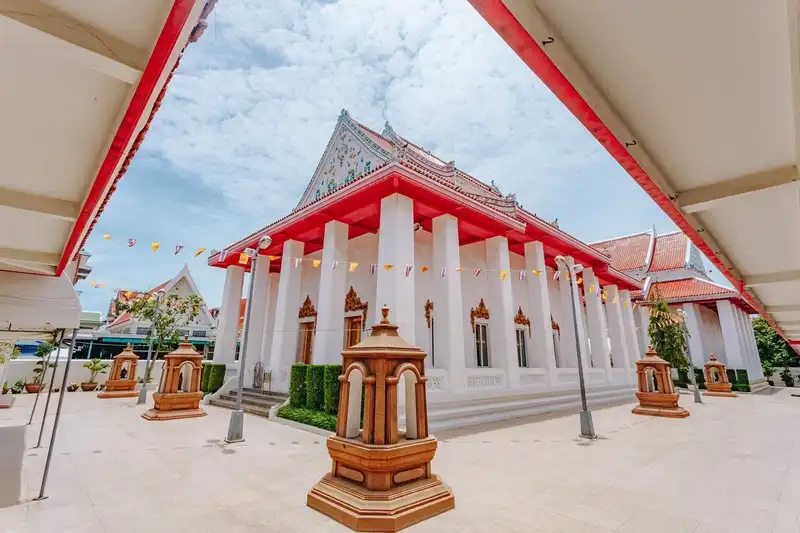
Wat Chantararam Worawihan
Open Days: Daily
Opening Hours: 06:00 – 18:00 (recommended to call ahead, especially during ceremonies)
Wat Chantararam Worawihan is a royal temple on Thoet Thai Road in Thonburi that genuinely feels like “the community’s temple.” It is not only a place for a quick visit and prayer, but a living center of faith and daily rhythm for the Bang Yi Ruea–Talat Phlu area. If you enjoy exploring Bangkok with local stories, craftsmanship, and real neighborhood atmosphere, this temple has a quiet charm that doesn’t need any exaggeration. Walk slowly, pay attention, and the details will gradually reveal themselves.
This is an old temple believed to date back to the Ayutthaya period. It was originally known as “Wat Bang Yi Ruea Klang” or simply “Wat Klang” because it sat “in the middle” between other important temples in the area, back when temple naming was not as formal as it is today. Communities often named temples by location and by their order along a route, which is why you still see the familiar sequence of “inner–middle–outer” used to indicate which temple was closer or farther along the same line of travel.
In this case, the meaning of “middle” is explained through local geography: Wat Chantararam sits between two temples—Wat Bang Yi Ruea Nai (now Wat Ratchakhruha) and Wat Intharam. People therefore referred to them by position as “Bang Yi Ruea Nai–Bang Yi Ruea Klang–Bang Yi Ruea Nok.” It is a simple, practical naming style, yet it reflects how older Thonburi communities were shaped by canals and local routes. Once you understand the original name, you begin to see that this temple is not only a religious building, but a true “central marker” for the area.
During the reign of King Rama III, the temple underwent a major restoration. Phraya Surasena (Khun Nen) carried out significant renovations, and the temple received the royal name “Wat Chantararam.” It was later elevated to the status of a third-class royal temple (Worawihan), confirming its formal role as a royal monastery on the Thonburi side of Bangkok and helping it remain a community hub for both faith and traditional ceremonies up to the present day.
One feature visitors often remember is the strong “Chinese-style” character of the architecture, especially the ubosot (ordination hall) and the viharn (assembly hall). These buildings follow a Chinese artistic style rather than the more familiar Thai roof ornaments such as chofa and bai raka. The ubosot was originally built with brick-and-mortar construction, then renovated between 1974 and 1977 (B.E. 2517–2520) and rebuilt with reinforced concrete while keeping the overall Chinese-style design and façade. This is why the temple’s architectural mood feels distinct from the Thai Ayutthaya–Rattanakosin forms many people are used to seeing.
Inside the ubosot, the principal Buddha image is cast in brass in the Mara-vijaya posture (subduing Mara), giving a grounded calm that many people feel simply by standing and looking for a while. Another important piece that many visitors come specifically to see is a teakwood Buddha image in the “Stopping the Ocean” posture, made as a half-relief (a form not commonly found). The appeal of a temple like this is that you don’t come to “tick off highlights,” but to notice each real object and let the craftsmanship and stories work on you slowly.
The viharn also carries a clear Chinese artistic identity, without chofa and bai raka, and its original brick-and-mortar structure was restored in a similar direction to the ubosot. As you walk through the temple, the overall visual language feels cohesive—one continuous style rather than a mix of unrelated forms. That’s what makes the visit enjoyable: it feels like reading a community’s taste and a period’s artistic worldview through the buildings themselves.
Another highly valuable aspect is the mural painting and ceiling patterns with distinct Chinese character, especially the detailed Chinese ceremonial motifs (including traditional “high ceremonial items”). The temple chose a conservation approach that preserves the original work, and where there is damage, repairs were made without painting over the old imagery. This allows later generations to still see traces of the earlier craftsmanship and the layers of time on the walls and ceiling. When viewing, it helps to scan from the upper areas downward, because the beauty often lies in framing, rhythm, and linework rather than only in the biggest scenes.
If you wonder who Wat Chantararam Worawihan is best for, it suits anyone who wants Bangkok travel that blends faith with genuine community context. After visiting, you can continue straight into the Talat Phlu area for local food and a lively old-neighborhood atmosphere, or connect to nearby temples along Thoet Thai Road that share linked histories. The strength of this zone is that you don’t need to go far, yet the cultural density is surprisingly high.
Getting There There are several convenient ways to reach the temple. If you prefer ease, you can come by car or taxi along Thoet Thai Road and nearby connections through Talat Phlu and Bang Yi Ruea, though it’s wise to allow time for traffic during morning and evening peaks. If you prefer rail transit, you can plan your route via the Thonburi-side stations and connect by local transport or walking. For a well-rounded neighborhood day out, a simple “temple–Talat Phlu–nearby temples” route works especially well—short travel time, but a very full experience.
The most comfortable time for a slower visit is usually weekday mornings, when it is less crowded and not too hot, making it easier to appreciate architectural and artistic details. On weekends and holidays, you will often see more of the area’s “community energy,” with more visitors making merit and more activity around the temple. Both options offer different atmospheres, so you can choose what fits your travel style.
| Place Name | Wat Chantararam Worawihan |
| Location | Thoet Thai Road, Bang Yi Ruea Subdistrict, Thon Buri District, Bangkok |
| Key Highlights | Chinese-style ubosot and viharn, brass principal Buddha in Mara-vijaya posture, teakwood half-relief Buddha in the “Stopping the Ocean” posture, Chinese-style murals and ceiling patterns |
| Period | Ayutthaya-era origins (major restoration in King Rama III era; ubosot renovation completed in 1977) |
| Name Origin | Originally known as Wat Bang Yi Ruea Klang / Wat Klang; renamed “Wat Chantararam” by royal decree during King Rama III |
| Current Status | Open for visits and merit-making (dress respectfully; avoid loud noise within sacred areas) |
| Contact | 02-465-1078 |
| Nearby Attractions (Approx. Distance) | Wat Intharam Worawihan approx. 1 km Tel. 02-472-7273 Wat Ratchakhruha Worawihan approx. 2 km Tel. 02-465-2908 Wat Paknam Phasi Charoen approx. 4 km Tel. 02-467-0811 Wat Khun Chan (Wat Woramatayaphanthasararam) approx. 3 km Tel. 02-472-5031 The Mall Lifestore Thapra approx. 4 km Tel. 02-469-1000 |
| Nearby Restaurants (Approx. Distance) | Ni-Ang shaved ice (Talat Phlu) approx. 2 km Tel. 02-457-3256 Talat Phlu chive dumplings (Li Po Ngak) approx. 2 km Tel. 081-858-5583 Pad Thai Luk Chai (Talat Phlu) approx. 2 km Tel. 084-089-9434 A-Auan roasted pork & crispy pork rice (Talat Phlu) approx. 2 km Tel. 087-915-7996 Kui Chai Yui Charoen (Talat Phlu) approx. 2 km Tel. 061-427-3266 |
| Nearby Accommodations (Approx. Distance) | JOLLY SUITES @THAPHRA approx. 4 km Tel. 02-878-9701 Cascade Hotel Bangkok approx. 6 km Tel. 02-100-4849 The Quarter Chaophraya by UHG approx. 7 km Tel. 02-044-4999 Avani+ Riverside Bangkok Hotel approx. 8 km Tel. 02-431-9100 Anantara Riverside Bangkok Resort approx. 9 km Tel. 02-476-0022 |
| Facilities | Merit-making and worship areas, internal walkways, shaded resting areas around buildings (may vary by temple arrangement at different times) |
| Admission Fee | Generally free entry (donations welcome) |
Frequently Asked Questions (FAQ)
Q: Is Wat Chantararam Worawihan open every day?
A: It is generally open daily from 06:00 – 18:00. If you plan to visit during ceremonies or important holidays, calling ahead is recommended.
Q: What was Wat Chantararam Worawihan originally called?
A: Locals originally called it “Wat Bang Yi Ruea Klang” or “Wat Klang” because it sits in the middle between key temples in the area, before it received the royal name “Wat Chantararam” in the reign of King Rama III.
Q: What are the must-see highlights at Wat Chantararam Worawihan?
A: The Chinese-style ubosot and viharn, the brass principal Buddha in Mara-vijaya posture, the teakwood half-relief Buddha in the “Stopping the Ocean” posture, and the Chinese-style murals and ceiling patterns.
Q: When is the best time to visit for fewer crowds?
A: Weekday mornings are usually quieter, cooler, and better for appreciating details at a comfortable pace.
Q: Where can I go after visiting the temple?
A: You can continue to Talat Phlu for local food, or visit nearby temples such as Wat Intharam, Wat Ratchakhruha, or Wat Paknam Phasi Charoen, all within a short travel distance.
 Category: ●Places of Worship
 Group: ●Temple
Last Update : 5 MonthAgo
 Last Update : 5 MonthAgo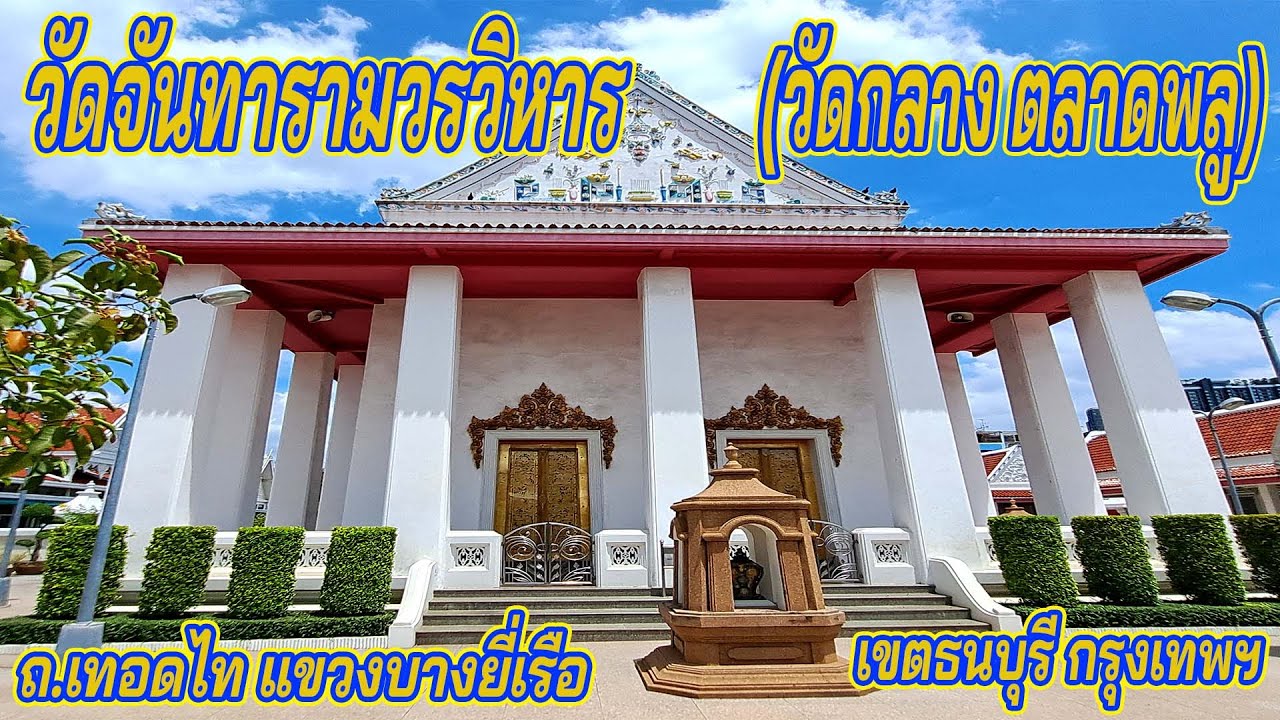
 Click to Access the Navigation Map GPS
Wat Chantararam Worawihan Map
Recommend
 Art, Culture and Heritage
 Historical Sites and Monuments(3)
 Landmarks and Memorials(23)
 Royal Palace(13)
 Art, Craft Centres, Tradition(35)
 Museums(59)
 Historical Houses and The Ancient City(3)
 Art Gallery(16)
 Educational Places
 Museum for Study(6)
 Library(4)
Temple(72)
Library(4)
Temple(72)
 Church(2)
 Mosque(67)
 Other religious and spiritural sites(8)
 Research and Development
 Royal Project(1)
 Suburban Living
 Village, Community(5)
 Local Market(9)
 Floating Market(2)
 Nature and Wildlife
 River, Canal(3)
 Bays and Beaches(1)
 Other natural attractions(1)
 Entertainment and Agricultural
 Zoos and Aquariums(4)
 Animal camps and shows(5)
 Stadium(9)
 Farm, Parks, Gardens and Ecotourism(20)
 Amusement Park(1)
 Waterpark(1)
 Theater(7)
 Cinema(1)
 Shopping
 Shopping and Night Market(20)
 Department Store(7)
 Spas and Wellness
 Spas and Wellness(1)
 Restaurant
 Michelin Star(5)
 Accommodation
 Hotel(3)
 Call Customer Service in Tourism
 Call Customer Service in Tourism(1)
 Travel Articles, Recipes
 Travel Review, Food Review(21)
 Royal Thai Desserts, Traditional Dessert, Thai Dessert Recipes(56)


