
lovethailand home >North Travel Attractions >Chiang Mai Travel Attractions >Muang Chiang Mai >Suthep > Kruba Srivichai Monument
TL;DR: Kruba Srivichai Monument is located at Foothill of Doi Suthep, Suthep Subdistrict, Mueang Chiang Mai District, Chiang Mai, open Open Daily, hours 24 Hours.
Kruba Srivichai Monument
Open Days: Open Daily
Opening Hours: 24 Hours
Kruba Srivichai Monument is one of Chiang Mai’s most important devotional landmarks at the foot of Doi Suthep. For many visitors, this is the place where a journey up the mountain truly begins. Before heading further to Wat Phra That Doi Suthep, many locals and travelers stop here to pay respect to Kruba Srivichai, the revered Lanna monk remembered for his spiritual leadership, his dedication to Buddhism in Northern Thailand, and his role in inspiring the construction of the road leading up Doi Suthep.
The significance of this monument goes far beyond being a roadside memorial. It stands at the meeting point of faith, memory, and movement. It connects Chiang Mai city with the sacred mountain above it, and it connects the living traditions of Lanna with the daily experience of modern travelers. People do not come here only to look at a statue. They come to begin a pilgrimage, to ask for blessings, to remember a beloved monk, and to experience a place that still carries deep emotional meaning for local communities.
The idea of creating a monument to Kruba Srivichai began around 1956, when the governor of Chiang Mai at the time, Prasert Kanchanadul, contacted the Fine Arts Department to commission a likeness of the monk. The design was entrusted to Professor Silpa Bhirasri, one of the most influential figures in modern Thai art. Silpa Bhirasri sculpted the head, while Ajarn Khien Yimsiri sculpted the body. The bronze statue, finished in dark patina, stands about 80 centimeters high. The design and sculpting process took place from late 1956 to 1958, and the monument was formally installed at the foothill of Doi Suthep on 8 June 1963.
That history matters because the monument was not created in isolation. It grew out of the profound respect that the people of Lanna had for Kruba Srivichai. He was not simply a famous monk from the past. He was a religious leader whose life, conduct, and public works shaped the spiritual landscape of Northern Thailand. Born in Ban Pang, Mae Tuen Subdistrict, Li District, Lamphun Province, his original name was Fuen. He was ordained at Wat Ban Hong Luang in Lamphun in 1899 at the age of 21, receiving the monastic name Sirivichayo Bhikkhu. In everyday Lanna usage, however, people came to know him as Phra Siwichai, and later more broadly as Kruba Srivichai.
His reputation rested on discipline, simplicity, humility, and compassion. He was known as a monk with admirable conduct and deep spiritual commitment. Wherever he found temples in decline, he often took part in restoring them. This visible dedication to Buddhist institutions, combined with his moral authority, led many people to honor him as a holy man of exceptional merit. In Lanna cultural memory, he became not only a religious figure but a symbol of righteous action and selfless service.
Kruba Srivichai’s contributions to Northern Thai Buddhism were extensive. One major aspect was his role in spreading Buddhism among communities that had long followed animist traditions and local spirit beliefs, especially among highland and ethnic communities. Another major contribution was his involvement in restoring temples across the region. Historical accounts mention his role in work connected to 108 temples. These include important sites in Chiang Mai, Lamphun, Phayao, Chiang Rai, Phrae, and other northern provinces. His efforts were not limited to rebuilding structures. They helped reinforce Buddhist identity and sacred geography across Lanna.
Among the achievements most widely remembered today is his leadership in inspiring the road to Wat Phra That Doi Suthep. That road remains one of the defining public works associated with his name. Even now, when travelers drive smoothly up the mountain, the memory of that achievement still gives meaning to this monument at the base of the route. The site reminds visitors that the road was not only an infrastructure project. It was an act of collective faith, made possible by the belief people placed in Kruba Srivichai and the community spirit he was able to mobilize.
He also played an important role in preserving Lanna Buddhist textual heritage. Northern manuscripts of the Tripitaka written in the local script had become scattered and neglected in many monasteries. Kruba Srivichai gathered them, organized them, and had them recopied onto new palm-leaf manuscripts. This effort helped preserve an important body of Buddhist knowledge and remains one of his most remarkable intellectual and religious contributions.
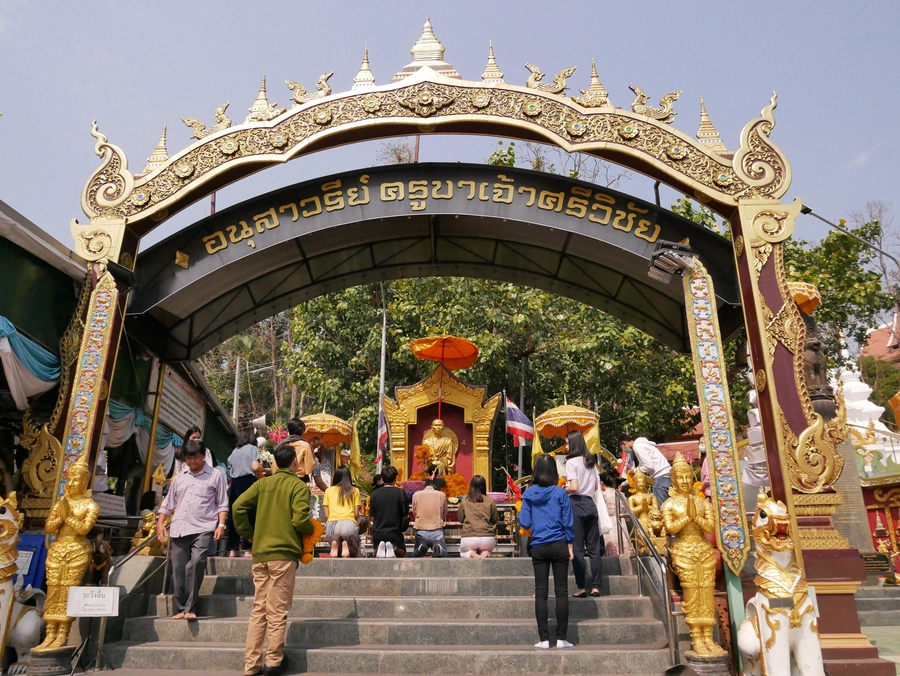
Today, the monument remains an active place of devotion rather than a silent historical object. Many people come here in the early morning to make merit, and on significant Buddhist dates or commemorative occasions related to Kruba Srivichai, the area becomes especially lively. Vendors selling flowers, incense, and candles line the approach, and the atmosphere often blends the quiet of a sacred place with the rhythm of an active pilgrimage stop. This is one reason why the monument feels so different from an ordinary urban landmark.
For first-time visitors, the monument offers a strong introduction to Chiang Mai’s spiritual and cultural character. The setting at the foothill of Doi Suthep gives it a meaningful geographical position. It is both physically and symbolically a threshold. Travelers moving from the city toward the mountain begin here, and many feel that a stop at the monument adds a sense of blessing and intention to the rest of the journey.
The atmosphere changes throughout the day. Early morning is especially peaceful and is often associated with almsgiving and quiet worship. Late morning and afternoon are practical times for sightseeing and continuing onward to nearby attractions. Evening and night create another kind of experience, with cooler air and a more reflective mood. Because the site remains accessible throughout the day, it works well for flexible travel plans and can easily be combined with nearby temples, waterfalls, and scenic stops.
From a cultural tourism perspective, the monument is an excellent starting point for exploring the Doi Suthep side of Chiang Mai. Nearby places include Wat Sri Soda, Huay Kaew Waterfall, Chiang Mai Zoo, Wat Pha Lat, and Wat Phra That Doi Suthep. This makes the monument especially useful for travelers who want more than a quick photo stop. It can be the first chapter of a full half-day or full-day route that combines religion, landscape, and local culture.
Visitors should approach the site with the respect appropriate to a sacred place. Modest clothing, calm behavior, and consideration for worshippers help preserve the atmosphere. Photography is generally easy to do, but it is best to avoid interrupting people who are praying or offering respects. Small gestures of courtesy matter here because the place remains emotionally important to many local people.
Another meaningful aspect of the monument is its place within public art history. Because Professor Silpa Bhirasri was involved in its design, the monument also carries value as a work of modern Thai sculpture. This gives the site another layer of importance, beyond religion and local devotion. It reflects how public memorials were conceived and created in mid-20th-century Thailand, especially when they commemorated figures whose influence was deeply rooted in regional identity.
Getting There is straightforward. If you are traveling by private car, follow Huay Kaew Road toward the foothill of Doi Suthep. The monument stands before Huay Kaew Waterfall and before the main ascent to Wat Phra That Doi Suthep. From the Old City or Nimmanhaemin area, the drive is relatively short. If you are using public transport, a red songthaew or hired vehicle from central Chiang Mai can usually take you directly to “Kruba Srivichai Monument” or “the start of the Doi Suthep road,” both of which are widely recognized by local drivers.
In the end, Kruba Srivichai Monument remains one of Chiang Mai’s most meaningful places to visit because it combines history, devotion, memory, and practical travel value in one location. It is where many journeys begin, but it is also a destination in its own right. For anyone who wants to understand Chiang Mai beyond surface-level sightseeing, this monument offers an especially clear window into the spiritual heritage of Lanna.
| Name | Kruba Srivichai Monument |
| Location | Foothill of Doi Suthep, Suthep Subdistrict, Mueang Chiang Mai District, Chiang Mai |
| Address | 99 Huay Kaew Road, Suthep, Mueang Chiang Mai, Chiang Mai 50300 |
| Coordinates | 18.8129, 98.9460 |
| Highlights | Major devotional stop before going up Doi Suthep, strong Lanna cultural significance, convenient starting point for nearby temple and nature routes |
| History | The project began around 1956, was designed and sculpted between late 1956 and 1958, and the monument was installed on 8 June 1963 |
| Name Origin | Named after Kruba Srivichai, the revered Lanna monk remembered for religious leadership and his role in inspiring the Doi Suthep road |
| Distinctive Features | Dark bronze likeness of Kruba Srivichai on a worship plaza, flower and incense stalls nearby, and a strong pilgrimage atmosphere throughout the day |
| Travel Information | Follow Huay Kaew Road toward Doi Suthep. The monument stands before Huay Kaew Waterfall and before the main ascent to Wat Phra That Doi Suthep. It is easy to reach by private car, red songthaew, or hired vehicle from central Chiang Mai |
| Current Status | Open and active as a worship site, with continuing commemorative and merit-making activities related to Kruba Srivichai |
| Open Days | Open Daily |
| Opening Hours | 24 Hours |
| Fees | No Admission Fee |
| Facilities | Worship plaza, flower and incense stalls, nearby parking area, and direct connection to the Doi Suthep route |
| Main Areas / Zones | Monument plaza, offering area, flower and incense vendor zone, connecting road toward Doi Suthep |
| Official Website / Official Page | Suthep Municipality tourism information, Amazing Thailand |
| Nearby Tourist Attractions | 1) Wat Sri Soda 1 km 2) Huay Kaew Waterfall 1 km 3) Chiang Mai Zoo 2 km 4) Wat Pha Lat 4 km 5) Wat Phra That Doi Suthep 8 km |
| Nearby Restaurants | 1) Khum Viang Yong 4 km Tel. 053-329-244 2) Hello Solao 4 km Tel. 053-270-190, 089-850-9343 3) Larb Rim Klong 5 km Tel. 090-241-9624 4) Ban Rommai Bali 4 km Tel. 080-120-7722, 053-271-122 5) The Volcano Behind CMU 3 km Tel. 088-261-3001 |
| Nearby Accommodations | 1) Furama Chiang Mai 4 km Tel. 053-415-222 2) Chiangmai Hill Hotel 4 km Tel. 053-218-960-3 3) Lotus Hotel Pang Suan Kaew 5 km Tel. 053-224-333 4) U Nimman Chiang Mai 5 km Tel. 052-005-111 5) Hotel MAYU Chiang Mai 5 km Tel. 098-806-5896 |
Frequently Asked Questions (FAQ)
Q: Where is Kruba Srivichai Monument located?
A: It is located at the foothill of Doi Suthep on Huay Kaew Road in Suthep Subdistrict, Mueang Chiang Mai District, Chiang Mai.
Q: Is Kruba Srivichai Monument open every day?
A: Yes. The monument is open daily and is accessible 24 hours a day.
Q: Is there an entrance fee?
A: No. Visitors can enter and pay respects without an admission fee.
Q: Why is Kruba Srivichai so important in Chiang Mai?
A: He is deeply respected as a holy monk of Lanna who contributed to Buddhism, temple restoration, and the creation of the road to Doi Suthep.
Q: When is the best time to visit?
A: Early morning is ideal for a peaceful atmosphere and merit-making, while evening offers cooler weather and a calm setting before or after a Doi Suthep trip.
Q: What can I visit nearby after stopping here?
A: You can continue to Wat Sri Soda, Huay Kaew Waterfall, Chiang Mai Zoo, Wat Pha Lat, and Wat Phra That Doi Suthep.
 Category: ●Art, Culture and Heritage
 Group: ●Historical Sites and Monuments
Last Update : 4 MonthAgo
 Last Update : 4 MonthAgo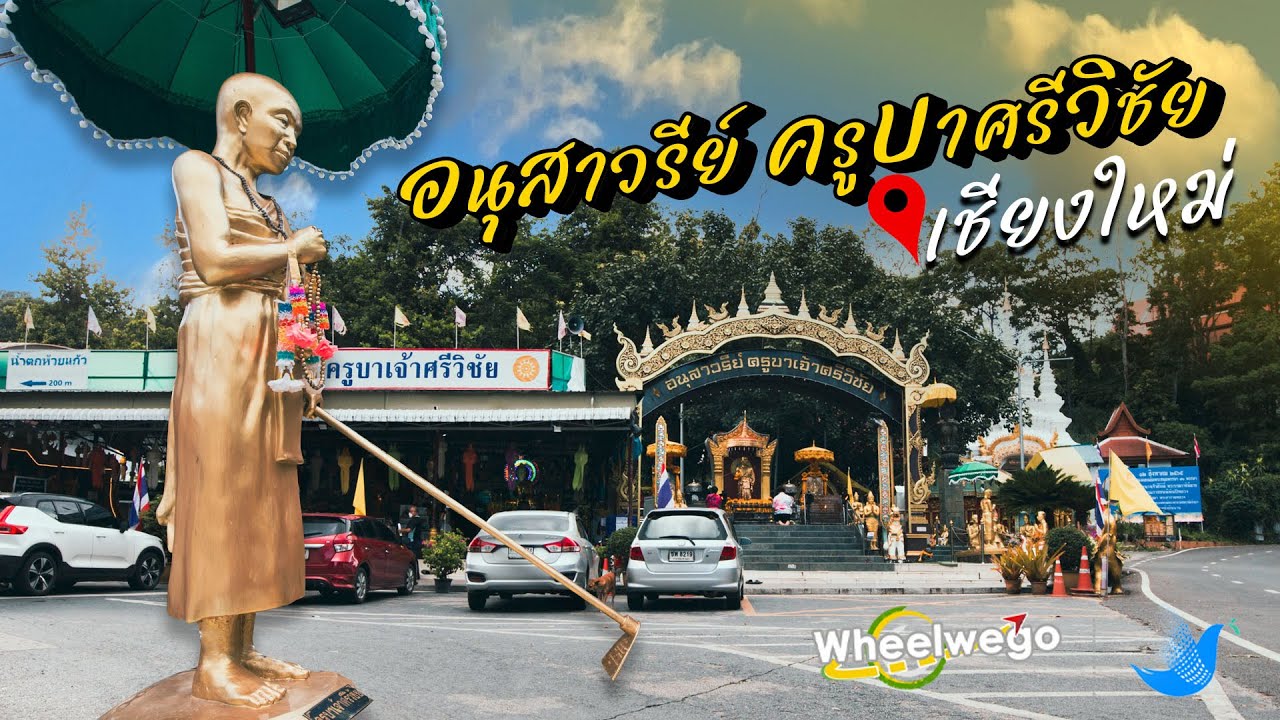
 Click to Access the Navigation Map GPS
Kruba Srivichai Monument Map
Recommend
 Historical Sites and Monuments(8)
 Landmarks and Memorials(5)
 Royal Palace(2)
 Art, Craft Centres, Tradition(43)
 Museums(24)
 Educational Places
 Museum for Study(2)
 Educational Gardens, Farm(5)
 Training Center(1)
 Places of Worship
 Temple(79)
 Mosque(2)
 Other Sacred Sites(17)
 Research and Development
 Royal Project(44)
 Suburban Living
 Village, Community(41)
 Local Market(14)
 Nature and Wildlife
 National Parks and Marine Reserves(16)
 Mountain (Doi)(21)
 Dam, Reservoir, Lake(26)
 Waterfalls(43)
 Hot Springs(12)
 Caves(11)
 River, Canal(6)
 Other natural attractions(14)
 Entertainment and Agricultural
 Zoos and Aquariums(2)
 Animal camps and shows(3)
 Stadium(1)
 Farms, Parks and Ecotourism(19)
 Waterpark(2)
 Theater(1)
 Outdoor and Adventure Activities(10)
 Shopping
 Shopping and Night Market(6)
 Restaurant
 Michelin Star(1)
 Michelin Guide(23)
 Call Customer Service in Tourism
 Call Customer Service in Tourism(1)
 Travel Articles, Recipes
 Travel Review, Food Review(15)
 Food Menu, North Recipes(30)
 Thai Desserts, North Recipes(17)


