
lovethailand home >North Travel Attractions >Chiang Mai Travel Attractions >Mae Taeng >Kuet Chang > Huai Kup Kab Village
TL;DR: Huai Kup Kab Village is located at Mae Taeng District, Chiang Mai (Kuet Chang area / mountain access route), open Daily (recommended: check the weather and confirm your stay/ride up the, hours Recommended 06.00–18.00 (best to head down before dark).

Huai Kup Kab Village
Open Days: Daily (recommended: check the weather and confirm your stay/ride up the mountain in advance, especially during the rainy season)
Opening Hours: Recommended 06.00–18.00 (best to head down before dark)
Huay Kub Kab Village is a small highland village perched on a mountain ridge in Mae Taeng District, Chiang Mai. It quietly sits within a lush natural landscape and keeps a slower, simpler rhythm of life—so much so that many first-time visitors from the city find themselves naturally unwinding without even trying. This is the kind of place for anyone craving a real break from noise, wanting to be close to forests and mountains, and looking for a calm atmosphere without flashy lights or packed activities interrupting the feeling.
Huay Kub Kab is home to the Lahu people (often locally known as “Red Lahu”). Daily life here remains closely tied to the mountains and the seasons. Most households farm rice and grow vegetables, with many still practicing traditional agriculture. It is not only the community’s main source of income, but also a way of keeping local knowledge and the relationship between people and nature alive. Walking through the village, exchanging small conversations, or simply noticing the vegetable plots helps you understand that the calm here is not “emptiness”—it is a life that moves with its own steady order.
The village name is memorable for a charming reason. It is said to come from the sound of horses’ hoofbeats in the past, when villagers traveled between highland communities along difficult red-dirt trails and steep mountain paths. The steady “kub kab” rhythm of hooves on the rough ground gradually became a nickname people repeated—and eventually the name of the village itself. The story is also a small reminder that before roads and 4x4 vehicles made access easier, this landscape relied heavily on human effort and animal power.
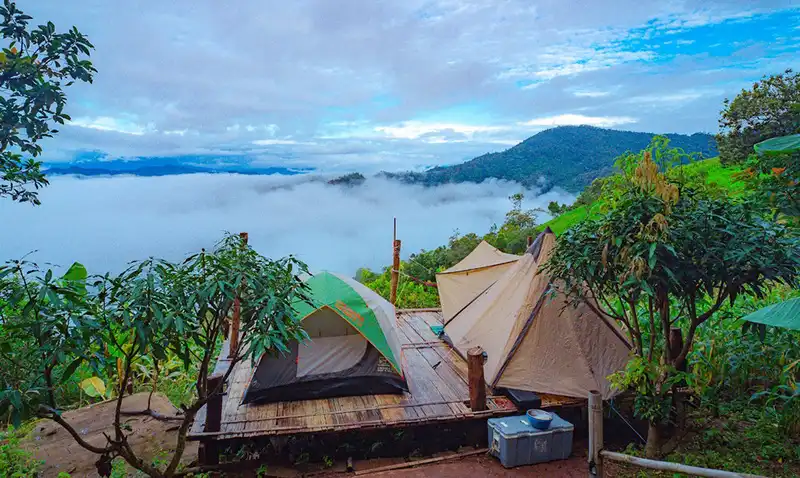
What makes Huay Kub Kab especially popular is its rich nature and wide-open scenery. From its high ridge location, you can look out over layers of green mountains and forests in a near 360-degree view in many seasons. In particular, from pre-dawn to early morning, there is a strong chance of seeing a broad sea of mist. The real magic is not only the mist itself, but the feeling of being far from hurried routines. The village becomes quieter by default, and time feels like it slows down on its own.
You can visit as a day trip if you mainly want the views and a gentle village walk. But if you truly want to “collect the morning” of Huay Kub Kab, staying overnight at a local homestay is a very different experience. Early morning is when mist and light work together at their best. Many travelers love waking up, sitting quietly with something warm to drink, and watching the mist drift along the ridgelines without needing to do anything at all—a kind of happiness that big cities rarely offer.
Another highlight of staying overnight is seeing community life without any staging. Small wooden homes, verandas facing the mountains, simple home-style aromas that feel comforting, and nights quiet enough that you can hear the wind clearly. That simplicity also means you should not expect city-level resort comfort. What you gain instead is calm, views, and an honest sense of everyday life.
Many people prefer visiting from the end of the rainy season into the cool season and winter, when temperatures are pleasant, mist is more likely, and roads are often easier than during heavy rains. Even in the “best” seasons, it is still wise to check the weather before you go. Conditions on the mountain can change quickly, with thick fog, strong winds, and higher humidity than below. During rainy periods the road can be slippery and deeply rutted, so extra caution is essential.
Your visit will feel best when you respect the place and the people, because this is a living ethnic community—not a tourist set. Ask before photographing people or private areas. Keep noise low, especially early morning and at night. Pack out as much trash as you can. Support community income in a considerate way, such as staying with local homestays, purchasing local items as appropriate, and following the village guidelines clearly and respectfully.
For preparation, bring a warm layer or windbreaker (temperatures drop quickly in the morning and at night), shoes with good grip, a flashlight or headlamp for pre-dawn hours, essential personal items and any medication you need. Shops on the mountain may have limited options. Mobile signal can be unstable in some areas, so let someone know your plan if you are staying overnight and allow extra travel time.
Getting There From Chiang Mai city, take Highway 107 toward Mae Taeng District (overall about 50 km). Continue toward Kuet Chang Subdistrict to connect to the mountain route up to Huay Kub Kab. The final stretch is often steep and unpaved (conditions vary by season), so it is recommended to use a suitable vehicle for steep dirt roads or arrange a community/homestay transfer in advance for safety and to reduce the risk of attempting the rough ascent and descent with an unprepared car.
On the climb, you will see layers of mountains and forest that make the difficulty feel lighter. Many visitors say that the moment the ridgeline starts opening into wider views is when they realize it is already worth it. Once you arrive, it becomes clear why so many people accept the challenging journey just to spend slower, quieter time on the mountain.
Some travelers also talk about going by horse in a traditional-style experience that echoes the village-name story beautifully. In practice, most visitors choose the safest option for the day’s weather and road conditions. However you go, the core of Huay Kub Kab is simple: reach the calm, and return with a lighter mind.
| Name | Huay Kub Kab Village |
| Location | Mae Taeng District, Chiang Mai (Kuet Chang area / mountain access route) |
| Characteristics | Highland village, wide 360-degree mountain views, strong chance of sea of mist, simple Lahu community life, rich natural surroundings |
| Period | Contemporary highland ethnic community |
| Key Evidence | Traditional agriculture practices, highland settlement patterns, and a largely intact natural landscape |
| Name Origin | From the “kub kab” sound of horses’ hoofbeats on red-dirt trails in the past |
| Travel | Chiang Mai city → Highway 107 → Mae Taeng (about 50 km) → Kuet Chang → final climb on steep/rough unpaved road (recommended: suitable vehicle or community/homestay transfer) |
| Current Status | Open for visits (recommended: check weather and road conditions before traveling) |
| Nearby Tourist Attractions with Distance | Bua Tong Waterfall – Seven Colors Spring National Park (about 45 km) Tel. 093-193-3556 Si Lanna National Park (about 60 km) Tel. 053-479-079 Elephant Nature Park (about 45 km) Tel. 053-272-855 Kaeng Kuet Rafting (Mae Taeng) (about 25 km) Tel. 085-034-8868 |
| Popular Restaurants Nearby with Distance | Jungle De Cafe (Kuet Chang) (about 20 km) Tel. 062-030-5511 Lung Same Restaurant (Kaeng Kuet) (about 25 km) Tel. 095-449-1658 |
| Popular Accommodations Nearby with Distance | Huay Kub Kab Himm-Mok Homestay (about 0 km) Tel. 096-006-1212 Malabar Homestay (Huay Kub Kab) (about 0 km) Tel. 061-647-8422 Ana Lahu Homestay (about 0 km) Tel. 092-5199-637 Klai Khao Homestay (about 1 km) Tel. 093-172-6366 Huay Kub Kab Himm-Doi Homestay (about 0 km) Tel. 098-545-8786 |
Frequently Asked Questions (FAQ)
Q: Which months are best for visiting Huay Kub Kab Village?
A: Most travelers prefer the end of the rainy season through winter, when the air is cooler and the chance of sea of mist is higher. Always check the weather before traveling.
Q: Can I visit as a day trip?
A: Yes. If you mainly want the views and a short village walk, a day trip works well. If you want the full early-morning mist experience, staying overnight is recommended.
Q: Is the road difficult, and what kind of vehicle should I use?
A: The final section is steep and unpaved, and conditions vary by season. Use a suitable vehicle for steep dirt roads or arrange a community/homestay transfer for safety.
Q: What local etiquette should I be mindful of?
A: This is a living community. Ask before taking photos of people or private spaces, keep noise low (especially early morning and at night), and pack out your trash.
Q: What can I do near the village besides enjoying the views?
A: You can explore nature activities in the Kuet Chang and Kaeng Kuet area, or visit nearby parks and attractions depending on your time, while keeping your travel respectful to the community and environment.
 Category: ●Suburban Living
 Group: ●Village, Community
Last Update : 9 MonthAgo
 Last Update : 9 MonthAgo
 Click to Access the Navigation Map GPS
Huai Kup Kab Village Map
Recommend

 Art, Culture and Heritage
 Historical Sites and Monuments(8)
 Landmarks and Memorials(5)
 Royal Palace(2)
 Art, Craft Centres, Tradition(43)
 Museums(24)
 Educational Places
 Museum for Study(2)
 Educational Gardens, Farm(5)
 Training Center(1)
 Places of Worship
 Temple(79)
 Mosque(2)
 Other Sacred Sites(17)
 Research and Development
 Royal Project(44)
Village, Community(41)
Royal Project(44)
Village, Community(41)
 Local Market(14)
 Nature and Wildlife
 National Parks and Marine Reserves(16)
 Mountain (Doi)(21)
 Dam, Reservoir, Lake(26)
 Waterfalls(43)
 Hot Springs(12)
 Caves(11)
 River, Canal(6)
 Other natural attractions(14)
 Entertainment and Agricultural
 Zoos and Aquariums(2)
 Animal camps and shows(3)
 Stadium(1)
 Farms, Parks and Ecotourism(19)
 Waterpark(2)
 Theater(1)
 Outdoor and Adventure Activities(10)
 Shopping
 Shopping and Night Market(6)
 Restaurant
 Michelin Star(1)
 Michelin Guide(23)
 Call Customer Service in Tourism
 Call Customer Service in Tourism(1)
 Travel Articles, Recipes
 Travel Review, Food Review(15)
 Food Menu, North Recipes(30)
 Thai Desserts, North Recipes(17)


