
lovethailand home >Northeastern Travel Attractions >Surin Travel Attractions >Muang Surin >Nai Muang > San Don Ta Tradition
TL;DR: San Don Ta Tradition, hours Ritual times at homes, temples, and community venues follow each local schedule.
San Don Ta Tradition
Event Period: The 10th Lunar Month, with the main San Don Ta Day observed on the 14th waning day of the 10th lunar month every year
Key Dates In 2026: Bend Toch Day on 25 September 2026, Kan Song Day on 26 September 2026, and San Don Ta Day on 10 October 2026
Opening Hours: Ritual times at homes, temples, and community venues follow each local schedule
San Don Ta, also known as the Khmer Sart Festival, is one of the most important ancestral merit-making traditions of Thai people of Khmer descent in Surin, Sisaket, Buriram, and other parts of Southern Isan. The tradition is held during the 10th lunar month every year, with the main purpose of making merit for ancestors, deceased relatives, and wandering spirits without living descendants. San Don Ta is not only a ritual of offering food to the dead. It is also a family reunion, a Buddhist merit-making occasion, a time to honour parents and elders, and a powerful expression of Khmer-Thai cultural identity in Northeastern Thailand.
The name San Don Ta comes from local Khmer language. The word San means offering, worship, ritual dedication, or merit-making. Don Ta refers to grandparents, elders, or ancestors. Together, San Don Ta means making offerings and merit for departed ancestors. This meaning directly expresses the heart of the tradition. The entire ritual is based on gratitude, remembrance, family duty, and the belief that descendants should honour those who gave them life, knowledge, culture, and family identity.
For Thai-Khmer communities, San Don Ta carries meaning for both the living and the dead. The living perform their duty by preparing offerings, making merit at temples, gathering relatives, and paying respect to elders. The departed receive merit and remembrance from their descendants. This creates a warm and sacred atmosphere at the same time. Homes are prepared with food, sweets, fruits, clothing, flowers, incense, candles, and ritual objects. Temples become centers of merit-making, while families gather to renew their bonds and remember their lineage.
San Don Ta is related to the broader Sart or tenth-month merit-making traditions found in several cultures, but it has a distinct Khmer character. Its language, ritual sequence, offerings, household ceremonies, temple merit-making, ancestral invocation, and respect for village guardian spirits give it a strong identity. The Thai name Sart Khmer helps general audiences understand that it is a Khmer-style tenth-month ancestral rite, but within the community, the name San Don Ta carries deeper emotional and cultural meaning because it belongs to family memory, local language, and inherited ritual practice.
In Surin Province, San Don Ta is one of the clearest expressions of local identity. Surin is home to many Thai people of Khmer descent who continue to preserve their language, rituals, foodways, textiles, and ancestral beliefs. San Don Ta is therefore not simply a seasonal event. It is a living cultural heritage that connects households, temples, communities, schools, government agencies, and provincial ceremonies. The tradition shows how deeply ancestral gratitude remains embedded in everyday life in Southern Isan.
The ritual sequence begins with Bend Toch Day, usually observed on the 14th waxing day of the 10th lunar month in many communities. This day marks the beginning of the San Don Ta period. Families prepare ritual offerings, food, sweets, fruits, and items for household rites. They also bring food to temples for Buddhist merit-making. Bend Toch functions as the opening of the ancestral season. It announces that the family is ready to honour the departed, invite ancestors to receive merit, and prepare for the larger ceremonies ahead.
Kan Song Day follows Bend Toch and is generally observed on the 15th waxing day of the 10th lunar month. In local understanding, Kan refers to practice or observance, while Song refers to monks. On this day, villagers bring food to the temple, offer meals to monks, and dedicate merit to the deceased. From the Kan Song period until the main San Don Ta Day, many communities take turns hosting meals and merit-making activities at temples. This emphasizes the close relationship between family ritual and Buddhist practice.
San Don Ta Day, also known as the great Sart day, falls on the 14th waning day of the 10th lunar month. It is the most important day of the tradition. Family members who live far away try to return home. In the morning, they make merit at the temple by offering food to monks and dedicating merit to ancestors, deceased relatives, and spirits without descendants. Later, families perform ancestral offerings at home, preparing food trays, sweets, fruits, water, liquor, clothing, fragrant items, and personal-use objects for the spirits of their ancestors.
The central belief of San Don Ta is that during this period, ancestral spirits are released to visit their living descendants and receive merit. The merit made at temples and the offerings prepared at home allow descendants to express gratitude, affection, remembrance, and continuity. The ritual is sacred, but it is also deeply intimate. It carries the tenderness of family memory and the emotional weight of those who are no longer physically present but remain part of the household’s identity.
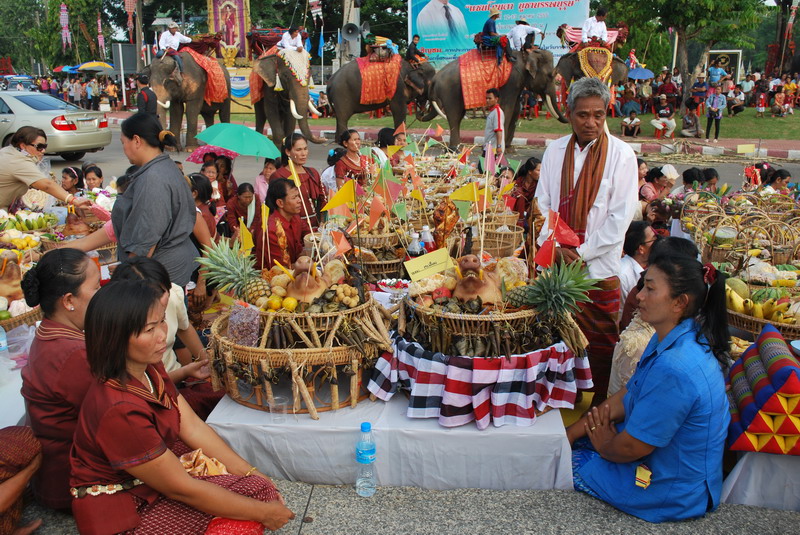
The offerings used in San Don Ta carry symbolic meaning. Five flower cones, known as khan ha, are prepared as a sign of respect. Some families place money or valuables on a tray to show sincerity and completeness. New clothing, sarongs, silk skirts, fragrant powder, perfume, scented water, combs, and mirrors are prepared as personal items for the ancestors. Food trays represent hospitality and care. Through these objects, descendants symbolically welcome their ancestors back to the family home.
Food is one of the most important parts of the ritual. Families prepare their best dishes, such as boiled duck, boiled chicken, pork head, local curries, rice, sticky rice, and dishes once favoured by deceased relatives. Common sweets include coconut-leaf-wrapped sticky rice, savoury rice parcels, khanom thian, khanom khai hong, and other local desserts. Fruits often include young coconut, ripe nam wa bananas, and seasonal fruits. Water and liquor are also included according to each family’s custom. Together, these items form a complete ancestral meal.
The household ritual is usually led by the senior family member. The elder lights incense and candles, lifts the khan ha offering, and calls the ancestral spirits, deceased relatives, and respected benefactors to receive the offerings. Water or drinks are poured to let the spirits know what has been prepared. The ritual usually lasts about 20 to 30 minutes. After it ends, the family eats together. This shared meal is important because the offering to ancestors continues into the strengthening of bonds among the living.
Chun Don Ta is closely related to San Don Ta. The word Chun means to give or present, while Don Ta refers to ancestors or elders. In practice, Chun Don Ta is the custom of bringing gifts to living parents, grandparents, and respected senior relatives. Common gifts include coconuts, sticky rice, sweets, fruits, daily-use items, and money for merit-making. This custom shows that San Don Ta is not only about the dead. It is also a time to honour living elders and maintain respect within the family.
Returning home during San Don Ta is more than holiday travel. Family members who work or study in other provinces come back to cook, arrange offerings, go to the temple, pay respect to elders, and participate in household rituals. The gathering gives relatives time to talk, reconcile, make merit together, and renew family ties. San Don Ta therefore works as a social mechanism that keeps extended families connected even when members live in different places.
Temples play a central role in the tradition. They are places for offering food to monks, listening to sermons, dedicating merit, and gathering as a community. During the Kan Song period and the days leading to San Don Ta, villagers take turns hosting temple meals and merit-making activities. Some communities also prepare offerings for spirits without relatives, allowing monks to dedicate merit to them. This reflects both Buddhist compassion and local beliefs about spirits and ancestral presence.
Beyond the home and temple, village guardian shrines and household spirit shrines also have roles in San Don Ta. Many families pay respect to the village Pu Ta shrine or the household spirit shrine before performing the main ceremony. These acts acknowledge the guardians of place and the protective spirits of the community. The belief in Pu Ta is part of Southern Isan’s local spiritual landscape, linking the household ritual with the wider village and ancestral territory.
San Don Ta is a clear example of the blending of older spiritual beliefs with Buddhism. The household offering reflects belief in ancestral spirits, while the temple rituals reflect Buddhist merit-making. Together, they create a complete ritual system. Descendants honour their ancestors through food and offerings, while also generating merit through monks and Buddhist practice. The result is a tradition that is both spiritual and religious, both family-based and community-based.
At the provincial level in Surin, the San Don Ta ancestral worship ceremony has been held at the Phraya Surin Phakdi Si Narong Changwang Monument, an important civic landmark in Surin town. This location is symbolically powerful because the monument honours the founder of Surin. Holding San Don Ta there expands the meaning of the tradition from the family level to the city level. It connects remembrance of household ancestors with remembrance of the forebears who shaped Surin as a province.
Provincial activities often include processions of Chun and San Don Ta offerings, Buddhist ceremonies, ancestral rites, cultural performances, living exhibitions, demonstrations of traditional food and sweets, and participation from government agencies, communities, youth groups, and local residents. These activities bring a household and temple tradition into the public space of the city. Visitors can see the family, spiritual, and cultural dimensions of San Don Ta in one place.
Food and sweets displayed during San Don Ta are an important form of cultural knowledge. Sticky rice parcels, coconut-leaf-wrapped sweets, khanom thian, khanom khai hong, local dishes, and ceremonial trays are passed down through practice. Preparing these foods teaches younger generations about taste, fragrance, wrapping techniques, boiling methods, presentation, and ritual meaning. Children learn culture not only through explanation, but through helping elders in the kitchen and arranging offerings.
Traditional clothing also expresses Thai-Khmer identity during the festival. Many communities wear silk skirts, sarongs, local textiles, or traditional dress during ceremonies. Silk is not only decorative. It represents refinement, respect, and Surin’s textile heritage. As a province famous for silk weaving, Surin naturally connects San Don Ta with local craft identity. When silk appears in ritual spaces, the tradition links ancestral remembrance with the province’s handwoven heritage.
Visitors who want to experience San Don Ta in Surin can begin at the provincial event area in the city to understand the overall atmosphere, then continue to temples or communities where the tradition is practiced in a more local form. Surin town also offers nearby cultural sites such as the Phraya Surin Phakdi Si Narong Changwang Monument, Surin City Pillar Shrine, Wat Burapharam, Surin National Museum, and Ban Tha Sawang Silk Weaving Village. These places help deepen understanding of Surin’s history, faith, silk, and ethnic diversity.
San Don Ta is best experienced with respect. Visitors should dress modestly when entering temples or ritual areas, avoid disturbing families during private offerings, ask before taking close photographs, and speak respectfully about local beliefs. The ceremony is tied to ancestors and family memory, so it has a private and sacred character even when observed in public. Respectful participation allows visitors to understand its value more deeply than simply watching it as a festival.
In 2026, the key San Don Ta dates are Bend Toch Day on 25 September 2026, Kan Song Day on 26 September 2026, and the main San Don Ta Day on 10 October 2026. Provincial and community events follow the schedule announced by each organizing area, while household rites follow the timing set by family elders. In general, families prepare food and offerings in the morning, make merit at temples, and perform ancestral offerings at home during the suitable time of the day.
San Don Ta remains powerful in modern society because it answers a deep emotional need. Many descendants now work or study far from home, but this tradition gives them a meaningful reason to return. They come back to bow to elders, make merit for ancestors, eat with relatives, and renew the family center. The tradition acts as a bridge between generations, between distant relatives and the homeland, and between the present family and the ancestral past.
Overall, San Don Ta is a major cultural heritage of Thai people of Khmer descent. It carries religious, family, community, and ethnic meaning. It teaches gratitude, remembrance, Buddhist merit-making, respect for elders, and preservation of local identity. Surin remains one of the most important places where the tradition continues strongly at the household, temple, community, and provincial levels. San Don Ta is therefore one of the clearest expressions of Surin’s Thai-Khmer cultural identity.
| Tradition Name | San Don Ta Ancestral Merit-Making Tradition, also known as the Khmer Sart Festival |
| Main Cultural Areas | Surin, Sisaket, Buriram, and Thai-Khmer communities in Southern Isan |
| Main Event Area In Surin | Ceremonial area at the Phraya Surin Phakdi Si Narong Changwang Monument, Nai Mueang Subdistrict, Mueang Surin District, Surin Province |
| Event Period | The 10th lunar month, with the most important ritual day falling on the 14th waning day of the 10th lunar month every year |
| Key Dates In 2026 | 1. Bend Toch Day: 25 September 2026 2. Kan Song Day: 26 September 2026 3. San Don Ta Day: 10 October 2026 |
| Activity Hours | Household rites usually take place from morning to afternoon, while provincial and community events follow each local schedule |
| Admission Fee | No Admission Fee For Public Ceremonial Areas |
| Name Meaning | San means offering, worship, or merit-making. Don Ta means grandparents, elders, or ancestors. Together, the name means making offerings and merit for departed ancestors |
| Distinctive Features | Temple merit-making, household ancestral offerings, Chun Don Ta offerings to living elders, family reunions, and merit dedication to spirits without relatives |
| Main Offerings | Five flower cones, khan ha offerings, new clothing, sarongs, silk skirts, fragrant powder, perfume, scented water, combs, mirrors, food trays, boiled duck, boiled chicken, pork head, local sweets, fruits, water, and traditional drinks according to family custom |
| Notable Food And Sweets | Coconut-leaf-wrapped sticky rice, savoury rice parcels, khanom thian, khanom khai hong, ripe nam wa bananas, young coconut, savoury dishes, sweets, and ancestral meal trays |
| Main Ritual Areas / Zones | 1. Family homes for ancestral offerings 2. Community temples for Buddhist merit-making 3. Village Pu Ta shrine or guardian spirit shrine 4. Provincial event area at the Phraya Surin Phakdi Monument 5. Procession area for Chun and San Don Ta offerings 6. Food, sweets, and cultural exhibition zones |
| Caretaker / Coordinating Agencies | Surin Province, Surin Provincial Administrative Organization, Surin Provincial Cultural Office, Surin Municipality, local temples, and Thai-Khmer communities |
| Main Contact Number | Surin Provincial Cultural Office Tel. 044-511963 Surin Municipality Tel. 044-511117, 044-511272 Tourism Authority of Thailand, Surin Office Tel. 044-514447 |
| Visitor Etiquette | Dress modestly at temples and ritual areas, avoid disturbing families during private rites, ask before taking close photographs, and respect local beliefs |
| Part 2: Nearby Attractions, Restaurants, And Accommodations | The following options are based on the provincial event area near the Phraya Surin Phakdi Si Narong Changwang Monument. Distances are approximate road distances in Surin town |
| Nearby Tourist Attractions | 1. Phraya Surin Phakdi Si Narong Changwang Monument, about 0 m 2. Surin City Wall And Moat, about 300 m 3. Surin City Pillar Shrine, about 700 m 4. Wat Burapharam Royal Monastery, about 800 m 5. Wihan Phra Phuttha Surin Phakdi, about 900 m 6. Surin National Museum, about 4.4 km, Tel. 044-513274 7. Ban Tha Sawang Silk Weaving Village, about 8.1 km |
| Nearby Restaurants | 1. For Foo Cafe On Lak Mueang Road, about 1 km, Tel. 089-426-9992 2. Craft Cafe, about 1.7 km, Tel. 095-605-4281 3. SATI Coffee Roaster, about 1.9 km, Tel. 085-567-7104 4. Lab Mahanakhon Surin On Lak Mueang Road, about 2 km, Tel. 095-571-6286 5. Sydney Grilled Surin, about 1 km, Tel. 063-289-7964, 044-519570 6. Thong Tarin Hotel Restaurant, about 1.4 km, Tel. 044-514281, 044-514282, 044-514283 |
| Nearby Accommodations | 1. The Grace Residence, about 300 m, Tel. 044-512164, 095-605-9350 2. The Wood Surin, about 1.1 km, Tel. 063-023-7999 3. Thong Tarin Hotel, about 1.4 km, Tel. 044-514281, 085-300-8858 4. Maneerote Hotel, about 1.1 km, Tel. 044-514569 5. Surin Majestic Hotel, about 1.1 km, Tel. 044-713980 6. Seven Bee Boutique Hotel - Surin, about 2.1 km, Tel. 089-355-5777 |
Frequently Asked Questions (FAQ)
Q: What is San Don Ta?
A: San Don Ta, also known as the Khmer Sart Festival, is an ancestral merit-making tradition of Thai people of Khmer descent. It is held during the 10th lunar month to dedicate merit to deceased relatives and bring family members together.
Q: What does San Don Ta mean?
A: San means offering, worship, or merit-making, while Don Ta means grandparents, elders, or ancestors. Together, the name means making offerings and merit for departed ancestors.
Q: When is San Don Ta in 2026?
A: The main San Don Ta Day falls on the 14th waning day of the 10th lunar month. In 2026, it falls on 10 October 2026. Bend Toch Day is on 25 September 2026, and Kan Song Day is on 26 September 2026.
Q: Where is San Don Ta held in Surin?
A: The rituals are held at family homes, temples, and Thai-Khmer communities. The latest provincial-level event area in Surin is the ceremonial area at the Phraya Surin Phakdi Si Narong Changwang Monument in Mueang Surin District.
Q: What offerings are prepared for San Don Ta?
A: Offerings include five flower cones, khan ha offerings, new clothing, sarongs, silk skirts, fragrant items, combs, mirrors, food trays, boiled duck, boiled chicken, pork head, local sweets, fruits, water, and traditional drinks according to family custom.
Q: How are Bend Toch, Kan Song, and San Don Ta different?
A: Bend Toch begins the ritual period with household offerings and temple merit-making. Kan Song focuses on offerings to monks and continued merit-making. San Don Ta is the great ancestral day when families make merit at temples and perform household ancestral offerings together.
Q: What is Chun Don Ta?
A: Chun Don Ta is the custom of bringing gifts to living parents, grandparents, and respected elders. Gifts may include coconuts, sticky rice, sweets, fruits, daily-use items, or money for merit-making.
Q: How should visitors behave during San Don Ta?
A: Visitors should dress modestly, respect temple and family ritual areas, avoid disturbing private ceremonies, ask before taking close photographs, and show respect for Thai-Khmer community beliefs.
 Category: ●Art, Culture and Heritage
 Group: ●Art, Craft Centres, Tradition
Last Update : 2 MonthAgo
 Last Update : 2 MonthAgo

 Historical Sites and Monuments(11)
 Landmarks and Memorials(2)
Art, Craft Centres, Tradition(5)
Landmarks and Memorials(2)
Art, Craft Centres, Tradition(5)
 Museums(1)
 Places of Worship
 Temple(15)
 Other Sacred Sites(1)
 Suburban Living
 Village, Community(9)
 Local Market(1)
 Nature and Wildlife
 National Parks and Marine Reserves(2)
 Mountain (Doi)(2)
 Dam, Reservoir, Lake(6)
 Waterfalls(1)
 River, Canal(2)
 Other natural attractions(4)
 Entertainment and Agricultural
 Farms, Parks and Ecotourism(2)


