
lovethailand home >North Travel Attractions >Mae Hong Son Travel Attractions >Muang Mae Hong Son >Chong Kham > Poi Sang Long Tradition (Brahma Luk Kaew)
TL;DR: Poi Sang Long Tradition (Brahma Luk Kaew), open Annually during late March to April (for 2026, event information is available, hours According to the ritual schedule and procession times of each day.
Poi Sang Long Tradition (Brahma Luk Kaew)
Open Days: Annually during late March to April (for 2026, event information is available for Mueang Mae Hong Son from 21 March – 29 April 2026)
Opening Hours: According to the ritual schedule and procession times of each day
Poy Sang Long, also known as the Buat Luk Kaeo novice ordination ceremony, is one of the most remarkable cultural traditions of Mae Hong Son. Deeply rooted in the Shan or Tai Yai community, this northern Thai tradition is a ceremonial ordination of young boys into novice monkhood. More than a religious event, it is a living expression of Buddhist faith, family devotion, and community identity. For local families, allowing a son to enter the monastic path even for a period of time is considered a powerful act of merit and a meaningful step in spiritual upbringing.
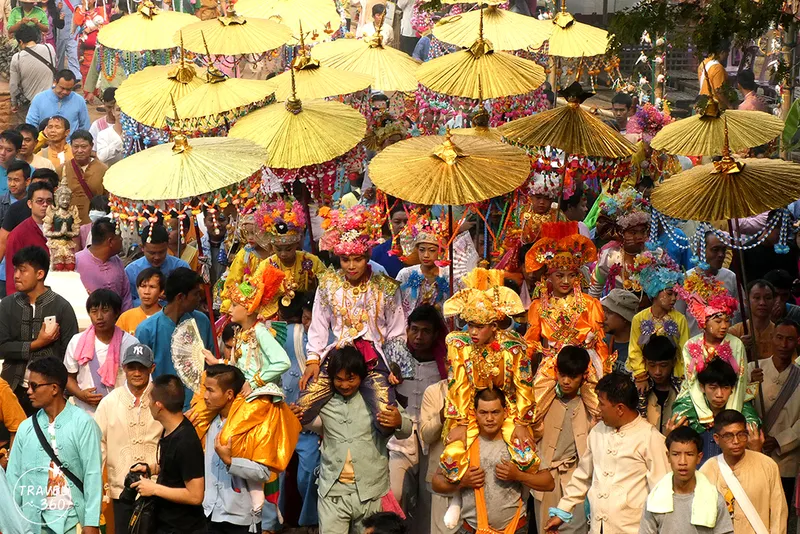
What makes Poy Sang Long especially distinctive is the extraordinary appearance of the boys who are about to be ordained. Before entering monkhood, they are dressed in bright, elaborate clothing, adorned with jewelry, and carefully made up so that they resemble young princes. This visual transformation is not simply for beauty or celebration. It symbolically reflects Prince Siddhartha before he renounced royal life and began the path that led him to become the Buddha. That symbolism gives the entire ceremony an emotional and spiritual depth that stays with visitors long after the procession ends.
The word “Poy” refers to a festive or auspicious event, while “Sang Long” refers to the young boys preparing to become novice monks. In Mae Hong Son, where Shan cultural heritage remains especially strong, the tradition has become one of the province’s best-known cultural highlights. It is most closely associated with Mueang Mae Hong Son, where the processions are especially beautiful and widely attended, though related ceremonies are also held in other districts across the province.
Historically, Poy Sang Long began as a family-based religious ceremony held within the network of relatives and local faith communities. Over time, the scale of the celebration expanded. A major turning point came in 1982, when a large mass ordination involving around 200 novices took place in connection with the bicentennial celebration of the Rattanakosin era. That moment helped shape the modern public form of the tradition in Mae Hong Son, especially in the provincial capital, where the event gained wider recognition and drew increasing interest from both Thai and international visitors.
Today, the festival is still held during the hot-season school break, usually in March and April. This timing allows families to prepare fully and gives young participants the opportunity to ordain during their vacation period. The season itself has become part of the identity of the festival. For many people, late March and early April in Mae Hong Son are inseparable from the image of colorful processions, golden parasols, temple-centered rituals, and the joyful yet reverent atmosphere of Shan cultural celebration.
The ceremony normally unfolds over 3 important days. Day 1 is often referred to as the day of presenting the boys as Sang Long. Their heads are shaved, but the eyebrows are left untouched in accordance with the custom associated with Burmese monastic practice. The boys are then dressed magnificently, with long socks, sarongs, headcloths, floral decorations, and other ceremonial ornaments. After this transformation, they formally become “Sang Long” and are taken to pay respect, ask forgiveness, and receive blessings from respected elders and relatives.
This first day is highly meaningful because it emphasizes humility, gratitude, and family bonds. Before the boys enter monastic life, they symbolically reconnect with the people who raised, guided, and supported them. The act of asking forgiveness and receiving blessings is one of the most moving parts of the tradition. It reveals that the ceremony is not only about religion, but also about family ethics, respect for elders, and social continuity within the Shan community.
Day 2 is known as the day of the Krua Lu procession. This is often the most visually striking stage of the festival. Sang Long boys join a grand procession with offerings, ritual items, and community participants moving through the streets. They may ride horses, but if horses are not available, they are carried on the shoulders of male guardians or mentors known as Tae Pae Sang Long. Above them, golden Shan-style parasols called Ti Kham are held to shield them from the sun. The image is elegant, theatrical, and deeply symbolic, making it one of the most unforgettable cultural spectacles in northern Thailand.
One of the most important ritual rules during the ceremony is that the feet of the Sang Long must not touch the ground during key moments. This custom highlights their elevated ceremonial status as princely figures on the threshold of religious life. The act of carrying them is therefore not a practical detail but a core symbolic gesture. It shows honor, care, and ritual purity, and it marks the boys as participants in a sacred transition rather than an ordinary public celebration.
In the evening of the second day, spiritual and welcoming rituals are often held, including ceremonies to call and strengthen the spirit of the Sang Long and gatherings to receive guests. These moments create a gentler and more intimate atmosphere after the energy of the procession. Traditional Shan performances, music, and festive entertainment may also take place, showing that the event is not only a Buddhist ordination ceremony but also a rich cultural stage for northern Thai and Shan artistic heritage.
Day 3 is the most sacred part of the entire ceremony. Known as Kham Sang, it is the day when the boys are formally ordained as novice monks. They are once again taken in procession before heading to the temple, where the ordination ritual is conducted. At this point, the beautiful prince-like clothing that defined the earlier days gives way to the saffron robes of monastic life. This moment of transformation lies at the heart of Poy Sang Long. It is visually powerful, spiritually significant, and emotionally profound for families and the wider community.
That final transformation is what gives the ceremony its lasting meaning. The luxury, beauty, and pageantry of the first days are not the destination. They are the symbolic prelude to renunciation. The boys are first honored in the image of royalty and then guided into simplicity, discipline, and Buddhist learning. This contrast is central to understanding Poy Sang Long. Without it, the processions may appear merely colorful. With it, the ceremony reveals itself as a deeply meaningful spiritual passage.
For cultural travelers, Poy Sang Long offers far more than a beautiful festival to photograph. It provides a rare opportunity to witness a living tradition in which religion, family, costume, language, music, and community participation are woven together in one continuous experience. Few ceremonies in northern Thailand combine visual splendor and spiritual purpose as effectively as this one. That is why it remains one of Mae Hong Son’s strongest cultural identities and one of the most compelling traditional festivals in the North.
If you plan to attend, it is best to check the annual schedule in advance. Although the overall season remains consistent, the exact dates and processional routes can vary by district, temple, and year. Mueang Mae Hong Son is usually the most popular place to witness the ceremony because of its especially attractive processions and wider public attention. Planning ahead will make it easier to choose the right day, especially if you want to see the street procession rather than only the ordination at the temple.
Getting There is straightforward if you are staying in Mae Hong Son town. Travelers can arrive via Mae Hong Son Airport or by road and continue into the municipal area where the processions and rituals are commonly held. Local transport, rental cars, motorbikes, and in-town vehicles can all be used to reach the event area. On major procession days, it is wise to arrive early, as some streets may become crowded or temporarily managed for ceremonial movement.
In the end, Poy Sang Long is one of the clearest expressions of northern Thai cultural heritage through a Shan lens. It is visually graceful, spiritually meaningful, and socially powerful. The ceremony continues to survive because it speaks to both tradition and identity. For anyone interested in the real cultural life of Mae Hong Son, this is not just an event to see. It is a tradition to understand.
| Name | Poy Sang Long / Buat Luk Kaeo Ceremony |
| Main Festival Area | Mae Hong Son Province, especially Mueang Mae Hong Son |
| Festival Type | Shan novice ordination ceremony for boys |
| Festival Season | Usually held in March and April during the school summer break |
| Latest 2026 Information | Event information is available for Mueang Mae Hong Son from 21 March – 29 April 2026 |
| Main Cultural Community | Shan / Tai Yai community |
| Significance | Allows boys to study Buddhist teachings and creates merit for the family and community |
| History | Originally family-based, later developed into large public mass ordinations, especially after 1982 |
| Distinctive Features | Prince-like costumes, processions, golden parasols, ritual offerings, and formal novice ordination |
| Main Ritual Days | Sang Long Procession Day, Krua Lu Procession Day, and Kham Sang Ordination Day |
| Important Ritual Rule | The feet of the Sang Long must not touch the ground during key ceremonial moments |
| Open Days | According to the annual festival calendar |
| Opening Hours | According to each day’s ritual and procession schedule |
| Travel Information | Start from Mae Hong Son town and continue to the annual temple or municipal event area by local transport, rental car, or motorbike |
| Current Status | Still actively celebrated as one of the major cultural traditions of Mae Hong Son |
| Official Information Sources | Tourism Authority of Thailand, Mae Hong Son provincial sources, and cultural heritage agencies |
Frequently Asked Questions (FAQ)
Q: What is Poy Sang Long?
A: It is a Shan novice ordination ceremony for boys, also known in Thai as Buat Luk Kaeo.
Q: When is Poy Sang Long usually held?
A: It is usually held in March and April during the school summer break.
Q: Why are the boys dressed like princes?
A: Their appearance symbolizes Prince Siddhartha before he renounced royal life and entered the spiritual path.
Q: Why is this ceremony important to the Shan community?
A: It reflects Buddhist faith, family merit-making, and the transmission of moral and cultural values to the next generation.
Q: How many days does the ceremony usually last?
A: The most important ritual sequence usually unfolds over 3 main days.
Q: What is one of the key ritual rules for the Sang Long?
A: During important ceremonial moments, their feet must not touch the ground.
Q: Where is the best place to witness the festival in Mae Hong Son?
A: Mueang Mae Hong Son is usually the most popular area because of its especially beautiful processions and strong public participation.
 Category: ●Art, Culture and Heritage
 Group: ●Art, Craft Centres, Tradition
Last Update : 6 MonthAgo
 Last Update : 6 MonthAgo
Recommend

 Historical Sites and Monuments(1)
 Landmarks and Memorials(1)
Art, Craft Centres, Tradition(10)
Landmarks and Memorials(1)
Art, Craft Centres, Tradition(10)
 Museums(3)
 Educational Places
 Educational Gardens, Farm(1)
 Places of Worship
 Temple(81)
 Other Sacred Sites(1)
 Research and Development
 Royal Project(4)
 Suburban Living
 Village, Community(19)
 Local Market(4)
 Nature and Wildlife
 National Parks and Marine Reserves(5)
 Mountain (Doi)(5)
 Dam, Reservoir, Lake(2)
 Waterfalls(12)
 Hot Springs(6)
 Caves(13)
 Flower Field(2)
 River, Canal(3)
 Other natural attractions(1)
 Entertainment and Agricultural
 Farms, Parks and Ecotourism(2)
 Shopping
 Shopping and Night Market(1)
 Travel Articles, Recipes
 Travel Review, Food Review(1)


