
lovethailand home >North Travel Attractions >Mae Hong Son Travel Attractions >Mae Sariang >Mae Sariang > Wat Uthayarom
TL;DR: Wat Uthayarom is located at Mae Sariang Subdistrict, Mae Sariang District, Mae Hong Son Province, open Open daily, hours 08:00–18:00.
Wat Uthayarom
Open Days: Open daily
Opening Hours: 08:00–18:00
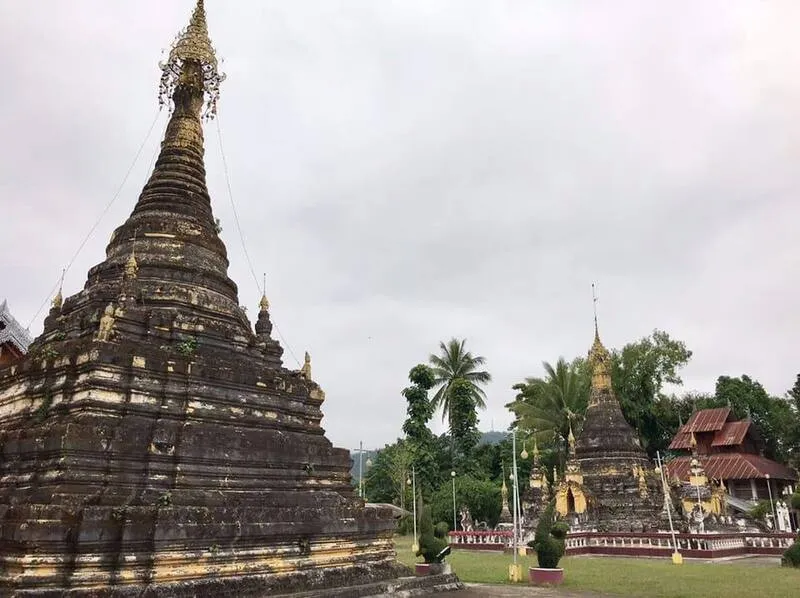
Wat Chong Sung, also known as Wat Uthayaram, is an important temple in the heart of Mae Sariang District, Mae Hong Son Province. It is distinguished by its Tai Yai artistic heritage and three ancient Mon-style stupas that have become the temple’s defining image. For anyone looking for an old temple in Mae Sariang that combines history, local craftsmanship, and the peaceful atmosphere of a small town along the Yuam River, Wat Chong Sung is one of the places well worth visiting. It is easy to reach, located within the town center, and clearly connected to the cultural heritage of the Tai Yai community in the area.
Wat Chong Sung was founded in 1838. It was originally a monastic residence under the care of Shan monks. Later, when a major fire broke out in Mueang Yuam in 1888, the temple was also damaged. The local people then joined together to restore and rebuild it, and the work was completed in 1896. From that point onward, the name Wat Chong Sung became the name by which the people of Mae Sariang came to know and refer to this temple. The temple also received its royal boundary charter on May 22, 1916, giving it continuous importance in both religion and local history.
The charm that sets Wat Chong Sung apart from other temples in Mae Sariang lies in its group of three stupas, which reflect an intriguing blend of Mon, Burmese, and Tai Yai artistic influences. The stupa on the western side is an old structure dating to the early reign of King Rama VI. The central stupa is a principal relic stupa that had once deteriorated until only half remained, before it was restored in 1956. Inside was a golden turtle-shaped reliquary containing the Buddha’s relics. The eastern structure is a seven-spired stupa inspired by Shwedagon style, built to enshrine nine brick Buddha images that survived the fire that destroyed the original viharn. These stories make a walk through the temple more than simply an appreciation of architectural beauty; they also allow visitors to read the history of the community through its buildings and the restoration work carried out in different periods.
As visitors walk into the temple grounds, they will find a raised wooden viharn with a multi-tiered roof built in the Tai Yai style of temple architecture. The atmosphere inside the viharn feels peaceful, simple, and distinct from typical Lanna temples. Inside are Mandalay-style gilded Buddha images, along with a small Burmese-style wooden reclining Buddha, which is another feature that adds to the artistic value of Wat Chong Sung. The fine details of the woodwork, roof structure, and spatial rhythm within the temple all reflect the deep-rooted Tai Yai cultural heritage embedded in Mae Sariang.
Another reason this temple is suitable for both worshippers and cultural travelers is its location within Mae Sariang town. Visitors can plan a trip that combines Wat Sri Bun Rueang, which stands right next to it, or continue on to hilltop stupas around town such as Phra That Chom Mon, Phra That Chom Thong, and Phra That Chom Kitti, all within the same day. This makes it especially suitable for those who want to experience the atmosphere of old temples and the story of Mae Sariang as a cultural cluster without having to drive long distances from one site to another.
In terms of its importance to the community, Wat Chong Sung is not merely an ancient monument or tourist attraction. It remains a living sacred space. The temple is one of the venues for the Ok Wa festival, the end-of-Buddhist-Lent tradition of Mae Sariang, reflecting its role as a living cultural center for the local community. That means visitors do not experience only the temple’s past, but also see how it remains part of everyday life and the cultural calendar of local people to this day.
The atmosphere at Wat Chong Sung is especially suitable in the morning or late afternoon, when the light beautifully highlights the details of the stupas and wooden structures. Those who enjoy architectural photography will find that the three stupas each offer clearly different visual dimensions, while visitors who come for worship can walk around at a relaxed pace. The temple grounds are not overly large, yet they contain several interesting elements, including the stupas, the wooden viharn, and the atmosphere of an old temple in the middle of town.
For those interested in art history, Wat Chong Sung is valuable as evidence of the cultural relationship between Tai Yai communities and the northwestern border region of Thailand. The design of the stupas, the viharn, and the Buddha images inside the temple all show the influence of Burmese and Mon art, adapted to the local context of Mae Sariang. This is one of the temple’s greatest charms, giving it significance beyond tourism alone, as it also helps explain the broader cultural identity of Mae Sariang itself.
A visit to Wat Chong Sung is therefore suitable for many kinds of travelers, whether they are driving the Mae Hong Son Loop and stopping in Mae Sariang, cultural travelers who want to understand a small town more deeply, or those simply looking for a peaceful temple in which to pay respect and admire historic art. With a little more time, continuing on foot to nearby Wat Sri Bun Rueang offers a chance to appreciate the beauty of two Tai Yai temples with different personalities yet a meaningful relationship to one another.
Getting There to Wat Chong Sung is quite convenient because it is located within Mae Sariang town. If you drive along Highway 108, once you enter the town you can use GPS navigation directly to the temple. It is not far from the main community area, restaurants, and principal accommodations in Mae Sariang. Travelers staying in town can easily reach it by car, motorcycle, or even on foot from some parts of town. Its location makes Wat Chong Sung ideal both for a short stop along the way and for a slower visit focused on absorbing the character of the town.
Although the temple is located in a tourist area, dressing respectfully and behaving appropriately within the temple grounds remain important. Visitors who wish to take photographs should respect areas used for religious activities and avoid disturbing worshippers, especially inside the wooden viharn and around the stupas. If you visit during a festival or community event, you will see a livelier atmosphere and gain a deeper understanding of the temple’s role in Mae Sariang.
For those searching for what makes Wat Chong Sung in Mae Sariang worth visiting, the clearest answer is that this is an old temple that brings together history, art, and community life in one place. Its highlights include the three ancient Mon-style stupas, the Tai Yai wooden viharn, important Buddha images, and its continuing role as a living cultural space. It is therefore an especially rewarding destination for visitors who want to see Mae Sariang from a deeper, warmer, and more distinctive perspective than that offered by larger tourist cities.
| Name | Wat Chong Sung (Wat Uthayaram) |
| Location | Mae Sariang Subdistrict, Mae Sariang District, Mae Hong Son Province |
| Address | 141 Ban Kat, Mae Sariang Subdistrict, Mae Sariang District, Mae Hong Son 58110 |
| Coordinates | 18.160557, 97.930783 |
| Highlights | Three ancient Mon-style stupas, a Tai Yai wooden viharn, Mandalay-style Buddha images, and a Burmese wooden reclining Buddha |
| History / Period / Era | Established in 1838, damaged in the great fire of Mueang Yuam in 1888, and restored and completed in 1896 |
| Name Origin | After the temple was rebuilt following the great fire, the local community began calling it “Wat Chong Sung,” and the name has continued ever since |
| Distinctive Features | A blend of Tai Yai, Mon, and Burmese artistic styles, located in the center of Mae Sariang next to Wat Sri Bun Rueang |
| Travel Information | Easy to reach from Highway 108 into Mae Sariang town, then follow GPS navigation to the temple in the central community area |
| Current Status | Still active as a temple and continues to serve as a venue for community traditions and cultural activities in Mae Sariang |
| Open Days | Open daily |
| Opening Hours | 08:00–18:00 |
| Main Areas | The group of three stupas, the raised wooden viharn, and the ceremonial and cultural courtyard area |
| Main Contact Number | 053-681-362 |
| Official Website / Official Page | Amazing Thailand (TAT) / Mae Sariang local public relations channels |
| Nearby Tourist Attractions | 1) Wat Sri Bun Rueang – 0.1 km 2) Mae Sariang Museum – 0.8 km 3) Phra That Chom Thong – 2 km 4) Phra That Chom Mon – 2 km 5) Phra That Chom Kitti – 4 km |
| Nearby Restaurants | 1) Indira – 1 km 2) Mitmaitri Coffee – 1 km. Tel. 061-457-8155 3) 99 Street Coffee, Mae Sariang Branch – 1 km. Tel. 085-106-3531 4) SOOK Coffee 108 – 3 km. Tel. 097-071-0389 5) Thai Coffee Mae Sariang – 3 km |
| Nearby Accommodations | 1) The Good View Guest House @ Mae Sarieng – 1 km. Tel. 081-998-2480 2) Riverhouse Hotel (The Teak House) – 1 km. Tel. 053-682-323 3) Above The Sea Mae Sariang – 2 km. Tel. 053-682-264 4) Riverhouse Resort – 2 km. Tel. 053-683-066, 053-683-068 5) River Bank Resort – 3 km. Tel. 053-682-787, 084-378-0471 |
Frequently Asked Questions (FAQ)
Q: Where is Wat Chong Sung located?
A: Wat Chong Sung is located in Mae Sariang District, Mae Hong Son Province, within the central community area. It is easy to reach and stands next to Wat Sri Bun Rueang.
Q: What is Wat Chong Sung best known for?
A: Its most outstanding features are the three ancient Mon-style stupas, the Tai Yai wooden viharn, and the important Buddha images inside the temple that reflect Burmese and Tai Yai artistic influences.
Q: When was Wat Chong Sung built?
A: The temple was established in 1838 and underwent a major restoration after the great fire of Mueang Yuam in 1888, before the rebuilding was completed in 1896.
Q: Who is Wat Chong Sung suitable for?
A: It is suitable for worshippers, architectural photography enthusiasts, and travelers interested in the Tai Yai cultural heritage of Mae Sariang.
Q: What other places can be visited together with Wat Chong Sung?
A: It is commonly visited together with Wat Sri Bun Rueang, Mae Sariang Museum, and the important stupas around town such as Phra That Chom Thong, Phra That Chom Mon, and Phra That Chom Kitti.
Q: Does Wat Chong Sung still play a role in the local community today?
A: Yes. The temple remains an active sacred space for the community and is one of the venues for important cultural activities in Mae Sariang, including the Ok Wa tradition.
 Category: ●Places of Worship
 Group: ●Temple
Last Update : 6 MonthAgo
 Last Update : 6 MonthAgo
 Click to Access the Navigation Map GPS
Wat Uthayarom Map
Recommend

 Art, Culture and Heritage
 Historical Sites and Monuments(1)
 Landmarks and Memorials(1)
 Art, Craft Centres, Tradition(10)
 Museums(3)
 Educational Places
 Educational Gardens, Farm(1)
Temple(81)
Educational Gardens, Farm(1)
Temple(81)
 Other Sacred Sites(1)
 Research and Development
 Royal Project(4)
 Suburban Living
 Village, Community(19)
 Local Market(4)
 Nature and Wildlife
 National Parks and Marine Reserves(7)
 Mountain (Doi)(5)
 Dam, Reservoir, Lake(2)
 Waterfalls(12)
 Hot Springs(6)
 Caves(13)
 Flower Field(2)
 River, Canal(3)
 Other natural attractions(1)
 Entertainment and Agricultural
 Farms, Parks and Ecotourism(2)
 Shopping
 Shopping and Night Market(1)
 Travel Articles, Recipes
 Travel Review, Food Review(1)


