
lovethailand home >Northeastern Travel Attractions >Amnat Charoen Travel Attractions >Lu Amnat >Pueai > Wat Pho Sila
TL;DR: Wat Pho Sila is located at Ban Pueai, Moo 6, Pueai Subdistrict, Lue Amnat District, Amnat Charoen Province, open Daily, hours 08.00 – 17.00.
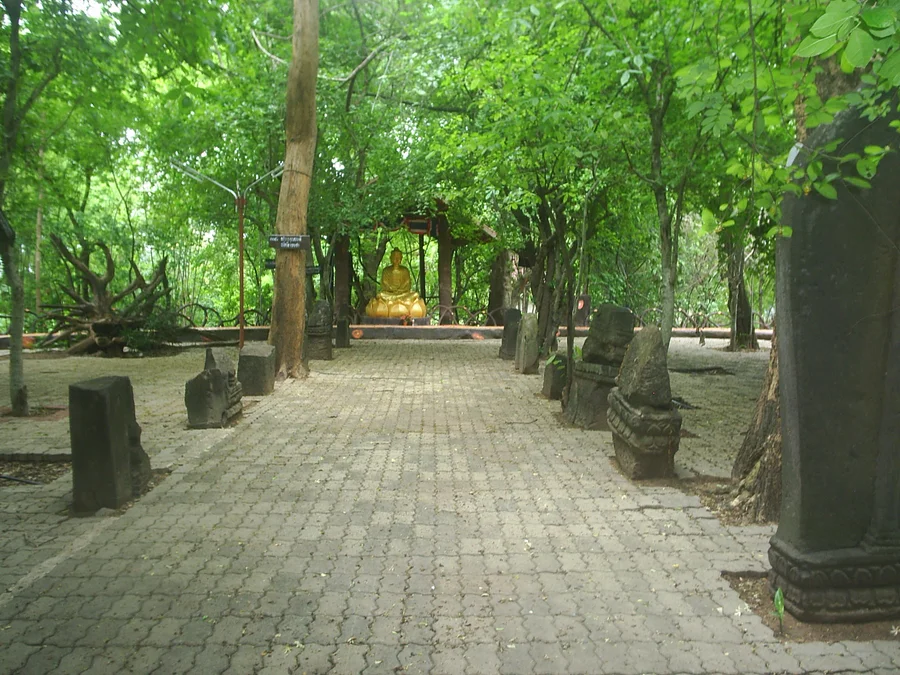
Wat Pho Sila
Open Days: Daily
Opening Hours: 08.00 – 17.00
Wat Pho Sila in Ban Pueai, Pueai Subdistrict, Lue Amnat District, Amnat Charoen Province, is one of the most important cultural and archaeological temple sites in the province. The temple is best known for its large sandstone bai sema, or Buddhist boundary stones, which are associated with the Dvaravati cultural period. For foreign travelers interested in ancient Buddhist art, local temples, and lesser-known heritage sites in northeastern Thailand, Wat Pho Sila offers a rare opportunity to see thousand-year-old stone markers in a living temple setting.
The main highlight of Wat Pho Sila is a group of 16 large sandstone bai sema arranged in 2 rows on a laterite-paved mound. Most of the stones are broken or damaged by age, but some remain relatively complete and still show important carved details. These bai sema are dated to the early historic period in the Dvaravati cultural tradition, around the 13th to 15th Buddhist centuries. Their age, material, form, and decorative motifs make them highly valuable for the study of Buddhist art in the lower northeastern region of Thailand.
The bai sema at Wat Pho Sila are carved from pale sandstone and have a tall, tapering form with a pointed top, similar to a broad spearhead. The lower part narrows, while the base is decorated with lotus motifs. In Buddhist art, the lotus represents purity, awakening, and spiritual growth. In Dvaravati art, lotus motifs often appear on Buddha image bases, Dharma wheels, and sacred architectural elements. Their presence on the bai sema at Wat Pho Sila clearly connects the stones with Buddhist symbolism.
Above the lotus base, the central axis of the stone resembles a miniature stupa or the finial of a stupa. The lower section includes a water pot placed above an inverted bell-shaped form, followed by ring-like segments and lotus bands. These details show that the bai sema were not merely practical boundary markers. They were sacred artistic objects that expressed Buddhist cosmology, ritual meaning, and the symbolic language of ancient religious communities.
The central decoration of the bai sema includes a three-lobed leaf motif rising upward to support a half-flower design inside a series of 3 connected arches. The upper part forms a pointed finial similar to a ceremonial banner top, with hanging ornaments. These motifs show strong artistic refinement and have been compared with designs seen in early Khmer-influenced art, including the Prei Khmeng style. The half-flower motif within connected arches is especially important because it resembles decorative patterns found on ancient lintels from Prasat Khao Noi Si Chomphu in Sa Kaeo Province.
This comparison helps explain why Wat Pho Sila is important beyond the local level. The motifs on its bai sema reflect artistic connections across regions, where Buddhist, Dvaravati, and early Khmer-influenced visual traditions moved through cultural networks. The stones are therefore valuable not only as religious markers but also as evidence of artistic exchange in mainland Southeast Asia.
In Buddhist practice, bai sema are normally associated with the sacred boundary of an ordination hall or religious area. However, large Dvaravati-period bai sema in northeastern Thailand may carry broader meanings. Many are found in groups, on mounds, or near sacred areas, suggesting their use in marking ritual spaces, commemorating Buddhist narratives, or defining a sacred landscape. The bai sema at Wat Pho Sila invite visitors to think about both the religious and archaeological meanings of the site.
The site at Wat Pho Sila is a raised earthen mound. Today, the area where the bai sema are displayed is paved with laterite. A staircase on the western side leads up to the mound, and concrete edging with stone reinforcement helps protect the earth from sliding. The bai sema have been reinstalled in 2 rows, allowing visitors to view the group in an organized way. Because the stones are ancient and fragile, visitors should not touch, climb, lean on, or move them.
Wat Pho Sila is located at Ban Pueai, Moo 6, Pueai Subdistrict, Lue Amnat District, Amnat Charoen Province. The site coordinates are latitude 15.686504 and longitude 104.684421. The temple is classified as a cultural environment site under the category of temple, abandoned temple, and religious site. Historical temple information identifies Wat Pho Sila as a Mahanikaya Buddhist temple with temple land covering 10 rai, 3 ngan, and 2 square wah, plus additional monastic land.
The main areas of the temple include the bai sema display area, the archaeological mound, the laterite-paved courtyard, the ordination hall, merit-making spaces, and religious activity areas. The ordination hall is recorded as measuring 10 meters wide and 20 meters long. While the temple continues to serve as a local Buddhist site, the bai sema remain the most distinctive and culturally important feature of Wat Pho Sila.
Recent public temple activity information lists Phra Khru Udom Phothikit as the abbot of Wat Pho Sila. The temple is a local Buddhist temple with monks in residence. The abbot’s role is important not only for temple administration and religious ceremonies but also for helping maintain the temple’s cultural heritage. Visitors should therefore treat Wat Pho Sila as both an active religious place and a heritage site.
The name “Wat Pho Sila” combines Buddhist and material meanings. “Pho” refers to the Bodhi tree, associated with the Buddha’s enlightenment. “Sila” means stone, which directly connects with the sandstone bai sema that define the temple’s identity. The name therefore reflects both spiritual meaning and the ancient stone heritage preserved at the site.
A good way to visit Wat Pho Sila is to begin at the bai sema area and observe the overall form of the stones first. Then, look more closely at the carved lotus base, stupa-like central axis, water pot motif, inverted bell form, three-lobed leaves, half-flower designs, connected arches, and pointed finial. These details reveal the artistic intelligence and religious imagination of the ancient craftsmen who created the stones.
Wat Pho Sila is suitable for many kinds of visitors, including travelers interested in archaeology, students of Buddhist art, cultural tourists, photographers, and those who enjoy quiet local temples. The site shows that Amnat Charoen has more than modern temples and natural attractions. It preserves ancient Buddhist art that links the province with wider Dvaravati and early historic cultural traditions in northeastern Thailand.
Wat Pho Sila also remains connected with the Buddhist calendar of the local community. Important occasions include Makha Bucha Day, Visakha Bucha Day, Asalha Bucha Day, Buddhist Lent, the end of Buddhist Lent, Kathin ceremonies, robe-offering events, and regular Buddhist holy days. During these times, local Buddhists gather at the temple for merit-making, chanting, offerings, and community participation. The ancient bai sema therefore exist within a living temple environment, not as isolated museum objects.
Getting There is most convenient by private car or rental car. From central Amnat Charoen, drive toward Lue Amnat District and continue to Pueai Subdistrict, Ban Pueai, Moo 6. Using a navigation map is recommended because the temple is located in a local community area. A private vehicle also makes it easier to combine Wat Pho Sila with nearby attractions in Lue Amnat and Mueang Amnat Charoen.
Nearby attractions that can be combined with Wat Pho Sila include Wat Amnat and Phra Chao Yai Wat Amnat in Lue Amnat District, as well as Phuttha Utthayan and Phra Mongkhon Ming Mueang, Ming Mueang Chalerm Phrakiat Park, Amnat Charoen Clock Tower, and Wat Tham Saeng Phet in or near Mueang Amnat Charoen. Travelers can visit Wat Pho Sila in the morning and continue to the provincial town in the afternoon.
Food options around Lue Amnat include local restaurants and cafés such as Lap Pet Khon Lue, Lueang Lue, Khanom Chin Sen Sot Mae Phon, Khun Tum Ban Lao Noi, Long Nua Coffee And Foods, and made-to-order restaurants in Lue Amnat town. These places are suitable for local food, Isan dishes, coffee, or a simple meal before or after visiting the temple.
For accommodation, most practical choices are located in Mueang Amnat Charoen rather than directly around the temple. Options include Zwa Hotel Amnat Charoen, Ramiarndao Boutique Place Hotel, Nakarin Hotel, Baan Ing Daan Hotel, Penphit Hotel, and LJ The Emerald Hotel. Staying in the provincial town gives travelers easier access to restaurants, services, and other attractions in Amnat Charoen.
The best time to visit Wat Pho Sila is in the morning or late afternoon, when the sunlight is softer and the carved details on the bai sema are easier to see. Visitors should prepare drinking water, a hat, or an umbrella during the hot season. Most importantly, visitors should respect the ancient stones by not touching, climbing, or leaning on them. Wat Pho Sila is both a sacred temple and an archaeological heritage site, and it deserves careful, respectful viewing.
Wat Pho Sila is one of the most valuable cultural sites in Amnat Charoen Province. Its thousand-year-old sandstone bai sema preserve the artistic language of the Dvaravati tradition, while the active temple setting keeps the site connected with present-day Buddhist life. For travelers seeking a deeper understanding of northeastern Thai heritage, Wat Pho Sila is a quiet but highly meaningful destination.
| Name | Wat Pho Sila |
| Location | Ban Pueai, Moo 6, Pueai Subdistrict, Lue Amnat District, Amnat Charoen Province |
| Address | Ban Pueai, Moo 6, Pueai Subdistrict, Lue Amnat District, Amnat Charoen Province 37000, Thailand |
| Coordinates | Latitude 15.686504, Longitude 104.684421 |
| Highlights | A group of 16 large sandstone bai sema from the Dvaravati cultural period, arranged in 2 rows on a laterite-paved mound |
| History | The bai sema are dated to the early historic period in the Dvaravati tradition, around the 13th to 15th Buddhist centuries, or over 1,000 years old. |
| Name Origin | “Pho” refers to the Bodhi tree associated with enlightenment, while “Sila” means stone, reflecting the temple’s ancient sandstone boundary markers. |
| Distinctive Features | Large pale sandstone bai sema with lotus bases, stupa-like central motifs, water pot designs, inverted bell forms, three-lobed leaves, and half-flower motifs within connected arches |
| Main Religious Structures | Ordination hall, merit-making area, religious activity spaces, and sandstone bai sema display area |
| Main Areas / Zones | Sandstone bai sema courtyard, archaeological mound, western staircase, laterite-paved platform, ordination hall, and merit-making area |
| Abbot / Caretaker | Phra Khru Udom Phothikit |
| Travel Information | Best reached by private car or rental car from central Amnat Charoen toward Lue Amnat District and Ban Pueai, Moo 6 |
| Current Status | Open as a local Buddhist temple and cultural environment site under the category of temple, abandoned temple, and religious site |
| Open Days | Daily |
| Opening Hours | 08.00 – 17.00 |
| Fees | No admission fee |
| Facilities | Parking area, merit-making area, bai sema viewing courtyard, staircase to the mound, and religious activity spaces |
| Nearby Tourist Attractions | 1. Wat Amnat And Phra Chao Yai Wat Amnat, about 9 km 2. Lue Amnat District Center, about 10 km 3. Phuttha Utthayan And Phra Mongkhon Ming Mueang, about 27 km 4. Ming Mueang Chalerm Phrakiat Park, Amnat Charoen, about 28 km 5. Amnat Charoen Clock Tower, about 28 km 6. Wat Tham Saeng Phet, about 32 km 7. Phuttha Utthayan Reservoir, about 30 km |
| Nearby Restaurants | 1. Lap Pet Khon Lue, Lue Amnat, about 9 km 2. Lueang Lue, Lue Amnat, about 10 km 3. Khanom Chin Sen Sot Mae Phon, about 10 km 4. Khun Tum Ban Lao Noi, Nong Daeng Intersection, about 12 km 5. Long Nua Coffee And Foods, about 10 km 6. Made-To-Order Thai Restaurants In Lue Amnat Town, about 10 km 7. Restaurants In Central Amnat Charoen, about 28 km |
| Nearby Accommodations | 1. Zwa Hotel Amnat Charoen, about 28 km, Tel. 082-867-6150 2. Ramiarndao Boutique Place Hotel, about 28 km, Tel. 081-067-4149 3. Nakarin Hotel, about 29 km, Tel. 045-511-226 4. Baan Ing Daan Hotel, about 29 km, Tel. 090-405-5504 5. Penphit Hotel, about 30 km 6. LJ The Emerald Hotel, about 30 km |
Frequently Asked Questions (FAQ)
Q: Where is Wat Pho Sila located?
A: Wat Pho Sila is located in Ban Pueai, Moo 6, Pueai Subdistrict, Lue Amnat District, Amnat Charoen Province.
Q: What is Wat Pho Sila famous for?
A: Wat Pho Sila is famous for its group of 16 large sandstone bai sema from the Dvaravati cultural period.
Q: How old are the bai sema at Wat Pho Sila?
A: The bai sema are dated to around the 13th to 15th Buddhist centuries, or over 1,000 years old.
Q: What are the distinctive features of the bai sema?
A: They are large pale sandstone markers with tapering forms, lotus bases, stupa-like central motifs, water pot designs, inverted bell forms, three-lobed leaves, and half-flower motifs in connected arches.
Q: Is there an admission fee for Wat Pho Sila?
A: No. There is no admission fee for visiting Wat Pho Sila.
Q: Who is the abbot of Wat Pho Sila?
A: The abbot listed in recent public temple activity information is Phra Khru Udom Phothikit.
Q: How can travelers get to Wat Pho Sila?
A: The most convenient way is by private car or rental car from central Amnat Charoen toward Lue Amnat District and Ban Pueai, Moo 6.
Q: What nearby places can be visited with Wat Pho Sila?
A: Travelers can combine the visit with Wat Amnat, Phra Chao Yai Wat Amnat, Phuttha Utthayan, Phra Mongkhon Ming Mueang, Ming Mueang Chalerm Phrakiat Park, Amnat Charoen Clock Tower, and Wat Tham Saeng Phet.
 Category: ●Places of Worship
 Group: ●Temple
Last Update : 5 MonthAgo
 Last Update : 5 MonthAgo
 Click to Access the Navigation Map GPS
 Art, Culture and Heritage
 Historical Sites and Monuments(1)
 Art, Craft Centres, Tradition(4)
 Museums(1)
Temple(30)
Museums(1)
Temple(30)
 Other Sacred Sites(8)
 Suburban Living
 Village, Community(4)
 Nature and Wildlife
 National Parks and Marine Reserves(3)
 Mountain (Doi)(6)
 Dam, Reservoir, Lake(5)
 Waterfalls(3)
 Caves(2)
 River, Canal(5)
 Other natural attractions(5)
 Entertainment and Agricultural
 Zoos and Aquariums(1)
 Farms, Parks and Ecotourism(4)
 Shopping
 Shopping and Night Market(1)
 Travel Articles, Recipes
 Travel Review, Food Review(3)


