
lovethailand home >Central Travel Attractions >Bangkok Travel Attractions >Phra Nakhon >Phra Borommaha Ratchawang > Krayakhu Rice Thai Dessert
TL;DR: Krayakhu Rice Thai Dessert. It is regarded as an ancient Thai royal dessert that uses soft rice that is still milky. and the bark is light green squeezed out into.
Krayakhu Rice Thai Dessert
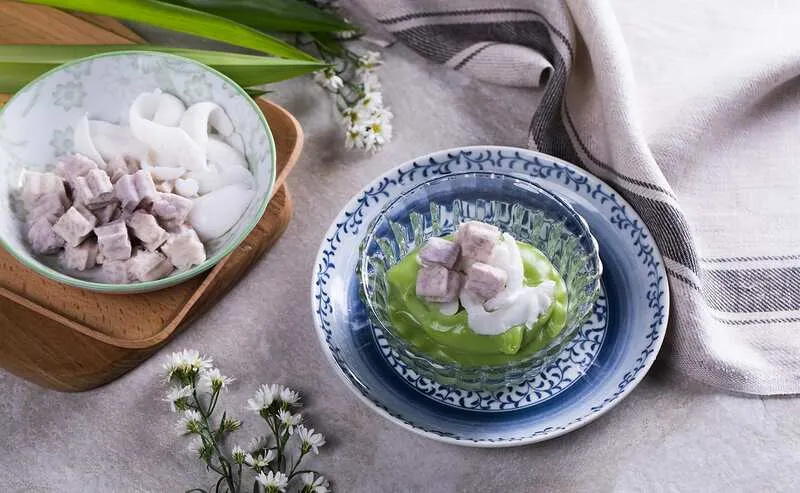
Krayakhu Rice Thai Dessert It is regarded as an ancient Thai royal dessert that uses soft rice that is still milky. and the bark is light green squeezed out into water Or use rice flour to simmer with freshly squeezed pandan juice until thick and light green in texture. Then topped with slightly salty coconut milk. and can add more grains or young coconut.
Ingredient
- 1 cup rice flour
- 1 tbsp arrowroot powder
- 4 cups medium-concentrated coconut milk
- The ears of rice that are getting milk (Rice that the pollen has fallen the ears of rice will bow)
- Shredded young coconut for decoration
- Roasted black sesame seeds for sprinkling
- 2 cups of granulated sugar
- 1 teaspoon coarse salt
- 6 cups pandan juice
How to make Thai dessert, Khao Kra Ya Ku (Thai dessert recipe)
1. The first step, pick out the rice leaves, wash them thoroughly. Use scissors to cut the rice grains, measure only 1 cup, and then pound them thoroughly. Then add pandan juice mixed with pounded rice, stir well and filter with a thin white cloth.
2. Then mix with salt, sugar, coconut milk, rice flour, arrowroot flour and stir well. Add the second ingredient, stir well, and then filter with a thin white cloth again.
3. The last step, put the ingredients into the gold pan, raise it over low heat, stirring constantly until thick and sticky. Prepare to scoop into a container. set aside to cool Garnished with young coconut, sprinkled with roasted black sesame, ready to eat.
| Name | Khao Kraya Khu |
| Category | Traditional Thai Dessert, Royal-Style Thai Sweet, Young Rice Dessert, Stirred Thai Dessert |
| History | Khao Kraya Khu is an ancient Thai dessert made from young rice in the milky stage, when the rice grains are still soft and pale green. It reflects Thailand’s long relationship with rice farming and seasonal ingredients. Traditionally, the young rice is pounded and mixed with pandan juice, then cooked with rice flour, arrowroot flour, coconut milk, sugar, and salt until thick and smooth. |
| Cultural Significance | Represents the connection between Thai dessert culture, rice farming, seasonal harvests, and traditional wisdom in using young rice |
| Distinctive Features | Pale green, thick, smooth dessert made from young rice and pandan juice, served with lightly salted coconut cream, young coconut, and toasted black sesame |
| Taste | Mildly sweet, fragrant from pandan and young rice, creamy from coconut milk, and lightly salty from the coconut topping |
| Texture | Smooth, thick, soft, and slightly chewy like a delicate stirred Thai pudding |
| Main Ingredients | Young rice in the milky stage, rice flour, arrowroot flour, coconut milk, pandan juice, sugar, salt, young coconut, and toasted black sesame |
| Recipe Ingredients | 1 cup rice flour, 1 tablespoon arrowroot flour, 4 cups medium-thick coconut milk, young rice in the milky stage, 2 cups sugar, 1 teaspoon coarse salt, 6 cups pandan juice, young coconut strips, and toasted black sesame |
| Young Rice Selection | Use young rice grains in the milky stage after the rice flowers have fallen and the panicles begin to bend. The grains should still be soft and pale green. |
| Preparation Method | Remove unwanted rice leaves, wash the young rice, cut only the grains, pound them finely, mix with pandan juice, and strain through cheesecloth before combining with flour, coconut milk, sugar, and salt. |
| Cooking Method | Cook the mixture in a brass pan over low heat, stirring continuously until thick, smooth, and fully cooked. |
| Key Technique | Strain the mixture twice and stir continuously over low heat to achieve a smooth texture without lumps or scorching |
| Serving Style | Served with lightly salted coconut cream, young coconut strips, and toasted black sesame; can be eaten warm or chilled |
| Occasions | Merit-making events, rice-related traditions, traditional Thai dessert occasions, and seasonal young rice periods |
| Difficulty Level | Moderate to difficult |
Frequently Asked Questions (FAQ)
Q: What is Khao Kraya Khu?
A: Khao Kraya Khu is a traditional Thai dessert made from young rice in the milky stage, pandan juice, rice flour, coconut milk, sugar, and salt. It has a smooth, thick texture and a delicate green color.
Q: What is young rice in the milky stage?
A: It refers to rice grains that are not fully mature yet. The husks are still pale green, and the grains contain a soft milky liquid that gives the dessert a fresh rice aroma.
Q: Can Khao Kraya Khu be made without young rice?
A: Yes. It can be made with rice flour, pandan juice, coconut milk, sugar, and arrowroot flour, although the aroma and flavor will be different from the version made with real young rice.
Q: Why is Khao Kraya Khu pale green?
A: The pale green color comes from pandan juice and the juice extracted from young rice, giving the dessert a soft natural color.
Q: How do you make Khao Kraya Khu smooth?
A: The mixture should be strained through cheesecloth at least twice and stirred continuously over low heat until fully cooked and smooth.
Q: What is Khao Kraya Khu served with?
A: It is commonly served with lightly salted coconut cream, young coconut strips, and toasted black sesame.
Q: How is Khao Kraya Khu related to Thai rice culture?
A: It reflects the importance of rice in Thai life and the traditional knowledge of using seasonal young rice to create meaningful desserts.
Q: Should Khao Kraya Khu be eaten warm or cold?
A: It can be enjoyed warm or chilled. Warm servings highlight the aroma of young rice and pandan, while chilled servings give a firmer, refreshing texture.
 Category: ●Travel Articles, Recipes
 Group: ●Royal Thai Desserts and Recipes
Last Update : 5 MonthAgo
 Last Update : 5 MonthAgo
Recommend

 Art, Culture and Heritage
 Historical Sites and Monuments(3)
 Landmarks and Memorials(23)
 Royal Palace(13)
 Art, Craft Centres, Tradition(35)
 Museums(59)
 Historic Homes and Cities(3)
 Art Gallery(16)
 Educational Places
 Museum for Study(6)
 Library(4)
 Places of Worship
 Temple(72)
 Church(2)
 Mosque(67)
 Other Sacred Sites(8)
 Research and Development
 Royal Project(1)
 Suburban Living
 Village, Community(5)
 Local Market(9)
 Floating Market(2)
 Nature and Wildlife
 River, Canal(3)
 Bays and Beaches(1)
 Other natural attractions(1)
 Entertainment and Agricultural
 Zoos and Aquariums(4)
 Animal camps and shows(5)
 Stadium(9)
 Farms, Parks and Ecotourism(20)
 Amusement Park(1)
 Waterpark(1)
 Theater(7)
 Cinema(1)
 Shopping
 Shopping and Night Market(20)
 Department Store(7)
 Spas and Wellness
 Spas and Wellness(1)
 Restaurant
 Michelin Star(5)
 Accommodation
 Hotel(3)
 Call Customer Service in Tourism
 Call Customer Service in Tourism(1)
 Travel Review, Food Review(21)
Royal Thai Desserts and Recipes(56)
Travel Review, Food Review(21)
Royal Thai Desserts and Recipes(56)


