
lovethailand home >Central Travel Attractions >Bangkok Travel Attractions >Phra Nakhon >Phra Borommaha Ratchawang > Kanom Sanae Chan Thai Dessert
TL;DR: Kanom Sanae Chan Thai Dessert. with the meaning of this type of dessert will make a charming person There are people who love love Shaped like the fruit of nutmeg. which.
Kanom Sanae Chan Thai Dessert
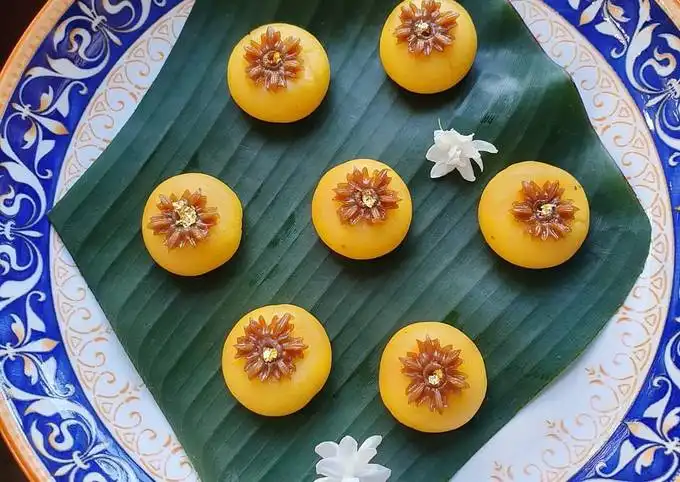
Kanom Sanae Chan Thai Dessert with the meaning of this type of dessert will make a charming person There are people who love love Shaped like the fruit of nutmeg. which has a mixture of nutmeg powder in the pastry dough itself The taste of the dessert is sweet but not much. It smells like sandalwood mixed with the scent of candle smoke. and is soft
Sanaechan dessert, Chao Wang dessert, another auspicious Thai dessert that is often found not different from Tok Ek, that is Sanae Chan, which comes in a glowing yellow shape into a round ball, similar to Luk Chan, a local fruit that has a yellow ripe fruit. It smells delicious. In the past, the ancient people used the moon fruit to become an auspicious dessert. At the top, there are small brown lumps from palm sugar that have been smoked by the candle until fragrant.
Moon Charm How to make Thai desserts, palaces, ancient recipes, which Khanom Chan is considered to be one of the 9 auspicious desserts that have a meaning that is auspicious. will make people attractive Therefore, it is commonly used in wedding ceremonies.
Secret recipe for making moon charms delicious Shape into a beautiful round ball with the right size. The charm of the moon dessert is to have a beautiful round loaf similar to the moon. Therefore, it is important to make a globular shape. We will need to mold the mixture into a ball approximately 1.5 centimeters in diameter, then press down a little flat. in order to be beautiful
Ingredient
- 2 pandan leaves
- 6 egg yolks
- 250 grams of coconut milk
- 250 grams of coconut milk
- 250 grams of granulated sugar
- All Purpose Flour (Light roast for a moment) 200 g.
- About 3 tablespoons of Kannigar flower stem water
- 40 grams of rice flour
- 40 grams of glutinous rice flour
- cocoa powder and ground nutmeg a little each
How to make Thai desserts (Thai dessert recipes)
1. First step, boil the coconut milk, coconut milk and sugar together until boiling, add pandan leaves and boil for 3-4 minutes until fragrant. Remove pandan leaves and set aside to cool or warm, then add the egg yolks. Stir together with a whisk. add rice flour Glutinous rice flour, wheat flour and Kannikar flower stalk water Then stir all of them in a brass pan with a whisk. use medium power When it starts to thicken, switch to using a spatula. Poor people don't stick to the pan. (The bottom of the pan will turn brown) Lift it down.
2. Second step, make the nut pole by dividing the nutmeg a little. Mix 1 part cocoa powder and 3 parts nutmeg. Add ground nutmeg. Mix together until the meat is brown. Form into small balls and prepare.
3. The last step, mold the dessert into round balls about 1 inch. Use your hands to smooth the surface. Press it to flatten slightly. Place the terminals that have been molded. Use a pointed stick to poke the pole and the candy together. then ready to eat.
Thai Dessert “Saneh Chan” (เสน่ห์จันทน์) is one of the most refined traditional Thai auspicious desserts, deeply rooted in royal Thai cuisine. Inspired by the appearance and fragrance of the “Chan fruit” (Diospyros decandra), this dessert reflects the elegance, delicacy, and symbolic meaning that characterize Thai sweets. Its golden-yellow color, smooth round shape, and subtle aroma make it both visually appealing and culturally significant.
The name “Saneh Chan” carries auspicious meaning in Thai culture. The word “Saneh” translates to charm or attractiveness, while “Chan” refers to the Chan fruit. Together, the name symbolizes a person who is charming, beloved, and admired by others. Because of this positive meaning, Saneh Chan is commonly included in traditional Thai auspicious dessert sets, especially in wedding ceremonies where it represents love, affection, and harmony in married life.
Historically, Thai people created this dessert by drawing inspiration from the natural beauty of the Chan fruit, which turns bright yellow when ripe and emits a pleasant fragrance. The dessert was carefully crafted to resemble the fruit in both shape and color. This transformation from nature into culinary art reflects the creativity and cultural sophistication of Thai royal kitchens.
Saneh Chan has a distinctive appearance. It is shaped into a small round ball, approximately 1.5 centimeters in diameter, slightly flattened, and topped with a small brown “stem.” This stem is made from a mixture of cocoa powder and a portion of the dough, enhanced with nutmeg powder to replicate the fruit’s natural look. The smooth surface and precise shaping demonstrate the meticulous craftsmanship required in making Thai royal desserts.
The taste of Saneh Chan is mildly sweet and rich, yet balanced. It is made primarily from egg yolks, coconut milk, sugar, and flour, resulting in a soft and smooth texture. What truly sets it apart is its fragrance—a delicate blend of coconut milk, pandan leaves, nutmeg, and traditional Thai candle smoke (known as “อบควันเทียน”), which gives the dessert a refined and unique aroma.
The preparation process requires patience and attention to detail. The mixture must be carefully cooked and stirred until it thickens and pulls away from the pan. After that, the dough is shaped while still warm to achieve a smooth and glossy finish. Precision in shaping is essential, as the beauty of Saneh Chan lies in its uniform, round form and delicate presentation.
In traditional Thai culture, desserts like Saneh Chan were not made for everyday consumption. Instead, they were reserved for special occasions such as weddings, religious ceremonies, and important celebrations. This is because the preparation process often requires time, skill, and sometimes multiple people working together, reflecting a sense of community and cultural heritage.
Today, Saneh Chan continues to be appreciated not only for its taste but also for its cultural significance. It is often found in Thai dessert sets, cultural exhibitions, and premium gift boxes. For many, it represents a connection to Thailand’s culinary history and the enduring charm of traditional craftsmanship.
| Name | Saneh Chan (เสน่ห์จันทน์) |
| Category | Traditional Thai Dessert / Royal Thai Dessert / Auspicious Dessert |
| History | Inspired by the Chan fruit, adapted into a Thai dessert by ancient Thai people, especially in royal kitchens, emphasizing beauty and fragrance |
| Meaning | Symbolizes charm, attractiveness, and being loved and admired by others |
| Appearance | Small round golden-yellow ball with a brown stem on top, resembling the Chan fruit |
| Taste & Aroma | Mildly sweet, soft texture, fragrant with coconut milk, pandan, nutmeg, and candle smoke |
| Main Ingredients | Egg yolk, coconut milk, sugar, flour, pandan leaves, nutmeg, cocoa powder |
| Key Technique | Careful stirring until thick, shaping while warm, and precise molding into smooth round forms |
| Occasions | Weddings, religious ceremonies, auspicious events, and traditional celebrations |
Frequently Asked Questions (FAQ)
Q: What is Saneh Chan?
A: Saneh Chan is a traditional Thai auspicious dessert known for its round shape, golden color, and symbolic meaning of charm and attractiveness.
Q: Why is Saneh Chan considered an auspicious dessert?
A: Because its name represents charm and admiration, it is believed to bring love, kindness, and popularity to those who receive or consume it.
Q: What does Saneh Chan taste like?
A: It has a mildly sweet taste with a soft, smooth texture and a delicate aroma from coconut milk, pandan, nutmeg, and candle smoke.
Q: What makes Saneh Chan unique?
A: Its resemblance to the Chan fruit, its refined aroma, and the meticulous craftsmanship involved in shaping each piece make it unique among Thai desserts.
Q: What occasions is Saneh Chan used for?
A: It is commonly used in weddings, religious ceremonies, and auspicious celebrations as part of traditional Thai dessert sets.
Q: What is the key technique in making Saneh Chan?
A: The key technique is stirring the mixture to the right consistency and shaping the dough into smooth, evenly sized balls while still warm.
Q: Can Saneh Chan be made at home?
A: Yes, but it requires patience, attention to detail, and practice to achieve the correct texture and shape.
Q: Why is it shaped like a fruit?
A: It is designed to resemble the Chan fruit, which symbolizes beauty, fragrance, and auspiciousness in Thai culture.
 Category: ●Travel Articles, Recipes
 Group: ●Royal Thai Desserts and Recipes
Last Update : 5 MonthAgo
 Last Update : 5 MonthAgo
Recommend

 Art, Culture and Heritage
 Historical Sites and Monuments(3)
 Landmarks and Memorials(23)
 Royal Palace(13)
 Art, Craft Centres, Tradition(35)
 Museums(59)
 Historic Homes and Cities(3)
 Art Gallery(16)
 Educational Places
 Museum for Study(6)
 Library(4)
 Places of Worship
 Temple(72)
 Church(2)
 Mosque(67)
 Other Sacred Sites(8)
 Research and Development
 Royal Project(1)
 Suburban Living
 Village, Community(5)
 Local Market(9)
 Floating Market(2)
 Nature and Wildlife
 River, Canal(3)
 Bays and Beaches(1)
 Other natural attractions(1)
 Entertainment and Agricultural
 Zoos and Aquariums(4)
 Animal camps and shows(5)
 Stadium(9)
 Farms, Parks and Ecotourism(20)
 Amusement Park(1)
 Waterpark(1)
 Theater(7)
 Cinema(1)
 Shopping
 Shopping and Night Market(20)
 Department Store(7)
 Spas and Wellness
 Spas and Wellness(1)
 Restaurant
 Michelin Star(5)
 Accommodation
 Hotel(3)
 Call Customer Service in Tourism
 Call Customer Service in Tourism(1)
 Travel Review, Food Review(21)
Royal Thai Desserts and Recipes(56)
Travel Review, Food Review(21)
Royal Thai Desserts and Recipes(56)


