
lovethailand home >Central Travel Attractions >Bangkok Travel Attractions >Phra Nakhon >Ban Phran Thom > Wat Parinayok Worawihan
TL;DR: Wat Parinayok Worawihan is located at 1 Parinayok Road, Ban Phan Thom Subdistrict, Phra Nakhon District, Bangkok 10200, open Daily, hours 05:00 – 20:00.
Wat Parinayok Worawihan
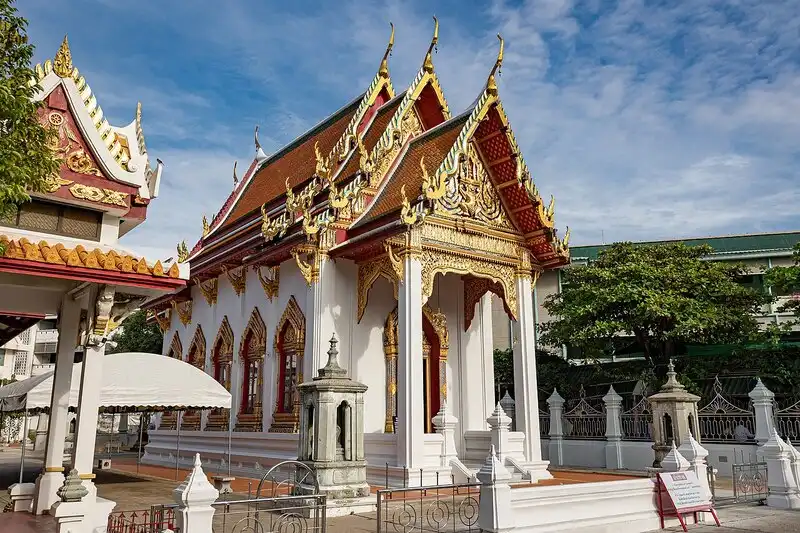
Open Days: Daily
Opening Hours: 05:00 – 20:00
Wat Parinayok Worawihan is one of those Bangkok temples you can easily pass by around Phan Fa Lilat Bridge and Ratchadamnoen Nok Road without ever really stopping—yet it holds a dense layer of city stories, especially the relationship between the temple grounds and Bang Lamphu Canal. The biggest turning point came during King Rama V, when the construction of Ratchadamnoen Nok Road took part of the temple’s land and led to the relocation and rebuilding of the ordination hall in the position you see today. If you enjoy exploring Bangkok by walking through the old town—and you want both the calm of a neighborhood temple and the kind of urban history you can read directly from the place itself—this temple is a stop that’s absolutely worth your time and steps.
The temple is located in the Ban Phan Thom area, close to the Phan Fa zone and the Bang Lamphu corridor—an area where “urban history” and “everyday life” constantly overlap. From the beginning, the temple stood along the edge of Bang Lamphu Canal, which gave the land a long and narrow shape commonly described as a “flag-shaped plot.” One end of the “flag” touches the canal on the western side, while the “tail” stretches eastward along land that used to be broader than it is today. This flag-like layout affects how the space feels when you walk inside: the grounds are arranged to support real use in a capital-city temple, rather than focusing on a wide open courtyard like many temples outside the city. And once you know the original boundary once extended from Lan Luang Road opposite Mahakan Fort all the way to the present temple site, it becomes clearer that this is not just one temple—it is a surviving fragment of Bangkok’s older urban layout, leaving traces you can still read.
Wat Parinayok Worawihan was founded during the reign of King Rama II (Phra Phutthaloetla Naphalai). In its early period, the temple was known as “Wat Phrom Surin,” reflecting the name and title of its founder, Chao Phraya Bodindecha (Sing Singhaseni). As a young man in the early Rama II era, he held the rank “Phra Phrom Surin” for a period, so the original temple name was directly tied to the person and his title, as seen in many early Rattanakosin Bangkok temples. Through that earlier name, you can sense the founder’s intention to leave merit-making as a root for the family line, and to establish a place of faith in a neighborhood growing along one of the city’s important canals.
Later, in the reign of King Rama III, Chao Phraya Bodindecha continued restoring the temple periodically and planned to expand it further. King Rama III also supported the temple through royal patronage and bestowed the name “Wat Parinayok.” The new name helped the temple become more widely known and reflected the relationship between the temple and the royal court during a time when Bangkok was actively reorganizing its city and society. However, when Chao Phraya Bodindecha passed away in 1839 (B.E. 2392), the temple lost its key patron and declined for around 50 years. This period matters because it shows the real life cycle of a capital-city temple—its growth is not a straight line, but rises and falls with faith, patronage, and the systems of each era.
The major turning point came in 1899 (B.E. 2442) during the reign of King Rama V (King Chulalongkorn), when Ratchadamnoen Nok Road was constructed and took part of the temple’s land. Previously, the old ordination hall stood closer to Bang Lamphu Canal, but once the new road cut through, the original ordination hall ended up too close to the roadside, which was considered unsuitable for monastic rites. The King therefore ordered a new ordination hall to be built further inward, away from the road—this is the ordination hall location seen today. This detail makes visiting Wat Parinayok especially interesting if you like “reading the city by walking,” because you are seeing how Rama V–era urban planning physically reshaped a sacred space—not as an abstract idea in a book, but as a visible change in the real landscape.
The newly built ordination hall was smaller than the original. When the ordination hall was relocated to its present position, “Phra Suraphi Phuttha Phim” was invited to become the principal Buddha image of the new ordination hall. From that time onward, Phra Suraphi Phuttha Phim became the temple’s central focus of faith. If you come here specifically to pay respects, try giving yourself a quiet moment before the principal image—you may notice the temple’s atmosphere feels dignified and restrained, not driven by grand spectacle, but by order, calm, and stillness, which suits the Ratchadamnoen context and the character of Bangkok in the Rama V period.
Beyond physical restoration, King Rama V also strengthened the temple through administration by inviting a capable abbot with strong governance experience from Wat Mahathat Yuwaratrangsarit, known as “Phra Wisutthinayok,” to serve as abbot here. He resided in a masonry kuti with a Chinese-style roof, which the King ordered to be built. With a clear administrative structure and strong leadership, the temple became orderly and well maintained again, and more worshippers began to visit. The temple also received its official monastic boundary (wisungkhamasima) in 1900 (B.E. 2443), an important milestone in the temple’s status. Altogether, these factors helped Wat Parinayok return to life as a royal monastery with active religious presence, and the Singhaseni family and relatives have continued supporting it as their “ancestral temple” up to the present day.
If you want the most rewarding visit, Wat Parinayok is best explored slowly. Its value isn’t in loud visual highlights, but in “layers of time” stacked within one place—from traces of a Rama II–period foundation, to the flourishing and renaming during Rama III, and finally to the major adaptation during Rama V after Ratchadamnoen Nok Road was built. Try walking while paying attention to what sits “near the road” and what was “set further inward,” and imagine how the temple’s shape and proportions might have looked if the road had never cut through. This is the kind of old-town Bangkok enjoyment where the more you know, the more you see—and the slower you walk, the more details you take home.
The best time to visit is in the morning or late afternoon, when the sun is softer and the neighborhood light feels noticeably gentler. Dress modestly, keep your voice low, and follow on-site guidance, especially around the ordination hall where visitors may be praying and making merit throughout the day. If you plan to continue exploring after, it’s worth saving time to walk onward to nearby points around Phan Fa, Mahakan Fort, and the Ratchadamnoen corridor—these places are genuinely walkable and easy to combine into a one-day loop.
Getting There Wat Parinayok Worawihan is close to Phan Fa Lilat Bridge and the Ratchadamnoen Nok Road area, making it convenient to reach on foot from the Phan Fa – Mahakan Fort zone. If you travel by bus, commonly referenced routes include 56, 35, and 159, which pass through the Ratchadamnoen – Phan Fa area. By MRT, you can get off at Sam Yot Station and continue walking into the old-town area along the main roads (it’s best to allow time for walking and weather). If you drive, plan extra time for parking in the old city and consider walking as your primary way of getting around once you arrive.
| Place Name | Wat Parinayok Worawihan |
| Location | 1 Parinayok Road, Ban Phan Thom Subdistrict, Phra Nakhon District, Bangkok 10200 |
| Key Features | Third-class royal monastery near Phan Fa, flag-shaped plot along Bang Lamphu Canal, the story of Ratchadamnoen Nok Road cutting through the temple land and prompting relocation of the ordination hall, principal Buddha image “Phra Suraphi Phuttha Phim” |
| Period | Early Rattanakosin (founded in King Rama II). Major changes during King Rama V (1899 – 1900 / B.E. 2442 – 2443) |
| Key Evidence / Significance | Originally named Wat Phrom Surin after the founder (Chao Phraya Bodindecha). Renamed “Wat Parinayok” by King Rama III. During King Rama V, Ratchadamnoen Nok Road construction led to a new ordination hall being built further inward, and “Phra Suraphi Phuttha Phim” was installed as the principal image of the new ordination hall. |
| Name Origin | Originally “Wat Phrom Surin,” tied to the founder’s title. Later renamed “Wat Parinayok” by King Rama III. |
| Abbot (Latest) | Phra Phipat Chariyalangkan (Boonchu Khemmapunyo) |
| Getting There | Near Phan Fa Lilat Bridge; walkable from the Ratchadamnoen – Mahakan Fort area. Commonly referenced buses: 56, 35, 159. MRT Sam Yot then walk into the old town (allow time for walking). |
| Current Status | Open for worship and visits |
| Temple Contact (Verified) | 02-282-0880 |
| Admission | Free entry |
| Facilities | Parking and public restrooms (based on compiled temple information sources) |
| Nearby Attractions (Distance) | Mahakan Fort (approx. 0.6 km) Phan Fa Lilat Bridge (approx. 0.7 km) Wat Ratchanatdaram Worawihan – Loha Prasat (approx. 1.2 km) Wat Saket (Golden Mount) (approx. 1.6 km) Giant Swing (approx. 2.0 km) Khao San Road (approx. 2.6 km) |
| Nearby Restaurants (Distance + Phone) | Thipsamai Pad Thai Pratu Phi (approx. 1.7 km) – 02-226-6666 Jay Fai (approx. 1.9 km) – 02-223-9384 Krua Apsorn (Dinso Road) (approx. 2.0 km) – 080-550-0310 Pad Thai Fai Ta Lu (Dinso Road) (approx. 2.2 km) – 089-811-1888 Kopi Hia Tai Kee (Giant Swing) (approx. 2.1 km) – 062-678-3003 Mont Nom Sod (Giant Swing) (approx. 2.0 km) – 02-224-1147 |
| Nearby Accommodations (Distance + Phone) | Once Again Hostel (approx. 1.8 km) – 092-620-5445 Villa De Pranakorn (approx. 2.0 km) – 02-221-1122 Nouvo City Hotel (approx. 2.9 km) – 02-282-7500 Chillax Resort (approx. 3.0 km) – 02-629-4400 Riva Surya Bangkok (approx. 3.4 km) – 02-633-5000 The Raweekanlaya Bangkok (approx. 3.6 km) – 02-628-5999 |
Frequently Asked Questions (FAQ)
Q: Where is Wat Parinayok Worawihan located in Bangkok?
A: It is located at 1 Parinayok Road, Ban Phan Thom Subdistrict, Phra Nakhon District, near Phan Fa Lilat Bridge and the Ratchadamnoen Nok Road area, making it easy to connect to the old town on foot.
Q: What is the temple’s key historical highlight?
A: The key highlight is the story of Ratchadamnoen Nok Road construction during King Rama V, which took part of the temple’s land and led to the rebuilding of the ordination hall in its current inward position—showing how urban planning reshaped a sacred space.
Q: What is the principal Buddha image of Wat Parinayok Worawihan?
A: The principal Buddha image of the new ordination hall is “Phra Suraphi Phuttha Phim,” installed when the ordination hall was relocated and rebuilt.
Q: Why was the temple formerly called Wat Phrom Surin?
A: The original name related to the founder, Chao Phraya Bodindecha (Sing Singhaseni), who held the title “Phra Phrom Surin” during a period in the early Rama II reign.
Q: Which bus routes are commonly used to reach the temple?
A: Travelers often reference buses 56, 35, and 159 that pass through the Ratchadamnoen – Phan Fa area, then walk onward along the main roads into the temple zone.
Q: Where should you visit after Wat Parinayok Worawihan?
A: Recommended nearby stops include Mahakan Fort, Phan Fa Lilat Bridge, Wat Ratchanatdaram – Loha Prasat, Wat Saket (Golden Mount), and the Giant Swing, all within an old-town route that can be explored in a single day.
 Category: ●Places of Worship
 Group: ●Temple
Last Update : 6 MonthAgo
 Last Update : 6 MonthAgo
 Click to Access the Navigation Map GPS
Wat Parinayok Worawihan Map
Recommend

 Art, Culture and Heritage
 Historical Sites and Monuments(3)
 Landmarks and Memorials(23)
 Royal Palace(13)
 Art, Craft Centres, Tradition(35)
 Museums(59)
 Historic Homes and Cities(3)
 Art Gallery(16)
 Educational Places
 Museum for Study(6)
 Library(4)
Temple(72)
Library(4)
Temple(72)
 Church(2)
 Mosque(67)
 Other Sacred Sites(8)
 Research and Development
 Royal Project(1)
 Suburban Living
 Village, Community(5)
 Local Market(9)
 Floating Market(2)
 Nature and Wildlife
 River, Canal(3)
 Bays and Beaches(1)
 Other natural attractions(1)
 Entertainment and Agricultural
 Zoos and Aquariums(4)
 Animal camps and shows(5)
 Stadium(9)
 Farms, Parks and Ecotourism(20)
 Amusement Park(1)
 Waterpark(1)
 Theater(7)
 Cinema(1)
 Shopping
 Shopping and Night Market(20)
 Department Store(7)
 Spas and Wellness
 Spas and Wellness(1)
 Restaurant
 Michelin Star(5)
 Accommodation
 Hotel(3)
 Call Customer Service in Tourism
 Call Customer Service in Tourism(1)
 Travel Articles, Recipes
 Travel Review, Food Review(21)
 Royal Thai Desserts and Recipes(56)


