
lovethailand home >Northeastern Travel Attractions >Bueng Kan Travel Attractions >Mueang Bueng Kan >Khai Si > Wat Ahong Silawat (Kaeng Ahong)
TL;DR: Wat Ahong Silawat (Kaeng Ahong) is located at Ban Ahong, Khai Si Subdistrict, Mueang Bueng Kan District, Bueng Kan Province, open Daily, hours 06.00 – 18.00.

Wat Ahong Silawat (Kaeng Ahong)
Open Days: Daily
Opening Hours: 06.00 – 18.00
Wat Ahong Silawat, also known as Kaeng Ahong, is a riverside Buddhist temple in Khai Si Subdistrict, Mueang Bueng Kan District, Bueng Kan Province. It is famous for its marble ordination hall, Phra Phuttha Khuwanan Satsada Buddha image, panoramic Mekong River views, and the legendary “Navel of the Mekong River,” believed by local people to be one of the deepest points of the Mekong in front of the temple. From March to May, the river level drops and the rock rapids become clearly visible, while the end of Buddhist Lent connects this sacred riverside area with the local belief in the Naga and the Naga Fireball phenomenon.
Wat Ahong Silawat is located on the bank of the Mekong River at Ban Ahong, Khai Si Subdistrict, Mueang Bueng Kan District, Bueng Kan Province. It is one of the most important spiritual and scenic attractions in Bueng Kan because it combines a riverside temple, natural river rapids, local legends, Buddhist faith, and Naga-related beliefs in one place. The area in front of the temple is widely known as Kaeng Ahong and is often called the “Navel of the Mekong River,” a name that reflects the local belief that this section of the river is exceptionally deep and spiritually powerful.
Standing at the temple’s riverside viewpoint, visitors can see the wide Mekong flowing calmly yet powerfully along the border, with Laos visible on the opposite bank. The view gives a strong sense of openness and scale, while the temple grounds create a peaceful atmosphere for prayer, photography, and quiet contemplation. Wat Ahong Silawat is not simply a scenic temple. It is a place where geography, belief, ecology, and community memory meet along one of Southeast Asia’s most important rivers.
The appeal of Wat Ahong Silawat lies in its layered experience. Local residents come here to make merit, worship the Buddha image, ask for blessings, and rest their minds. Thai travelers often visit to see the famous Mekong viewpoint, the rock rapids, the marble ordination hall, and the sacred sites connected with the Naga. Foreign travelers can gain a clear understanding of how Buddhism and local river beliefs coexist in northeastern Thailand. The temple is therefore suitable for cultural travelers, families, photographers, and visitors planning a wider Bueng Kan itinerary.
The temple grounds are spacious, orderly, and naturally beautiful. Important areas include the marble ordination hall, the principal Buddha image, the riverside viewpoint, Naga-related worship points, the shrine of the Goddess of the Mekong Navel, rock garden areas, and resting spaces overlooking the river. Visitors can move easily between religious, natural, and cultural areas without feeling that the visit is limited to only one type of attraction.
Historically, Wat Ahong Silawat is connected with the riverside community of Ban Ahong and the natural landscape of the Mekong. The area was once associated with a forest temple or monastic retreat, a quiet place suitable for meditation and spiritual practice. Later, the temple was restored and developed with more permanent structures, monks’ residences, pavilions, and facilities. The name “Wat Ahong Silawat” became closely linked with the local area of Ahong and the stone landscape of the Mekong riverbank.
The word “Ahong” refers to the local place name, while “Silawat” suggests a dwelling or sacred place associated with stone. This name matches the physical character of the temple perfectly because the surrounding area includes river rocks, rapids, and stone formations that become especially visible during the dry season. The temple’s identity is therefore inseparable from its landscape. Its name, location, and sacred reputation are all rooted in the relationship between stone, river, and belief.
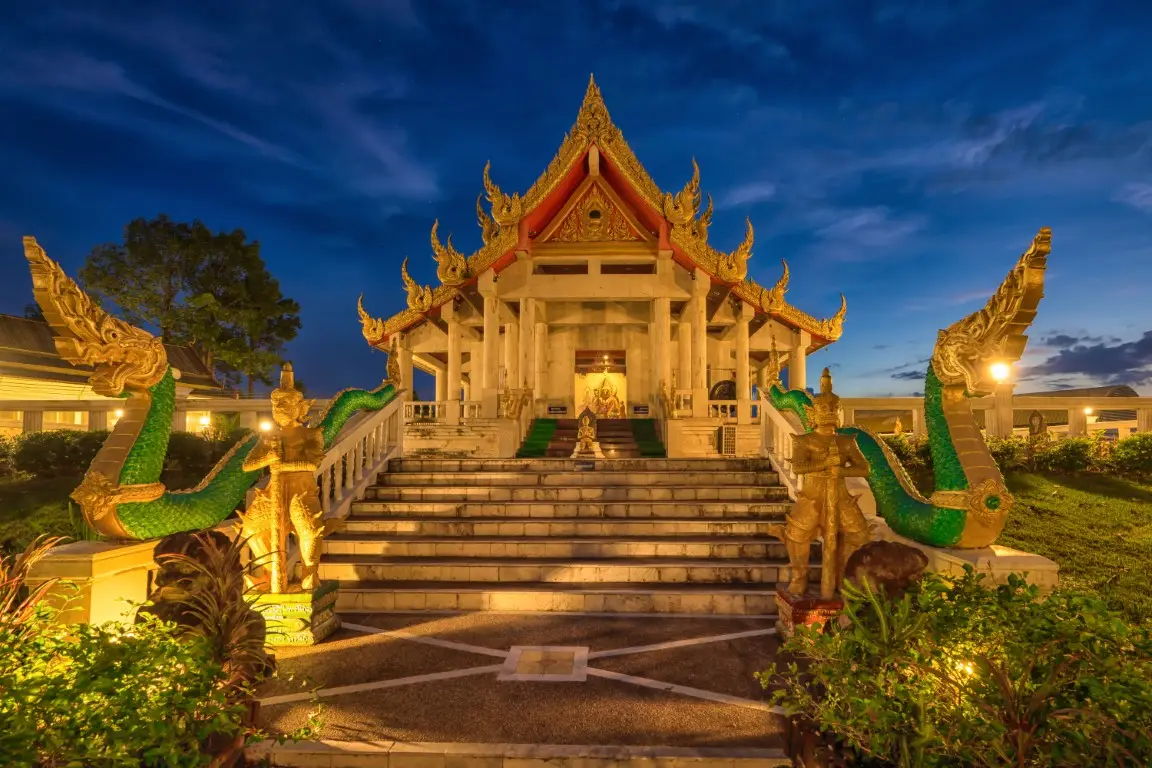
The marble ordination hall is the architectural highlight of Wat Ahong Silawat. The building stands gracefully near the river, with a staircase leading upward and Naga sculptures framing the approach. The roof, decorative details, and Thai-style elements make the ordination hall photogenic from many angles, especially against the blue sky and the Mekong River. Inside is Phra Phuttha Khuwanan Satsada, the temple’s important Buddha image, cast in brass and admired for its elegant form resembling Phra Phuttha Chinnarat.
Phra Phuttha Khuwanan Satsada is the spiritual center of the temple. Visitors usually begin their visit by entering the ordination hall to pay respect to the Buddha image before walking out toward the riverside viewpoint. The interior atmosphere is calm and simple, suitable for prayer, short meditation, and quiet reflection. The combination of the Buddha image, the temple’s marble architecture, and the natural river setting gives the visit a deep sense of peace.
The most famous natural feature of the temple is the section of the Mekong River in front of the temple known as the Navel of the Mekong River. Local belief holds that this area is among the deepest points of the Mekong. Some traditional accounts mention measuring the depth by tying a stone to a rope and lowering it into the river to a depth of 98 wa, while other travel sources describe the depth as around 200 meters. Regardless of the exact figure, the important shared meaning is that local people regard this part of the river as unusually deep, powerful, and sacred.
During the high-water season, the current at Kaeng Ahong becomes strong and forms large whirlpool-like movements. The water can appear to spiral into a funnel shape before breaking apart with a sound similar to water rushing against submerged rocks. When the current strengthens again, the movement reforms. This repeated motion gives the area a mysterious and dramatic character. Watching the water here reminds visitors that the Mekong is not only a scenic river but also a living natural force.
During the dry season from March to May, the river level drops and the rock rapids become more visible. This is the best period for visitors who want to see the physical character of Kaeng Ahong clearly. Rocks and formations appear in the river, and some are known by local names based on their shapes, such as Hin Lin Naga, Hin Pla Khe, and Tham Pla Sawai. The dry-season landscape allows travelers to see how the Mekong changes dramatically between high water and low water.
Kaeng Ahong is also connected with the ecology of the Mekong. Areas with underwater caves, deep pools, rocks, and strong currents are important to river life. Local stories mention the giant Mekong catfish, one of the world’s largest freshwater fish, and describe underwater caves near the opposite bank as places associated with large fish and river spirits. These beliefs reflect the deep relationship between the river, aquatic life, local imagination, and the cultural memory of riverside communities.
The Naga legend is another central element of Wat Ahong Silawat. The Navel of the Mekong River is believed to be a gathering place of Naga spirits during the end of Buddhist Lent. Local tradition connects the area with the Naga Fireball phenomenon, in which glowing fireballs are believed to rise from the Mekong as an act of worship to the Buddha. During the full moon of the 11th lunar month, many people gather along the Mekong in Bueng Kan and nearby areas to witness this phenomenon and participate in the atmosphere of faith.
Within the temple grounds, visitors will also find Naga-related worship points and the Goddess of the Mekong Navel. Local people often visit this shrine to ask for blessings, especially for fortune, love, and fulfillment. These sacred points make the temple experience more diverse. Visitors can worship the principal Buddha image, contemplate the river, pay respect to Naga symbols, and learn how local faith is woven into the natural landscape.
The temple’s rock garden is another interesting area. Large natural rocks are arranged or preserved within the temple grounds, giving the area a mythical and almost literary atmosphere. Some visitors describe the rock landscape as resembling a scene from Himmapan forest imagination in Thai literature. The rock garden adds another layer to the temple visit because it allows travelers to walk through a landscape that feels both natural and symbolic.
The white pagoda known as Chedi Si Ahong is another notable feature of the temple. Its simple and peaceful appearance fits well with the riverside setting. Together with the ordination hall, the Naga sculptures, the river viewpoint, and the rock garden, it creates several strong photo points within the temple. Visitors can photograph Buddhist architecture, symbolic sculptures, natural scenery, and panoramic river views in a single visit.
For photography, early morning and late afternoon are the best times to visit. Morning light gives the temple a soft and calm atmosphere, while late afternoon allows visitors to enjoy warm light on the Mekong River. During the dry season, the visible rock rapids provide more dramatic river compositions. During the end of Buddhist Lent, the area becomes more active because many people come in connection with the Naga Fireball belief, making the atmosphere more festive and devotional.
Visitors should allow at least 1 hour for a basic visit, including worshipping the Buddha image, seeing the ordination hall, walking to the Mekong viewpoint, and taking photos. Those who want to explore the rock garden, worship at different sacred points, sit by the river, or observe the water movement should allow 1.5 to 2 hours. Travelers visiting during the dry season or the end of Buddhist Lent should plan more time because the area can be busier than usual.
When visiting Wat Ahong Silawat, dress respectfully, speak quietly within religious areas, avoid climbing or touching sacred structures unnecessarily, and keep the riverside clean. Visitors should also be careful near the water and rock areas, especially during the high-water season when the current is strong. Families traveling with children should keep them close while walking near the riverbank.
Getting There is easiest by private car or rental car. From Bueng Kan town, take Highway 212 on the Bueng Kan–Nong Khai route for about 21 km. The drive usually takes around 20 to 30 minutes depending on traffic. The temple is located beside the Mekong River in Khai Si Subdistrict. Travelers without a private vehicle can hire local transport from Bueng Kan town or arrange a private sightseeing route that includes other attractions in the province.
Wat Ahong Silawat is easy to include in a wider Bueng Kan itinerary. A 1-day route can begin in Bueng Kan town, continue to Wat Photharam to worship Luang Pho Phra Yai, then visit Wat Ahong Silawat for the Mekong viewpoint and Navel of the Mekong River. Travelers with more time can continue to Three Whale Rock, Phu Sing, Nong Kut Thing, or Wat Phu Tok. This route shows Bueng Kan as a province of faith, dramatic landscapes, river culture, and unusual natural formations.
For travelers interested in meaning rather than only scenery, Wat Ahong Silawat is especially rewarding. It is not just a beautiful riverside temple. It contains a sacred Buddha image, a marble ordination hall, a legendary deep point of the Mekong, seasonal rock rapids, Naga belief, the Goddess of the Mekong Navel, stories of giant fish, and a landscape that changes with the river. These layers give visitors a richer understanding of why the temple is important to local people.
For foreign travelers, Wat Ahong Silawat offers a clear introduction to the relationship between Thai Buddhism, the Mekong River, and northeastern local belief. In one place, visitors can see a Buddhist sanctuary, a border river, Naga imagery, a sacred river legend, and a local viewpoint that looks toward Laos. This makes the temple an ideal stop for anyone seeking to understand Thailand beyond major cities and mainstream tourist attractions.
No confirmed ticketed admission fee is listed for Wat Ahong Silawat in the main tourism sources checked. Visitors may enter to worship and make merit according to their faith. The temple is generally open daily from 06.00 to 18.00. Morning or late afternoon is the most comfortable time to visit, especially for walking and photography. During the hot midday hours, visitors should bring water, a hat, and comfortable footwear.
Wat Ahong Silawat is one of Bueng Kan’s essential destinations because it brings together the beauty of the Mekong River, the sacred presence of Phra Phuttha Khuwanan Satsada, the mystery of the Navel of the Mekong River, the seasonal drama of Kaeng Ahong, and the living belief in the Naga. A visit here reveals Bueng Kan not only as a riverside province but also as a place where nature, faith, and local identity remain deeply connected.
| Name | Wat Ahong Silawat, or Kaeng Ahong |
| Location | Ban Ahong, Khai Si Subdistrict, Mueang Bueng Kan District, Bueng Kan Province |
| Address | Khai Si Subdistrict, Mueang Bueng Kan District, Bueng Kan 38000, Thailand |
| Highlights | Marble ordination hall by the Mekong River, Phra Phuttha Khuwanan Satsada, Navel of the Mekong River viewpoint, Kaeng Ahong rapids, rock garden, Naga worship points, and views toward Laos |
| History | An old riverside temple area formerly associated with a forest monastic retreat, later restored with proper temple buildings, monastic residences, and worship areas under the name Wat Ahong Silawat |
| Name Origin | The name is connected with Ban Ahong and Kaeng Ahong, while “Silawat” refers to a sacred place associated with stone, matching the temple’s rocky Mekong landscape |
| Distinctive Features | A riverside temple combining Buddhist worship, Mekong scenery, seasonal rock rapids, and Naga-related local legends |
| Main Buddha Image | Phra Phuttha Khuwanan Satsada, a brass Buddha image with an elegant form resembling Phra Phuttha Chinnarat |
| Travel Information | From Bueng Kan town, take Highway 212 on the Bueng Kan–Nong Khai route for about 21 km. The temple is best reached by private car, rental car, or hired local transport. |
| Current Status | Open for visitors and worshippers |
| Open Days | Daily |
| Opening Hours | 06.00 – 18.00 |
| Fees | No ticketed admission fee. Visitors may make merit according to their faith. |
| Facilities | Parking area, worship areas, pavilions, riverside walkway, photo spots, rest areas, and toilets within the temple grounds |
| Main Areas / Zones | 1. Marble Ordination Hall 2. Phra Phuttha Khuwanan Satsada 3. Navel Of The Mekong River Viewpoint 4. Kaeng Ahong Rapids And Riverside Viewpoint 5. Naga And Goddess Of The Mekong Navel Worship Points 6. Temple Rock Garden 7. Chedi Si Ahong |
| Founder / Caretaker | The restoration history is associated with Luang Pho Lun, Phra Nites Satsanakhun, and Luang Pho Metha Jittakakutto, who is mentioned as the abbot during the temple’s revival period. |
| Main Contact Number | 043-873-480, 042-901-112, 042-325-406-7 |
| Nearby Tourist Attractions | 1. Kaeng Ahong / Navel Of The Mekong River Viewpoint, about 0 km 2. Wat Photharam, or Luang Pho Phra Yai Temple, Ban Tha Khrai, about 23 km 3. Chao Mae Song Nang Shrine, Mueang Bueng Kan, about 22 km 4. Lao Market, Mueang Bueng Kan, about 22 km 5. Nong Kut Thing, about 32 km 6. Three Whale Rock, Phu Sing, about 58 km 7. Wat Jetiyakhiri Wihan, or Wat Phu Tok, about 80 km |
| Nearby Restaurants | 1. Riverside Restaurant&Bar Bungkan, about 22 km, Tel. 042-082-082, 087-222-9899 2. Im Nam Samran & Cafe Samranjai, about 22 km, Tel. 099-470-7774 3. Krua Rim Khong Bueng Kan, about 22 km, Tel. 061-056-8964 4. Steak Rim Khong, about 22 km, Tel. 096-587-4256 5. Tam Yam Yua By Miki, Rim Khong Bueng Kan Branch, about 22 km, Tel. 082-689-1316 |
| Nearby Accommodations | 1. Kaeng Ahong Riverview, about 1 km 2. The One Hotel Bueng Kan, about 22 km, Tel. 042-492-234 3. BK Place Hotel Bueng Kan, about 23 km, Tel. 082-495-2125 4. Vipat Bueng Kan, about 23 km 5. Pen Nueng Hotel Bueng Kan, about 24 km 6. Sri Wilai Bueng Kan Hotel, about 25 km |
Frequently Asked Questions (FAQ)
Q: Where is Wat Ahong Silawat located?
A: Wat Ahong Silawat is located at Ban Ahong, Khai Si Subdistrict, Mueang Bueng Kan District, Bueng Kan Province, on the bank of the Mekong River, about 21 km from Bueng Kan town.
Q: What are the opening hours of Wat Ahong Silawat?
A: The temple is open daily from 06.00 to 18.00.
Q: Is there an entrance fee for Wat Ahong Silawat?
A: There is no ticketed admission fee. Visitors may make merit or donations according to their faith.
Q: What is the Navel of the Mekong River?
A: The Navel of the Mekong River is the local name for the deep section of the Mekong in front of Wat Ahong Silawat, believed to be one of the deepest points of the river and known for strong whirlpool-like currents during the high-water season.
Q: When is the best time to see Kaeng Ahong rapids?
A: March to May is the best period to see the rock rapids clearly because the Mekong water level is lower.
Q: How is Wat Ahong Silawat related to the Naga Fireballs?
A: The riverside area in front of the temple is connected with local Naga beliefs, and many people gather along this part of the Mekong during the end of Buddhist Lent to witness the Naga Fireball phenomenon.
Q: What are the main points to see inside Wat Ahong Silawat?
A: Main points include the marble ordination hall, Phra Phuttha Khuwanan Satsada, the Navel of the Mekong River viewpoint, Kaeng Ahong, Naga worship points, the Goddess of the Mekong Navel, the rock garden, and Chedi Si Ahong.
Q: What attractions can travelers visit after Wat Ahong Silawat?
A: Travelers can continue to Wat Photharam, Chao Mae Song Nang Shrine, Lao Market, Nong Kut Thing, Three Whale Rock, and Wat Phu Tok depending on their schedule and route.
 Category: ●Places of Worship
 Group: ●Temple
Last Update : 2 MonthAgo
 Last Update : 2 MonthAgo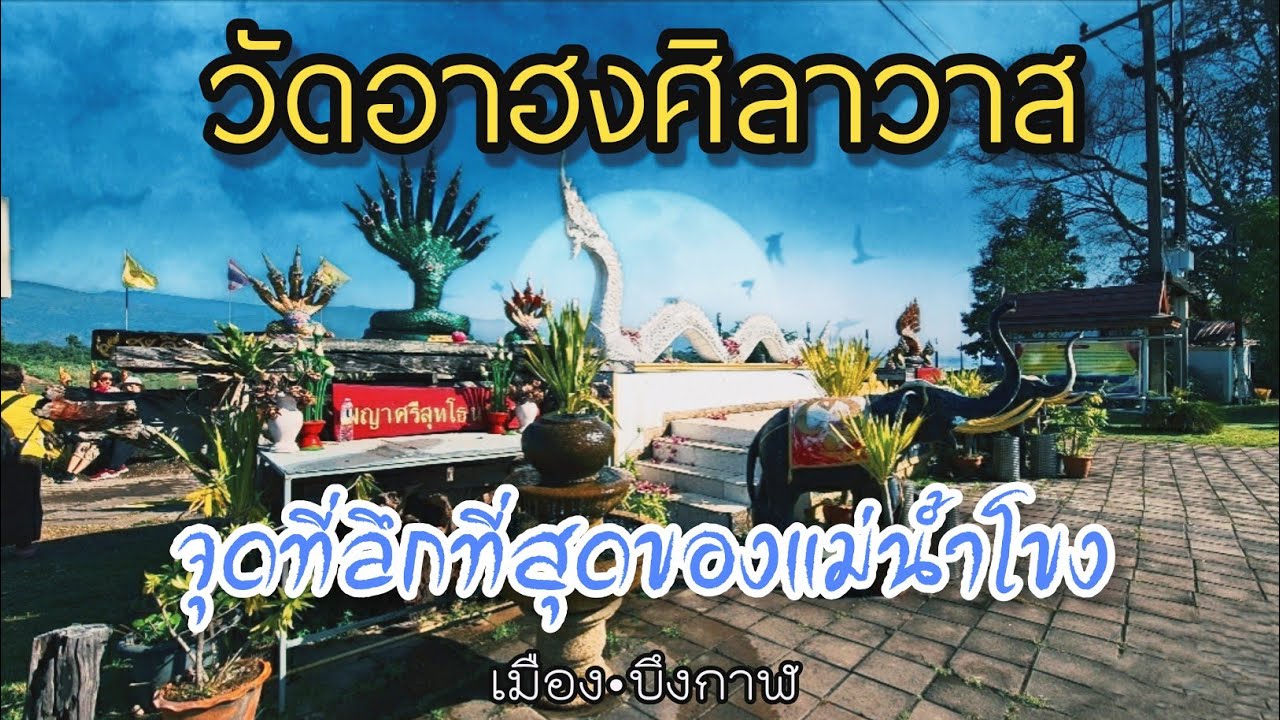
 Click to Access the Navigation Map GPS
Wat Ahong Silawat (Kaeng Ahong) Map
Recommend

 Art, Culture and Heritage
 Museums(1)
Temple(12)
Museums(1)
Temple(12)
 Other Sacred Sites(1)
 Suburban Living
 Local Market(1)
 Nature and Wildlife
 National Parks and Marine Reserves(1)
 Mountain (Doi)(1)
 Waterfalls(1)
 River, Canal(4)
 Entertainment and Agricultural
 Waterpark(1)


