
lovethailand home >South Travel Attractions >Satun Travel Attractions >Muang Satun >Khlong Khut > Traditional Kite Competition
TL;DR: Traditional Kite Competition.
Traditional Kite Competition
Festival Period: February every year; in 2026, the event was held from February 12–15, 2026
Festival Venue: Satun Air Force Airport, Khlong Khut Subdistrict, Mueang Satun District, Satun Province
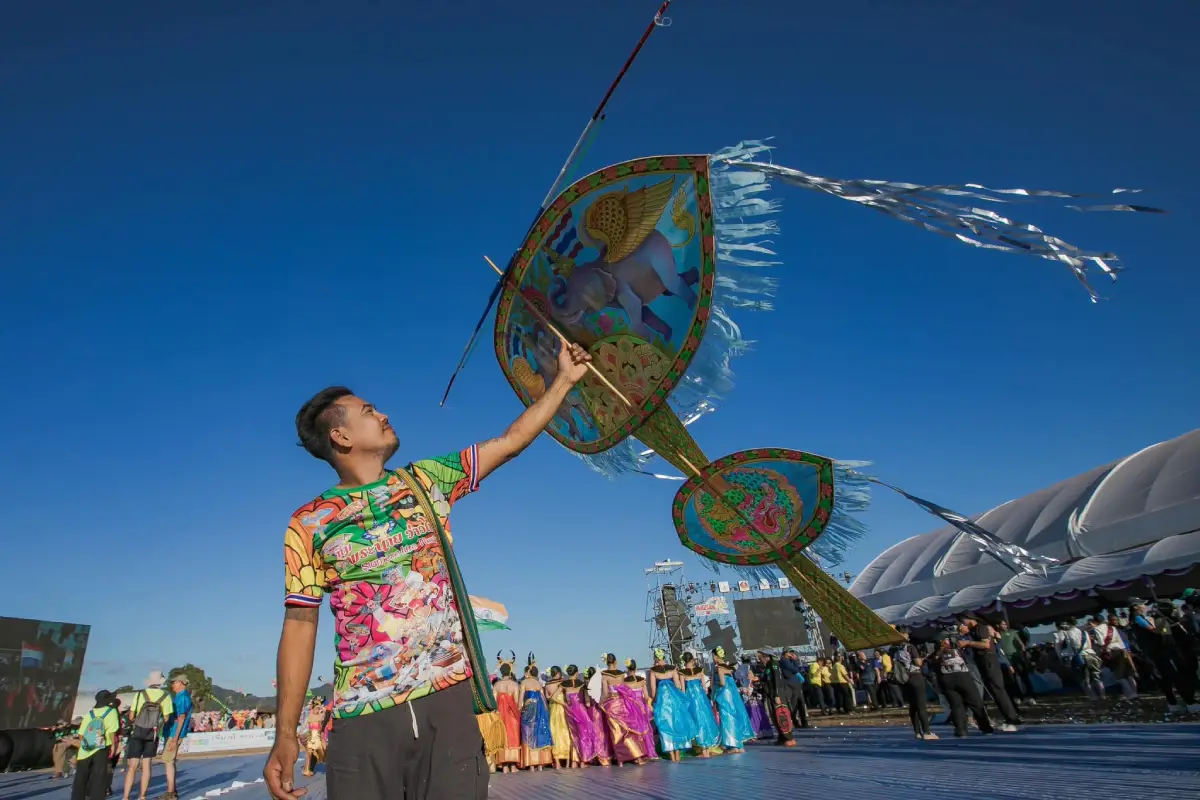
The Satun Traditional Kite Competition is one of Satun Province’s most important cultural events, growing from a local folk pastime into a major international kite festival. Its most distinctive symbol is the buffalo kite, a local kite form that represents Satun’s craftsmanship, rural memory, agricultural heritage, and creative identity. The competition began on February 19, 1976, when teachers from Satun Witthaya School and villagers in Khlong Khut Subdistrict, Mueang Satun District, initiated a kite competition during the season when the northeast monsoon, locally associated with kite-flying winds, made the airport field and southern region suitable for kite flying.
The Satun Traditional Kite Competition is more than an annual festive gathering. It is a living platform for kite-making art, wind reading, local craftsmanship, intergenerational knowledge, and cultural preservation. A traditional kite is not made simply by cutting bamboo and attaching paper. Skilled makers must select proper materials, shape the frame, balance the structure, tie the bridle, adjust the form, and ensure that the kite can rise, hold steady, move correctly, or produce sound according to its intended design. The festival therefore functions as a competition ground, a learning space, and a cultural heritage stage at the same time.
The main venue is Satun Air Force Airport in Khlong Khut Subdistrict, Mueang Satun District. This wide open field is well suited to large-scale kite flying, traditional competitions, international kite demonstrations, and major public activities. The field is closely tied to the history of the festival because the event originated in this area. Its open landscape allows visitors to see kites clearly against the sky and gives organizers enough space to arrange competition zones, kite display areas, food zones, local product areas, and performance spaces.
The festival is usually held in February because this period offers favorable kite winds in southern Thailand. Steady wind helps kites rise, remain airborne, and show their shapes clearly. In 2026, the 45th Satun Traditional and International Kite Festival was held from February 12 to 15 at Satun Air Force Airport. The continued use of this venue and the scale of the 45th edition show that the tradition remains active and continues to play an important role in Satun’s cultural tourism identity.
The strongest symbol of the Satun kite festival is the buffalo kite. This kite form comes from close observation of rural life and the deep relationship between farmers and buffaloes. In the past, buffaloes were essential to rice farming. They helped plough fields, pull loads, and support farmers during the agricultural cycle. Local kite makers transformed the buffalo’s appearance into a kite. When the buffalo kite rises into the air, its tail sits above while the head, horns, nose, and ears appear below. Its movement and sound evoke the strong, stubborn, energetic character of a buffalo, giving the kite its distinctive name and personality.
The buffalo kite is not only a playful object. It is a cultural symbol of Satun Province because it expresses gratitude toward the animal that helped sustain farming communities. By placing the buffalo kite at the heart of the festival, Satun honors rural labor, local imagination, and the everyday life of agricultural communities. In the competition field, a buffalo kite tells a story through form, color, sound, and movement. For visitors who understand its meaning, it becomes more than a crafted object; it becomes a cultural language of Satun.
Making a buffalo kite requires considerable skill. The process begins with selecting mature bamboo that is strong, flexible, and suitable for framing. The bamboo may be prepared through soaking, smoking, drying, or other traditional methods to improve durability and reduce damage from insects. The maker then splits and shapes the bamboo into frame pieces, ties the frame, refines the form, covers it with paper or another material, and adjusts the weight until the kite can fly with proper balance.
The challenge of a buffalo kite lies in making a complex animal-like form fly effectively. The head, horns, ears, nose, and other elements must not disturb the kite’s aerodynamic balance. The maker must understand wind force, weight distribution, the pull of the string, tail length, and the center of gravity. If the frame is even slightly unbalanced, the kite may tilt, swing too strongly, or fail to rise. For this reason, the buffalo kite competition evaluates not only visual beauty but also precision, structural knowledge, and long experience.
Sound is another element that gives the buffalo kite its life. Some kites include parts designed to make noise when wind passes through them. This sound adds motion, identity, and memorability. In older kite traditions, sound was part of both wind reading and folk enjoyment. When a kite makes sound in the sky, viewers may feel as if a large living creature is moving above the field. Sound and swaying movement therefore make the buffalo kite different from ordinary decorative kites.
Historically, kites have played many roles in human society. They have served as tools for reading wind, devices of divination, objects in stories and legends, folk toys, and items appreciated by royal courts. Chula and Pakpao kites have been closely associated with Thai kite traditions and competitions at Sanam Luang. In Chinese contexts, kites were used in warfare and communication, while in the West, Benjamin Franklin famously used a kite in scientific experimentation. These varied roles show that kites connect art, science, play, and culture.
The Satun Traditional Kite Competition is connected to the broader history of kite flying in Thailand and the world, but Satun’s identity comes from its local interpretation. The buffalo kite was born from images of buffaloes in rice fields, not from royal court forms or central Thai fighting kites. The beauty of Satun’s kite tradition lies in its rural imagination, local creativity, and pride in agricultural life. What began in the Khlong Khut community gradually became known among neighboring provinces and international visitors.
The goals of the festival are to honor the buffalo’s contribution to farming, preserve the skills of kite makers, strengthen friendly ties between Satun and Malaysian border communities, establish Satun as a southern Thai kite center, encourage constructive use of free time, and help young people recognize the value of Thai cultural wisdom. The festival therefore has cultural, educational, tourism, and cross-border significance.
As the event developed into a traditional and international kite festival, it expanded beyond local kite competitions. It now includes kites from the 4 regions of Thailand, fancy kites, stunt kites, fighting kites, giant kites, and performances by kite teams from Thailand and abroad. The atmosphere combines local heritage and international spectacle in one place. Visitors can see the buffalo kite, Satun’s cultural root, flying alongside colorful foreign designs, filling the sky with forms, colors, and stories.
The 45th edition in 2026 featured many competition categories, including high-flying kites, resonant-sound kites, beautiful kites, creative kites, marathon kites, local buffalo kites, kite-painting contests, and giant kites. These activities allow visitors to appreciate both competitive skill and artistic design. High-flying kites require wind reading and structural strength. Sound kites require knowledge of airflow and resonance. Beautiful kites depend on art, proportion, and color. Buffalo kites must preserve the local identity of Satun.
Beyond competition, the festival includes exhibitions of Thai kites from the 4 regions and demonstrations of traditional kite making. These educational sections are important for visitors who want to understand more than the visual beauty of the event. Exhibitions show the different kite shapes, materials, techniques, and meanings found across Thailand. Demonstrations allow children, students, and general visitors to see the maker’s process, from bamboo selection and frame building to covering, balancing, and preparing the kite for flight.
The festival also includes evening activity areas, photo spots, decorative lighting, a Siam Andaman food festival, cultural performances, music, local product booths, and other family-friendly activities. It is not only for serious kite enthusiasts. It is also suitable for families, children, students, photographers, cultural travelers, and visitors who want to experience Satun’s public festival atmosphere in an open-air setting.
The international character of the Satun kite festival plays an important role in promoting provincial tourism. It brings together kite flyers, spectators, and cultural networks from many countries. Satun’s geography and culture are closely connected with Malaysia, making kite flying a suitable medium for cross-border friendship. The festival demonstrates how a folk activity can become an international cultural exchange platform without losing its local roots.
For young people, the festival is a valuable outdoor classroom. Children can learn about wind, lift, weight, balance, creativity, craft, teamwork, and local heritage in one event. Kite-painting contests allow young participants to express themselves through art, while demonstrations and real competitions show that folk wisdom is not only found in textbooks. It is learned through practice, observation, patience, and skilled hands.
Kite flying also reflects seasonal life after the agricultural cycle. When fields are open, winds are suitable, and communities have more time after periods of heavy labor, kite flying becomes a form of communal recreation. The buffalo kite strengthens this relationship between farming, leisure, gratitude, and local memory. The Satun kite festival did not arise by chance; it grew from the seasonal rhythm of local life and the natural environment.
Getting There is convenient because Satun Air Force Airport is located in Mueang Satun District. Visitors can travel from Satun town toward Khlong Khut Subdistrict and the event field by local roads. During the festival, extra travel time should be allowed because traffic around the venue may become heavy, especially during the opening ceremony, evening activities, and weekends. Visitors should follow traffic directions and park only in designated areas arranged by officials.
Because the event takes place outdoors, visitors should prepare for sun, heat, wind, and extended walking. Comfortable clothing, hats, umbrellas, sunglasses, drinking water, and walking shoes are recommended. Families with children should keep them close and avoid competition areas unless allowed by officials. Large kites and taut strings can create strong pulling forces in windy conditions. Safe viewing means staying within spectator areas and following field staff instructions.
Visitors should not walk across kite-launching lines, touch competitors’ strings or equipment, approach large kites while they are launching or landing, or allow children to run through areas where kite strings are under tension. Kite competition requires space, concentration, and careful handling. Respecting safe distances helps the competition proceed smoothly and allows spectators to enjoy the skill of kite flyers properly.
Food and local products are another strong part of the festival experience. The event commonly includes food areas and stalls selling local products, allowing visitors to experience Satun through southern food, seafood, Muslim-influenced dishes, local snacks, and community products. These areas support small vendors and help spread festival income into the local economy. The kite festival therefore contributes not only to culture but also to grassroots livelihoods.
From a travel perspective, the Satun kite festival pairs well with important attractions in Satun town, such as Satun National Museum at Kuden Mansion, Mambang Mosque, Wat Chanathip Chaloem, Khao To Phaya Wang Public Park, and Tammalang Pier. Visitors with one full day can enjoy the kite festival, photograph the evening atmosphere, and visit historic or cultural sites in town before or after the event.
Satun National Museum, also known as Kuden Mansion, helps visitors understand the province’s history. The historic building combines Western, Thai, and Islamic architectural elements. Its exhibitions present Satun’s history, communities, cultural traditions, and way of life. When combined with the kite festival, the museum helps show that Satun is not only a province of islands and sea, but also a place with deep cultural and historical roots.
Mambang Mosque, the Satun Central Mosque, is another landmark that reflects the province’s identity. Its presence in the town shows the importance of Islamic culture in Satun’s urban life. Visiting respectfully from the outside helps travelers understand Satun’s Muslim cultural character. Wat Chanathip Chaloem, a royal Buddhist temple in the same city, also shows the province’s religious diversity. Together, these places help connect the kite festival with Satun’s broader multicultural landscape.
Khao To Phaya Wang Public Park is suitable for a calm stop after the festival because it has limestone hill scenery and a shaded setting. Tammalang Pier provides a coastal view, fishing boats, and a sea-facing atmosphere. With good planning, travelers can experience the open sky of the kite field, the historic town, major religious landmarks, a public park, and coastal scenery in one Satun itinerary.
The Satun Traditional Kite Competition is also a strong example of how cultural events can become contemporary without losing their roots. The festival still tells the story of the buffalo kite, kite makers, and folk knowledge, while adding activities that appeal to modern visitors, such as photo spots, international performances, music, food zones, and family activities. This balance helps the festival remain attractive to younger audiences without weakening its cultural value.
The success of the festival depends on cooperation among many sectors: Satun Province, Satun Provincial Administrative Organization, the Satun Office of Tourism and Sports, the Tourism Authority of Thailand Satun Office, educational institutions, private partners, kite makers, local communities, and kite flyers from many places. This cooperation has allowed an event that began in a local community to become a major provincial and international festival while also generating income through tourism, trade, and related services.
For those interested in Thai traditions, the Satun kite festival is an important case study. It shows that tradition does not have to remain frozen in the past. The event began as an inexpensive, accessible folk pastime based on local wisdom. With long-term support, it developed into an organized festival with awards, multiple competition categories, international participants, and creative-economy impact for the province.
What makes the Satun kite festival worth documenting in detail is the completeness of its cultural dimensions. It has a clear origin, a unique provincial kite symbol, a seasonal reason for its timing, deep kite-making knowledge, a relationship with farming life, conservation goals, youth engagement, cross-border connections with Malaysia, and international development. A strong article should therefore explain more than where the event is held and how beautiful the kites are. It should help readers understand why the buffalo kite is the heart of the festival.
For spectators, seeing many kites floating over Satun’s wide field is instantly memorable. Yet the image becomes more meaningful when its background is understood. A buffalo kite swaying in the sky is not merely an animal-shaped kite. It carries memories of rice fields, farmers’ labor, the strength of buffaloes, the creativity of local makers, and the pride of a province that transformed an ordinary part of rural life into a cultural identity.
In summary, the Satun Traditional Kite Competition is a living cultural festival rooted in Khlong Khut community history since 1976. It has grown into a traditional and international kite festival, with the buffalo kite as its defining symbol and Satun Air Force Airport as its main sky stage. The festival honors the buffalo’s role in farming, preserves kite-making craftsmanship, encourages youth learning, strengthens ties with neighboring countries, and positions Satun as a southern Thai center of kite culture recognized by both Thai and international visitors.
| Tradition Name | Satun Traditional Kite Competition / Satun Traditional and International Kite Festival |
| Category | Southern Thai cultural tradition, local kite festival, and cultural tourism event |
| Festival Area | Satun Air Force Airport, Khlong Khut Subdistrict, Mueang Satun District, Satun Province, Thailand |
| Venue Address | Khoun Khan Airport / Satun Air Force Airport, Khlong Khut 51 Road, Khlong Khut Subdistrict, Mueang Satun District, Satun Province 91000, Thailand |
| Coordinates | 6.6622431, 100.0800349 |
| Festival Period | February every year; in 2026, the event was held from February 12–15, 2026 |
| Current Status | An annual cultural event of Satun Province. The 45th edition in 2026 has been completed, and the festival remains one of the province’s major cultural tourism events. |
| First Held | February 19, 1976 |
| Founders | Teachers from Satun Witthaya School and villagers in Khlong Khut Subdistrict, Mueang Satun District, Satun Province |
| Main Symbol | The buffalo kite, a local kite form that honors the buffalo’s contribution to farming and represents Satun’s kite identity |
| Reason For February Timing | February is associated with northeast monsoon kite winds that are favorable for kite flying in the airport field and southern Thailand |
| Importance | Preserves kite-making wisdom, promotes youth learning, strengthens Thai-Malaysian border friendship, supports cultural tourism, and generates income for local communities |
| Main Activities | High-flying kite competition, resonant-sound kite competition, beautiful kite contest, creative kite contest, marathon kite contest, buffalo kite contest, giant kite contest, Thai kite displays from 4 regions, international kite shows, exhibitions, and kite-making demonstrations |
| Main Festival Zones | Kite competition zone, international kite display zone, Thai kite exhibition zone, kite-making demonstration zone, Siam Andaman food zone, local product zone, decorative light zone, and performance area |
| Organizer / Related Bodies | Satun Province, Satun Provincial Administrative Organization, Satun Office of Tourism and Sports, Tourism Authority of Thailand Satun Office, and partner networks |
| Main Host Executive | Mr. Samrit Liangprasit, Chief Executive of Satun Provincial Administrative Organization |
| Main Contact Number | Satun Provincial Administrative Organization Tel. 074-712-380 |
| Official Host Website | Satun Provincial Administrative Organization |
| Getting There | From Satun town, travel toward Khlong Khut Subdistrict and Satun Air Force Airport. During the festival, allow extra travel time and park only in designated areas arranged by officials. |
| Nearby Tourist Attractions | 1. Satun National Museum / Kuden Mansion, about 4 km, Tel. 074-723-140 2. Mambang Mosque / Satun Central Mosque, about 4 km, Tel. 081-328-2735 3. Wat Chanathip Chaloem, about 5 km, Tel. 090-412-9266 4. Khao To Phaya Wang Public Park, about 5 km 5. Tammalang Pier, about 13 km, Tel. 074-750-910 |
| Nearby Restaurants | 1. Anda Shop Khlong Khut 37, about 2 km, Tel. 065-527-3638 2. Mother’s Kitchen, about 2 km, Tel. 088-791-0662, 066-109-9758, 095-706-6022 3. Wannasiri Cafe, about 3 km, Tel. 097-347-7424 4. Arayeh Bakery, about 3 km, Tel. 064-168-6566 5. Lannaban Restaurant, about 4 km, Tel. 082-802-8312 6. Nong Nee Restaurant, about 4 km, Tel. 074-723-012, 091-979-9826 |
| Nearby Accommodations | 1. Lomlay Resort, about 1 km, Tel. 081-738-1230 2. V Valley Resort, about 4 km, Tel. 084-241-4159 3. Satun Boutique Resort, about 4 km, Tel. 074-740-188 4. The Gleam Resort, about 4 km, Tel. 074-711-909 5. Udomsuk Hotel, about 5 km, Tel. 086-969-6196 6. SinKiat Buri Hotel, about 5 km, Tel. 074-721-055 |
Frequently Asked Questions (FAQ)
Q: When is the Satun Traditional Kite Competition held?
A: The festival is held annually in February, when kite-flying winds are favorable. In 2026, it was held from February 12 to 15.
Q: Where is the Satun kite festival held?
A: The festival is held at Satun Air Force Airport in Khlong Khut Subdistrict, Mueang Satun District, Satun Province.
Q: What is a buffalo kite?
A: A buffalo kite is Satun’s local kite form inspired by the appearance and character of a buffalo. It has a head, horns, nose, ears, sound, and swaying movement in the sky.
Q: When did the Satun kite competition first begin?
A: The competition began on February 19, 1976, initiated by teachers from Satun Witthaya School and villagers in Khlong Khut Subdistrict.
Q: What activities are included in the festival?
A: Activities include multiple kite competitions, buffalo kite contests, giant kite contests, Thai kite displays from 4 regions, international kite shows, kite-making demonstrations, food areas, local product booths, and cultural performances.
Q: Why is the Satun kite festival important?
A: It preserves local kite-making wisdom, promotes youth learning, strengthens regional friendship, supports cultural tourism, and highlights the buffalo kite as Satun’s cultural identity.
Q: What should visitors prepare before attending?
A: Visitors should prepare sun protection, drinking water, comfortable shoes, and should supervise children closely while staying within designated spectator areas.
Q: What attractions can be visited near the festival venue?
A: Nearby attractions include Satun National Museum, Mambang Mosque, Wat Chanathip Chaloem, Khao To Phaya Wang Public Park, and Tammalang Pier.
 Category: ●Art, Culture and Heritage
 Group: ●Art, Craft Centres, Tradition
Last Update : 3 WeekAgo
 Last Update : 3 WeekAgo
Recommend

 Historical Sites and Monuments(1)
 Landmarks and Memorials(1)
Art, Craft Centres, Tradition(5)
Landmarks and Memorials(1)
Art, Craft Centres, Tradition(5)
 Museums(3)
 Places of Worship
 Temple(3)
 Mosque(27)
 Suburban Living
 Village, Community(1)
 Local Market(2)
 Nature and Wildlife
 National Parks and Marine Reserves(7)
 Mountain (Doi)(1)
 Dam, Reservoir, Lake(2)
 Waterfalls(9)
 Hot Springs(1)
 Caves(9)
 Bays and Beaches(10)
 Islands(16)
 Other natural attractions(5)
 Entertainment and Agricultural
 Zoos and Aquariums(1)
 Farms, Parks and Ecotourism(4)
 Outdoor and Adventure Activities(1)


