
lovethailand home >South Travel Attractions >Pattani Travel Attractions >Sai Buri >Pa Se Ya Wo > Wat Thamphawas
TL;DR: Wat Thamphawas is located at No. 36, Ban Bang Talo, Bang Kao Road, Moo 3, Pa Seyawo Subdistrict, Saiburi District, Pattani Province, Thailand, open Daily, hours 08.00 – 17.00.
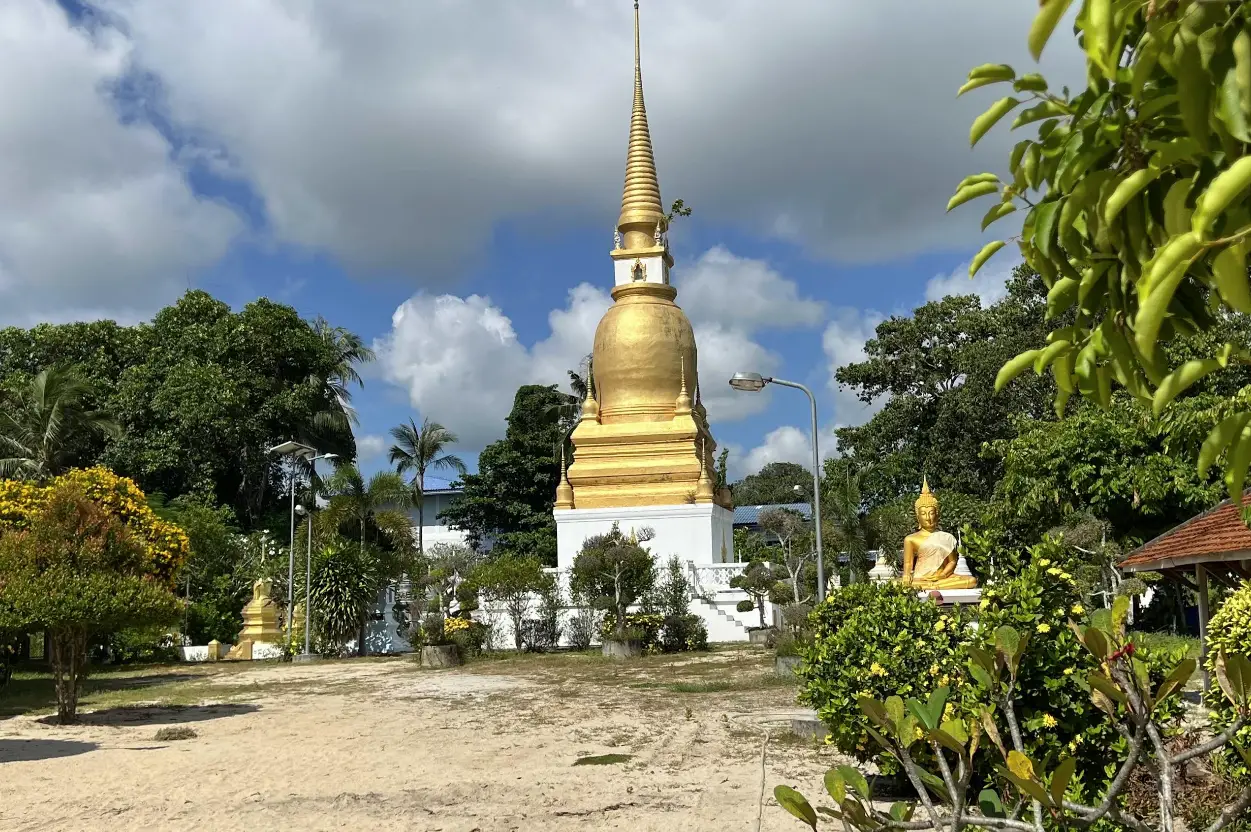
Wat Thamphawas
Open Days: Daily
Opening Hours: 08.00 – 17.00
Wat Thamphawas is an old Buddhist temple in Saiburi District, Pattani Province. It is also known as Wat Bang Talo, while older temple history records the former name as Wat Bang Khalo. The temple is important for its long history, old ordination hall, unusual exterior mural paintings, Luang Pho Sila, the marble Buddha image created during the reign of King Rama VI, and the Arahanta Relic Pagoda built during the time of Phra Khru Saman Kan Koson. Wat Thamphawas is therefore not only a place of worship but also a valuable cultural and artistic learning site of Saiburi.
The importance of Wat Thamphawas lies in its many connected roles. It has served as a Buddhist temple, a community faith center, a place of local art, and an educational foundation for the people of Pa Seyawo and Bang Talo. The temple’s story connects the old Wat Bang Khalo, the development period under Phra Khru Saman Kan Koson, the establishment of a community school, and the continuing care of a Buddhist religious site in the southern border region.
Wat Thamphawas was established around 1848 during the reign of King Rama III, with Pho Than Langka as the first abbot. Historical temple records state that the temple was formerly called Wat Bang Khalo and that Nang Hao donated funds for its construction. Later, during the time of Phra Khru Saman Kan Koson, also known as Sao Dhammachoto, the third abbot, the temple was greatly restored and developed before its name was changed to Wat Thamphawas.
The temple is closely connected with the Pa Seyawo and Bang Talo communities, as well as the Saiburi River landscape. The history of Wat Thamphawas Community School records that the first school building was once located near the river landing in front of the temple. After the old building was damaged by river erosion, the school moved to use the temple’s Dhamma study hall. This shows the temple’s role as a stable community center in an area shaped by water, settlement, and environmental change.
The ordination hall is one of the most important parts of Wat Thamphawas. Temple history records that the hall measures 14 meters wide and 22 meters long and was built in 1909. The temple received its royal consecrated boundary on 20 June 1908, measuring 18 meters wide and 22 meters long. This consecrated boundary gives the temple formal religious status for monastic rites such as ordination and other Sangha ceremonies.
The most distinctive artistic feature of the ordination hall is the mural painting on its exterior walls. Exterior murals are less common than interior murals in Thai temple art. At Wat Thamphawas, the murals make the outer wall of the ordination hall a public teaching surface, allowing visitors and local people to encounter Buddhist stories, moral lessons, and local visual culture even before entering the building.
The exterior murals depict several important stories, including the Buddha preaching to his mother, the Buddha descending from Tavatimsa heaven, scenes from the Ramakien such as Tosakan abducting Sita and Phaya Phali fighting Thoraphi, and episodes from the story of Chanthakorop, including the forest bandit killing Chanthakorop and the bandit fleeing. These varied subjects show that the temple’s mural tradition combines Buddhist narrative, Thai literature, moral storytelling, and local artistic imagination.
A particularly valuable feature of the murals is the inclusion of villagers in different corners of the scenes. These figures are not merely decorative. They act as visual evidence of local life, clothing, gesture, social imagination, and the worldview of local artists. The murals therefore help visitors understand Saiburi society through both religion and community memory.
Inside the ordination hall is Luang Pho Sila, an important marble Buddha image created during the reign of King Rama VI. Luang Pho Sila is one of the temple’s main worship images. The use of marble gives the image a calm, cool, and enduring presence, while the name Sila suggests firmness and spiritual stability. For visitors, paying respect to Luang Pho Sila is the central devotional experience of the temple.
In addition to Luang Pho Sila, temple history records a principal Buddha image in the ordination hall and several stone Buddha images. The large stone Buddha image has a lap width of 28 inches, while smaller images have a lap width of 8 inches. These sacred objects show that Wat Thamphawas has accumulated many layers of Buddhist devotion over time.
The Arahanta Relic Pagoda is another important sacred structure. Historical records state that the pagoda was built on Tuesday, 16 May 1915 by Phra Khru Saman Kan Koson, the temple’s third abbot. It is 23.50 meters high with a base width of 8.43 meters and was built in the Srivijaya style. This gives the pagoda both religious and architectural importance within the southern Buddhist heritage context.
The name Arahanta Relic Pagoda suggests a sacred function connected with relic worship and remembrance of enlightened disciples. Visitors should therefore view the pagoda as one of the temple’s main sacred points, together with the ordination hall, Luang Pho Sila, and the mural paintings. These elements form the temple’s spiritual and artistic core.
The sermon hall also plays an important role in the temple’s community life. Historical records state that the hall measures 17 meters wide and 10 meters long and was built in 1922. A sermon hall is where monks and laypeople gather for Dhamma talks, merit-making, meetings, and community activities. Its construction during the temple’s important development period shows the broad role of Wat Thamphawas in local life.
The temple history also mentions 2 monks’ residences built as wooden hip-roof structures. These details are useful for understanding the older physical character of the temple. Wooden monastic buildings and hip roofs reflect local adaptation to southern climate, materials, and temple life, even though not every structure has detailed public documentation today.
Wat Thamphawas has a strong educational history. Wat Thamphawas Community School, also known as Wat Thamphawas (Sao Uthit), first opened on 21 November 1922. Phra Khru Saman Kan Koson, the abbot at the time, allowed the school to use temple buildings, and Nai Yen Sakunpradit became the first head teacher. This makes the temple a foundation of local education in Pa Seyawo.
The school was originally called Prachaban Pa Seyawo Subdistrict School. Its first building stood near the river landing in front of Wat Thamphawas. In 1937, after the building was affected by river erosion, the school moved to use the temple’s Dhamma study hall. In 1952, it was renamed Wat Bang Talo School (Sao Uthit). This history shows how the temple protected community education through changing environmental conditions.
Temple history also records that Wat Thamphawas established the Chittanuson Library and Museum for public use. This is important because it shows that the temple was not only a ritual space. It also served as a public learning center where religious, historical, and cultural knowledge could be preserved and shared.
The known abbot lineage of Wat Thamphawas includes Pho Than Langka, Luang Pho Si, Phra Khru Saman Kan Koson or Sao Dhammachoto, Phra Khru Chittanurak, and Phra Athikan Bua Nonthiyo. Public Kathin-related information from 2021 also lists Phra Athikan Phithak Wiriyo as the temple caretaker. These names help show the continuity of monastic care across generations.
Wat Thamphawas remains a cared-for Buddhist religious site today. Public information records that the temple appeared in a 2024 Kathin list, and a 2024 public news report described cooperation between state agencies, religious leaders, and local people in improving the landscape around the temple to keep it orderly, clean, and suitable for religious activities.
A meaningful visit should begin with paying respect to Luang Pho Sila and the principal Buddha image inside the ordination hall. Visitors can then study the exterior murals carefully, especially scenes of the Buddha’s life, the descent from Tavatimsa heaven, Ramakien episodes, Chanthakorop scenes, and local villager figures inserted into the compositions. The Arahanta Relic Pagoda should also be included as one of the temple’s major sacred points.
Because the murals are painted on exterior walls, they are exposed to sunlight, rain, moisture, and weathering. Visitors should not touch the painted surfaces, write on walls, use flash close to the murals, or behave in ways that may damage the artwork. Respectful viewing helps preserve the temple’s heritage for future generations.
Wat Thamphawas is suitable for travelers interested in old Buddhist temples, local mural painting, Buddha images, community education history, and the Buddhist heritage of Pattani’s southern border area. Its strength is not commercial tourism or large-scale architecture, but the depth of its history and the rarity of its mural tradition.
A visit to Wat Thamphawas can be combined with important Saiburi attractions such as Lao Ia Kong Shrine, Wang Phiphitphakdi, the old Saiburi palace, Wasukri Beach, Masjid Raya, the old Thai-Chinese community area, Wat Liap, and Salindong Bayu Hill. This route allows visitors to experience Saiburi through Buddhist, Chinese, Malay, Islamic, royal, coastal, and trading-community dimensions.
Lao Ia Kong Shrine is especially meaningful for understanding Saiburi’s Chinese heritage. Cultural-environment information links the shrine’s older story to Bang Talo and river erosion, which also resonates with the water-related history of Wat Thamphawas and its school. Visiting both places helps explain Saiburi as an old settlement shaped by rivers, trade, religious diversity, and community memory.
Wang Phiphitphakdi and the old Saiburi palace add the historical dimension of local rulers and architecture. Wang Phiphitphakdi reflects the prosperity of old Saiburi, with architecture influenced by Western styles and local design. Wasukri Beach adds the coastal leisure dimension. Together with Wat Thamphawas, these places form a strong one-day cultural route.
Travel is most convenient by private car, rental car, or local hired vehicle. From Pattani city, travel toward Saiburi District and continue into Pa Seyawo Subdistrict. Daytime travel is recommended, especially for visitors who want to study the murals carefully and continue to nearby heritage and beach attractions.
Visitors should dress modestly, speak quietly, remove shoes where required, avoid disturbing monks or worshippers, and take photographs respectfully. When photographing murals or Buddha images, avoid behavior that may harm the artwork or disturb religious practice. A respectful visit makes the temple experience both meaningful and responsible.
Food options in Saiburi include local restaurants, cafés, roti shops, halal food, and simple made-to-order restaurants. Accommodation is available in Saiburi for those who want to stay close to the temple and beach, while Pattani city offers more hotel choices and transport convenience. A practical one-day route can begin at Wat Thamphawas in the morning, continue to Wang Phiphitphakdi and Lao Ia Kong Shrine, and end at Wasukri Beach in the evening.
The strength of Wat Thamphawas lies in the richness of its evidence. It has a history dating to the reign of King Rama III, a former name connected with Bang Talo, an ordination hall from the early twentieth century, Luang Pho Sila from the reign of King Rama VI, exterior murals, a Srivijaya-style Arahanta Relic Pagoda, a sermon hall, an educational legacy, and continuing community care. A complete article about the temple should therefore cover worship, art, history, education, river landscape, and Saiburi community life together.
Getting There From Pattani city, travel toward Saiburi District and continue into Pa Seyawo Subdistrict. A private car, rental car, or local hired vehicle is the most convenient option. The temple can be included in a route with Lao Ia Kong Shrine, Wang Phiphitphakdi, the old Saiburi palace, Wasukri Beach, Masjid Raya, the Thai-Chinese community area, and Wat Liap.
In summary, Wat Thamphawas is an important old Buddhist temple of Saiburi District. Its key features are Luang Pho Sila, the marble Buddha image from the reign of King Rama VI; exterior mural paintings on the ordination hall; the Srivijaya-style Arahanta Relic Pagoda; and the temple’s role in the founding history of Wat Thamphawas Community School. The temple is highly suitable for worship, merit-making, mural study, and understanding Saiburi as a historical town shaped by religion, art, water, education, and community memory.
| Name | Wat Thamphawas |
| Related Names | Wat Bang Talo, Wat Bang Khalo, Wat Thamphawas Community School (Sao Uthit) |
| Location | No. 36, Ban Bang Talo, Bang Kao Road, Moo 3, Pa Seyawo Subdistrict, Saiburi District, Pattani Province, Thailand |
| Temple Type | Mahanikaya Community Temple |
| History | Established around 1848 during the reign of King Rama III, with Pho Than Langka as the first abbot. The temple was formerly known as Wat Bang Khalo and was later renamed Wat Thamphawas during the development period of Phra Khru Saman Kan Koson |
| Royal Consecrated Boundary | Received on 20 June 1908, measuring 18 meters wide and 22 meters long |
| Highlights | Luang Pho Sila, a marble Buddha image from the reign of King Rama VI; exterior ordination hall murals; Srivijaya-style Arahanta Relic Pagoda; the educational history of Wat Thamphawas Community School; and the old Bang Talo Buddhist community |
| Important Buddha Images / Sacred Objects | Luang Pho Sila, principal Buddha image in the ordination hall, several stone Buddha images, and the Arahanta Relic Pagoda |
| Important Structures | Ordination hall measuring 14 meters wide and 22 meters long, built in 1909; sermon hall measuring 17 meters wide and 10 meters long, built in 1922; wooden hip-roof monks’ residences; and the Arahanta Relic Pagoda, 23.50 meters high with a base width of 8.43 meters, built in 1915 |
| Murals And Art | Exterior murals on the ordination hall depict the Buddha’s life, the Buddha preaching to his mother, the descent from Tavatimsa heaven, Ramakien episodes, Phaya Phali fighting Thoraphi, Chanthakorop stories, and village-life scenes inserted into the compositions |
| Important Monks Connected With The Temple | Pho Than Langka, Luang Pho Si, Phra Khru Saman Kan Koson or Sao Dhammachoto, Phra Khru Chittanurak, Phra Athikan Bua Nonthiyo, and Phra Athikan Phithak Wiriyo |
| Publicly Listed Abbot / Caretaker | Phra Athikan Phithak Wiriyo |
| Publicly Listed Contact Number | 080-5479770 |
| Current Status | Active Buddhist religious site with public evidence of Kathin activity in 2024 and a community landscape-improvement activity at the temple in 2024 |
| Open Days | Daily |
| Opening Hours | 08.00 – 17.00 |
| Community Role | Spiritual center of the Bang Talo and Pa Seyawo communities, local mural-art learning site, and historical foundation of Wat Thamphawas Community School (Sao Uthit) |
| Facilities | Worship area, ordination hall, mural viewing area, Arahanta Relic Pagoda, sermon hall, merit-making area, and parking around or near the temple |
| Main Areas / Zones | Ordination hall with Luang Pho Sila, exterior mural walls, Arahanta Relic Pagoda, sermon hall, monks’ residence area, and community merit-making area |
| Travel Information | From Pattani city, travel toward Saiburi District and continue into Pa Seyawo Subdistrict. Private car, rental car, or local hired vehicle is the most convenient option |
| Nearby Tourist Attractions | 1. Lao Ia Kong Shrine, about 5 km 2. Wang Phiphitphakdi, about 6 km 3. Old Saiburi Palace, about 6 km 4. Masjid Raya, about 6 km 5. Wasukri Beach, about 8 km 6. Wat Liap Saiburi, about 6 km 7. Thai-Chinese Community Area Of Saiburi, about 6 km |
| Nearby Restaurants | 1. ZN Cha & Burger, about 2 km, Tel. 084-8544088 2. Ma Kae Ma Kin, about 6 km, Tel. 083-4601887 3. Sobariyah Saiburi Restaurant, about 6 km, Tel. 061-2296359 4. Plai Na Restaurant, about 6 km, Tel. 089-4676216 5. Na Ban Cafe, about 7 km, Tel. 093-5764672 6. Sup Ton Makham, about 8 km, Tel. 091-3165595 |
| Nearby Accommodations | 1. Saiburi Resort, about 6 km, Tel. 086-6931691, 081-7381093, 073-411915 2. Suan Pa Resort, about 8 km, Tel. 073-420336 3. Nee Ran Nee Resort, about 10 km 4. C.S. Pattani Hotel, about 58 km, Tel. 073-335093, 073-336090 5. Park View Resort Pattani, about 58 km, Tel. 073-335100 |
Frequently Asked Questions (FAQ)
Q: Where is Wat Thamphawas located?
A: Wat Thamphawas is in Pa Seyawo Subdistrict, Saiburi District, Pattani Province, and is connected with the old Bang Talo community.
Q: What are the opening hours of Wat Thamphawas?
A: The temple is open daily from 08.00 to 17.00.
Q: What is Luang Pho Sila at Wat Thamphawas?
A: Luang Pho Sila is an important marble Buddha image inside the ordination hall, created during the reign of King Rama VI.
Q: What was the former name of Wat Thamphawas?
A: Older temple history records the former name as Wat Bang Khalo, while the temple is also known locally as Wat Bang Talo.
Q: Why are the murals at Wat Thamphawas special?
A: The murals are painted on the exterior walls of the ordination hall and depict the Buddha’s life, Ramakien scenes, Chanthakorop stories, and local villagers within the compositions.
Q: Why is the Arahanta Relic Pagoda important?
A: The pagoda was built in 1915 by Phra Khru Saman Kan Koson in the Srivijaya style and is one of the temple’s major sacred structures.
Q: How is Wat Thamphawas connected with education?
A: The temple was the original educational base of Wat Thamphawas Community School, which first opened in 1922 using temple buildings with permission from Phra Khru Saman Kan Koson.
Q: What nearby places can be visited with Wat Thamphawas?
A: Nearby places include Lao Ia Kong Shrine, Wang Phiphitphakdi, the old Saiburi palace, Masjid Raya, Wasukri Beach, Wat Liap, and the old Thai-Chinese community area of Saiburi.
 Category: ●Places of Worship
 Group: ●Temple
Last Update : 4 WeekAgo
 Last Update : 4 WeekAgo
 Click to Access the Navigation Map GPS
 Art, Culture and Heritage
 Historical Sites and Monuments(3)
 Landmarks and Memorials(7)
 Royal Palace(2)
 Art, Craft Centres, Tradition(7)
 Historic Homes and Cities(1)
 Educational Places
 Museum for Study(1)
 Training Center(1)
Temple(13)
Training Center(1)
Temple(13)
 Mosque(5)
 Other Sacred Sites(4)
 Research and Development
 Royal Project(2)
 Suburban Living
 Village, Community(5)
 Local Market(2)
 Nature and Wildlife
 National Parks and Marine Reserves(2)
 Mountain (Doi)(3)
 Waterfalls(3)
 River, Canal(2)
 Bays and Beaches(13)
 Islands(2)
 Other natural attractions(1)
 Entertainment and Agricultural
 Farms, Parks and Ecotourism(1)
 Travel Articles, Recipes
 Travel Review, Food Review(1)
 Southern Food Menu, Southern Food Recipes(3)


